The Content Compound Effect: Why Starting Today Beats Starting Perfect
The Content Compound Effect: Why Starting Today Beats Starting Perfect
Here's the truth about content marketing that no startup founder wants to hear: your competitor who started publishing mediocre blog posts six months ago is now outranking your (still unpublished) perfect article idea.
While you've been polishing that comprehensive industry guide in Google Docs, they've built domain authority, attracted their first 50 subscribers, and started showing up in Google searches. The content compound effect doesn't wait for perfection.
The Math Behind Content Compounding
Content marketing follows the same mathematical principle as compound interest — small, consistent efforts create exponential returns over time. Businesses blogging consistently see 13x more positive ROI, and brands producing content weekly saw a 3.5x increase in conversions versus monthly publishers.
But here's where the math gets interesting: Over 55% of marketing experts say it takes 3-9 months to gain initial traction for a new blog, while significant traction can take over a year. This means your February article won't peak until August. Your August article compounds on top of that February foundation.
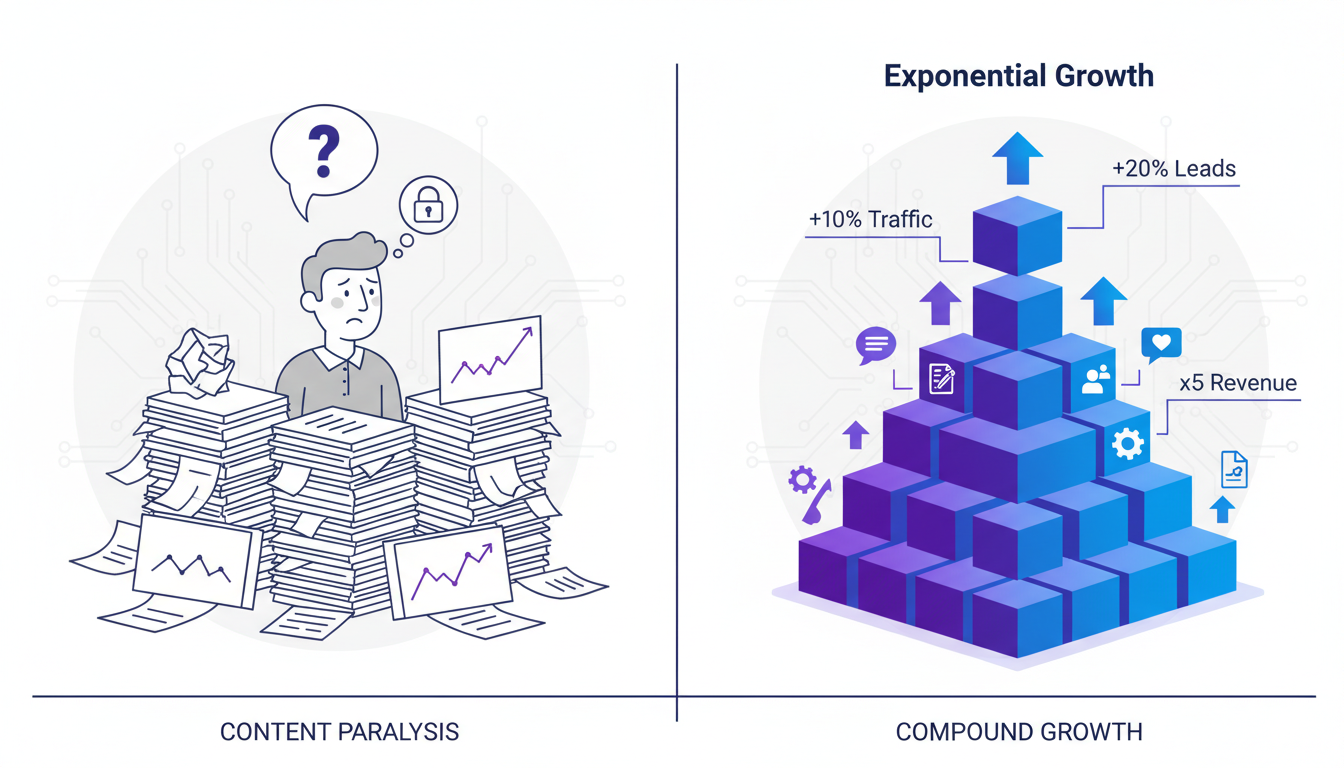
Every month you delay is a month of lost compound growth. The founder who starts today with "good enough" content will be miles ahead of the perfectionist who starts "perfect" content six months from now.
Perfectionism: The Silent Startup Killer
Perfectionism isn't about high standards — it's about paralysis disguised as quality control. The biggest publishing bottleneck for most founders isn't the technical process—it's the perfectionism that keeps content in draft status.
Self-made millionaire Emma Grede warns that aspiring founders are sabotaging their ventures by obsessing over perfection before launch. 'Stop thinking you have to have everything in perfect shape to launch a business,' Grede said. That mindset breeds paralysis and allows competitors to seize first-mover advantages.
The same principle applies to content. Founders often wait until an idea feels fully formed and polished before they publish. That delayed perfection kills consistency. Inconsistency means your content never compounds.
Early Content Creates Future Success
Your first blog post isn't just content — it's infrastructure. Updating old content leads to a 74% spike in traffic, compared to newly published articles, which see slower gains. But you can't update content that doesn't exist.
Consider this progression:
- Month 1: Publish basic "How to X" article (100 views)
- Month 3: Update with new examples (300 views)
- Month 6: Expand with case studies (800 views)
- Month 12: Comprehensive rewrite based on year of feedback (2,000 views)
The perfectionist waiting for the comprehensive version misses 11 months of learning, feedback, and incremental improvements. Publishing is not the end of the process. It is the beginning of the learning. When your audience reacts to content, you get signals about what resonates and what does not. Either way, it is useful.
The Real Performance Data
Here's what the data tells us about content performance curves:
24% of high-performing websites publish one article per day on average while 27% of low-performing websites publish one article every few weeks. 62% of average-performing websites publish several articles per day. The pattern is clear: consistency trumps perfection.
Companies publishing 11+ blog posts per month gain 4x more leads than those publishing fewer than four. But here's the kicker — bloggers who publish more often are more likely to report strong results. The data suggests that publishing content biweekly is the minimum for content performance.
The compound effect accelerates with volume and consistency, not with individual post perfection.
Starting Your Content Compound Today
Here's your anti-perfectionist action plan:
1. Define "Good Enough"
Set a quality threshold that's "good enough to publish" rather than "perfect," then use your automation to publish quickly. You can always update content after publication, but you can't get traffic from content sitting in your drafts folder.
2. Embrace the 48-Hour Rule
Set a firm deadline for when the content will publish and commit to it. Give yourself 48 hours from first draft to published post. No exceptions.
3. Publish to Learn
Publishing creates data. Even imperfect content can teach you something important about your audience. That feedback becomes fuel for the next piece.
4. Plan for Updates
Treat your first version as Version 1.0, not the final product. Schedule quarterly content audits to improve what's working.
The Compound Effect in Action
The compound effect of increased content velocity drives exponential ROI growth. AI-powered teams deliver content 84% faster than traditional workflows, compressing time-to-market for campaigns. This acceleration particularly benefits product launches and time-sensitive campaigns.
Startups leveraging AI tools for content creation aren't just working faster — they're compounding faster. AI users report 88% increased efficiency in content production. This near-doubling of productivity allows teams to test more content variations and scale successful formats faster.
Your Content Legacy Starts Today
A year from now, you'll have one of two stories:
Story A: "I finally published my perfect content strategy. It got 50 views and no leads."
Story B: "I started publishing imperfect content 12 months ago. I now have 20,000 monthly readers, 500 email subscribers, and content that ranks on page one for my target keywords."
The difference? Story B started today. Story A is still editing.
Content does nothing for your business when it's sitting in your Google Docs—it needs to be published, promoted, and working for you. Execute the game plan, and put your content marketing strategy into motion. Don't wait for it to be perfect. It won't be. Just ship it.
The content compound effect is math, not magic. But like compound interest, it only works if you start.
Ready to turn your content ideas into a lead-generating engine? Supramono's AI agents help founders publish consistent, high-quality content without the perfectionist paralysis. Start your compound effect today.

Supramono
AI agents that build your pipeline — inbound and outbound
AI agents that build your pipeline — inbound and outbound
Learn more about Supramono and get started today.
Visit Supramono