10 Smart Ways to Validate Your Product Idea Before You Build It
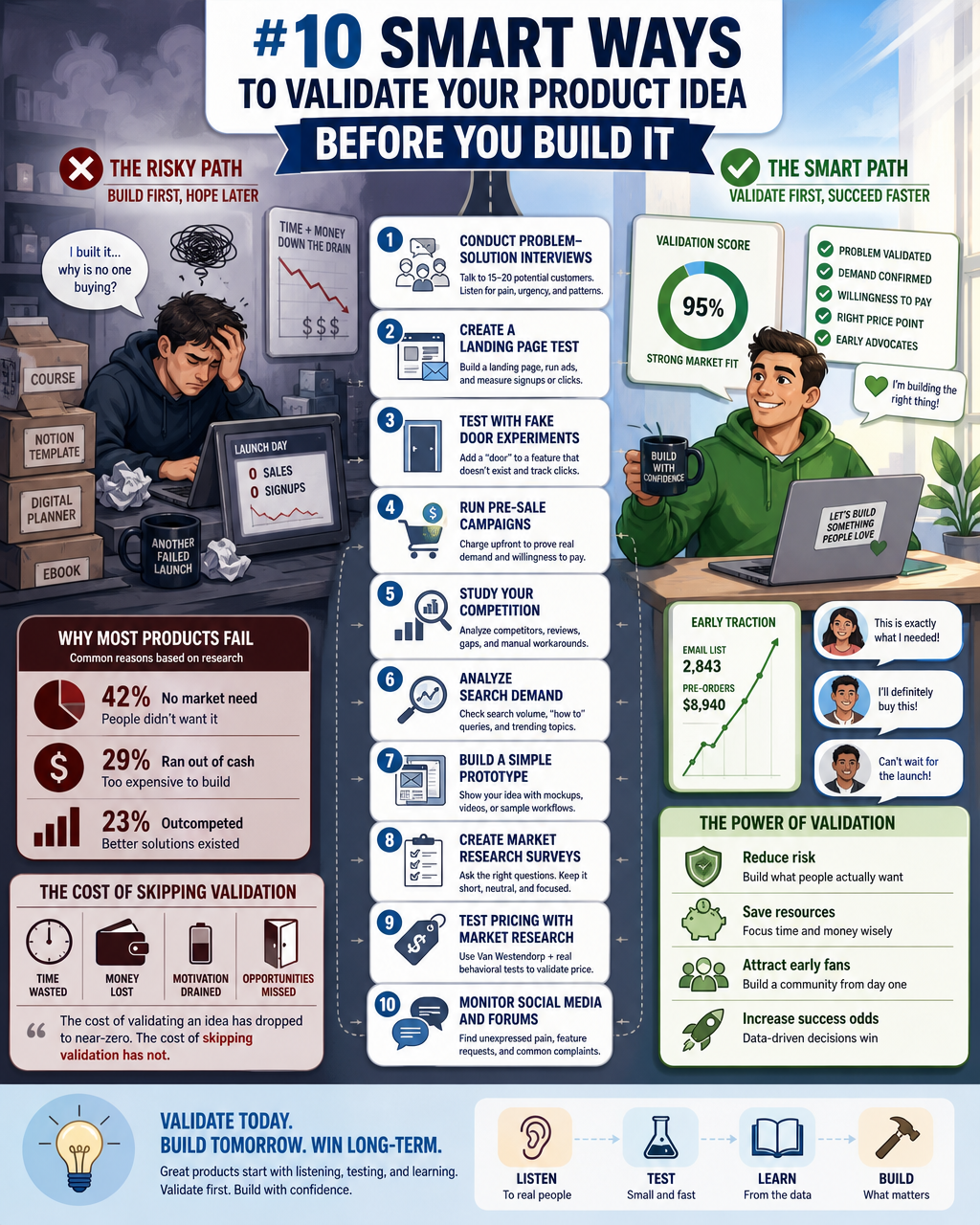
You've got what feels like a brilliant product idea. Your mind races with possibilities, and you can already picture the success story unfolding. But here's the thing: most creators don't fail because their ideas are bad—they fail because they never validated them. They spend weeks filming a course or designing a Notion template, only to hear crickets on launch day.
Before you invest months of work and thousands of dollars into development, take a step back. Product validation isn't about killing your dreams—it's about making them bulletproof.
Why Product Validation Matters More Than You Think
Studies consistently show that many new products fail to find sustainable market traction. Research on consumer packaged goods launches indicates that a significant percentage of new products struggle to maintain shelf space beyond their first year, with failure rates often attributed to insufficient market validation.
The common thread? Building before you know a market exists. The cost of validating an idea has dropped to near-zero thanks to modern tools, but the cost of skipping validation has not.
Here are 10 practical ways to test your product idea without writing a single line of code or spending a fortune.
1. Conduct Problem-Solution Interviews
Start by talking to real people who might face the problem you're trying to solve. Consider conducting 15-20 conversations as a starting point, though your specific needs may vary. Look for patterns across multiple interviews rather than isolated feedback.
How to do it:
- Use LinkedIn or industry forums to find potential customers
- Ask about their current pain points, not your solution
- Listen for emotional language—frustration, urgency, or excitement
- Focus on what they do now to solve the problem
If users don't describe the problem unprompted, it may indicate weaker market need. This approach is emphasized repeatedly by Y Combinator, which advises founders to "talk to users before you build" and look for patterns, not compliments.
2. Create a Landing Page Test
Build a single landing page describing the product as if it already exists, run a small ads budget at it, and measure how many people sign up for the waitlist or click "Buy Now."
Current tools make this easier:
A landing page that previously required significant development time can now be created quickly using tools like Webflow, Framer, or other no-code platforms. Copy can be drafted efficiently with AI assistance, allowing you to get a credible-looking page live within hours.
Key elements to include:
- Clear value proposition in the headline
- Benefits, not just features
- Social proof or testimonials (even from interviews)
- Email capture form or "Get early access" button
Industry data suggests that dedicated landing pages typically convert better than general website pages, with top-performing pages achieving conversion rates in the double digits. However, conversion rates vary significantly by industry and offer type.
3. Test with Fake Door Experiments
Fake door testing is a lean research technique product teams use to validate new products, features, or services. Sometimes called painted-door tests, they present users with an invitation to use a product that isn't actually there.
How it works:
It involves creating user interface elements that suggest the existence of a feature, even if it hasn't been developed yet. The goal is to gauge user interest and intent by tracking how many users click on this virtual door.
Best practices:
- Make sure you represent the feature the same way it would be built. If you exaggerate the button or particularly highlight the link, your results will be biased and therefore useless.
- Track clicks with Google Analytics events
- Show a "coming soon" page with email signup
- Be transparent about the test to maintain trust
4. Run Pre-Sale Campaigns
Charge people money before the product exists. Pre-orders are the cleanest validation signal possible. Someone parting with £29 or £199 to get on a list is doing a much harder thing than typing their email into a form. It's the only validation method that proves willingness to pay rather than just willingness to express interest.
How to structure it ethically:
- Be clear about timelines ("shipping in 6 months")
- Offer founding member pricing as an incentive
- Provide a no-questions refund policy
- Use the funds to validate, not mislead
If three people pre-order at £99, you have £297 in revenue and three highly motivated beta users. If nobody pre-orders at any price, you have data: your idea isn't compelling enough to convert at this stage, and you should figure out why before building.
5. Study Your Competition
Don't just look at direct competitors—understand the entire landscape of how people currently solve this problem.
Research tactics:
- Analyze competitor pricing, features, and customer reviews
- Look for gaps in their offerings or common complaints
- Browse Upwork for jobs that describe the manual workaround for your idea. If 50 people are paying freelancers $200 to do something a tool could automate, that's a market.
- Check search volume for related terms using tools like Ahrefs or SEMrush
For products similar to yours, research sales data, the number and share of current manufacturers, and what percentage of the total market your segment holds. Determine where your product fits into the market and assess how much of it your business could own.
6. Analyze Search Demand
Research the monthly search volume of terms related to your product or mission. When consumers need a product or service, they often use a search engine to see what the market has to offer.
What to look for:
- High search volume for problem-related keywords
- "How to" queries that your product could answer
- Trending topics in your niche
- Low competition for specific long-tail keywords
If there's not a lot of search volume surrounding your product, use terms that express customer intent.
7. Build a Simple Prototype
Sometimes you need to show, not just tell. Tools like Notion, Canva, or Figma let you create quick prototypes of templates, digital planners, or course outlines. Share screenshots or short walkthroughs to gauge reactions. When people respond positively or ask when it's launching, you've validated your direction.
Prototype options:
- Figma mockups for software interfaces
- Canva designs for physical products
- Loom videos demonstrating the workflow
- Simple Notion pages showing the information architecture
8. Create Market Research Surveys
While interviews provide depth, surveys give you breadth. Market research questions are structured prompts used in surveys or interviews to collect data about customer needs, behaviors, and preferences. The best ones are tied to a specific decision you need to make, written in plain language, and free of wording that nudges people toward the answer you want.
Survey best practices:
- Focus on past behavior, not hypotheticals; write plain-language, unbiased questions, anchor time frames, split doubles, and trigger in-context after key actions to capture accurate signals.
- Keep surveys short (5-7 questions max)
- Avoid leading questions like "Would you pay $X for this amazing product?"
- Use tools like Typeform or Google Forms for easy distribution
9. Test Pricing with Market Research
Pricing validation can prevent costly mistakes. Do not ask "Would you pay X for this?" People say yes to hypothetical prices all the time and then do not convert when the real price appears. Validate with a real behavioral test, such as a landing page with an actual purchase button, before changing your pricing model.
Use the Van Westendorp method:
Ask four questions about the price points where the product feels like a great deal, expensive but worth it, too expensive, and too cheap to trust. Treat the results as directional and validate with a real behavioral test, such as a landing page with an actual purchase button, before locking in pricing.
10. Monitor Social Media and Forums
Your potential customers may already be discussing relevant problems online. Listen to them.
Where to look:
- Reddit communities related to your niche
- LinkedIn groups for B2B products
- Twitter conversations using relevant hashtags
- Industry-specific forums and Facebook groups
- Review sites for competing products
What to track:
- Use AI to scrape Reddit, forums, and reviews to find the "Unexpressed Pain." People rarely say what they want, but they always complain about what they hate.
- Common feature requests
- Pricing complaints
- Workflow frustrations

Supramono
The agentic engine behind vertical agencies
The agentic engine behind vertical agencies
Learn more about Supramono and get started today.
Visit Supramono