10 Distribution Challenges Early-Stage Founders Face (And How to Fix Them)
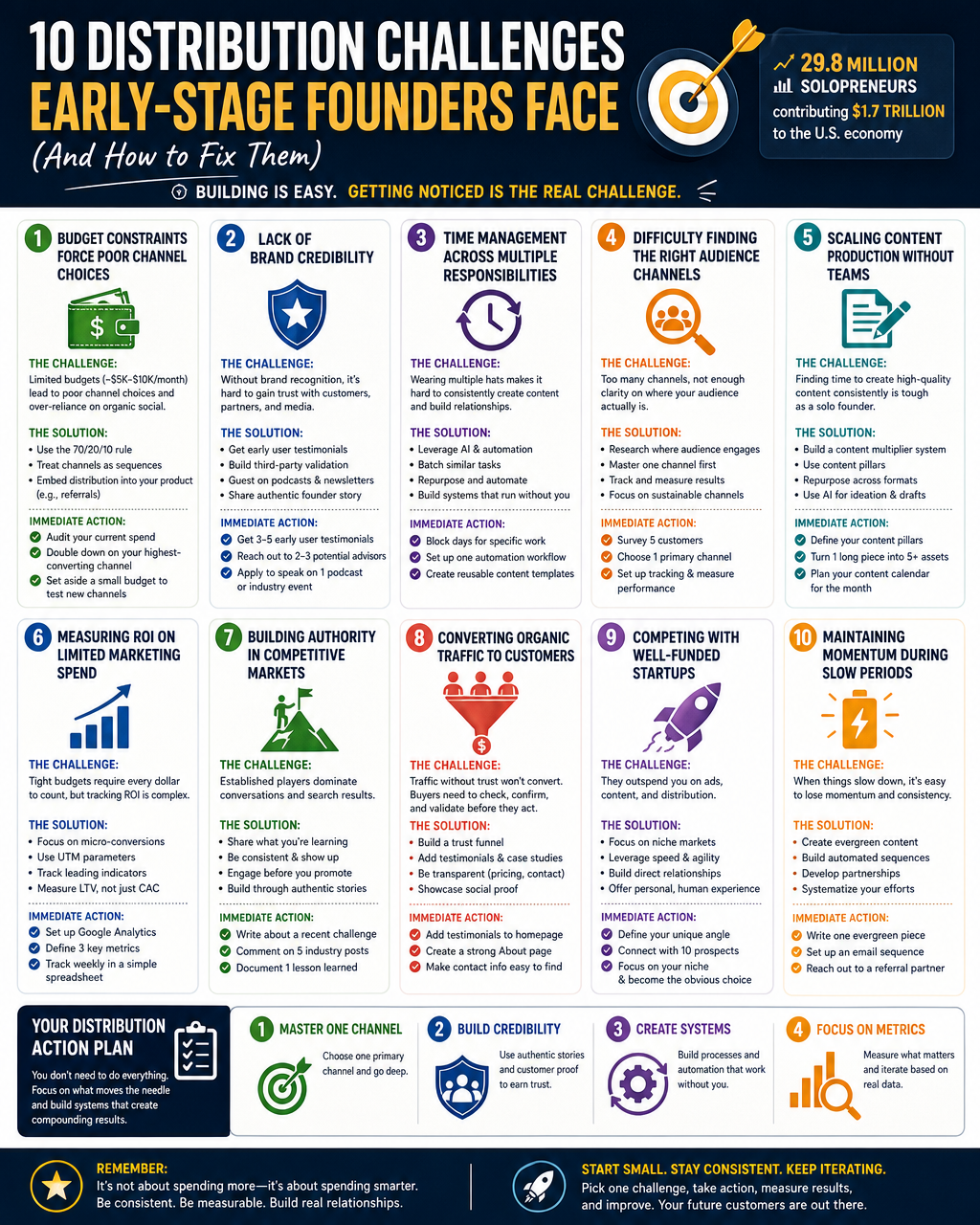
Building is easy and getting noticed is the real challenge. For solopreneurs and early-stage tech startup founders, distribution has become the make-or-break factor for success. With 29.8 million solopreneurs now contributing $1.7 trillion to the U.S. economy, the competition for attention has never been fiercer.
While you can build a product quickly with modern tools, reaching the right customers with limited resources presents unique challenges. Let's break down the top 10 distribution challenges facing solo founders today and explore practical solutions you can implement immediately.
1. Budget Constraints Force Poor Channel Choices
The Challenge: Early-stage startups typically have a marketing budget of around 10% of planned annual revenue or roughly $5,000 to $10,000 monthly. This forces founders to choose between paid channels, often leading to over-reliance on organic social media that may not effectively reach target audiences.
The Solution:
- Start with the 70/20/10 rule: Allocate 70% to proven, high-ROI channels where you have data showing reliable returns. Put 20% into channels with strong early signals but less history. Reserve 10% for experimental channels and net-new bets.
- Stop treating channels as isolated tactics and start treating them as sequences.
- Focus on channels where you can embed distribution into your product, like referral programs
Immediate Action Steps:
- Audit your current spend across channels
- Identify your highest-converting channel and double down
- Set aside a small experiment budget for testing new channels
2. Lack of Brand Credibility
The Challenge: For early-stage startups, trust is often the only real advantage you have. Before your product is fully built or your brand scales, trust is what gets you in the door. Without established brand recognition, it's difficult to gain credibility with potential customers, partners, and media outlets.
The Solution:
Find willing design partners: Offer product access in exchange for feedback. Capture what they love: Use their quotes and exact words to describe your product. Turn feedback into proof: Create testimonials or mini case studies to share.
Build Third-Party Validation:
- Pick credible advisors: Choose people your buyers respect or see as peers. Connect advisors with prospects: Involve them in sales calls and technical discussions. Highlight their endorsement: Share their quotes and showcase that they're part of your team.
- Guest on relevant podcasts and contribute to industry newsletters
- Founders often succeed with authentic storytelling, targeted press outreach, industry thought leadership, case studies, and niche community engagement.
Immediate Action Steps:
- Identify 3-5 early users who can provide testimonials
- Reach out to 2-3 potential advisors in your space
- Apply to speak at one industry event or podcast
3. Time Management Across Multiple Responsibilities
The Challenge: Time management emerges as the primary struggle, but solopreneurs face multiple competing demands across marketing, finances, and compliance. Many underestimate these demands before launching their ventures. Wearing multiple hats prevents consistent content creation and relationship building across distribution channels.
The Solution:
Tools like ChatGPT, Claude, and Jasper AI handle content creation, email sequences, and social media while maintaining your brand voice. The key is building systems that work even when you're not actively managing them.
Time-Saving Strategies:
- Batch similar tasks together (all content creation on Mondays, all outreach on Fridays)
- You can see the math: if you end up with at least seven good comments per week, you have seven of your own posts the following week.
- Use automation tools for scheduling and follow-up sequences
Immediate Action Steps:
- Block specific days for specific types of work
- Set up one automation workflow this week
- Create content templates you can reuse
4. Difficulty Finding the Right Audience Channels
The Challenge: With countless distribution channels available, it's hard to identify where your ideal customers actually spend their time and consume content. The first step is to identify which marketing channels are most likely to reach your target audience and achieve your business goals. For example, if your target audience primarily consists of young adults, investing more in social media and digital content may yield better results than traditional print advertising. The choice of channels should reflect where your audience is most active and receptive.
The Solution:
- Research where your competitors are getting traction
- Start with one primary channel and master it before expanding
- Consider whether you can reasonably support content creation for that channel to participate in an active way. While some will be harder to measure than others (like those that focus on brand recognition), as a solopreneur you need to be able to understand what's working and what's not.
Channel Selection Framework:
- Where do your current customers discover similar solutions?
- Which channels align with your content creation strengths?
- What can you realistically maintain with your current resources?
Immediate Action Steps:
- Survey 5 existing customers about where they found you
- Choose one primary channel to focus on for the next 30 days
- Set up tracking to measure channel performance
5. Scaling Content Production Without Teams
The Challenge: One of the biggest challenges for solopreneurs is finding the time to create high-quality content consistently. The rise of AI and rapid improvements have enhanced the competitiveness of small business owners worldwide. Maintaining quality while increasing output becomes nearly impossible without dedicated team members.
The Solution:
Create a content multiplier system. Founders use "Content Multipliers" to turn a single long-form insight (like a weekly newsletter) into 30+ tailored assets across social platforms. In 2026, Technology ensures that each piece is optimized for the specific "Spatial" or "Voice" interface the consumer is using.
Content Scaling Framework:
- In Trello, I organize my content ideas into different "pillars" based on the topics I talk about (solopreneurship, apps and tools, content marketing, and more). When I plan my content, I pull from different lists in Trello so I make sure to rotate through all of my different pillars.
- Use AI tools for ideation and first drafts, then add your expertise
- Repurpose one piece of content across multiple formats and platforms
Immediate Action Steps:
- Create content pillars for your expertise areas
- Write one comprehensive piece and break it into 5 smaller pieces
- Set up a content calendar for the next month
6. Measuring ROI on Limited Marketing Spend
The Challenge: With tight budgets, every marketing dollar needs to count, but tracking effectiveness across multiple channels becomes complex. But what does that look like when you've only got $300 in your pocket? Start by defining micro-goals: not "grow awareness," but "double LinkedIn replies this week" or "generate 15 qualified signups in 10 days." The tighter your KPIs, the faster you'll know what's working.
The Solution:
- Focus on micro-conversions and leading indicators
- If you're fortunate enough to have money to promote and distribute content, consider which pieces of information you require to track metrics like cost-per-acquisition for the paid traffic source. Use UTM parameters in your content links to quickly analyze data at a high level.
- Track customer lifetime value, not just acquisition cost
Immediate Action Steps:
- Set up Google Analytics with goal tracking
- Define 3 key metrics that matter for your business
- Create a simple spreadsheet to track weekly performance
7. Building Authority in Competitive Markets
The Challenge: Established players dominate search results and industry conversations. Breaking through requires more than just good content—it requires strategic positioning.
The Solution:
This type of content builds credibility because it signals real experience. It also invites conversation instead of feeling like performance. Focus on sharing authentic experiences rather than trying to appear as an overnight expert.
Authority-Building Tactics:
- Share what you're learning, not just what you know
- Repetition builds recognition. Recognition builds familiarity. Familiarity builds trust.
- Engage genuinely in industry conversations before promoting your own content
Immediate Action Steps:
- Write about one challenge you recently overcame
- Comment thoughtfully on 5 industry posts this week
- Document one lesson learned from your business journey
8. Converting Organic Traffic to Customers
The Challenge: Generating traffic is one thing; converting that traffic into paying customers is another. "Traffic without trust won't convert." If your startup doesn't answer them up front, you lose trust and the sale.
The Solution:
Create a trust funnel that addresses buyer hesitations at each stage. In 2025, buyers don't just land and buy. They follow a mental trust funnel. This means a path of checking, confirming, and validating before taking action. If your startup isn't prepared at each step, it will lose the customer to someone who has all the information.
Trust-Building Elements:
- Clear founder bio and company story
- Customer testimonials and case studies
- Transparent pricing and contact information
- Social proof and industry recognition
Immediate Action Steps:
- Add testimonials to your homepage
- Create an "About" page that builds credibility
- Ensure your contact information is easy to find
9. Competing with Well-Funded Startups
The Challenge: Funded startups can outspend you on ads, content creation, and distribution. In 2026, the best product with no audience loses to a decent product with 100,000 followers.
The Solution:
Focus on areas where money can't buy success: authenticity, niche expertise, and personal relationships. In an era where Artificial Intelligence can generate infinite content, the 2026 solopreneur wins through "Personal Distribution" and "Proof of Human Insight." By sharing real-time data, AI-prompting workflows, and failure logs, they build radical trust—a "Human Premium" that automated corporations struggle to replicate.
Competitive Advantages:
- Speed of decision-making and implementation
- Direct founder involvement in customer interactions
- Ability to serve niche markets too small for larger companies
Immediate Action Steps:
- Identify your unique angle that larger companies can't replicate
- Build direct relationships with 10 potential customers
- Focus on a niche where you can be the obvious choice
10. Maintaining Momentum During Slow Periods
The Challenge: Without a team to maintain momentum, everything depends on your personal energy and motivation. During tough periods, distribution efforts often suffer first.
The Solution:
Build systems that create momentum even during low-energy periods. Ultimately, content production as a solopreneur is something you have to plan for and set aside time to work on. With a strategy to collect ideas and product content, it doesn't have to feel like a chore. And once you start seeing results (like more inbound opportunities), you'll be even more motivated to work on content as a necessary part of running your business.
Momentum Maintenance:
- Create evergreen content that works while you sleep
- Build email sequences that nurture leads automatically
- Develop partnerships that generate referrals
Immediate Action Steps:
- Write one evergreen piece of content this week
- Set up an email sequence for new subscribers
- Reach out to one potential referral partner
Moving Forward: Your Distribution Action Plan
Distribution challenges are real, but they're not insurmountable. The key is focusing on systematic approaches rather than random tactics. The most sustainable visibility strategy is built around repeatable content categories. "What I'm learning" posts build connections without requiring perfection. Framework posts build authority by turning experience into clarity. Proof posts build credibility by showing that the work is real.
Start with these priorities:
1. Choose one primary distribution channel and master it
2. Build credibility through authentic storytelling and customer proof
3. Create systems that work even when you're not actively managing them
4. Focus on metrics that matter for your specific business
Remember: When it comes to marketing, it's not always about spending more—it's about spending smarter. That's especially true for startups and other high-growth companies. The way you distribute your marketing resources can make a huge difference in long-term growth and success.
Your distribution strategy doesn't need to be perfect from day one. It needs to be consistent, measurable, and focused on building genuine relationships with your target audience. Start with one challenge, implement the solution, measure the results, and iterate from there.

Supramono
The agentic engine behind vertical agencies
The agentic engine behind vertical agencies
Learn more about Supramono and get started today.
Visit Supramono