You Built It But They Didn't Come: 10 Strategies to Move the Needle
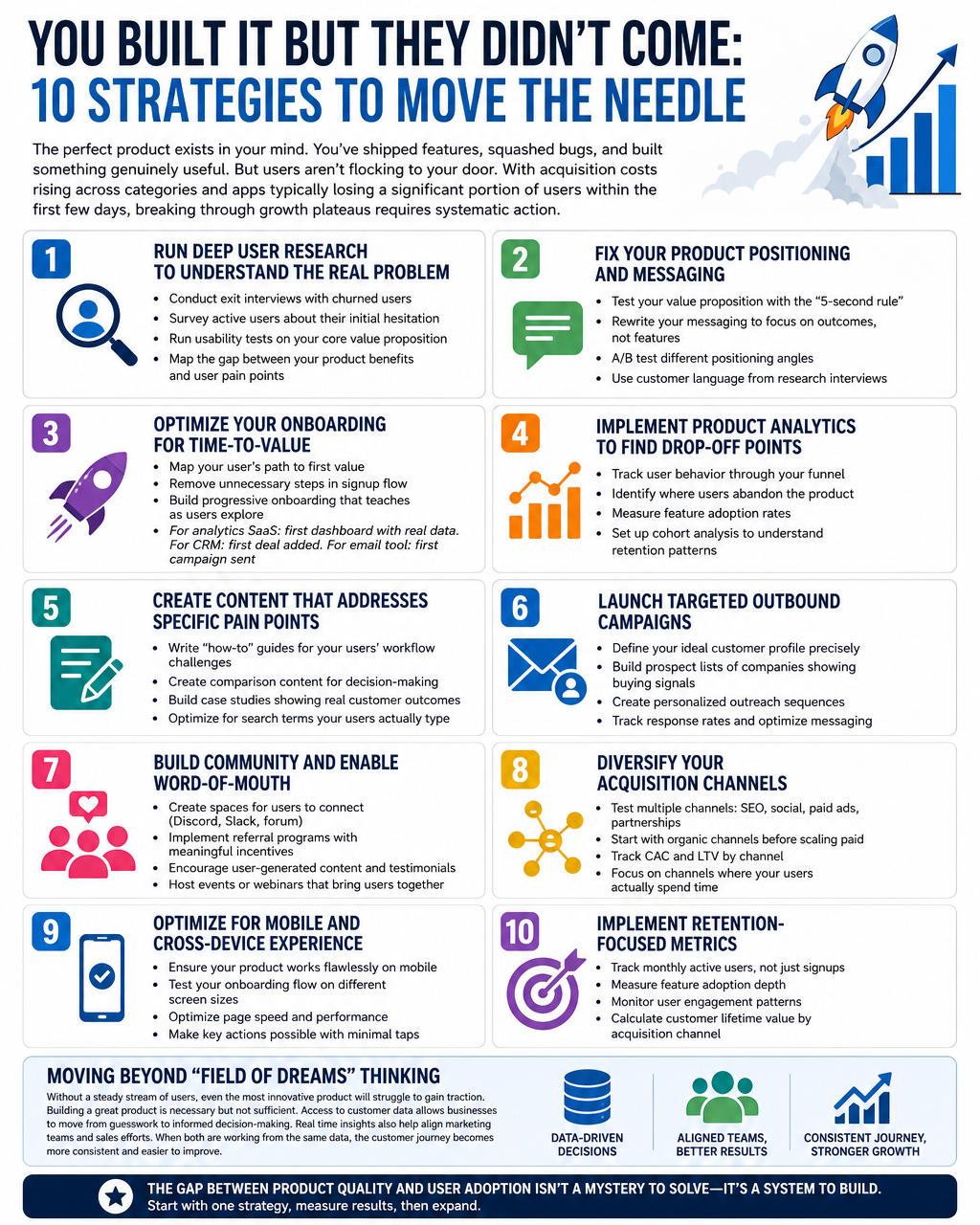
The perfect product exists in your mind. You've shipped features, squashed bugs, and built something genuinely useful. But users aren't flocking to your door. With acquisition costs rising across categories and apps typically losing a significant portion of users within the first few days, breaking through growth plateaus requires systematic action.
Here are 10 strategies technical founders can implement:
1. Run Deep User Research to Understand the Real Problem
Understanding why users leave can inform acquisition strategy. Start by talking to users who tried your product but didn't stick.
- Conduct exit interviews with churned users
- Survey active users about their initial hesitation
- Run usability tests on your core value proposition
- Map the gap between your product benefits and user pain points
2. Fix Your Product Positioning and Messaging
If visitors come to your site and don't immediately understand what the product does, most will leave without a second thought. Your homepage should answer "what this does" in 5 seconds.
- Test your value proposition with the "5-second rule"
- Rewrite your messaging to focus on outcomes, not features
- A/B test different positioning angles
- Use customer language from research interviews
3. Optimize Your Onboarding for Time-to-Value
Time to first value correlates with retention. Focus on getting users to meaningful moments efficiently, though this requires ongoing testing to get right.
- Map your user's path to first value
- Remove unnecessary steps in signup flow
- Build progressive onboarding that teaches as users explore
- For analytics SaaS: first dashboard with real data. For CRM: first deal added. For email tool: first campaign sent
4. Implement Product Analytics to Find Drop-Off Points
Analytics and performance tracking: Measure onboarding engagement, completion rates, and feature adoption to optimize flows and identify drop-off points.
- Track user behavior through your funnel
- Identify where users abandon the product
- Measure feature adoption rates
- Set up cohort analysis to understand retention patterns
5. Create Content That Addresses Specific Pain Points
When your content reflects your ideal customer profile and addresses real pain points, it becomes a reliable lead generation tool. Focus on problems, not product features, though this approach requires significant time investment to see results.
- Write "how-to" guides for your users' workflow challenges
- Create comparison content for decision-making
- Build case studies showing real customer outcomes
- Optimize for search terms your users actually type
6. Launch Targeted Outbound Campaigns
For high-ticket or B2B products, outbound campaigns like email sequences, LinkedIn prospecting, or account-based marketing can provide targeted reach. Success here depends on clean ICP definitions, and timely data triggers that align sales outreach with buyer intent.
- Define your ideal customer profile precisely
- Build prospect lists of companies showing buying signals
- Create personalized outreach sequences
- Track response rates and optimize messaging
7. Build Community and Enable Word-of-Mouth
Incentivized referral systems lower CAC and boost retention simultaneously, since referred customers tend to stay longer and spend more. Building community requires consistent effort and authentic engagement.
- Create spaces for users to connect (Discord, Slack, forum)
- Implement referral programs with meaningful incentives
- Encourage user-generated content and testimonials
- Host events or webinars that bring users together
8. Diversify Your Acquisition Channels
Reliance on a single or a few dominant acquisition channels is a risky strategy. The volatility of platform policies and the rising cost of traditional paid channels necessitate a diversified approach. Managing multiple channels requires more resources and expertise.
- Test multiple channels: SEO, social, paid ads, partnerships
- Start with organic channels before scaling paid
- Track CAC and LTV by channel
- Focus on channels where your users actually spend time
9. Optimize for Mobile and Cross-Device Experience
Users expect a seamless experience across devices. If onboarding isn't mobile-friendly, they're far more likely to drop off.
- Ensure your product works flawlessly on mobile
- Test your onboarding flow on different screen sizes
- Optimize page speed and performance
- Make key actions possible with minimal taps
10. Implement Retention-Focused Metrics
Focus on quality users, not just quantity, though this may initially show slower growth numbers.
- Track monthly active users, not just signups
- Measure feature adoption depth
- Monitor user engagement patterns
- Calculate customer lifetime value by acquisition channel
Moving Beyond "Field of Dreams" Thinking
Without a steady stream of users, even the most innovative product will struggle to gain traction. Building a great product is necessary but not sufficient. Access to customer data allows businesses to move from guesswork to informed decision-making. Real time insights also help align marketing teams and sales efforts. When both are working from the same data, the customer journey becomes more consistent and easier to improve.
The gap between product quality and user adoption isn't a mystery to solve—it's a system to build. Start with one strategy, measure results, then expand.
Ready to build a systematic approach to user acquisition? Supramono's AI agents handle content creation, user research, and outbound campaigns so you can focus on building while we fill your pipeline.

Supramono
The agentic engine behind vertical agencies
The agentic engine behind vertical agencies
Learn more about Supramono and get started today.
Visit Supramono