Why Big Business Will Fail in the AI Era (And Small Players Will Win)
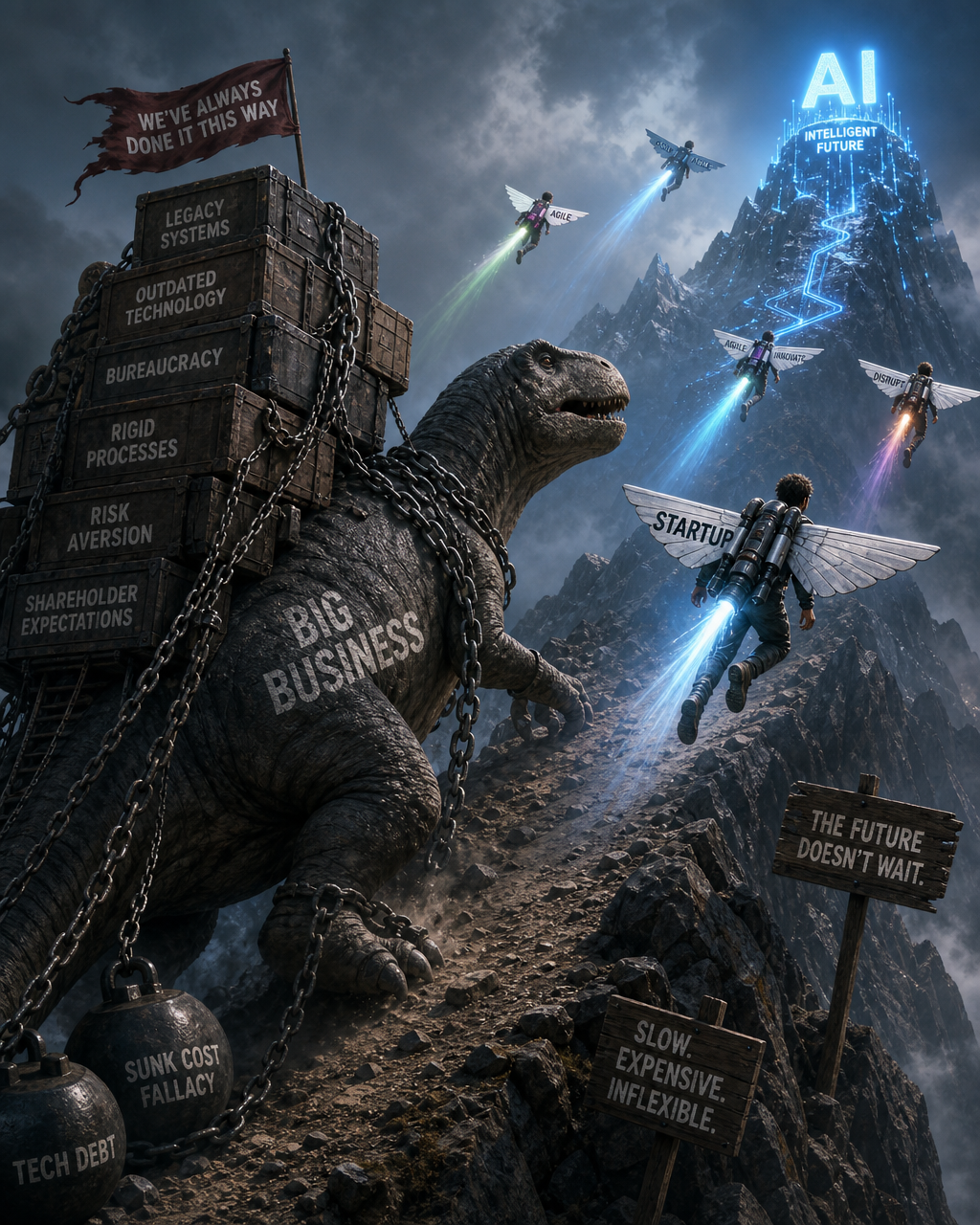
The corporate giants that dominated the pre-AI world are about to face their Nokia moment. While executives scramble to implement AI strategies, most large enterprises are fundamentally unprepared for the speed and agility this technology demands.
The data tells a stark story. 79% of organizations face challenges in adopting AI — a double-digit increase from 2024 — with 54% of C-suite executives admitting that adopting AI is tearing their company apart. Meanwhile, entrepreneurs and small teams are building AI-native companies from scratch, free from the structural constraints that plague legacy organizations.
Here's why big business may be heading for disruption — and why this could create opportunities for founders willing to move fast.
Legacy Infrastructure Creates Massive AI Barriers
Large corporations aren't just carrying old systems; they're drowning in them. Nearly two-thirds of businesses invest more than $2 million on maintaining and upgrading legacy systems, with nearly one-third saying up to 25% of their legacy systems are unable to support AI tools and workloads.
This isn't just about outdated software. Industry estimates suggest the Global 2000 are carrying $1.5–2 trillion in accumulated tech debt. Every API call becomes a negotiation with systems designed decades before cloud computing existed. Every AI integration requires months of infrastructure work just to make basic connections possible.
Startups bypass this entirely. They build on modern cloud architectures from day one, choosing tools designed for AI workloads. While large enterprises may spend months just getting their customer data into a format their AI can read, smaller teams can ship, test, and iterate their AI-powered products much more quickly.
Research indicates that companies with fragmented or legacy systems face significantly higher rates of AI implementation delays due to integration challenges with modern data platforms. These delays create substantial competitive disadvantages when agile competitors can implement similar AI capabilities in a fraction of the time.
Bureaucracy Kills AI Speed
Three-quarters of executives (75%) admit their company's AI strategy is "more for show" than actual internal guidance, with 39% lacking any formal plan to drive revenue from AI tools and 48% calling adoption a "massive disappointment".
The problem isn't strategy documents. It's that large organizations have optimized for consensus and risk management, not speed. Every AI pilot needs approval from IT, legal, compliance, procurement, and three different VPs who each want to add their requirements.
Small teams make decisions in real time. The founder sees an opportunity, evaluates the risk, and ships within days. There are no committees to convince, no change management processes to navigate, no stakeholder alignment sessions.
Many AI programs slow down when decisions are unclear: who approves tools, what data is acceptable, how use cases are prioritized and what quality review is required. Organizations also often experience tension between business and compliance when guardrails are introduced late, after teams have already started building momentum.
While large companies argue about governance frameworks, nimble competitors are learning what works through direct customer feedback.
Workforce Resistance and Prohibitive Retraining Costs
More than half of businesses cite a shortage of AI‑ready talent as a primary barrier to implementation. Many organizations lack the internal capabilities required to deploy, maintain and scale AI systems effectively.
Ninety-two percent of the C-suite are actively cultivating a new class of "AI elite" employees, while 60% plan to lay off those who can't or won't adopt AI. This divide is widening: studies suggest AI super-users showed significantly higher rates of raises and promotions and demonstrate substantially higher productivity than those slow to adopt.
This creates a massive internal disruption. Enterprises must simultaneously retrain thousands of employees while managing the political fallout of workforce restructuring. The cultural resistance is predictable and intense.
Small companies hire AI-native talent from the start. Every team member understands the tools and embraces the workflow. There's no legacy workforce to retrain, no internal politics around job displacement, no cultural change management programs.
When your entire team was hired specifically for an AI-first world, adoption isn't a transformation project. It's just how you work.
Risk-Averse Culture Prevents AI Experimentation
Many companies make an understandable mistake. Instead of leadership calling the shots with a top-down program, they take a ground-up approach, crowdsourcing initiatives that they then try to shape into something like a strategy. The result: projects that may not match enterprise priorities, are rarely executed with precision, and almost never lead to transformation. Crowdsourcing AI efforts can create impressive adoption numbers, but it seldom produces meaningful business outcomes.
Large organizations have spent decades building processes to avoid failure. Every new technology goes through pilot programs, risk assessments, compliance reviews, and gradual rollouts. This works fine for predictable improvements to existing processes.
AI demands experimentation. The breakthrough applications emerge from trying things that might not work. You need to test, fail fast, and iterate based on real user behavior.
As engineering velocity increases, weaknesses in product strategy become harder to ignore. The cost of building the wrong thing is increasingly high, precisely because it is so easy to build.
Startups embrace this reality. They can afford to be wrong because the cost of being wrong is low, and the cost of being slow is devastating. Large companies optimize to avoid being wrong, which makes them slow by design. However, enterprises do bring advantages like extensive customer relationships, regulatory expertise, and substantial resources that can be leveraged once they overcome initial barriers.
Regulatory Compliance Limits Bold AI Pivots
While AI adoption is accelerating, so are regulatory expectations. As a result, businesses must prioritize building robust governance structures that align with emerging international, federal and state regulations, as well as industry-specific standards.
Heavily regulated industries face an impossible choice: move fast and risk compliance violations, or move carefully and get disrupted by unregulated competitors. In Financial Services, large banks are increasingly digital-first and seek faster time to market for product changes. However, they must still navigate rigorous quality gate processes shaped by FCA, BASEL, and AML regulations. Similarly, in the pharmaceutical sector, businesses push for agility to respond swiftly to public health emergencies or pivot R&D towards promising compounds, while maintaining strict compliance with good manufacturing practices, clinical trial protocols, and drug approval regulations.
New companies can often operate in regulatory gray areas while building their initial product and customer base. By the time regulators catch up, they've already established market position and can afford proper compliance infrastructure.
This isn't about avoiding regulation; it's about timing. Startups can move fast while regulations are still forming, then adapt as requirements become clear. Large companies must assume full regulatory compliance from day one of any AI initiative.
The AI Opportunity for Entrepreneurs
This structural disadvantage for large corporations creates a potential opportunity window for entrepreneurs. While enterprises struggle with technical debt and change management, you can:
- Build AI-native from day one: No legacy systems to integrate with, no technical debt to manage
- Make decisions in days, not quarters: No committees, no change management, no stakeholder alignment sessions
- Hire AI-first talent: Every team member understands and embraces AI tools
- Experiment without permission: Test breakthrough applications that might not work
- Move fast in regulatory gray areas: Establish market position before compliance requirements solidify
The window won't stay open forever. Eventually, large companies will modernize their infrastructure, streamline their decision-making, and retrain their workforce. But that transformation takes years, not months.
Most senior leaders are giving themselves two years to accomplish a wide array of ambitious goals, such as modernizing their front- and back-office legacy systems, doing so depends on a similarly aggressive timeline for retiring tech debt—something analysis suggests most businesses may struggle to achieve even on a five-year horizon.
Five years represents multiple technology cycles in AI. For agile startups, this timeline could provide opportunity to build market position, establish customer relationships, and create data advantages, though success will depend on execution and market dynamics.
The AI era isn't just changing how businesses operate. It's creating a rare moment when structural advantages flip, potentially giving small, agile teams the opportunity to outmaneuver industry giants.
The question isn't whether large corporations will eventually adapt to AI. They will. The question is whether you'll move fast enough to establish a strong position before they do.
Ready to build your AI venture engine? Discover, build, and sell with Supramono — the platform that gives founders the speed advantage big business can't match.

Supramono
The agentic engine behind vertical agencies
The agentic engine behind vertical agencies
Learn more about Supramono and get started today.
Visit Supramono