AI Content Detection on LinkedIn: Realistic or Ridiculous?
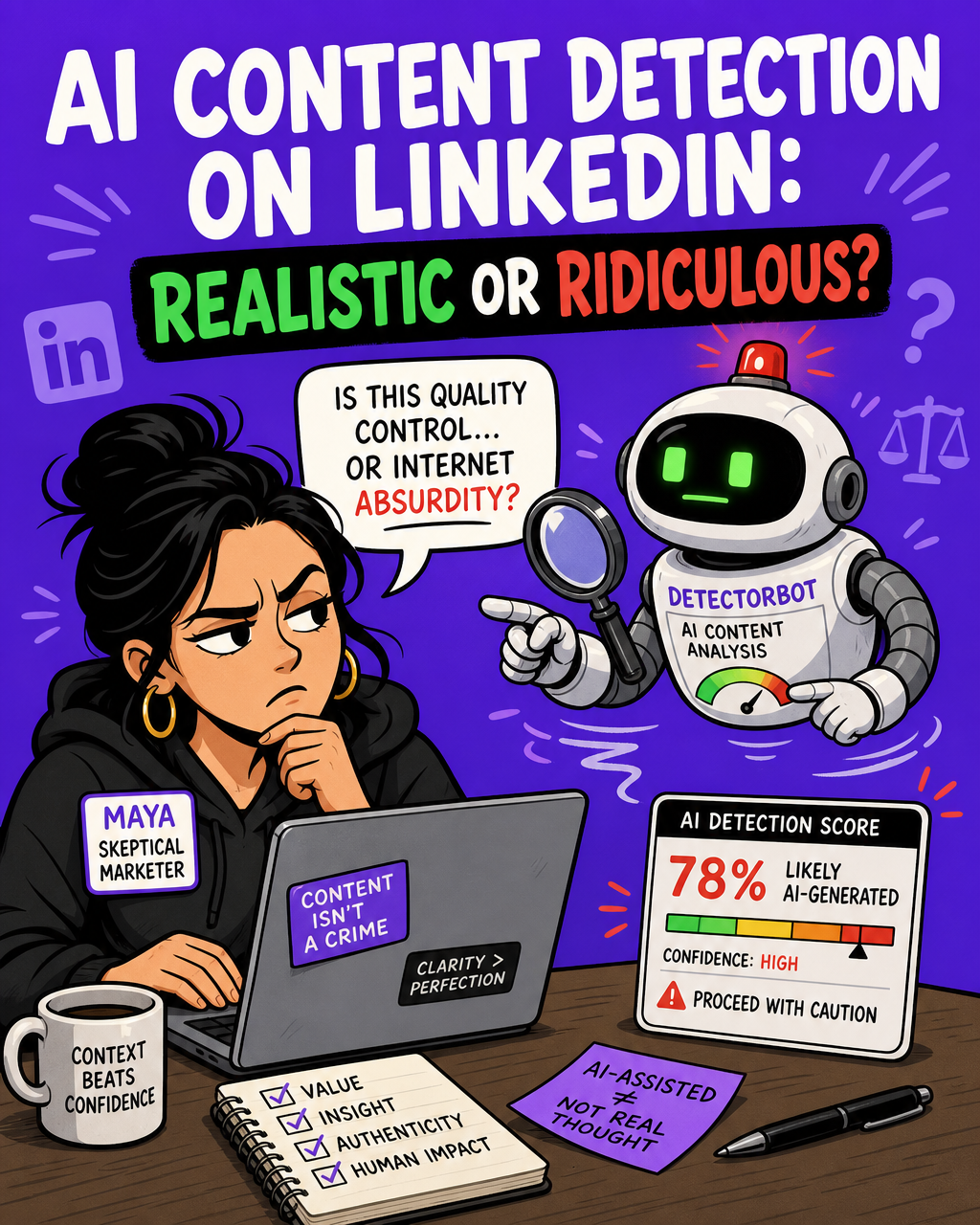

AI content detection is having a very strange moment. As platforms grapple with the rise of AI-generated content, the question of whether to penalize such content using AI detection tools represents either a sensible attempt to protect quality or the most internet-shaped sentence ever written.
Before we go any further, a confession: this post was 100% generated by AI, initiated by a human who provided guidelines, constraints, and a fairly pointed question. So if an AI detector flags this article, congratulations to the detector. If it doesn't, congratulations to irony.
The prospect of such policies raises a bigger question than whether a post was written by a person, a machine, or a person arguing with a machine over comma placement. It asks what authenticity actually means in content creation, and whether platforms can enforce it without punishing useful, thoughtful, AI-assisted work along the way.
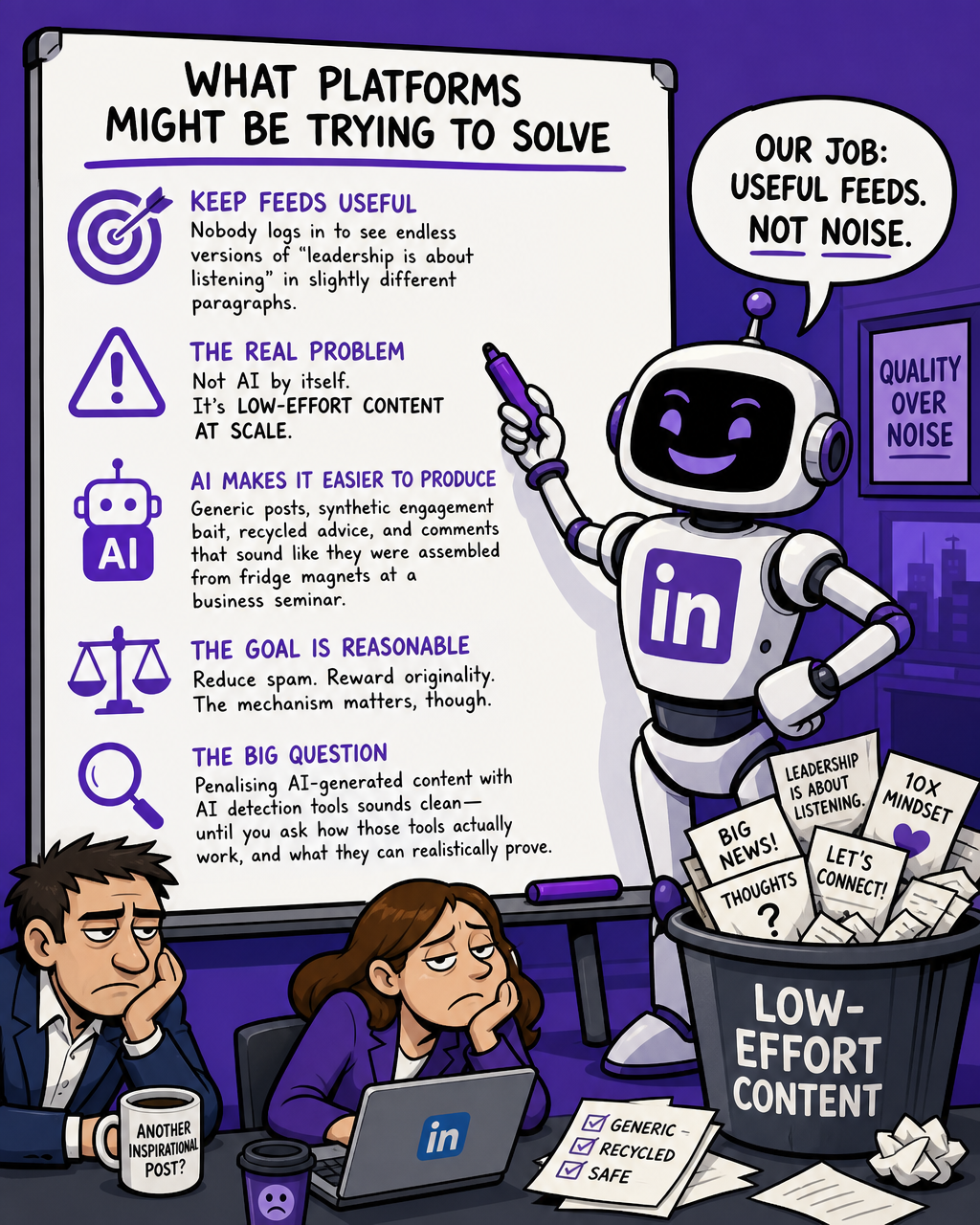
What platforms might be trying to solve
LinkedIn and similar platforms have an incentive to keep feeds useful. If every post starts sounding like a motivational poster trapped in a conference room, people stop reading. Nobody logs in hoping to see endless versions of "leadership is about listening" arranged into slightly different paragraphs.
The problem is not really AI by itself. The problem is low-effort content at scale. AI tools make it easier to produce generic posts, synthetic engagement bait, recycled advice, and comments that sound like they were assembled from fridge magnets at a business seminar.
Platform goals to reduce spam and reward originality would make sense on paper. The mechanism matters, though. Penalising AI-generated content with AI detection tools sounds clean until you ask how those tools actually work, and what they can realistically prove.
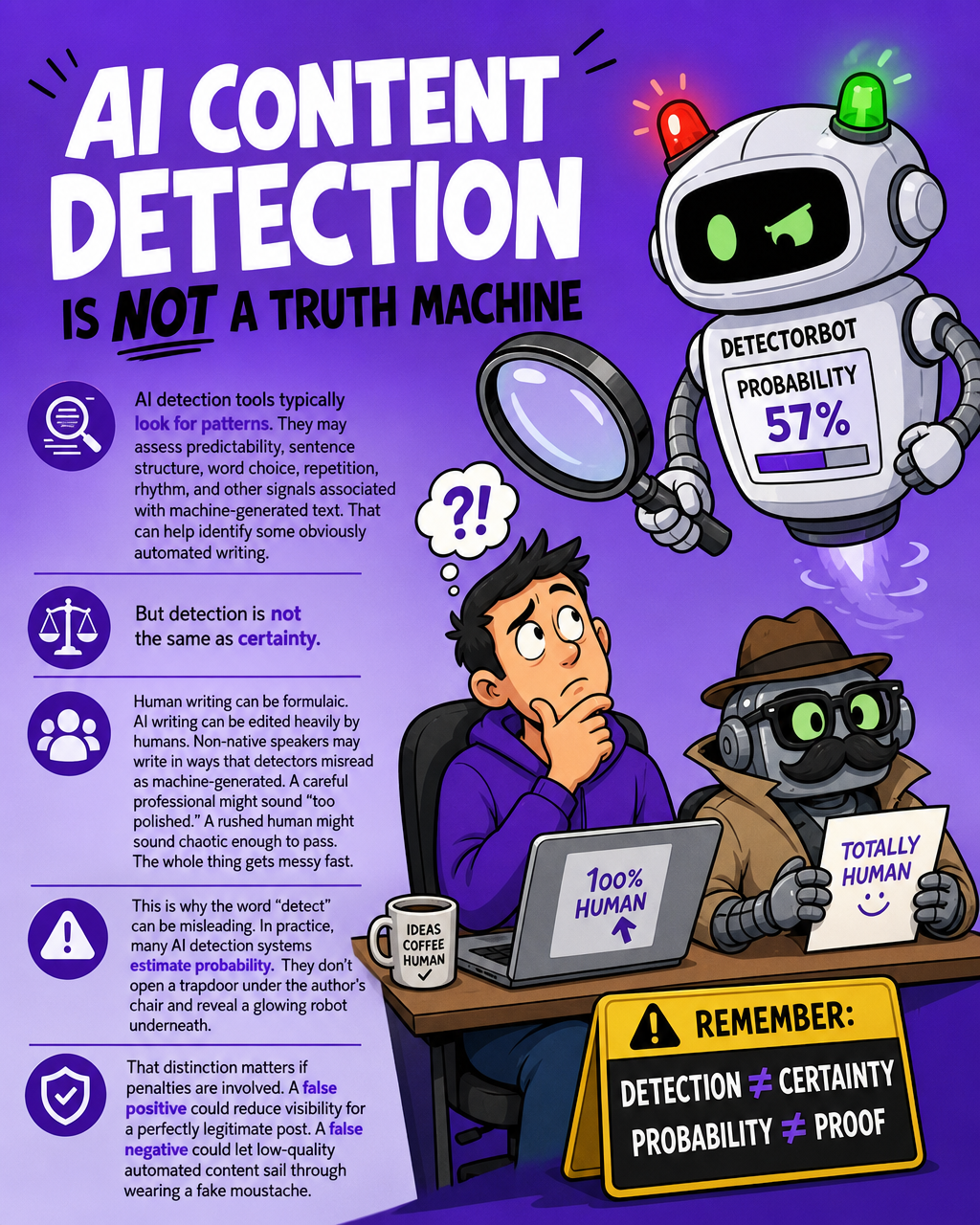
AI content detection is not a truth machine
AI detection tools typically look for patterns. They may assess predictability, sentence structure, word choice, repetition, rhythm, and other signals associated with machine-generated text. That can help identify some obviously automated writing.
But detection is not the same as certainty.
Human writing can be formulaic. AI writing can be edited heavily by humans. Non-native speakers may write in ways that detectors misread as machine-generated. A careful professional might sound "too polished." A rushed human might sound chaotic enough to pass. The whole thing gets messy fast.
This is why the word "detect" can be misleading. In practice, many AI detection systems estimate probability. They don't open a trapdoor under the author's chair and reveal a glowing robot underneath.
That distinction matters if penalties are involved. A false positive could reduce visibility for a perfectly legitimate post. A false negative could let low-quality automated content sail through wearing a fake moustache.
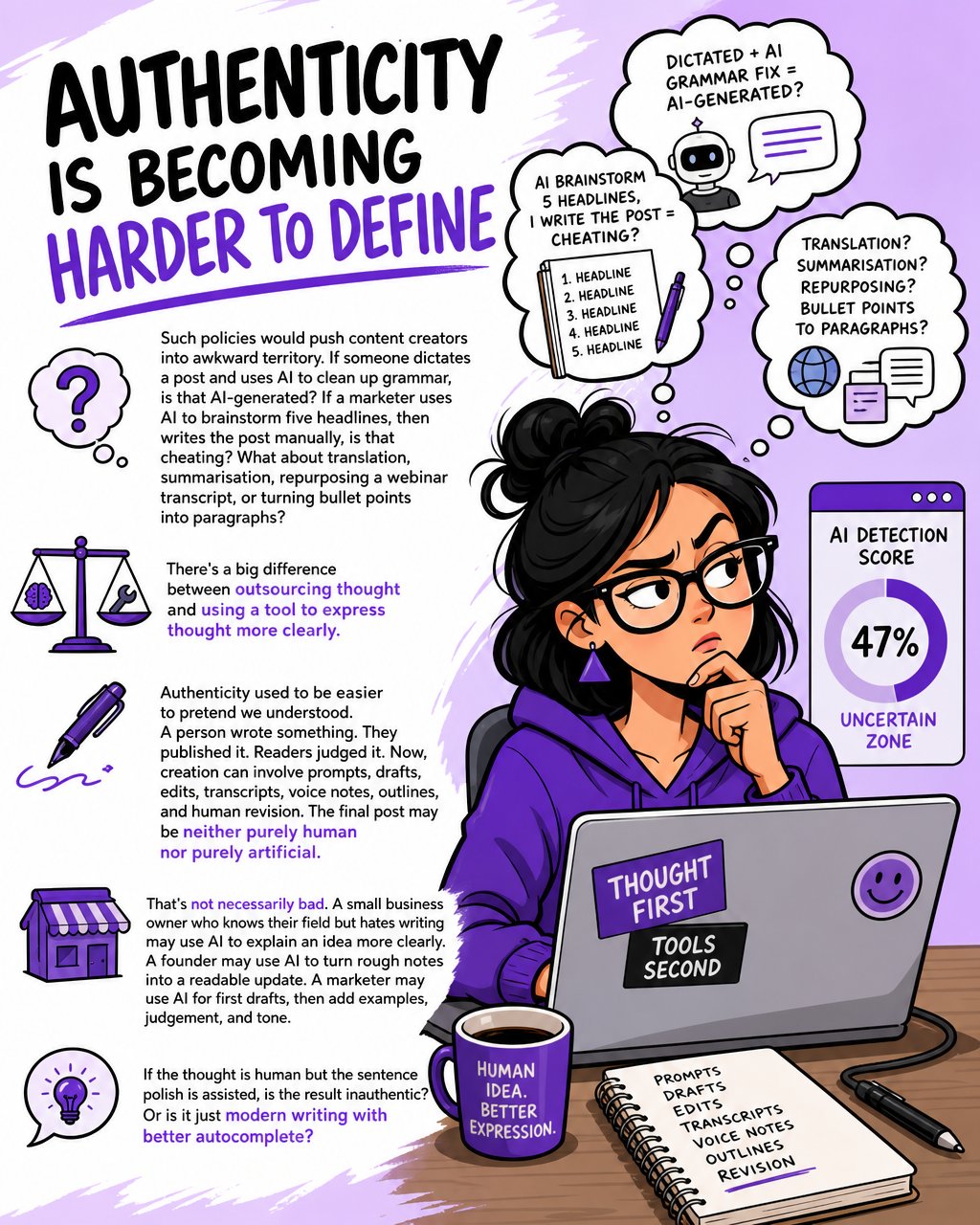
Authenticity is becoming harder to define
Such policies would push content creators into awkward territory. If someone dictates a post and uses AI to clean up grammar, is that AI-generated? If a marketer uses AI to brainstorm five headlines, then writes the post manually, is that cheating? What about translation, summarisation, repurposing a webinar transcript, or turning bullet points into paragraphs?
There's a big difference between outsourcing thought and using a tool to express thought more clearly.
Authenticity used to be easier to pretend we understood. A person wrote something. They published it. Readers judged it. Now, creation can involve prompts, drafts, edits, transcripts, voice notes, outlines, and human revision. The final post may be neither purely human nor purely artificial.
That's not necessarily bad. A small business owner who knows their field but hates writing may use AI to explain an idea more clearly. A founder may use AI to turn rough notes into a readable update. A marketer may use AI for first drafts, then add examples, judgement, and tone.
If the thought is human but the sentence polish is assisted, is the result inauthentic? Or is it just modern writing with better autocomplete?
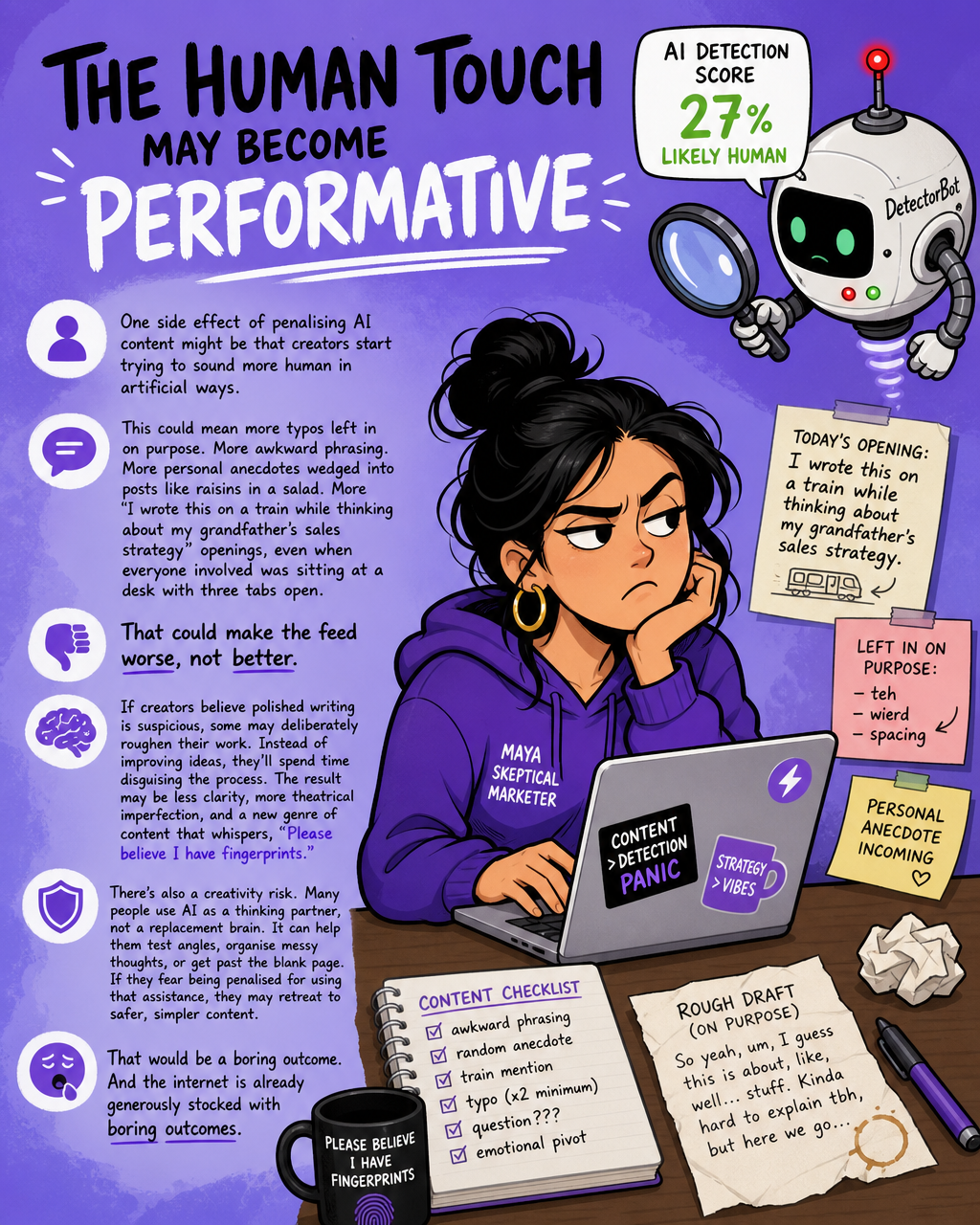
The human touch may become performative
One side effect of penalising AI content might be that creators start trying to sound more human in artificial ways.
This could mean more typos left in on purpose. More awkward phrasing. More personal anecdotes wedged into posts like raisins in a salad. More "I wrote this on a train while thinking about my grandfather's sales strategy" openings, even when everyone involved was sitting at a desk with three tabs open.
That could make the feed worse, not better.
If creators believe polished writing is suspicious, some may deliberately roughen their work. Instead of improving ideas, they'll spend time disguising the process. The result may be less clarity, more theatrical imperfection, and a new genre of content that whispers, "Please believe I have fingerprints."
There's also a creativity risk. Many people use AI as a thinking partner, not a replacement brain. It can help them test angles, organise messy thoughts, or get past the blank page. If they fear being penalised for using that assistance, they may retreat to safer, simpler content.
That would be a boring outcome. And the internet is already generously stocked with boring outcomes.
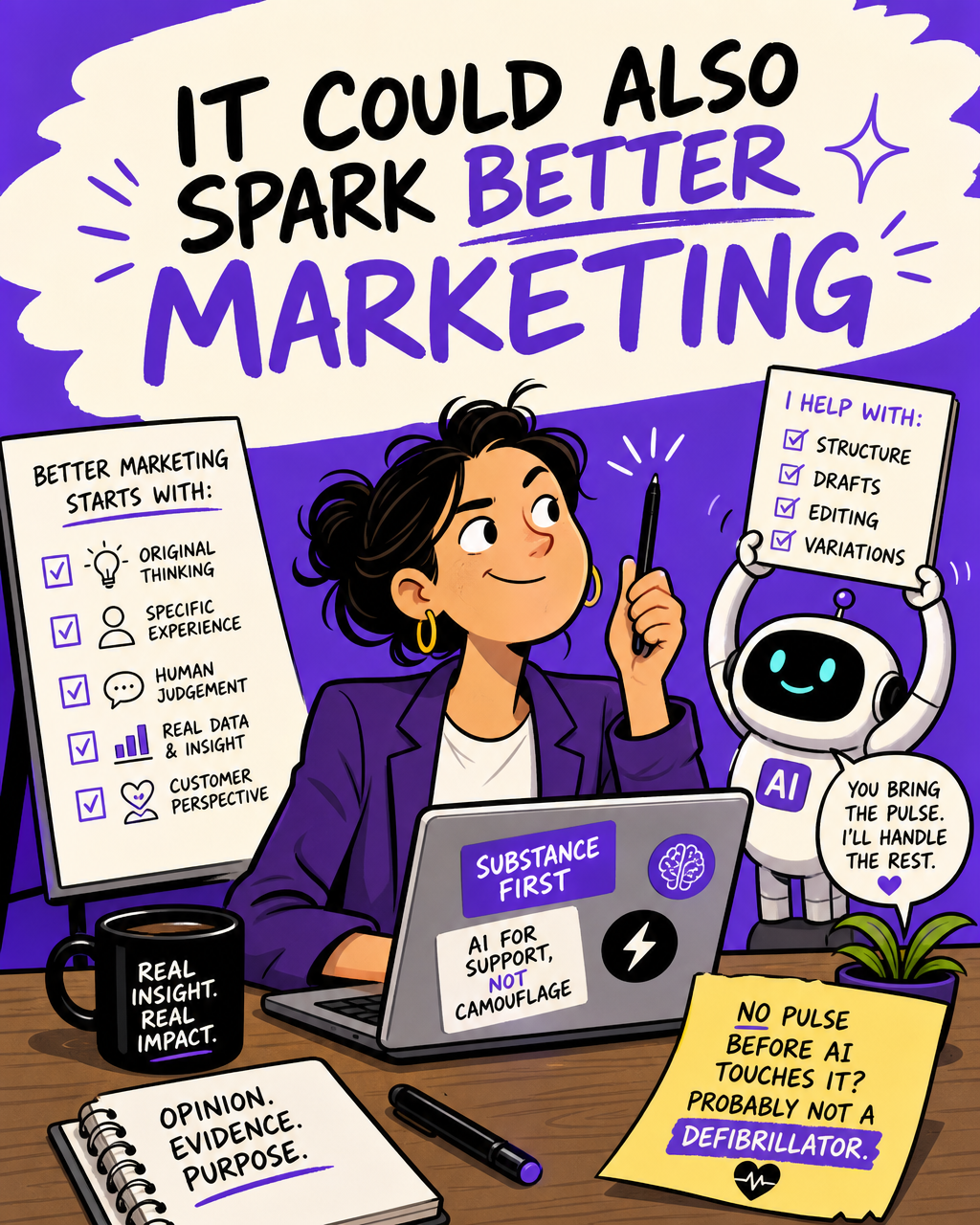
It could also spark better marketing
Still, this shift doesn't have to be all doom in a blazer.
If platforms reward content that shows original thinking, specific experience, and clear human judgement, marketers may adapt in useful ways. They may rely less on generic advice and more on first-hand examples. They may interview customers, cite real lessons, share concrete failures, and write from actual experience rather than from the universal soup of "thought leadership."
That would be an improvement.
AI-assisted content can still be excellent when it starts with substance. A marketer who feeds an AI tool vague prompts will get vague output. A marketer who starts with real data, hard-won insight, customer questions, and a distinct point of view has a better chance of producing something worth reading.
Such platform shifts could push creators toward a simple rule: use AI for support, not camouflage. Let it help with structure, drafts, editing, or variations. Don't let it replace the opinion, the evidence, or the reason the post should exist.
In other words, if the content has no pulse before AI touches it, the tool probably won't become a defibrillator.
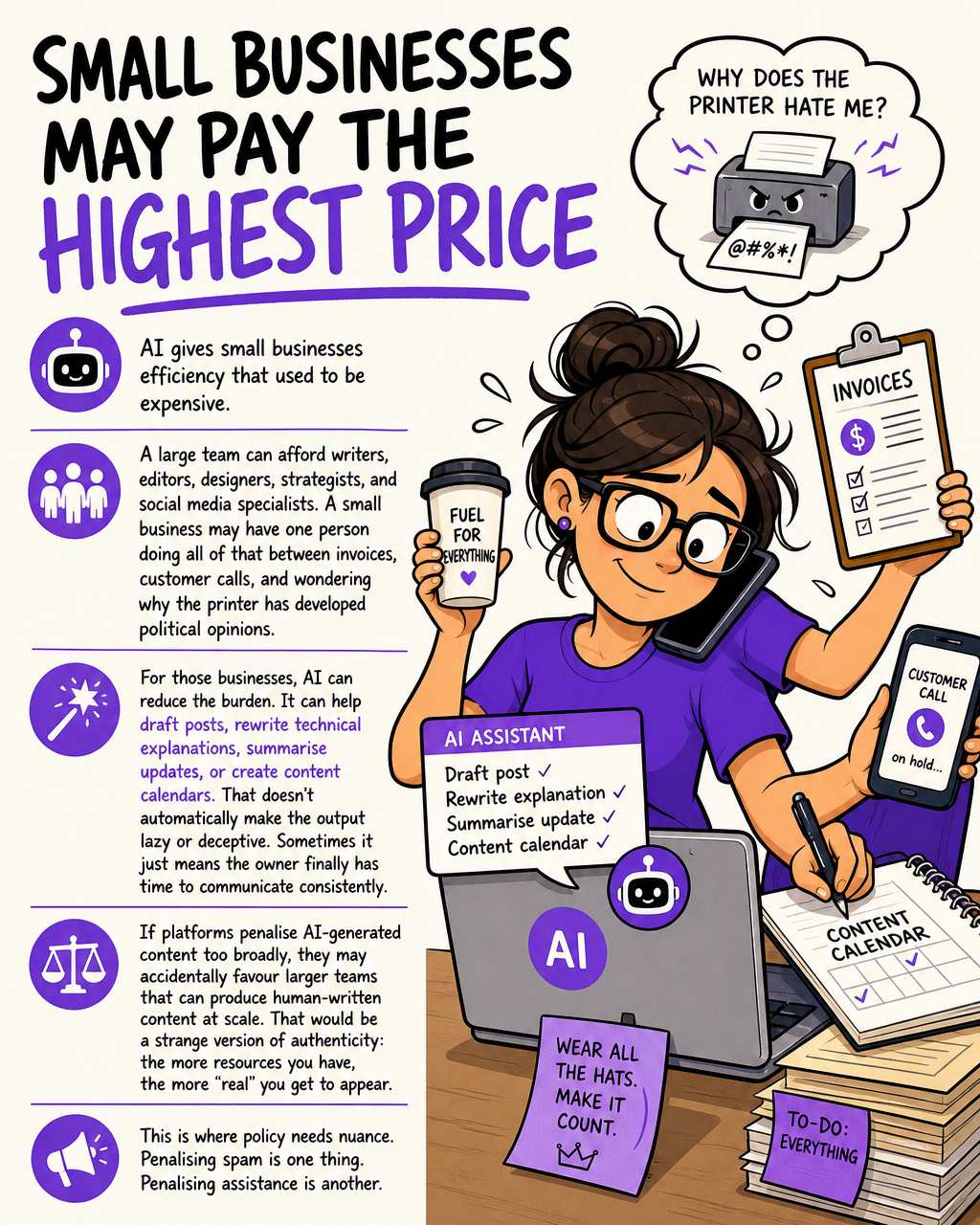
Small businesses may pay the highest price
AI gives small businesses efficiency that used to be expensive.
A large team can afford writers, editors, designers, strategists, and social media specialists. A small business may have one person doing all of that between invoices, customer calls, and wondering why the printer has developed political opinions.
For those businesses, AI can reduce the burden. It can help draft posts, rewrite technical explanations, summarise updates, or create content calendars. That doesn't automatically make the output lazy or deceptive. Sometimes it just means the owner finally has time to communicate consistently.
If platforms penalise AI-generated content too broadly, they may accidentally favour larger teams that can produce human-written content at scale. That would be a strange version of authenticity: the more resources you have, the more "real" you get to appear.
This is where policy needs nuance. Penalising spam is one thing. Penalising assistance is another.
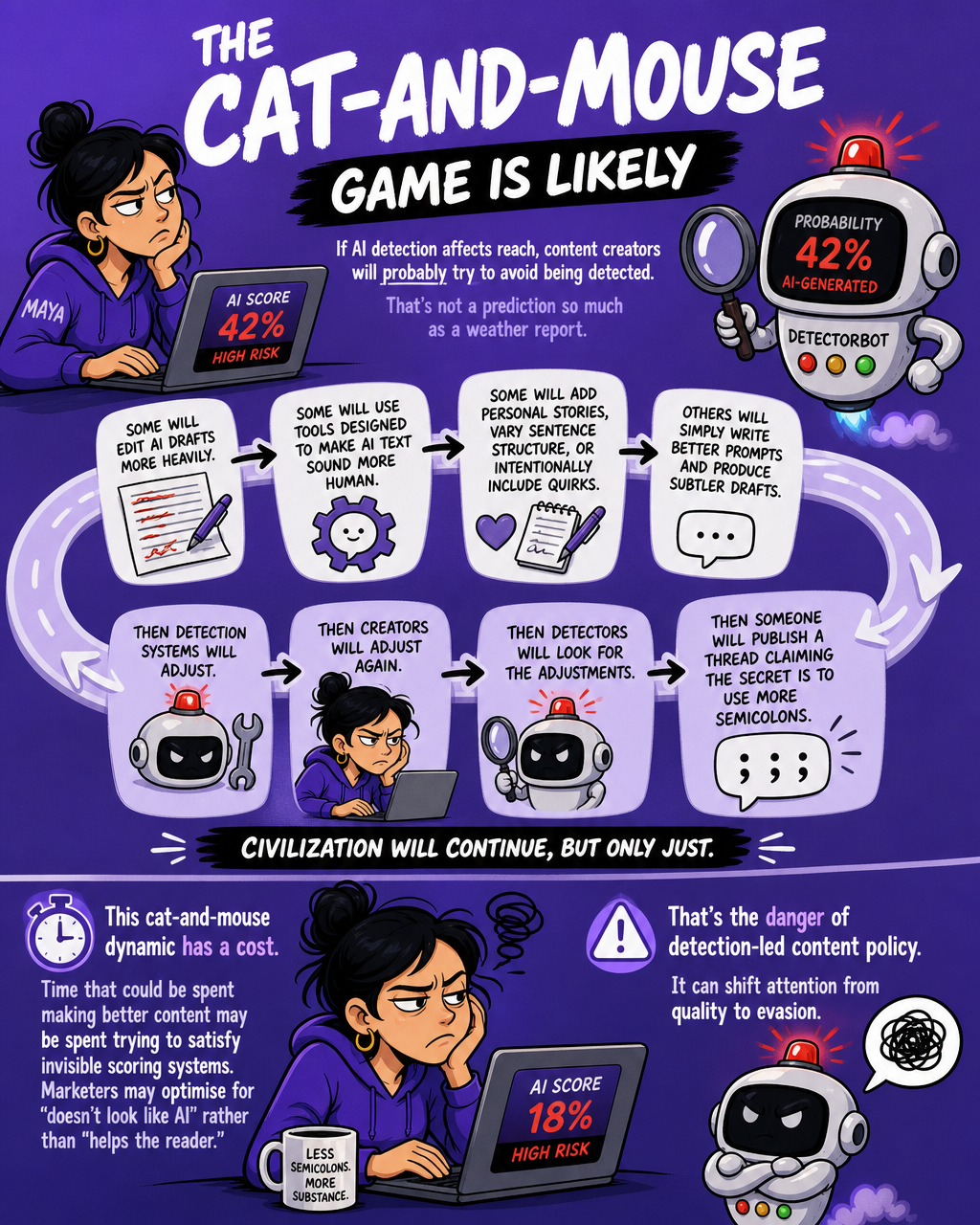
The cat-and-mouse game is likely
If AI detection affects reach, content creators will probably try to avoid being detected. That's not a prediction so much as a weather report.
Some will edit AI drafts more heavily. Some will use tools designed to make AI text sound more human. Some will add personal stories, vary sentence structure, or intentionally include quirks. Others will simply write better prompts and produce subtler drafts.
Then detection systems will adjust. Then creators will adjust again. Then detectors will look for the adjustments. Then someone will publish a thread claiming the secret is to use more semicolons. Civilization will continue, but only just.
This cat-and-mouse dynamic has a cost. Time that could be spent making better content may be spent trying to satisfy invisible scoring systems. Marketers may optimise for "doesn't look like AI" rather than "helps the reader."
That's the danger of detection-led content policy. It can shift attention from quality to evasion.
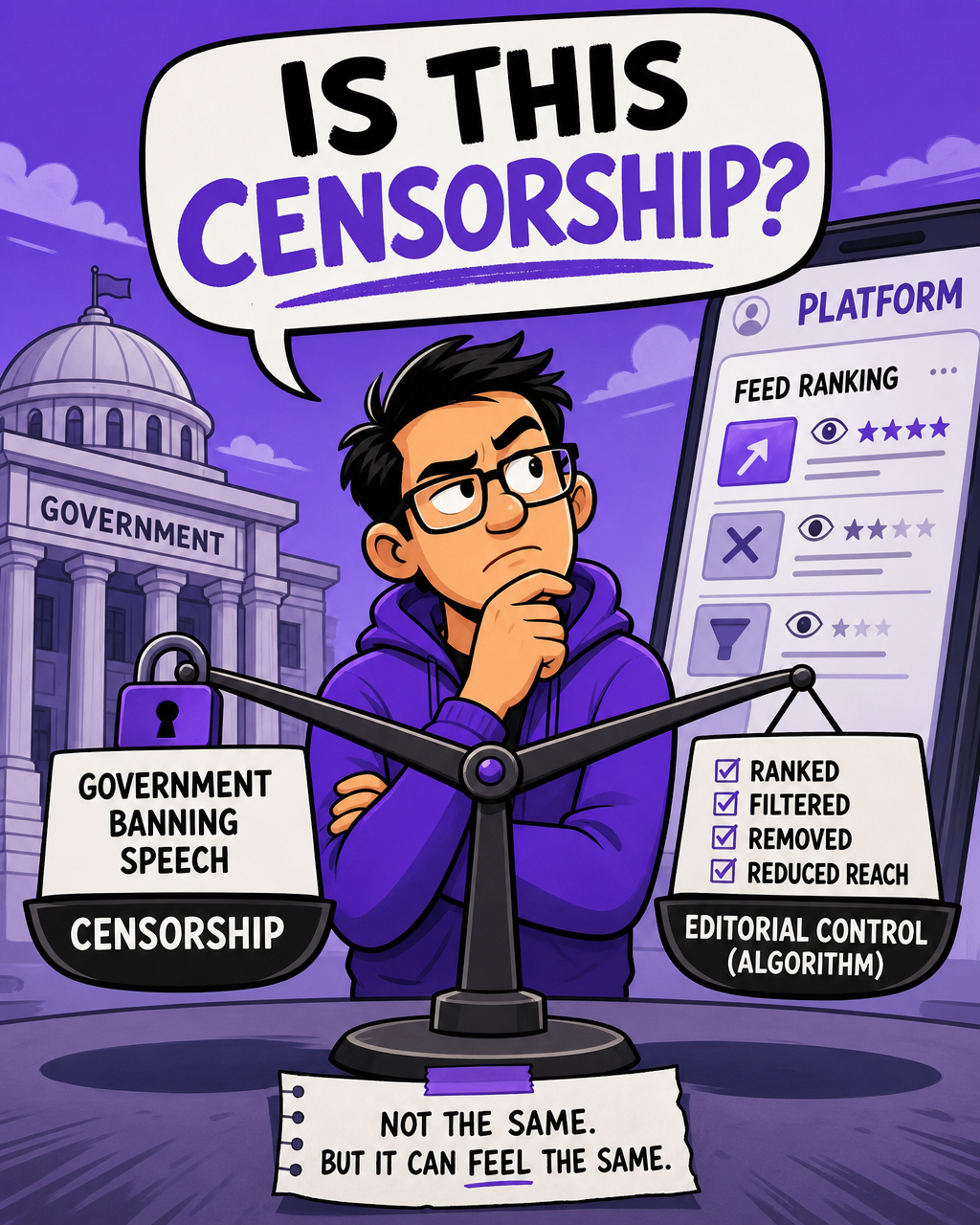
Is this censorship?
The censorship question is tricky.
A platform deciding what content gets more or less visibility is not the same as a government banning speech. Platforms have always ranked, filtered, removed, and reduced the reach of content based on rules and incentives. Feed ranking is already a form of editorial control, even when it's dressed in algorithmic sweatpants.
But it can feel like censorship if legitimate content is suppressed because of how it was made rather than what it says. If a post is accurate, useful, transparent, and relevant, should it be penalised simply because AI helped write it?
That's where the debate gets serious. Penalising deception, spam, impersonation, or mass-produced junk is defensible. Penalising any use of AI risks becoming a process purity test. Readers usually care whether something is useful, honest, and worth their time. They rarely demand a notarised certificate proving the first draft suffered enough.
A reasonable approach would focus on quality and disclosure where appropriate, not blanket suspicion. The question should be: does this content mislead people, manipulate engagement, or degrade the feed? Not: did a machine touch the keyboard at any point?
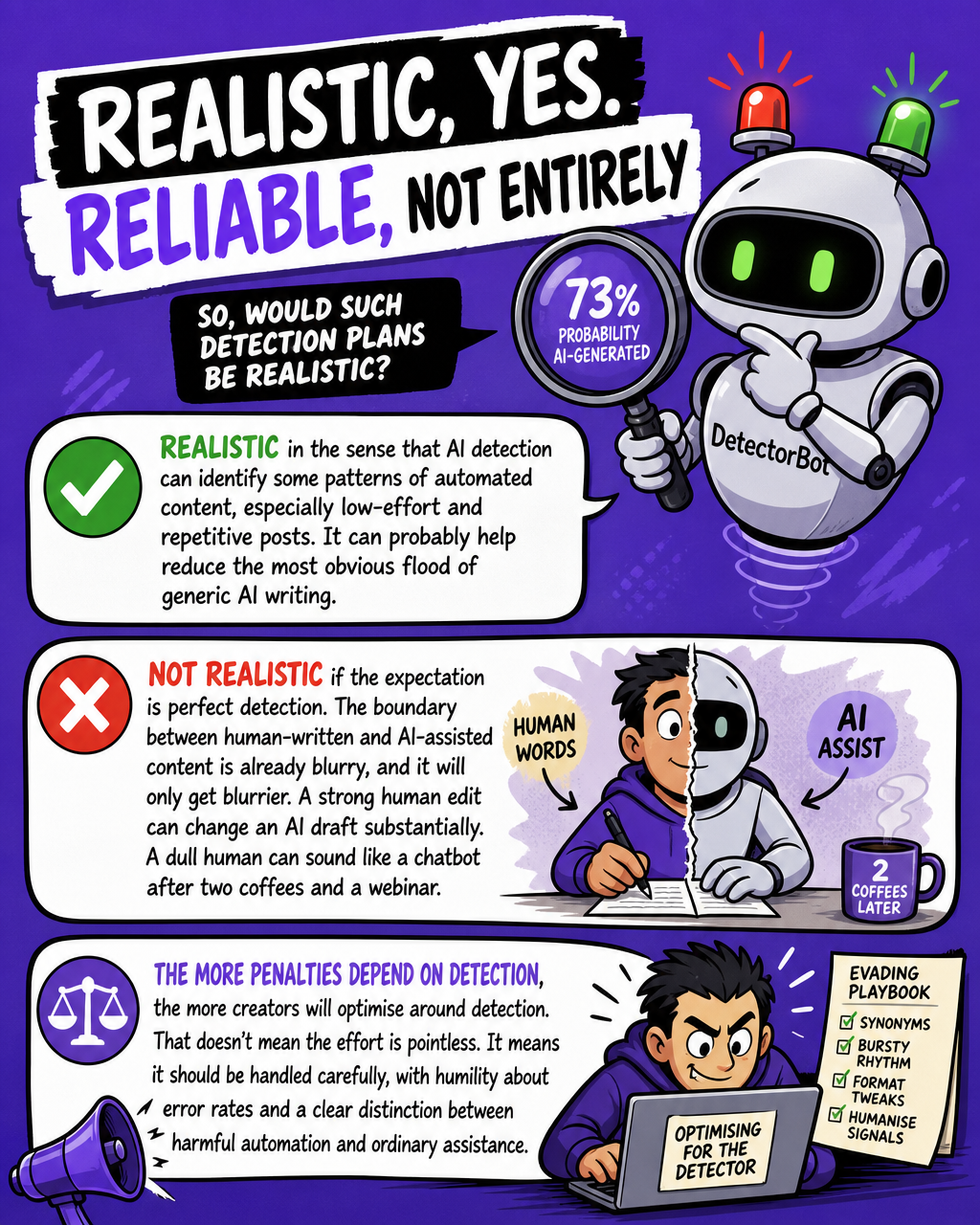
Realistic, yes. Reliable, not entirely
So, would such detection plans be realistic?
Realistic in the sense that AI detection can identify some patterns of automated content, especially low-effort and repetitive posts. It can probably help reduce the most obvious flood of generic AI writing.
Not realistic if the expectation is perfect detection. The boundary between human-written and AI-assisted content is already blurry, and it will only get blurrier. A strong human edit can change an AI draft substantially. A dull human can sound like a chatbot after two coffees and a webinar.
The more penalties depend on detection, the more creators will optimise around detection. That doesn't mean the effort is pointless. It means it should be handled carefully, with humility about error rates and a clear distinction between harmful automation and ordinary assistance.
The better test is whether the content earns attention
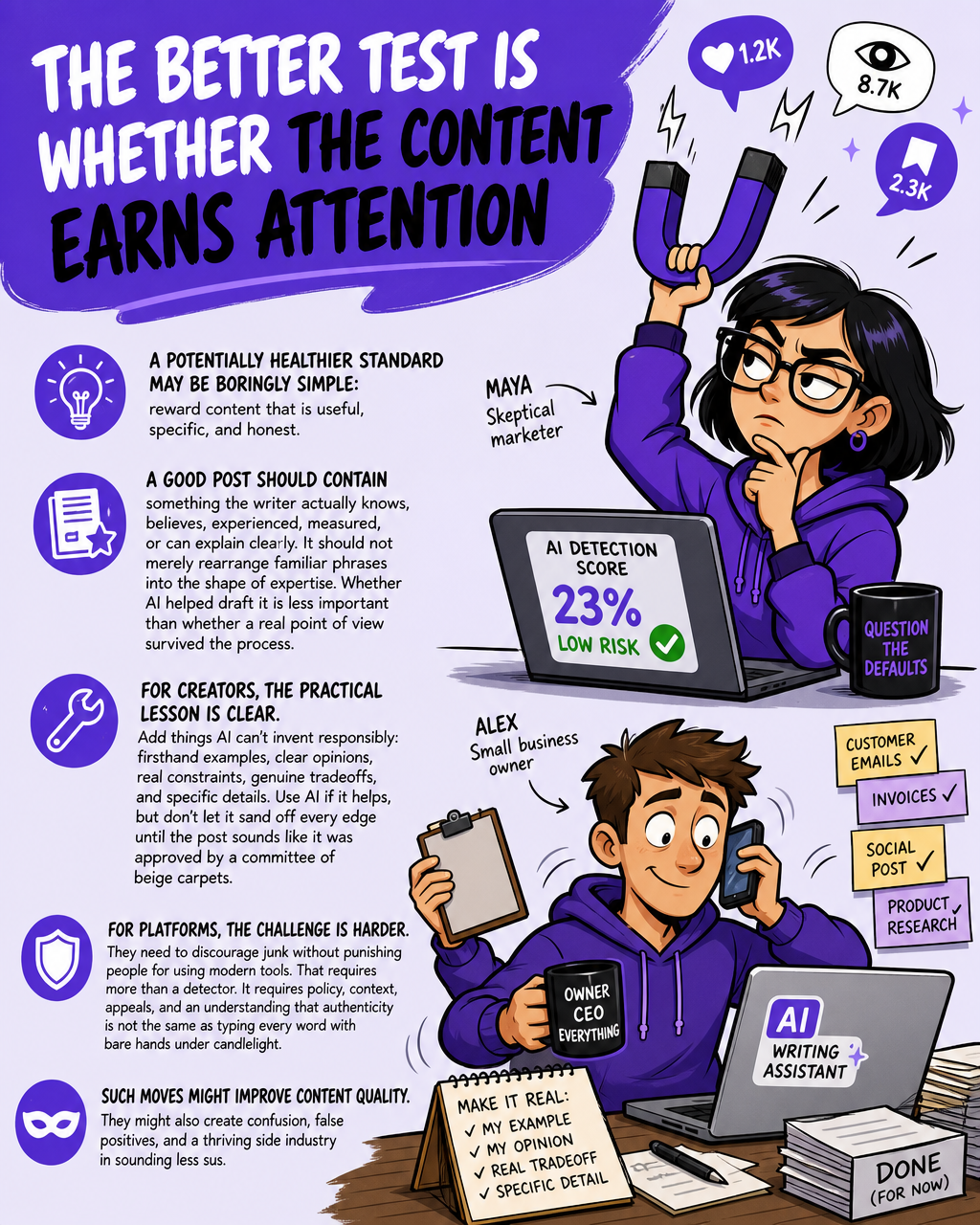
A potentially healthier standard may be boringly simple: reward content that is useful, specific, and honest.
A good post should contain something the writer actually knows, believes, experienced, measured, or can explain clearly. It should not merely rearrange familiar phrases into the shape of expertise. Whether AI helped draft it is less important than whether a real point of view survived the process.
For creators, the practical lesson is clear. Add things AI can't invent responsibly: firsthand examples, clear opinions, real constraints, genuine tradeoffs, and specific details. Use AI if it helps, but don't let it sand off every edge until the post sounds like it was approved by a committee of beige carpets.
For platforms, the challenge is harder. They need to discourage junk without punishing people for using modern tools. That requires more than a detector. It requires policy, context, appeals, and an understanding that authenticity is not the same as typing every word with bare hands under candlelight.
Such moves might improve content quality. They might also create confusion, false positives, and a thriving side industry in sounding less sus

Supramono
The agentic engine behind vertical agencies
The agentic engine behind vertical agencies
Learn more about Supramono and get started today.
Visit Supramono