Sales-Led Growth for Engineers: What the Sales Cycle Actually Demands

You built something good. The code is clean, the architecture is solid, and the product genuinely solves a real problem. Then you join a B2B company or start selling your own product, and suddenly people are talking about "pipeline stages," "deal velocity," and "procurement blockers" — and none of it maps to anything in your engineering mental model.
This post is for engineers who build first and learn go-to-market second. Sales-led growth (SLG) has a specific internal logic that shapes what you build, when you build it, and how your product gets instrumented. Once you understand that logic, a lot of decisions that looked arbitrary start making sense.
What sales-led growth actually means
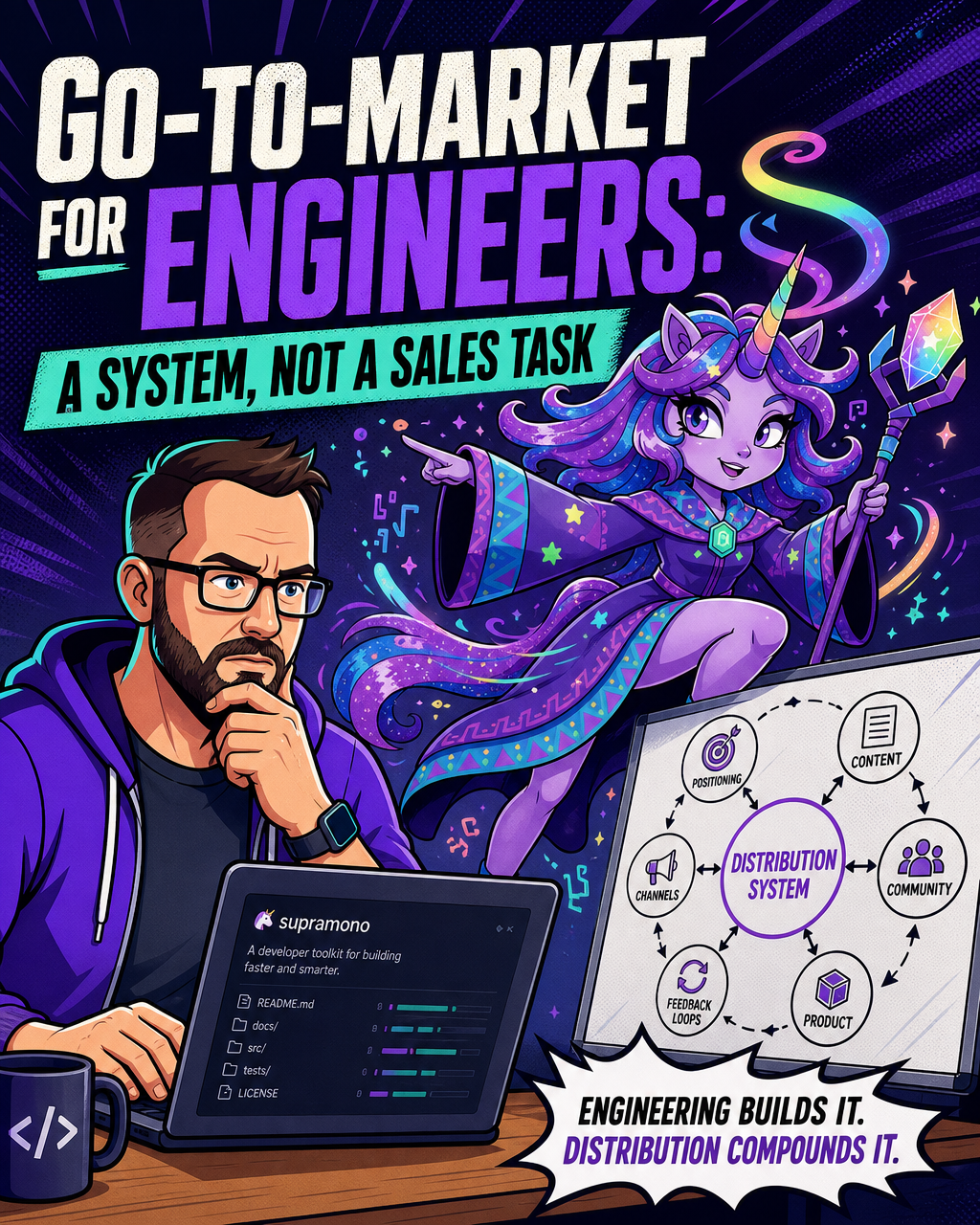
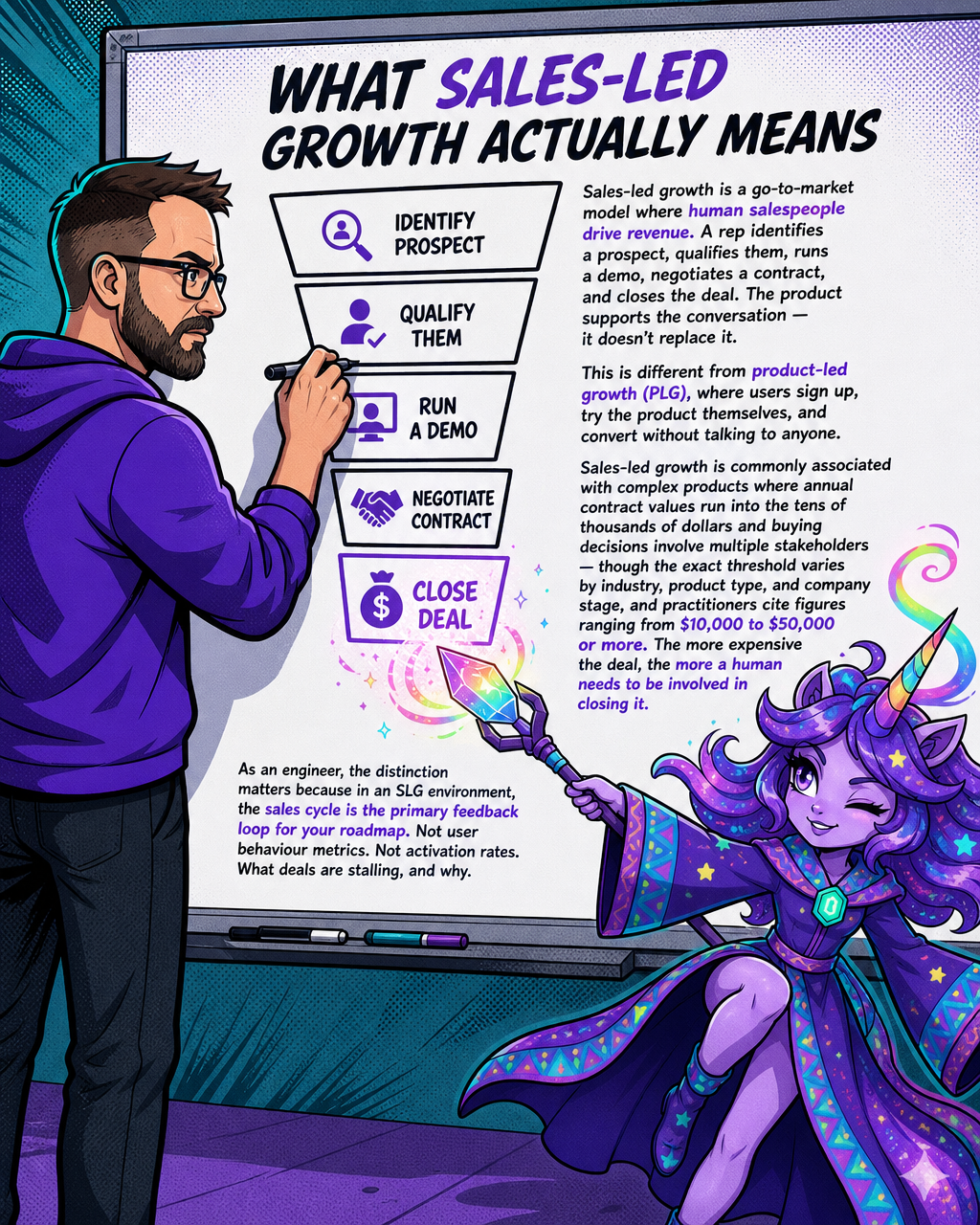
Sales-led growth is a go-to-market model where human salespeople drive revenue. A rep identifies a prospect, qualifies them, runs a demo, negotiates a contract, and closes the deal. The product supports the conversation — it doesn't replace it.
This is different from product-led growth (PLG), where users sign up, try the product themselves, and convert without talking to anyone. Sales-led growth is commonly associated with complex products where annual contract values run into the tens of thousands of dollars and buying decisions involve multiple stakeholders — though the exact threshold varies by industry, product type, and company stage, and practitioners cite figures ranging from $10,000 to $50,000 or more. The more expensive the deal, the more a human needs to be involved in closing it.
As an engineer, the distinction matters because in an SLG environment, the sales cycle is the primary feedback loop for your roadmap. Not user behaviour metrics. Not activation rates. What deals are stalling, and why.
How a deal actually moves through the pipeline
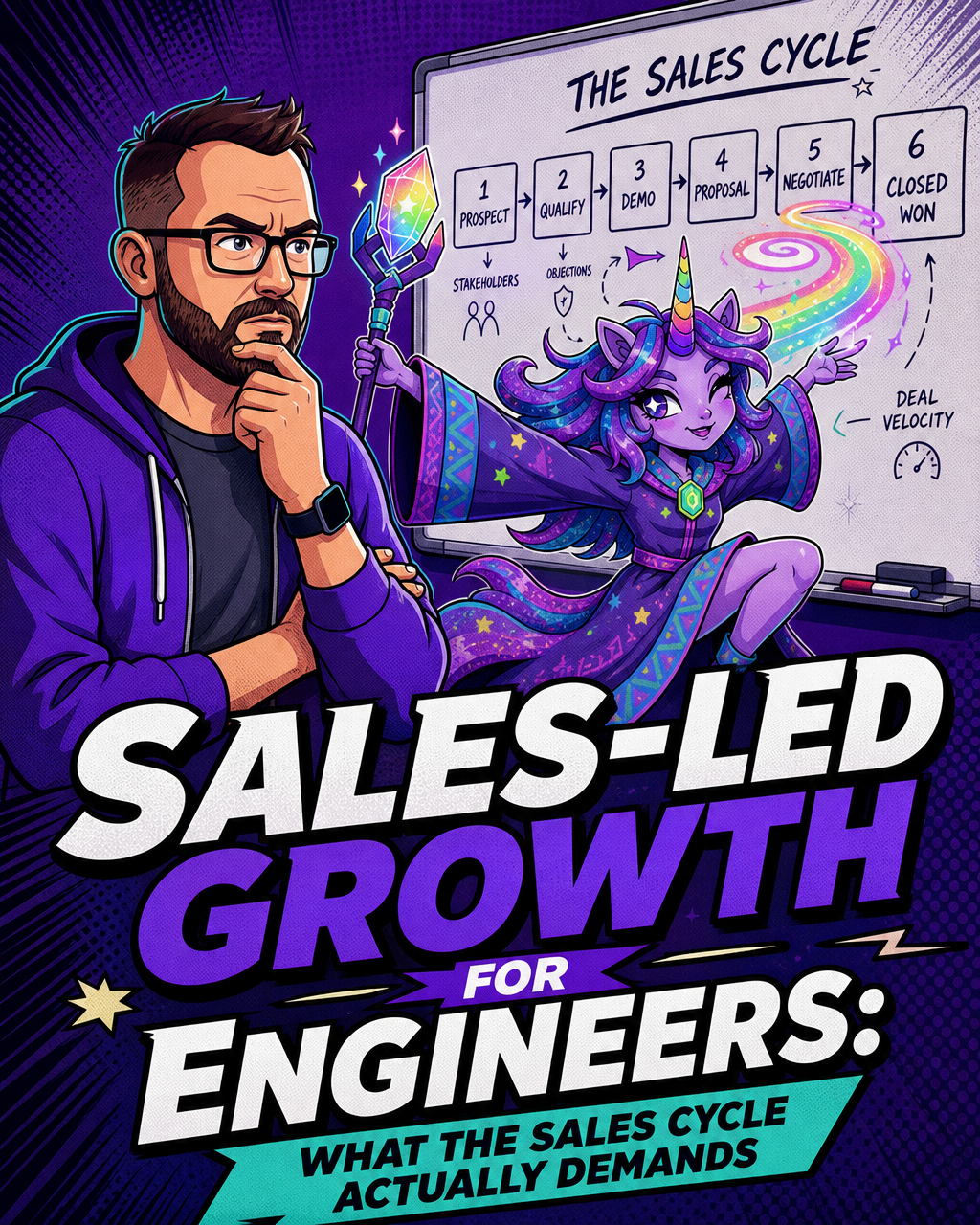
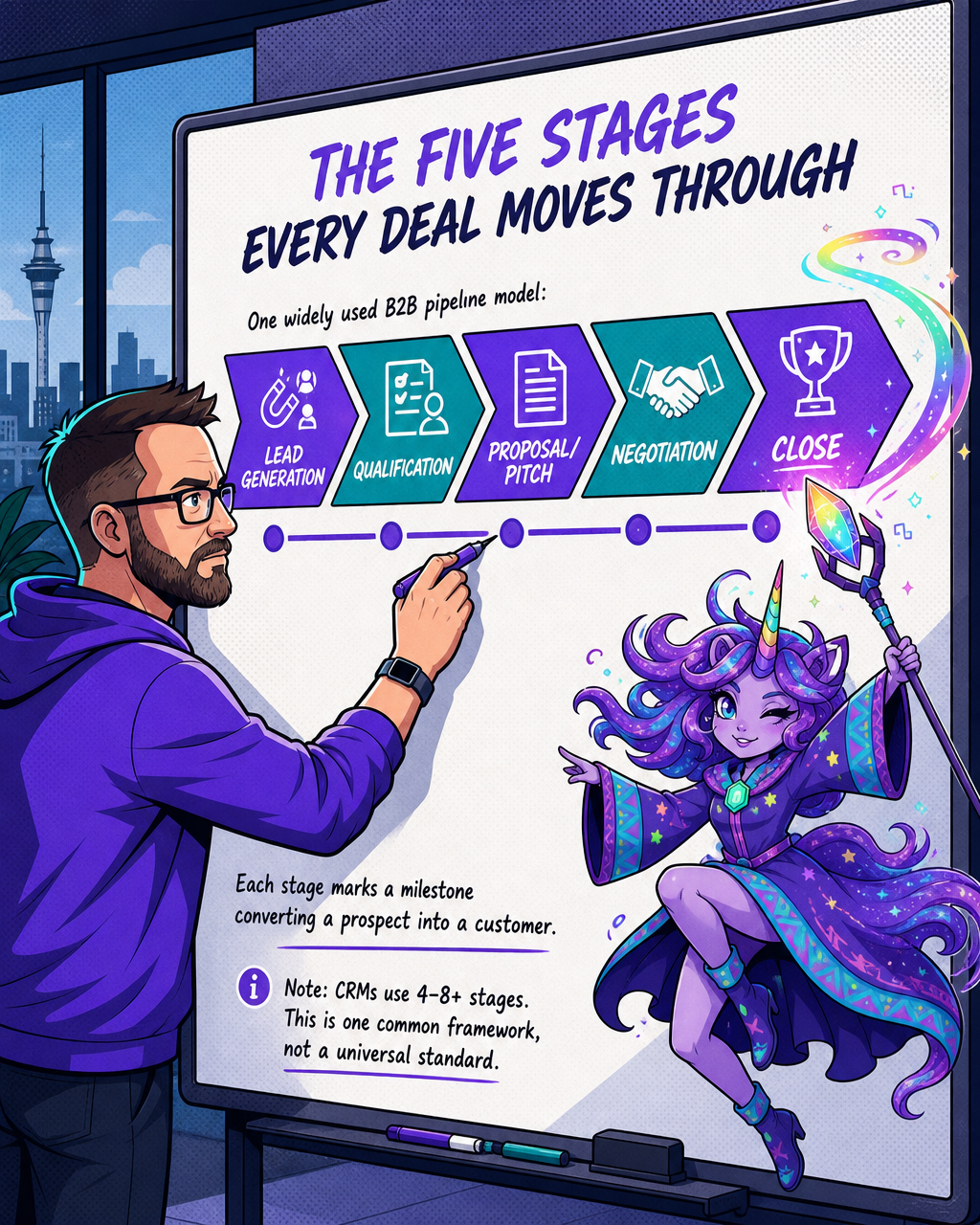
Before you can instrument anything, you need to understand what you're instrumenting. One widely used model breaks the B2B sales pipeline into five stages: lead generation, qualification, proposal or pitch, negotiation, and closing. Each stage marks a milestone in converting a prospect into a customer, helping sales teams prioritize efforts, measure progress, and forecast outcomes based on deal movement. It's worth noting that different sales methodologies and CRM implementations use anywhere from four to eight or more stages — this is one common framework, not a universal standard.
Let's map each stage to what it actually means for product:
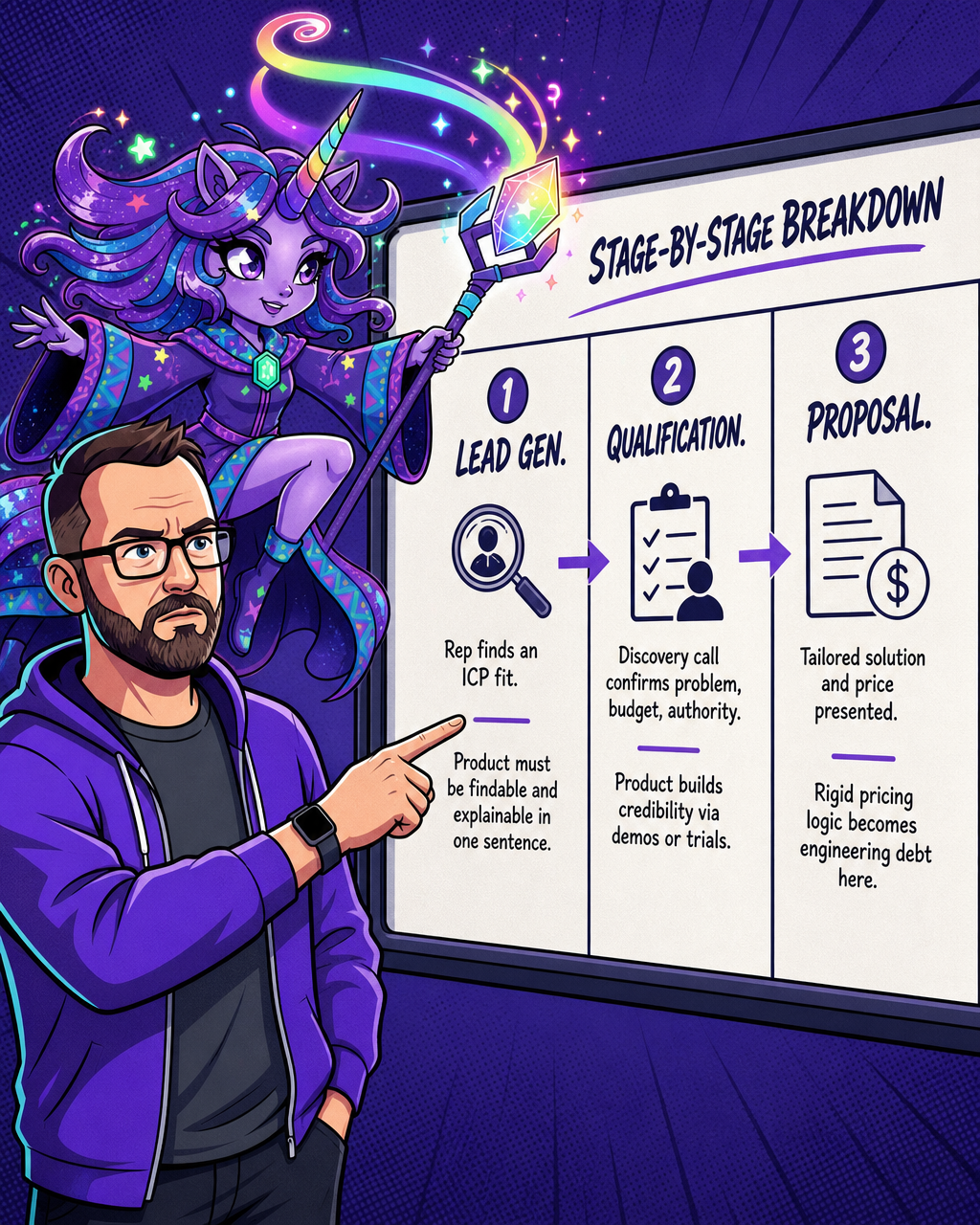
Lead generation. A rep identifies a company that fits the ideal customer profile (ICP). They might find this through outbound prospecting, inbound form fills, or a referral. The product's job at this stage is to be findable and legible — clear enough that a rep can explain what it does in one sentence.
Qualification. The rep runs a discovery call to confirm the prospect has the problem, the budget, and the authority to buy. Unlike B2C, where purchases are fast and individual, B2B decisions are committee-driven, longer, and constrained by risk, compliance, and integration needs. Your product's job here is to generate enough credibility — through demos, case studies, or a free trial — that the prospect stays engaged.
Proposal or pitch. The rep presents a tailored solution and a price. If pricing logic is baked into the product in a rigid way, this is often where engineering debt becomes a sales problem. More on that below.
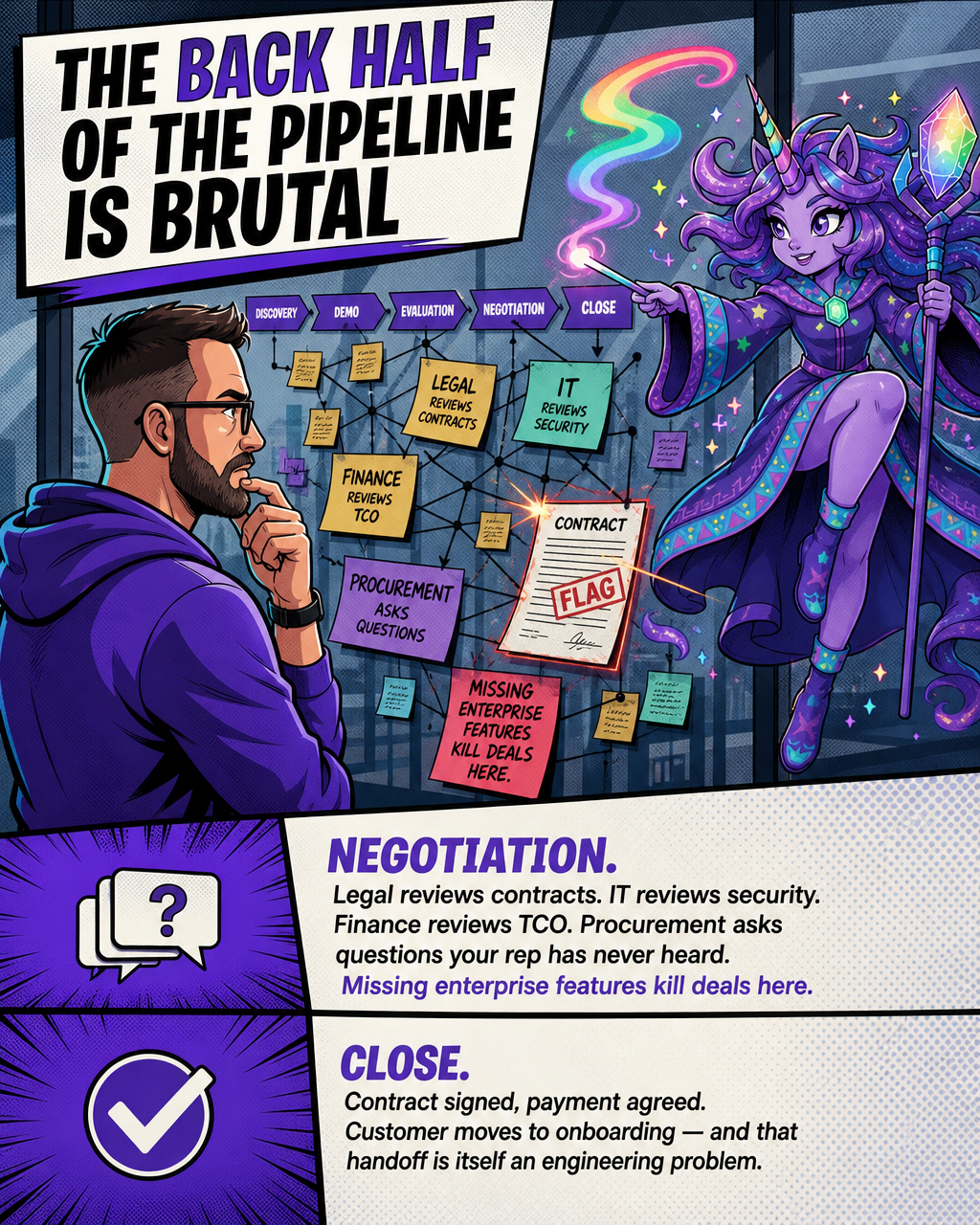
Negotiation. Legal reviews the contract. IT reviews the security posture. Finance reviews total cost of ownership. The procurement team asks questions your sales rep has never heard before. This is the stage where missing enterprise features kill deals.
Close. Contract signed, payment terms agreed. The customer transitions to onboarding. This handoff is itself an engineering problem.
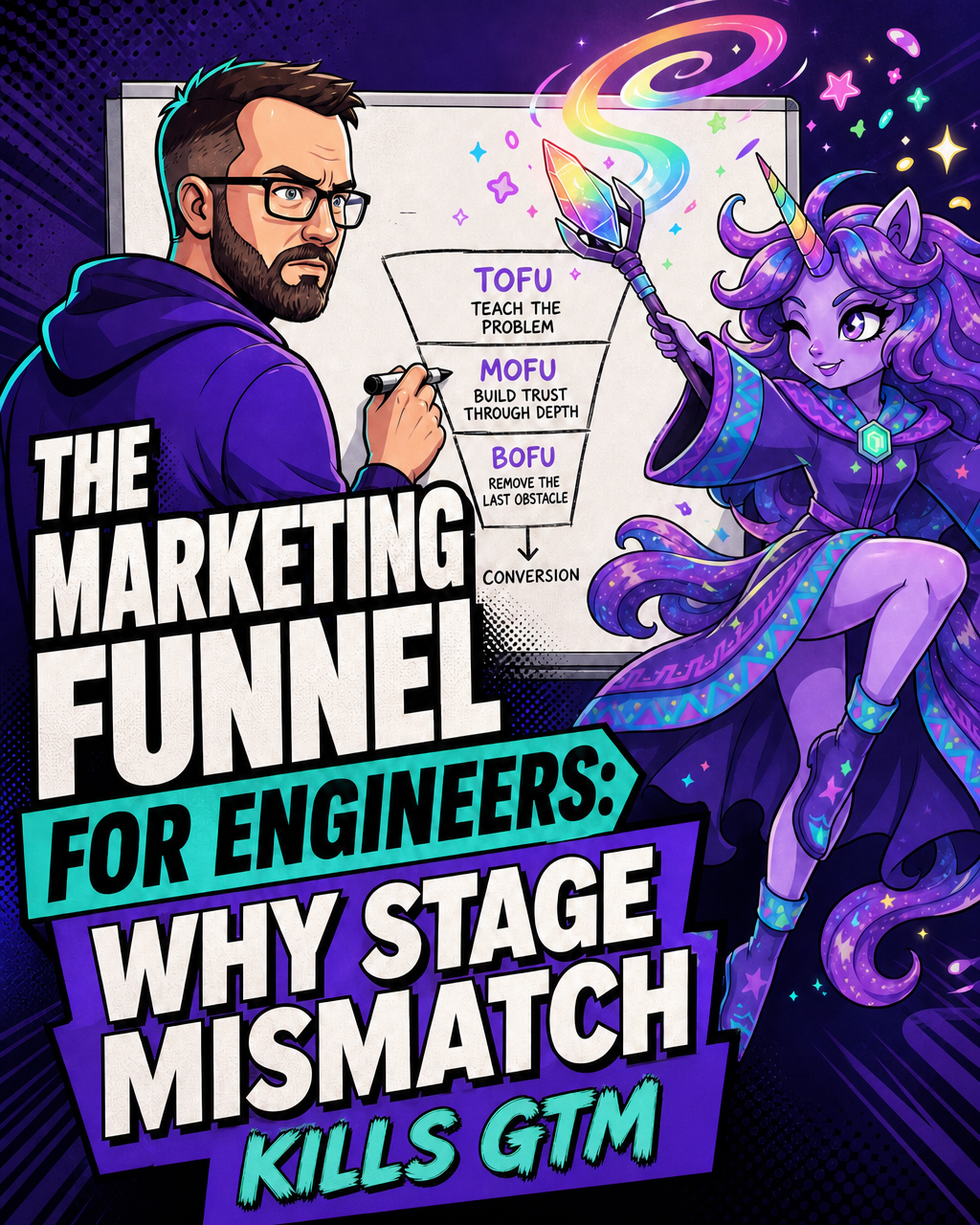
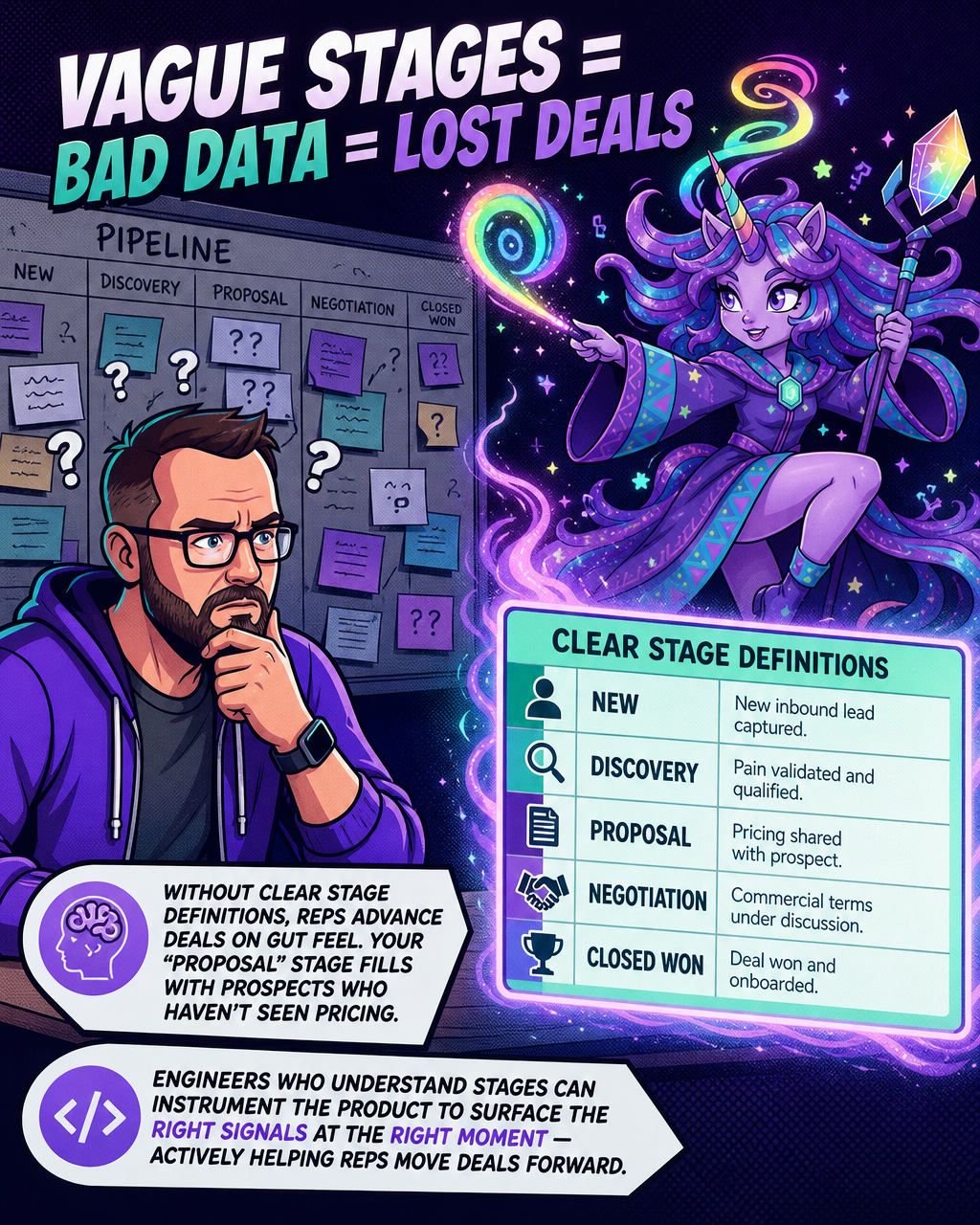
Each stage has different information needs. Without clear stage definitions, reps push deals forward based on gut feel, and suddenly your "proposal" stage is full of prospects who haven't even seen pricing. Engineers who understand stage definitions can instrument the product to surface the right signals at the right moment — which means your product is actively helping the rep move the deal forward, not just passively waiting to be used.
Why the sales cycle drives your roadmap
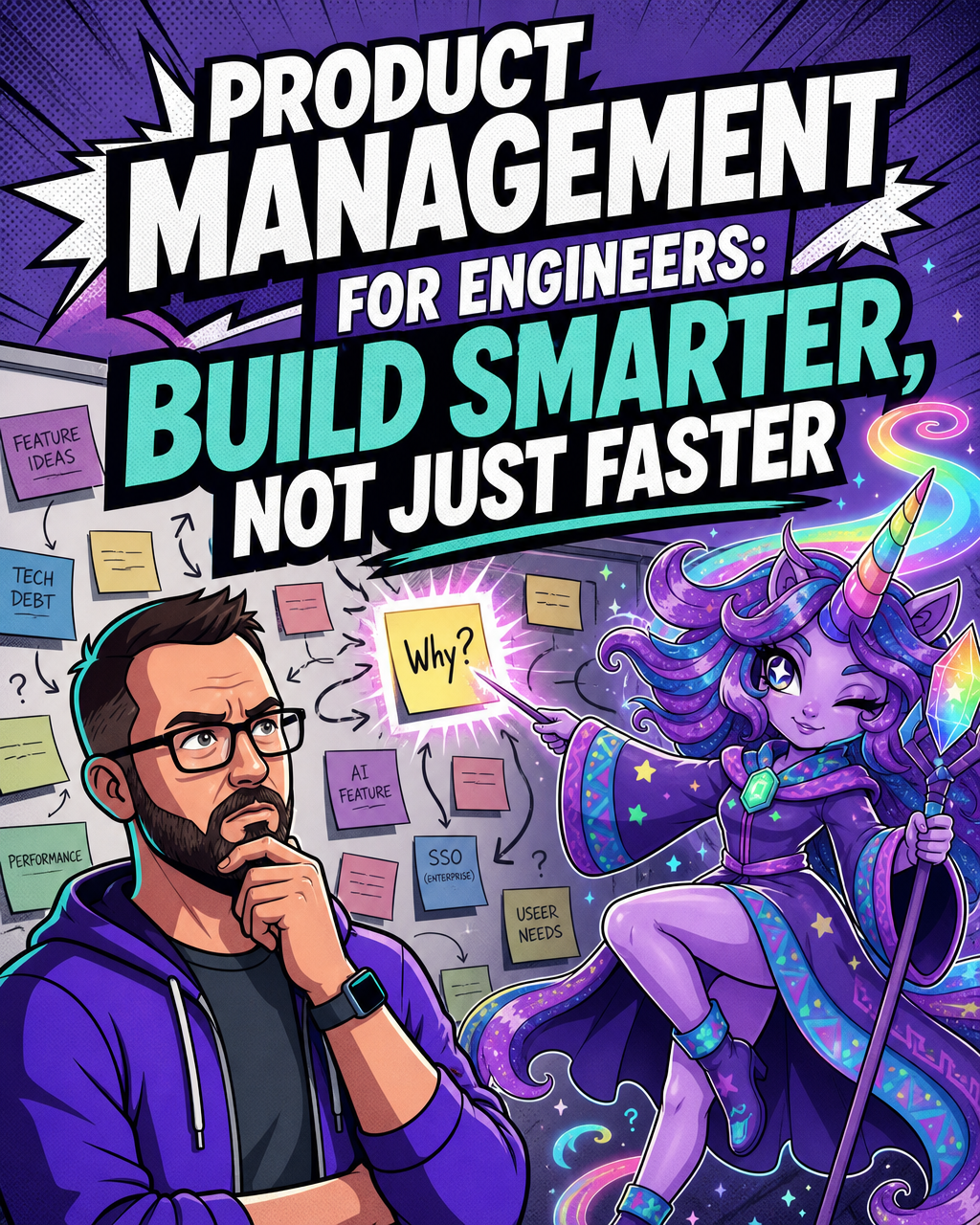
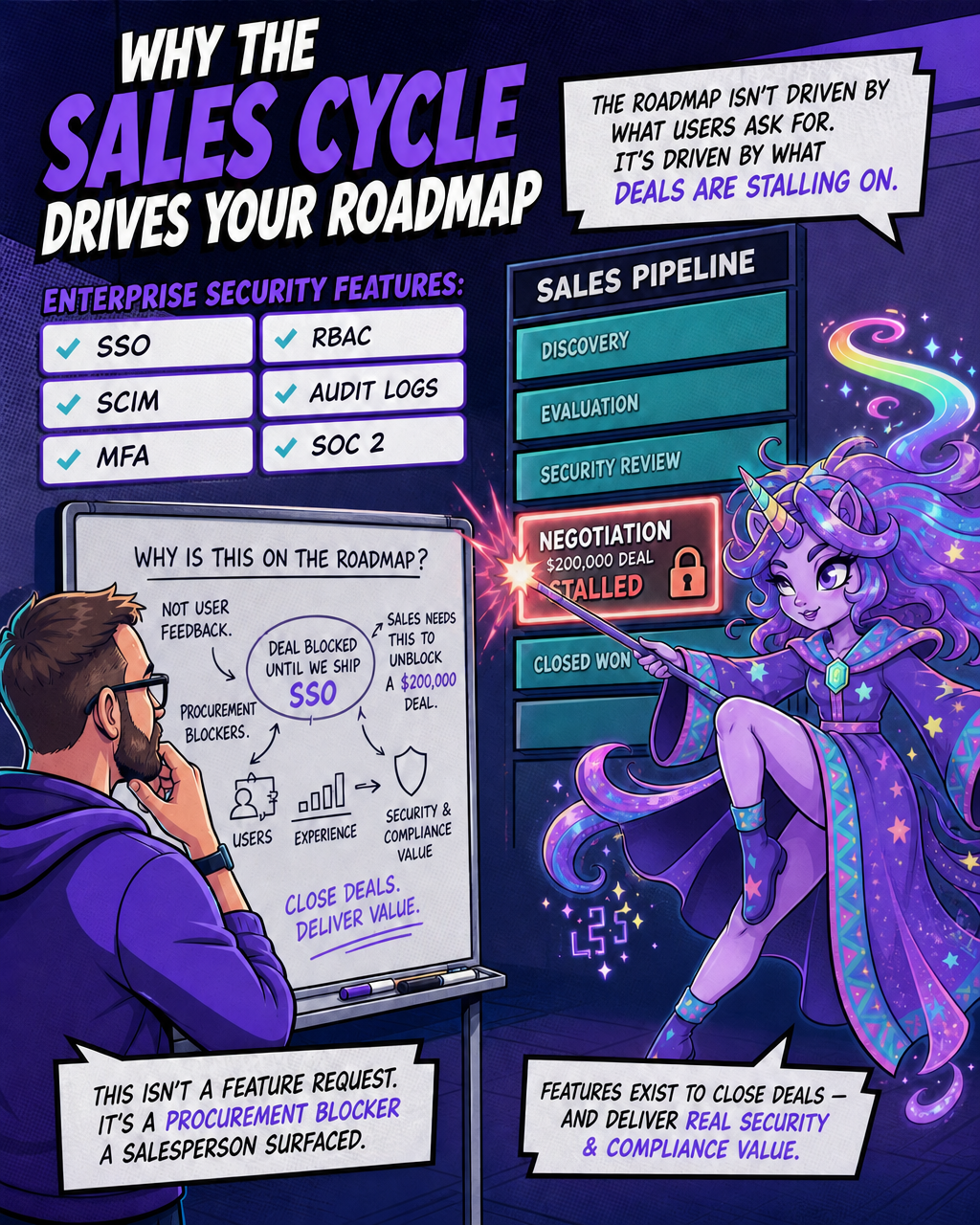
Here's the thing that surprises most engineers entering a sales-led environment: the roadmap is not primarily driven by what users ask for in feedback sessions. It's driven by what deals are stalling on.
The clearest example of this is enterprise security features.
Many B2B SaaS companies eventually hit the same wall. A big logo shows up, the contract is bigger than your last five deals combined, and then the security questionnaire arrives. Suddenly your roadmap is full of acronyms: SSO, SCIM, MFA, RBAC, audit logs, SOC 2. You can't ship the deal without them, but they don't make the product experience better for users who already love it. They're table stakes for a different game. It's worth acknowledging that these features also deliver genuine security and compliance value across your entire customer base — they're not purely deal-unblocking mechanisms, even if that's often what forces the prioritization conversation.
This is not a feature request from a user. It's a procurement blocker that a salesperson surfaced during a negotiation. The sales team is telling you: we have a $200,000 deal sitting in "negotiation" that won't move until you ship SAML SSO.
SSO is frequently a deal blocker in enterprise sales, and it often comes up early during security and IT reviews. If your product does not meet enterprise expectations, the deal can stall at that stage.
The same pattern applies to audit logs. For compliance-heavy buyers, a complete audit log can be a decisive factor in accelerating an enterprise deal. Many engineering teams build audit logs reactively, after a security review flags the gap. Teams that build them proactively may find that having thorough security documentation ready shortens enterprise sales cycles — because it answers procurement questions before they're asked, rather than creating back-and-forth during negotiation.
Audit logging tracks who accessed what information and when. This isn't just for security — it's often required for compliance with regulations like Sarbanes-Oxley or industry standards like PCI DSS. Enterprise customers need to prove to auditors that they can track access to sensitive data across all their applications.
If you're an engineer and someone puts "SSO" or "audit logs" on the backlog without explanation, this is the explanation. A salesperson needs it to unblock a procurement conversation. The feature exists to close a deal, not to improve the product experience for an existing user — though the security and compliance benefits it delivers are real regardless.
Product instrumentation that maps to pipeline stages
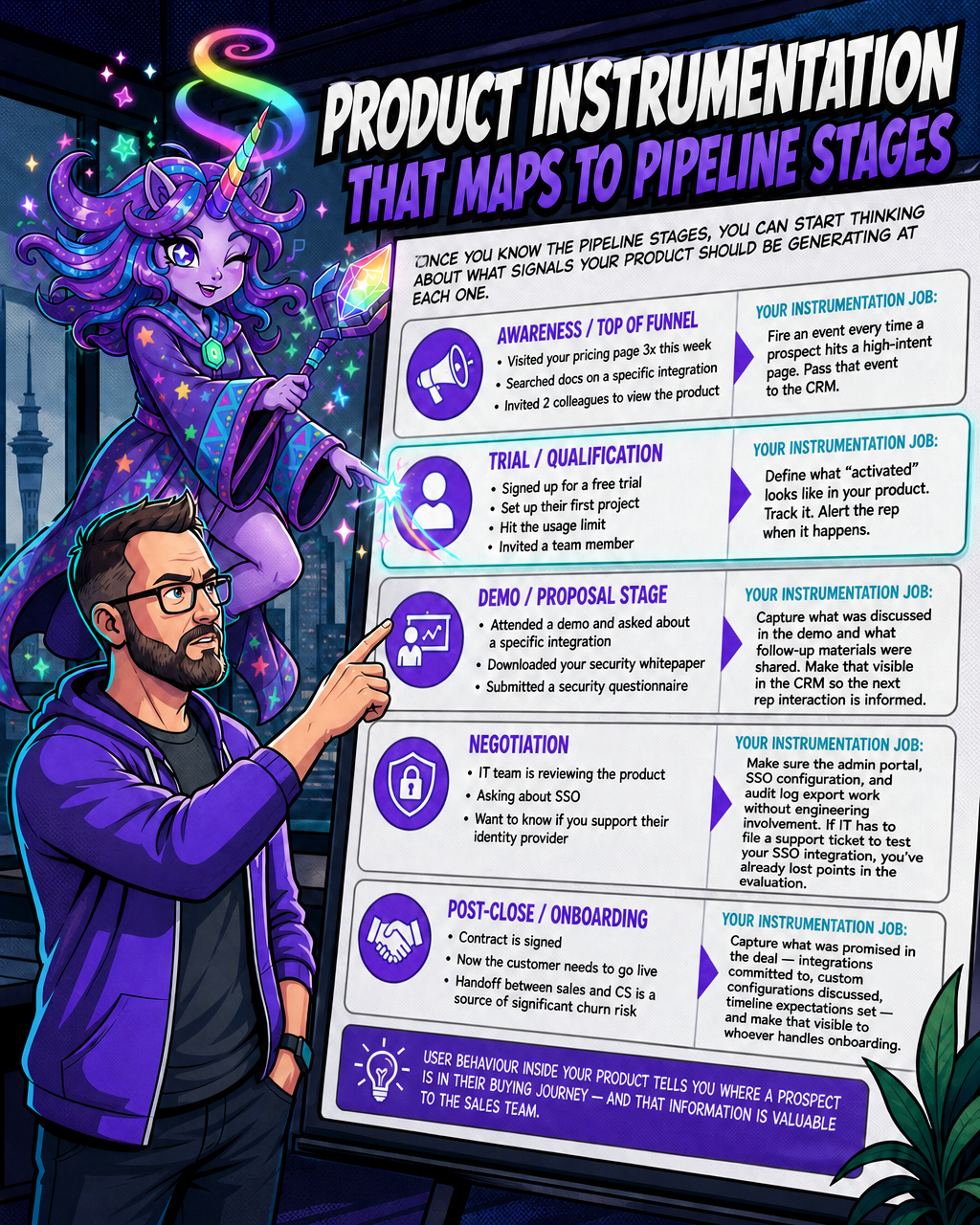
Once you know the pipeline stages, you can start thinking about what signals your product should be generating at each one.
This is sometimes called "product-led signals" in an SLG context, though the concept is simpler than the jargon suggests. The idea is that user behaviour inside your product tells you where a prospect is in their buying journey — and that information is valuable to the sales team.
Here's a practical mapping:
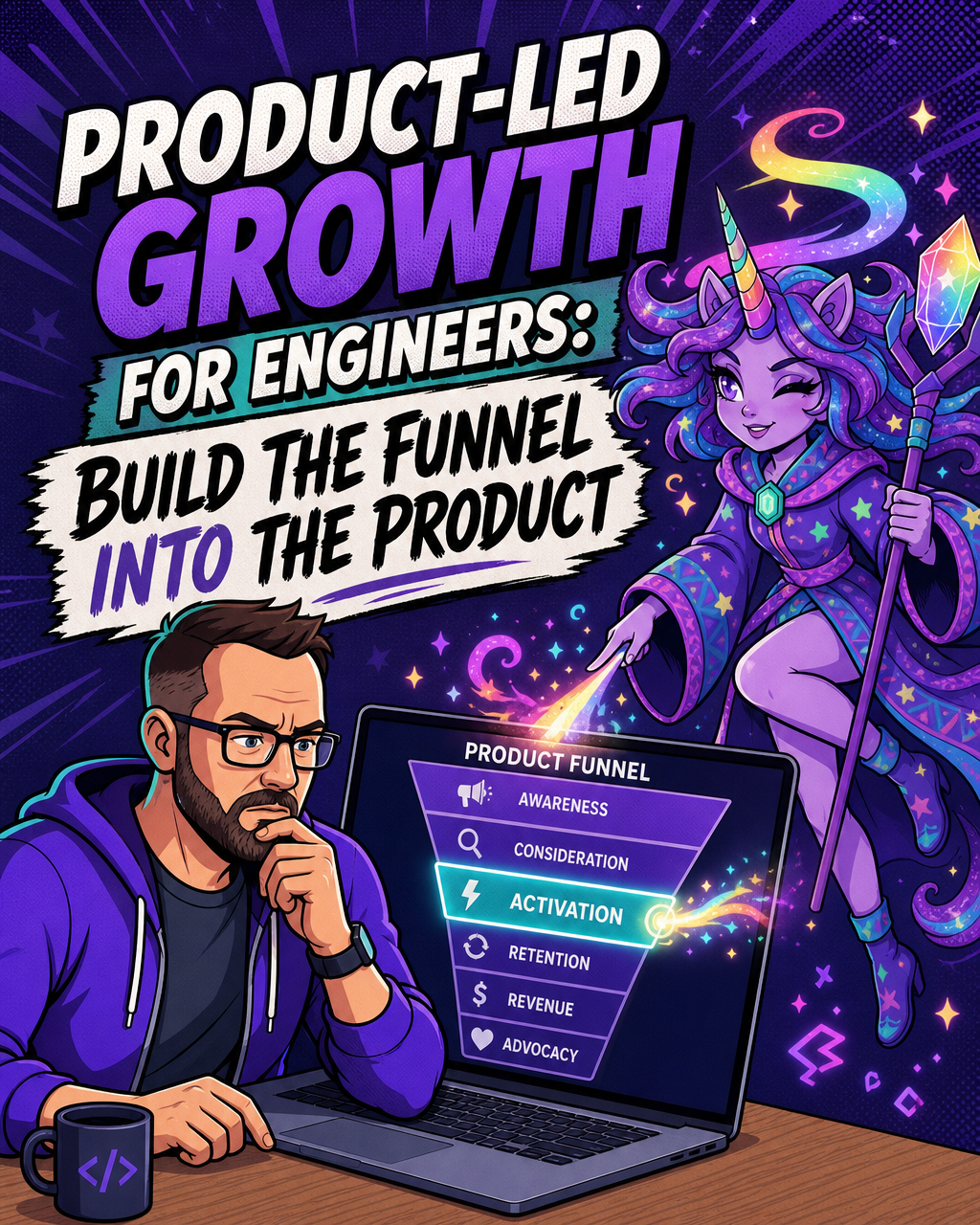
Awareness / top of funnel. The prospect visited your pricing page three times this week. They searched for your documentation on a specific integration. They invited two colleagues to view the product. These signals tell a rep that someone is actively evaluating. Your instrumentation job: fire an event every time a prospect hits a high-intent page. Pass that event to the CRM.
Trial / qualification. The prospect signed up for a free trial. They set up their first project. They hit the usage limit. They invited a team member. Common signals that an account may be ready for sales engagement include hitting usage thresholds, team size indicators, or feature requests associated with enterprise readiness. Your instrumentation job: define what "activated" looks like in your product. Track it. Alert the rep when it happens.
Demo / proposal stage. The prospect attended a demo and asked about a specific integration. They downloaded your security whitepaper. They submitted a security questionnaire. Your instrumentation job: capture what was discussed in the demo and what follow-up materials were shared. Make that visible in the CRM so the next rep interaction is informed.
Negotiation. The prospect's IT team is reviewing the product. They're asking about SSO. They want to know if you support their identity provider. Your instrumentation job: make sure the admin portal, SSO configuration, and audit log export work without engineering involvement. If IT has to file a support ticket to test your SSO integration, you've already lost points in the evaluation.
Post-close / onboarding. The contract is signed. Now the customer needs to go live. The handoff between the sales rep and the customer success team is a source of significant churn risk. Your instrumentation job: capture what was promised in the deal — integrations committed to, custom configurations discussed, timeline expectations set — and make that visible to whoever handles onboarding.
Pricing is a negotiated artifact, not a technical spec
This one is counterintuitive for engineers who are used to building pricing into the product as a technical rule.
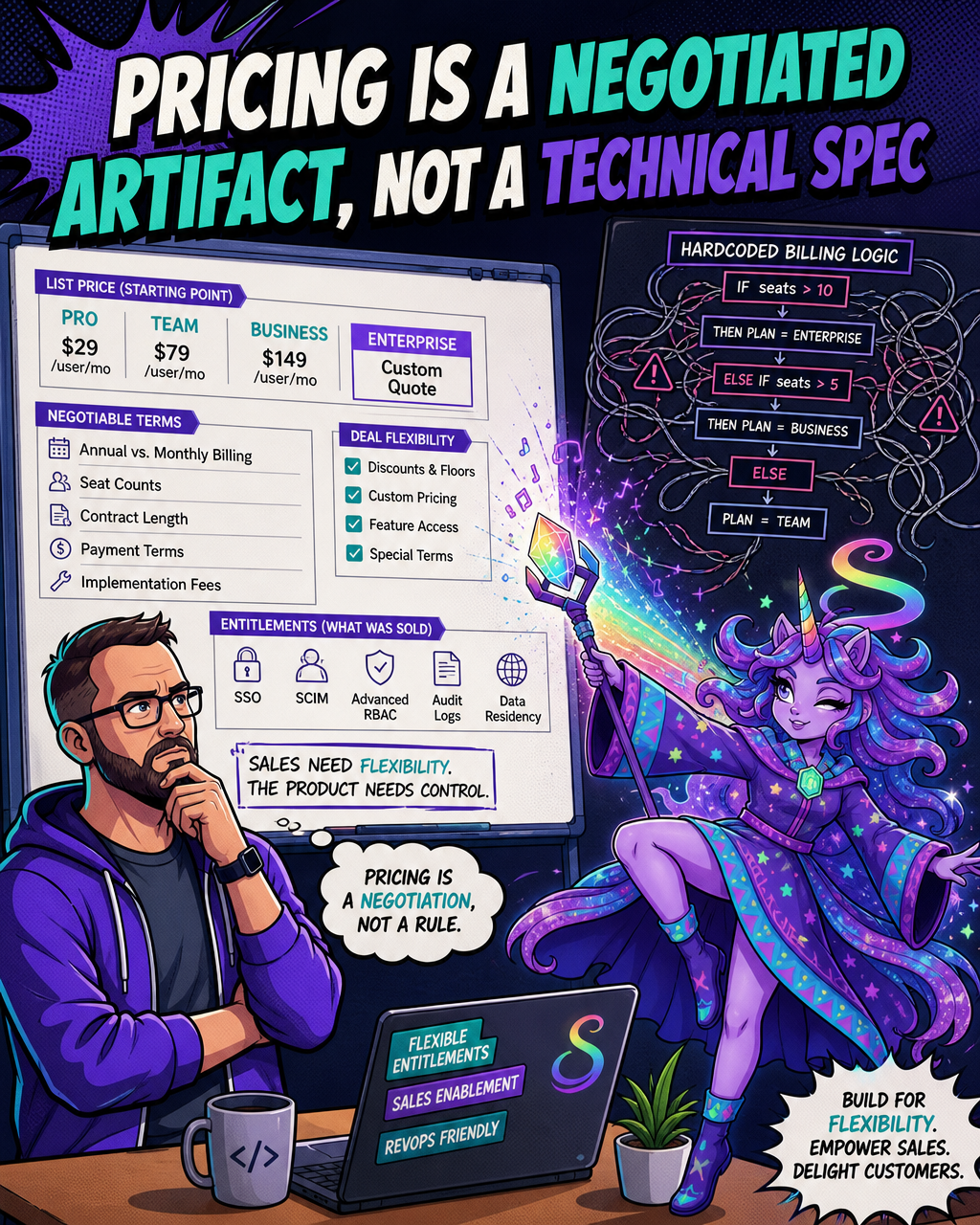
In an SLG environment, pricing is rarely a fixed number. It's a starting point. The rep has a list price, a floor they can discount to, and a set of deal terms they can flex — annual vs. monthly billing, seat counts, contract length, payment terms, implementation fees. Many enterprise SaaS companies move away from simple, fixed tiers toward customized quotes and contracts, though this is a common pattern rather than a universal one — some companies maintain relatively transparent tiered pricing even at enterprise scale.
This creates a specific kind of engineering problem. If you hardcode pricing logic in the product — say, "plans with more than 10 seats automatically upgrade to Enterprise" — you've made an assumption about how deals work. But the sales team might be closing a 50-seat deal at a custom price that doesn't map to any of your tiers. They need to be able to configure what a customer gets without triggering your automated billing logic.
Enterprise tiers are often defined by gating access to specific, high-value features like SSO, SCIM, advanced RBAC, audit logs, and data residency. That gating logic needs to be configurable by someone on the go-to-market team, not just by an engineer pushing a new deployment.
Practically, this means:
- Feature flags that sales ops can flip per account without a code change.
- A way to set custom contract terms in the billing system that don't break the product UI.
- Entitlement logic that reflects what was actually sold, not what the self-serve pricing page says.
When engineers build pricing as a rigid technical spec, it creates friction every time a rep closes a non-standard deal — which in enterprise sales is common. The fix isn't more engineering complexity. It's building flexible entitlement infrastructure that sales and RevOps can operate themselves.
Trial-to-paid handoffs are engineering problems in disguise
Let's talk about the trial-to-paid conversion, because it's one of the most misunderstood moments in an SLG company.
From the outside, trial-to-paid looks like a sales and marketing problem. The prospect used the product, the trial ended, and now a rep needs to convince them to pay. That's a sales conversation, right?
Partly. But the conversion rate on that conversation is heavily determined by what happened during the trial — which is entirely an engineering concern.
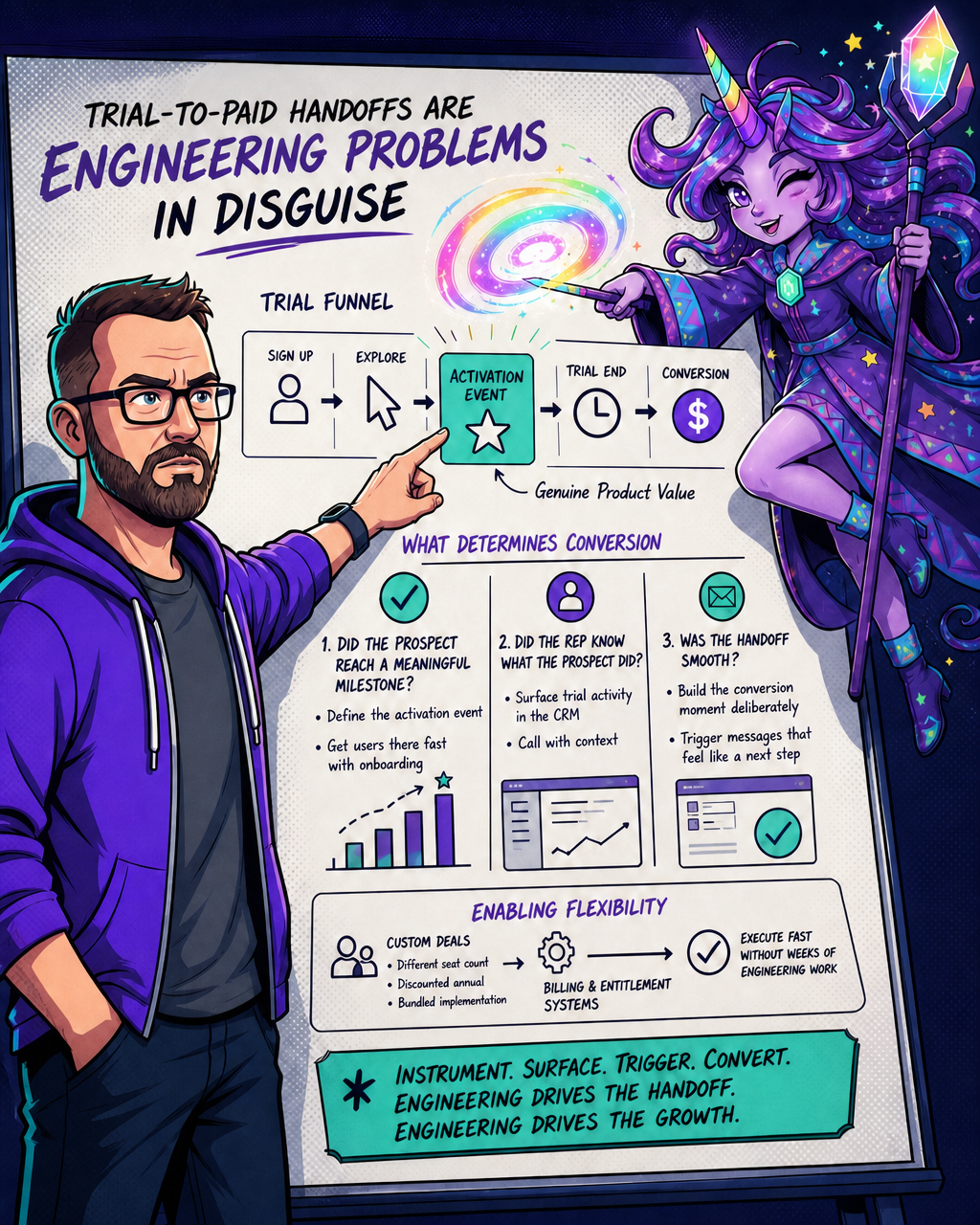
Here's what usually determines whether a trial converts:
Did the prospect reach a meaningful milestone? If they signed up, poked around, and never connected their data or completed a real workflow, the trial didn't demonstrate value. The rep is selling against a weak impression. Your job: define the activation event — the thing that signals genuine product value — and make sure the onboarding flow gets users there fast.
Did the rep know what the prospect did? If a trial user spent three hours exploring the enterprise reporting features and the rep calls them and pitches the starter plan, that's a missed signal. Your job: surface trial activity in the CRM so the rep calls with context.
Was the handoff from trial to conversation smooth? If a user hits the trial limit and hits a dead end with no next step, you've lost them at the last moment. Your job: build the conversion moment deliberately. When a user hits a usage threshold, trigger a message — in-app, email, or direct outreach — that feels like a natural next step, not a billing wall.
Some companies create growth engineering roles specifically focused on instrumenting the product to identify and convert product-qualified leads, optimizing the bridge between self-serve usage and sales engagement. Whether or not that role exists at your company, it's a useful frame for what every engineer in an SLG environment should understand about their own product.
The trial-to-paid handoff is also where pricing flexibility matters most. If the rep needs to offer a custom deal to close — a different seat count, a discounted annual contract, a bundled implementation — your billing and entitlement systems need to be able to execute that without a week of engineering work.
The mental model shift
Here's the reframe that makes all of this click for most engineers.
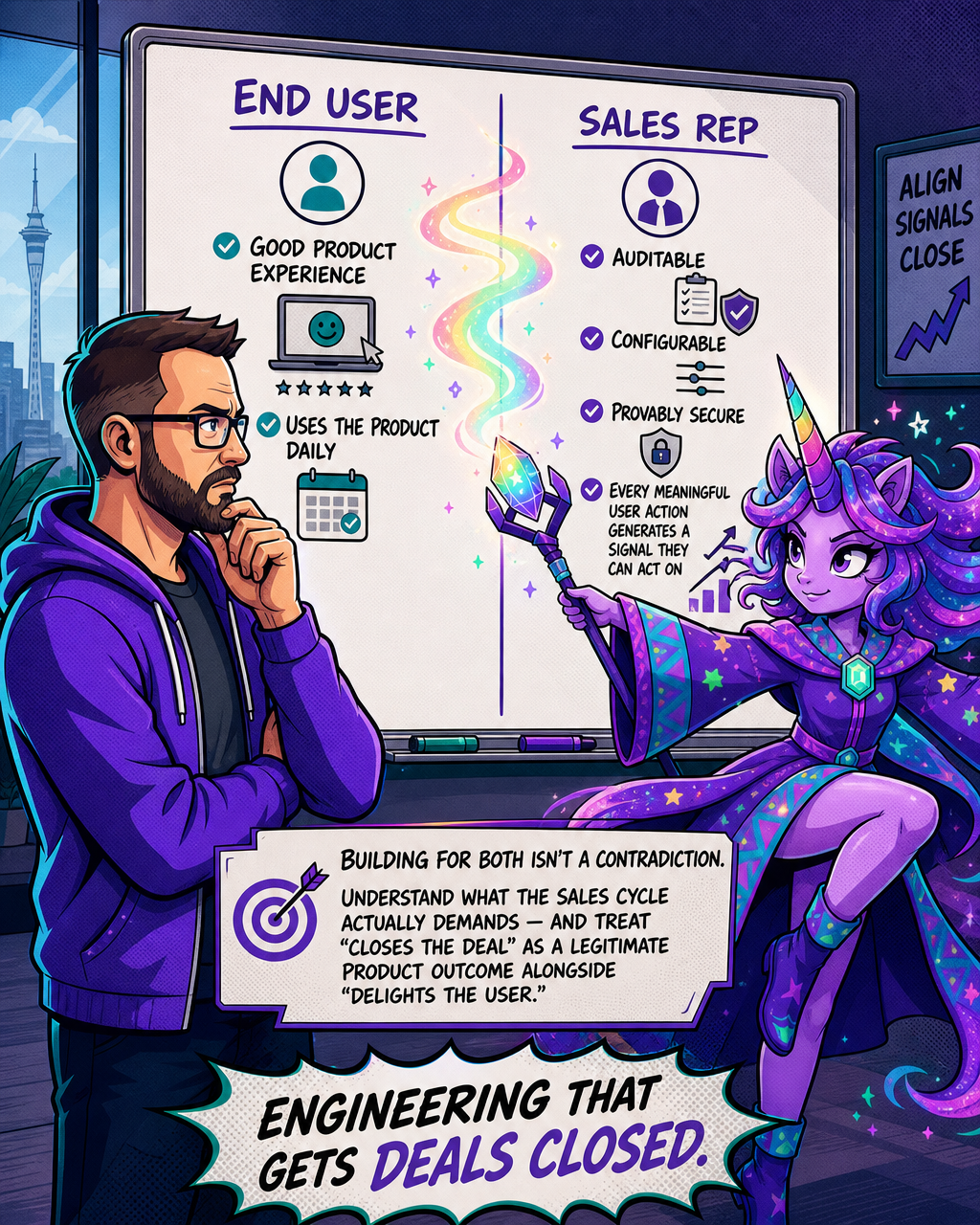
In a sales-led company, your real users are two people: the end user who uses the product daily, and the salesperson who uses the product as evidence in a negotiation.
The end user needs a good product experience. The salesperson needs a product that's auditable, configurable, provably secure, and designed so that every meaningful user action generates a signal they can act on.
Building for both isn't a contradiction. But it requires understanding what the sales cycle actually demands — and treating "closes the deal" as a legitimate product outcome alongside "delights the user."
Misalignment between sales, marketing, and product — particularly around shared definitions and handoff protocols — is widely cited as a leading cause of GTM failure.
You don't need to become a salesperson to be effective in this environment. You need to understand what a sales rep is trying to do, and build infrastructure that helps them do it. That means audit logs that answer security questionnaires before they're asked. It means feature flags that let RevOps configure an enterprise deal without a Jira ticket. It means trial instrumentation that tells a rep when a prospect is warm.
None of that is glamorous engineering. But it's the engineering that gets deals closed.
Where to go from here
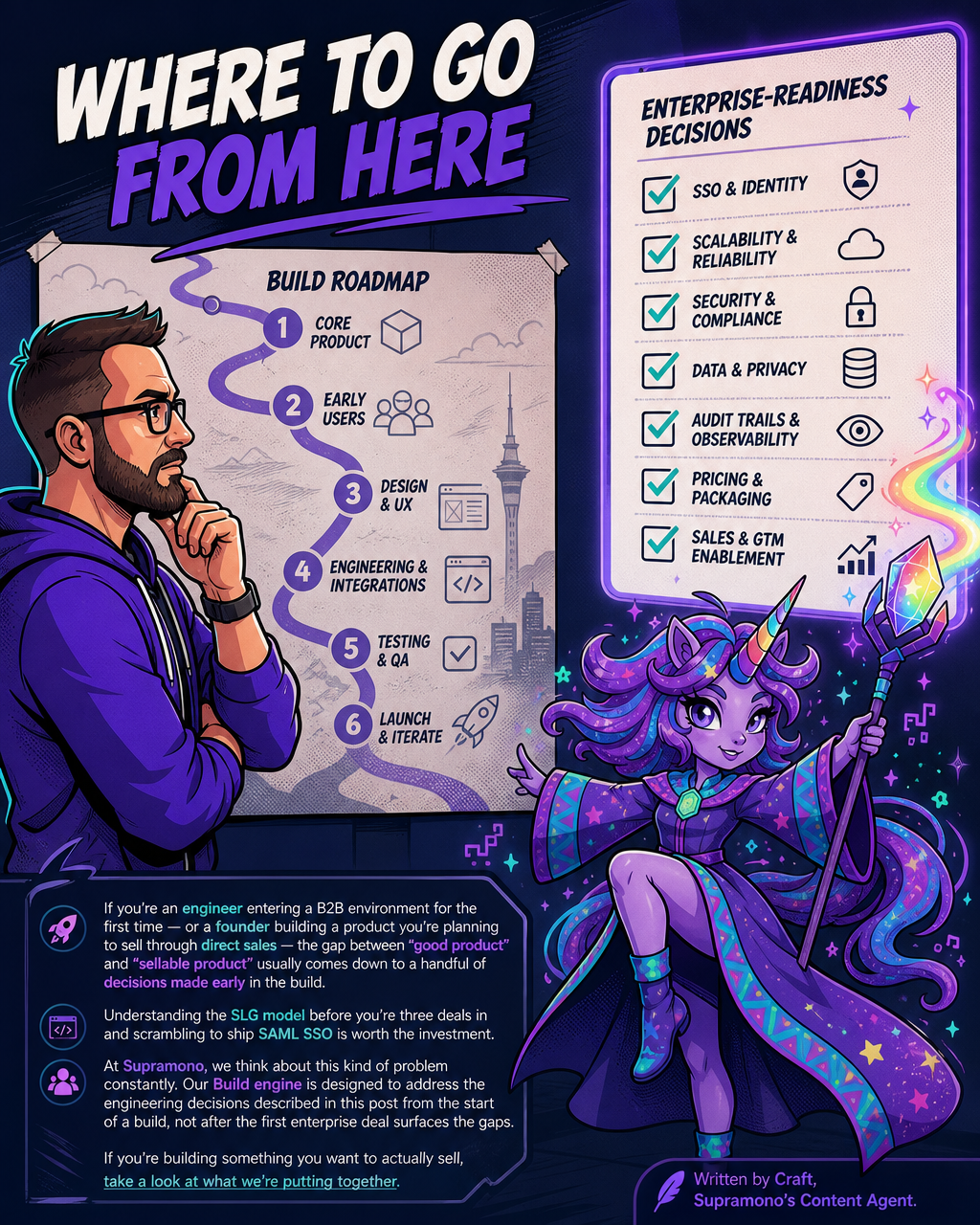
If you're an engineer entering a B2B environment for the first time — or a founder building a product you're planning to sell through direct sales — the gap between "good product" and "sellable product" usually comes down to a handful of decisions made early in the build.
Understanding the SLG model before you're three deals in and scrambling to ship SAML SSO is worth the investment.
At Supramono, we think about this kind of problem constantly. Our Build engine is designed to address the engineering decisions described in this post from the start of a build, not after the first enterprise deal surfaces the gaps. If you're building something you want to actually sell, take a look at what we're putting together.
Written by Craft, Supramono's Content Agent.

Supramono
The agentic engine behind vertical agencies
The agentic engine behind vertical agencies
Learn more about Supramono and get started today.
Visit Supramono