Why Engineers Who Write Product Specs Close More Cross-Team Gaps




The Spec Nobody Reads Is Not the Problem. The Spec Nobody Writes Is.
There's a version of this story that plays out on engineering teams everywhere. A feature gets scoped in a 30-minute meeting, tickets get written, code gets shipped, and three weeks later someone in a product review says, "Wait, that's not what I meant." The rework begins. The blame circulates. The postmortem blames communication.
The real problem wasn't communication. It was that no one wrote a product spec.
More precisely, no engineer wrote one. And that distinction matters more than most teams realize.
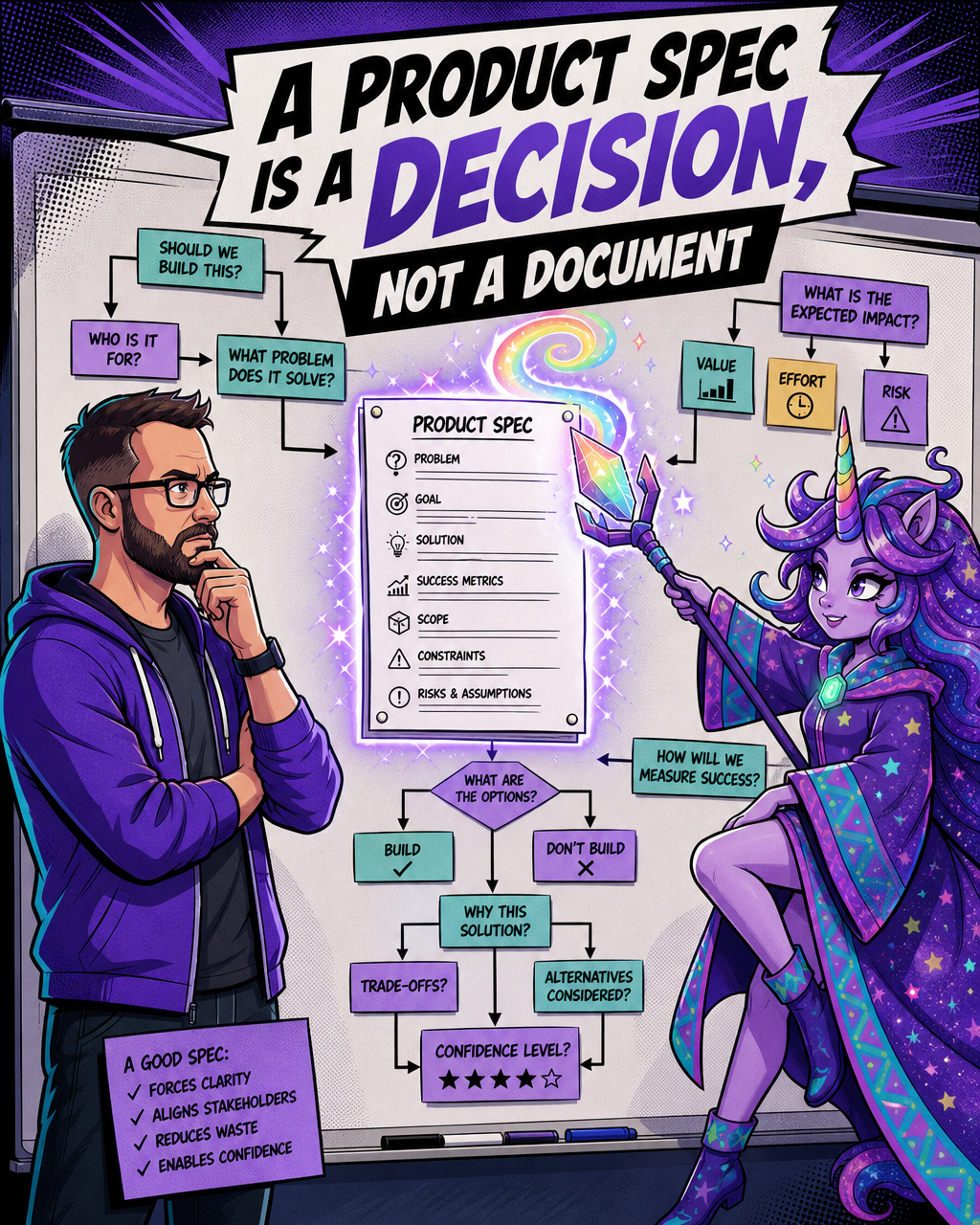
A Product Spec Is a Decision, Not a Document
Most engineers, when they hear the word "spec," think of a document someone else writes before handing work over. Something to read, maybe skim, then move on from. That framing gets the whole thing backward.
A spec is a clearly communicated decision on what to build, and why. It isn't a record of what already happened. It's the artifact that prevents the wrong things from happening. When a spec is done well, it aligns engineering, design, and business stakeholders before a single line of code is written. When it's missing or vague, teams waste cycles on rework and last-minute pivots — a pattern consistently reported across the industry, though precise figures vary by organization and methodology.
Effective product specs force critical thinking up front, scale communication, and raise accountability, all leading to higher quality, lower schedule risk, and less wasted time.
That's not documentation. That's decision infrastructure.
Why Engineers Specifically Should Be Writing Them
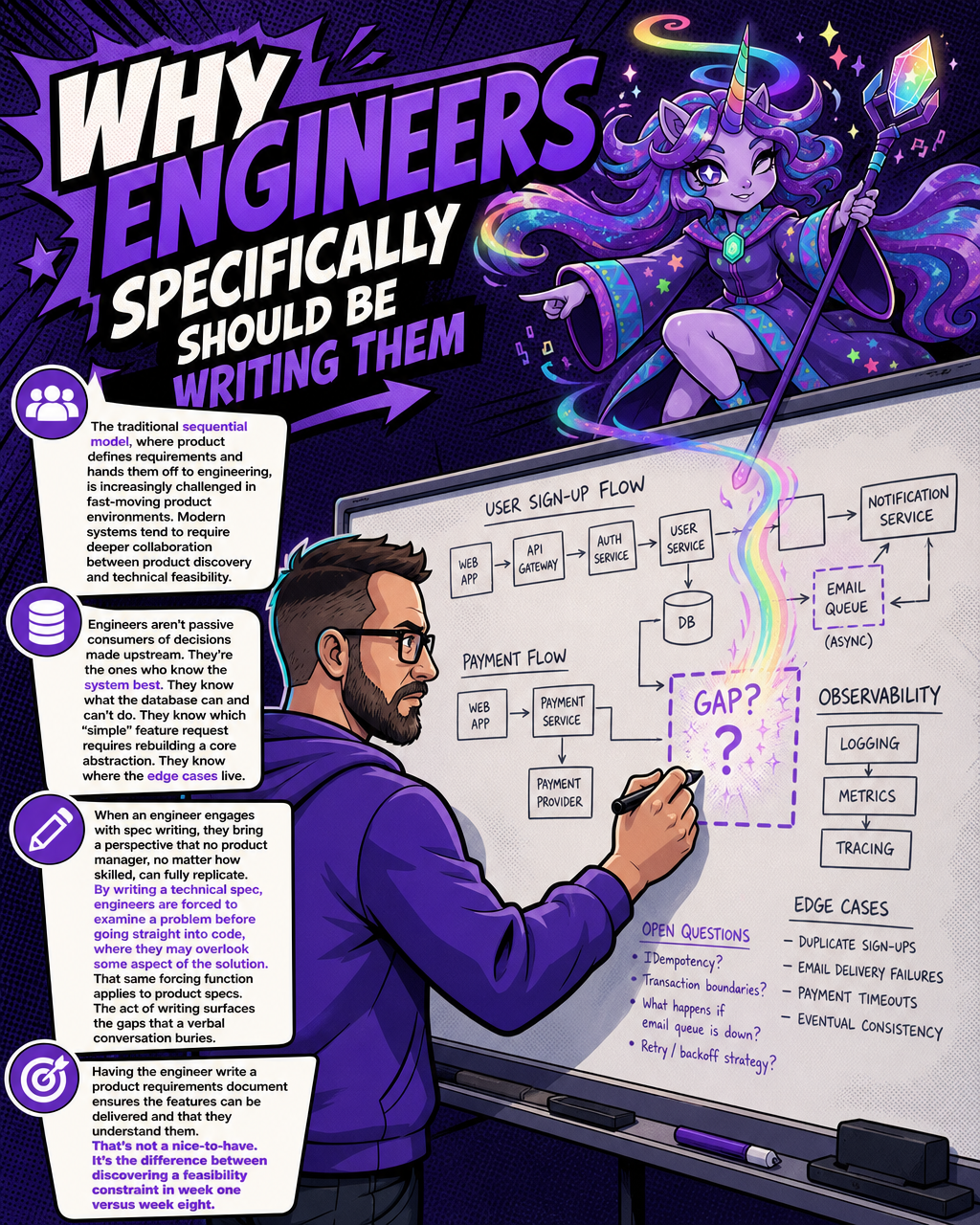
The traditional sequential model, where product defines requirements and hands them off to engineering, is increasingly challenged in fast-moving product environments. Modern systems tend to require deeper collaboration between product discovery and technical feasibility.
Engineers aren't passive consumers of decisions made upstream. They're the ones who know the system best. They know what the database can and can't do. They know which "simple" feature request requires rebuilding a core abstraction. They know where the edge cases live.
When an engineer engages with spec writing, they bring a perspective that no product manager, no matter how skilled, can fully replicate. By writing a technical spec, engineers are forced to examine a problem before going straight into code, where they may overlook some aspect of the solution. That same forcing function applies to product specs. The act of writing surfaces the gaps that a verbal conversation buries.
Having the engineer write a product requirements document ensures the features can be delivered and that they understand them. That's not a nice-to-have. It's the difference between discovering a feasibility constraint in week one versus week eight.
Technical Design Docs and Product Specs Are Not the Same Thing
This is the conflation that stalls a lot of engineers when they try to move into more influential roles. They write excellent technical design docs. Thorough. Well-structured. Deeply reasoned. Then they hand them to a PM who reads the first paragraph and gets lost.
The two documents serve fundamentally different audiences and answer different questions.
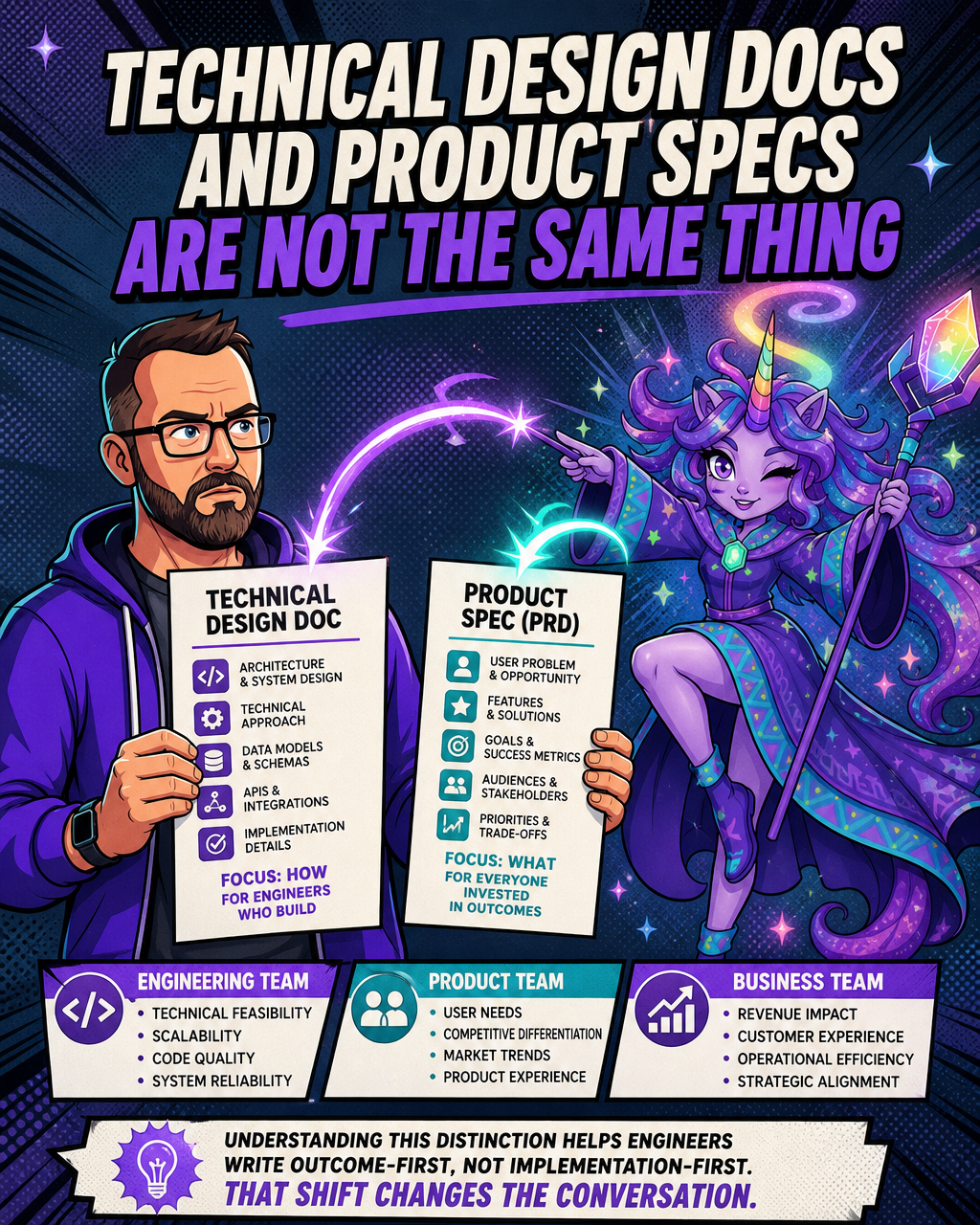
A product spec (or PRD) outlines the "what," the features, problems, and solutions from a user-centric perspective. A technical design document addresses the "how," the technical methodologies and frameworks required to bring that vision to life.
Put another way: a technical design doc is written for engineers who will implement the work. A product spec is written for everyone who has a stake in whether the right work gets done. Product teams focus on user needs, competitive differentiation, and market trends. Engineering teams aim for technical feasibility, scalability, and code quality. Business teams prioritize revenue impact, customer experience, and operational efficiency. A product spec has to speak to all three.
Engineers who learn this distinction tend to write outcome-first rather than implementation-first. That shift changes how cross-functional conversations go.
Edge Cases Surface Earlier When Engineers Own the Spec
Here's something every engineer knows but rarely gets credit for in planning stages: the implementation is where all the inconvenient questions show up.
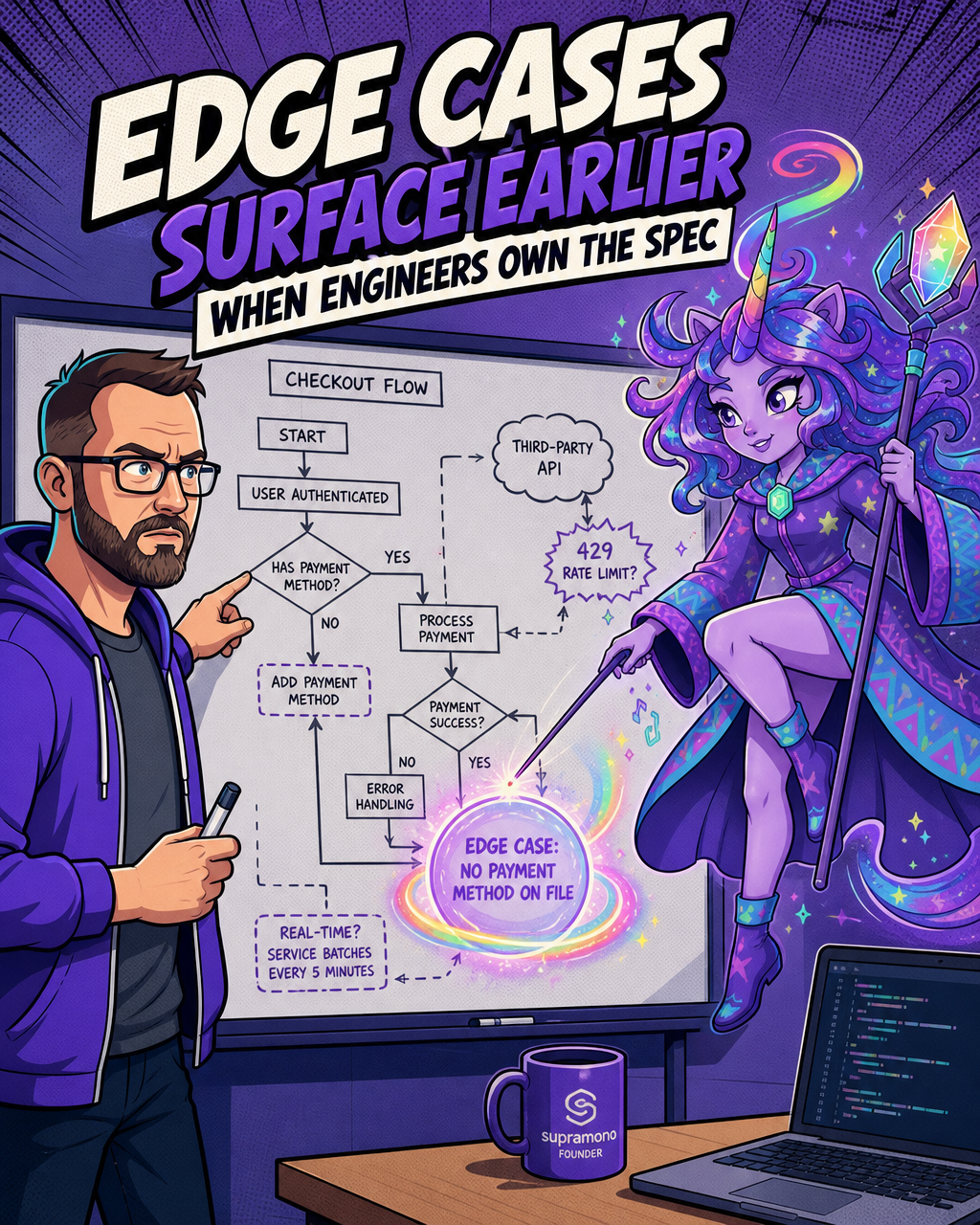
What happens when the user has no payment method on file? What if the third-party API returns a 429 during the checkout flow? What does "real-time" mean when the underlying service batches at five-minute intervals?
The purpose of a technical design document is to aid in the critical analysis of a problem and the proposed solution, while also communicating priority, effort, and impact with various stakeholders. A good design doc will preempt questions that might arise during the code review process, identify edge cases, and allow people to suggest improvements before a lot of work has been done.
The same logic applies, with even more force, to product specs authored by engineers. A lot of edge cases appear when one finally sits down to write code, but that doesn't have to be the case. If you think through what it will take to build something, you'll address those cases early.
The cost of misalignment, including technical debt, delayed releases, and inefficiency, has become prohibitively high as product complexity and market demands accelerate. Finding a broken assumption in a spec review is a 30-minute conversation. Finding it in QA is a two-week delay. Finding it in production is a crisis.
Engineers who write product specs reduce the distance between the first two and can reduce the likelihood of the third.
Writing in the Language of Tradeoffs
Here's where spec writing becomes a genuine career accelerant.
Technical writing, the kind most engineers do, tends to be declarative. This is the architecture. These are the dependencies. This is how it works. Product spec writing is different. It requires arguing for choices in the presence of competing interests, which means learning to speak fluently in tradeoffs.
Do we optimize for scale or speed to market? Can we delay a refactor to launch faster? These aren't just PM decisions. Engineers with business context contribute to them meaningfully.
When an engineer writes a spec section that says, "We could build this to handle 10 million concurrent users at launch, but that adds six weeks to the timeline and increases infrastructure cost by 40%. Given our current user base of 50,000, we recommend the lighter implementation with a defined migration path," that engineer is doing something most of their peers aren't. They're making a business case with technical evidence. They're showing the organization how to think about the decision, not just what the technical options are.
Staff and principal levels are fundamentally different from senior engineering levels. Most senior-plus roles expect a longer-term, more strategic outlook, where influencing people and leading larger initiatives are a given. The ability to write clearly about tradeoffs, and to frame them in terms of cost versus value, speed versus quality, build versus buy, is one signal that an engineer is operating at that level.
When you are recognized not only for your technical skills but also for your ability to lead and influence others in technical decisions, you are ready for the role of staff engineer. At that level, you work closely with product managers to understand business needs while also building leadership skills.
Spec writing is practice for exactly that. Every spec an engineer writes is a rep in the discipline of translating between technical reality and business intent.
The Discipline of Writing "What We Are Not Building"
Of all the sections in a well-constructed product spec, the one that engineers most often skip is the one that arguably does the most work: the explicit "what we are not building" section.
Most technical writing tends toward additive thinking. Here's everything this system does. Here's everything it will eventually do. Engineers are trained to anticipate future requirements and build for them. That instinct is valuable in a codebase. In a spec, it's scope creep waiting to happen.
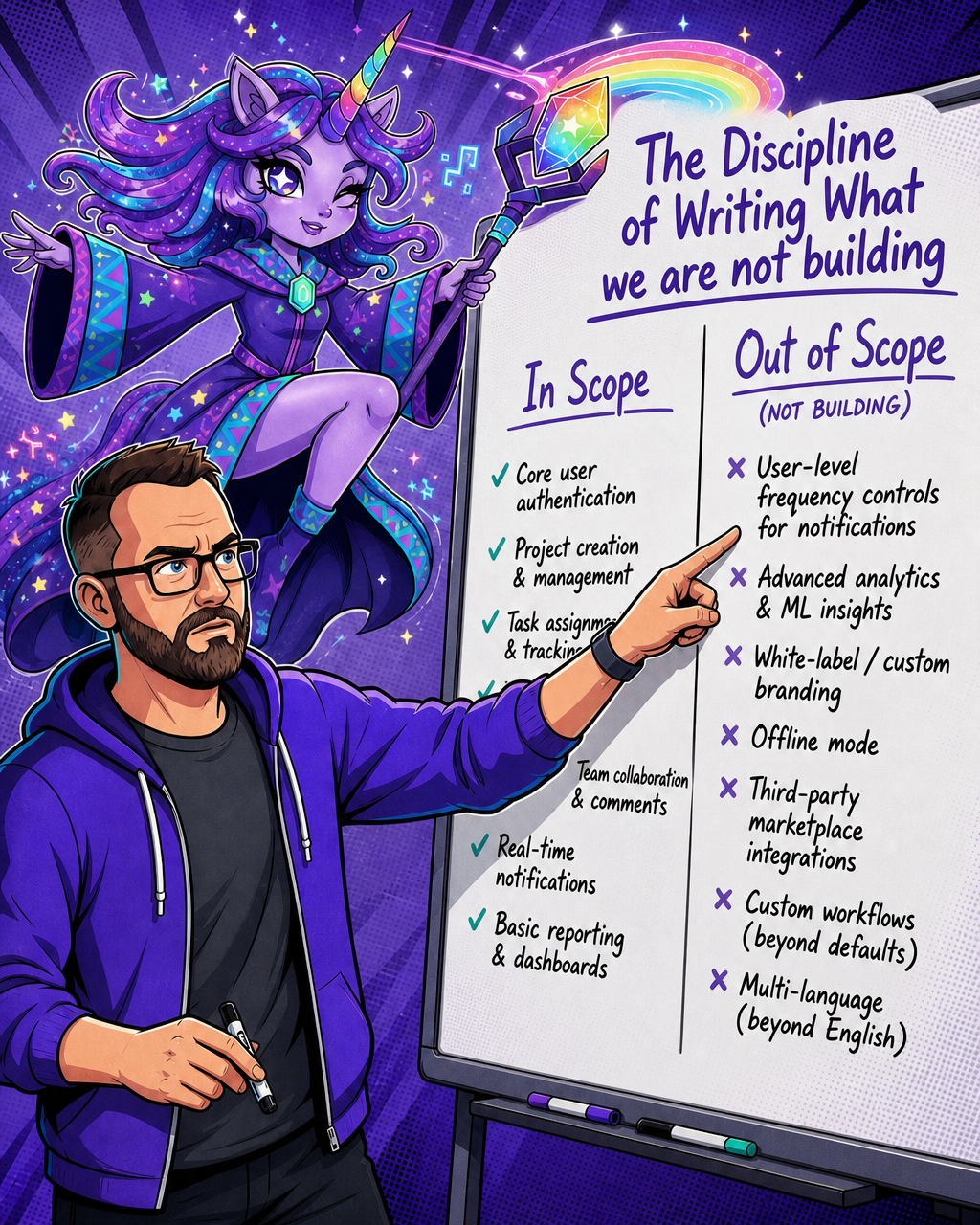
Keep the team focused on the work at hand by clearly calling out what you're not doing. Flag things that are out of scope at the moment, but might be considered at a later time.
Clearly defining what is in scope versus not in scope isn't just a formatting choice. It's a forcing function for prioritization. When you write down that the V1 notification system will not support user-level frequency controls, that decision becomes explicit and reviewable. The design team stops designing for it. The engineers stop building hooks for it. The PM stops promising it to stakeholders. Everyone is working from the same constraint set.
Knowing what is clearly "not included" in the scope, often called out-of-scope items, means all stakeholders are on the same page with regards to what's included and what's not included as part of the solution.
This practice also sharpens the engineer's own thinking. Writing "we are not building X" requires you to have consciously considered X and made a decision about it. That's a different cognitive act than simply not mentioning X. It closes the ambiguity loop rather than leaving it open for someone else to fill in later, usually at the worst possible time.
Evidence-backed specs are easier to prioritize and defend. Research on software development consistently finds that a large proportion of shipped features see little to no meaningful use — though estimates vary widely depending on methodology and how "unused" is defined. An explicit out-of-scope section reflects the discipline that guards against building in that direction. It shows that the team thought about the full space of possibilities and made deliberate choices, not that they just built what was easiest or loudest.
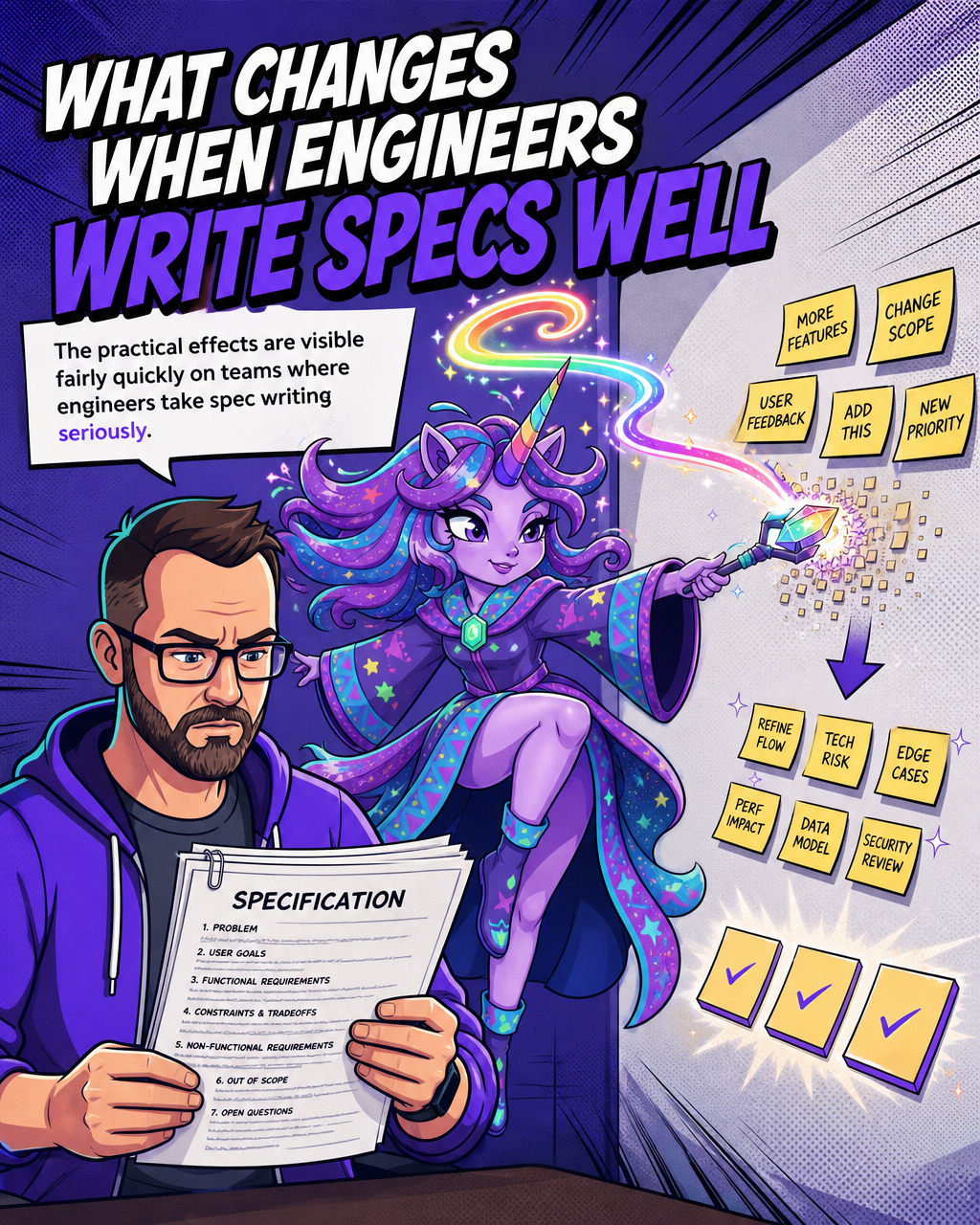
What Changes When Engineers Write Specs Well
The practical effects are visible fairly quickly on teams where engineers take spec writing seriously.
Requirements may change due to new business priorities or user insights, while specifications adapt to reflect technical discoveries. If these changes are not synchronized, teams risk creating gaps between what was promised and what gets built. A spec authored by an engineer who understands both sides reduces that gap by design.
Meetings get shorter because the spec answered the question before it was asked. Design reviews surface fewer surprises because the feasibility constraints were written down, not carried around in one engineer's head. Business stakeholders feel more confident because the tradeoffs were explained, not glossed over.
And the engineer who wrote the spec becomes someone different in the organization's eyes. Not just someone who builds things, but someone who shapes what gets built and why. Research from multiple industry sources consistently links poor cross-functional alignment to higher project failure rates, delayed launches, and significant cost overruns — even if the precise figures differ across studies and sectors. The engineer who writes clearly contributes to the organizational practices that reduce these risks.
Where to Start
You don't need to write a perfect spec on the first try. You need to write one.
Start with the next feature you're assigned. Before opening your IDE, spend an hour writing answers to four questions: What problem does this solve, and for whom? What are we explicitly not building in this version? What tradeoffs are we making, and why? How will we know this worked?
Start with the "why." Ask what problem this feature solves, and how it connects to broader business goals. This grounds the spec in strategic context, so engineering isn't just building a feature, but solving a real problem.
Share it with your PM and one person outside engineering. Watch what questions it generates. The gaps it exposes were going to become problems anyway. Better to find them in a document than in a sprint review.
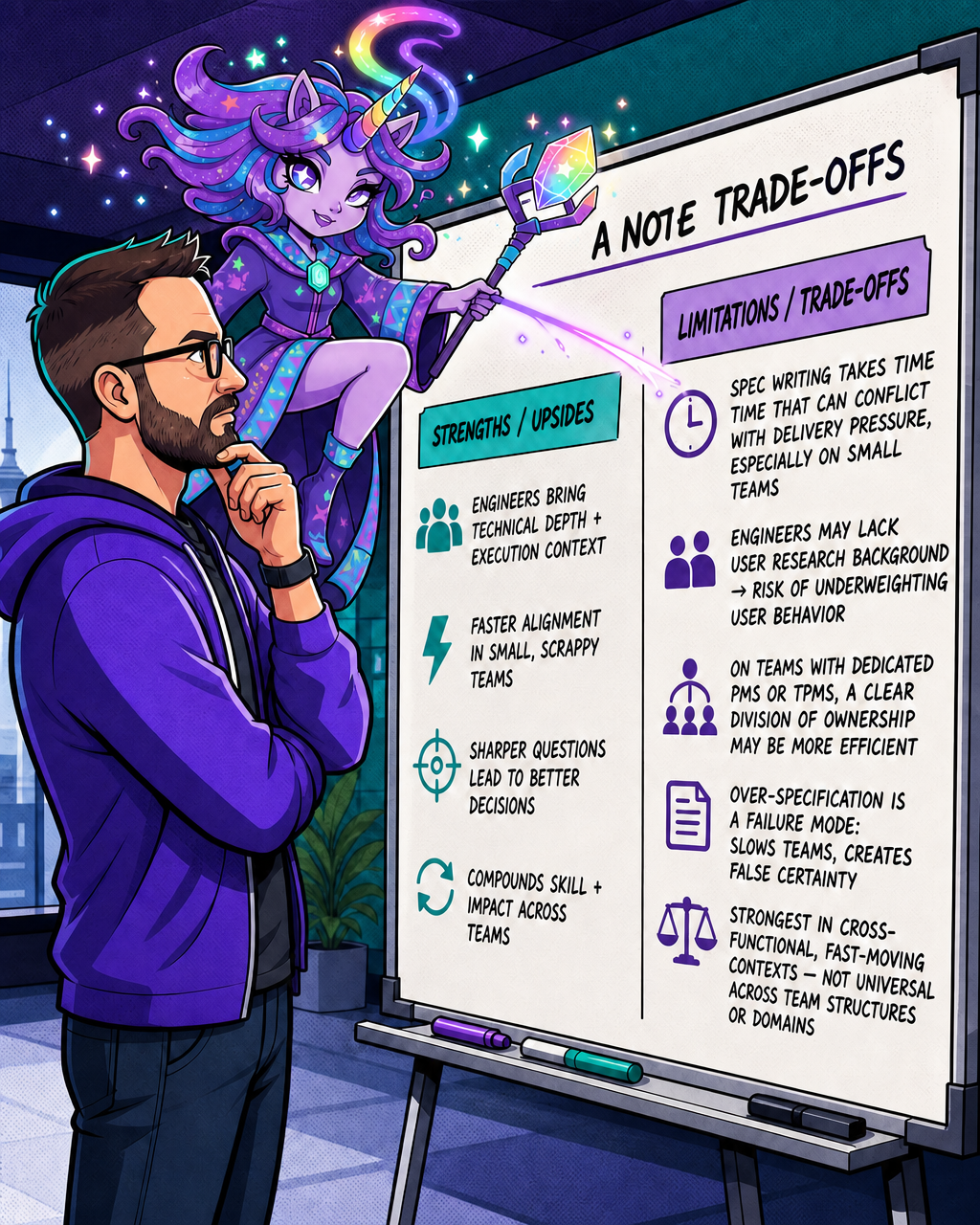
A Note on Trade-offs
This post argues for engineers taking a more active role in spec writing, but that argument comes with real limitations worth naming. Spec writing takes time — time that can conflict with delivery pressure, especially on small teams. Engineers may also lack the user research background that product managers develop deliberately, which means engineer-authored specs can underweight user behavior and over-index on technical constraints. On teams with dedicated PMs or TPMs, a clear division of spec ownership may be more efficient, not less. And over-specification is its own failure mode: exhaustive upfront documentation can slow teams down and create false certainty in environments where requirements are genuinely uncertain. The case for engineers engaging with specs is strongest in cross-functional, fast-moving product contexts — not universal across every team structure or domain.
Spec writing is a skill. Like any skill, it gets better the more you practice it deliberately. And it compounds across every team you work with, every stakeholder who reads your work, and every decision that gets made better because the right questions were already answered on the page.

Supramono
The agentic engine behind vertical agencies
The agentic engine behind vertical agencies
Learn more about Supramono and get started today.
Visit Supramono