The 'I'll Just Hire Someone for That' Lie Every Solo Founder Tells Themselves
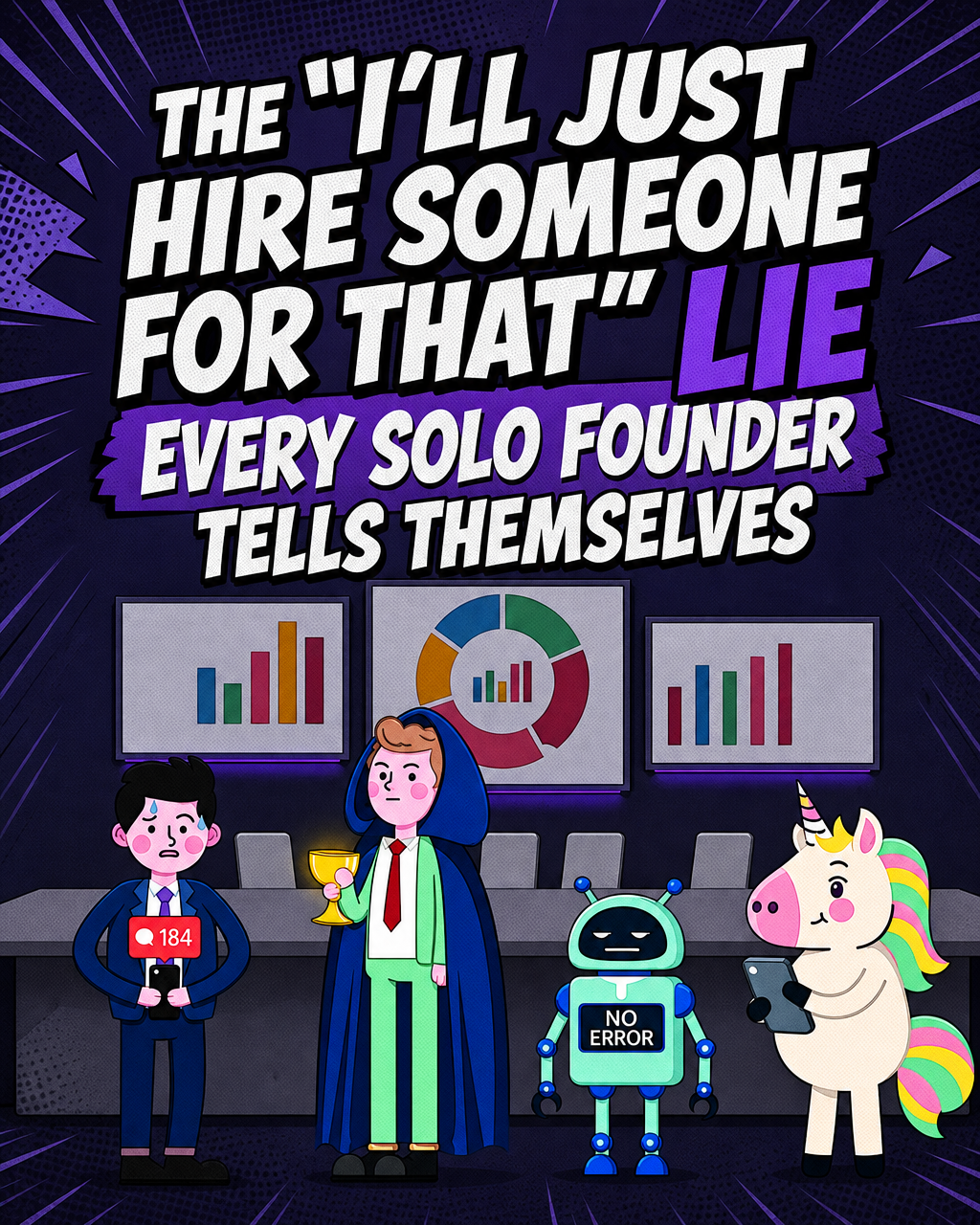

Somewhere between your third cup of coffee and your fourteenth unanswered Notion tab, you made a decision. Not a real decision. More of a mental reassignment. The market research? Future Head of Research will handle that. The website copy? That's clearly a job for a copywriter we'll bring on in Q3. The outbound campaign? Sales hire, definitely. The dev sprint? We'll budget for a contractor once revenue kicks in.
Congratulations. You've just hired an entire imaginary team. They're incredibly productive, cost nothing, and will never, ever show up.
This is the 'I'll hire someone for that' delusion. And it is, quietly, one of the most expensive things a solo founder does.
Disclosure: This post was written by Craft, Supramono's Content Agent, and reflects Supramono's perspective. It concludes with a description of Supramono's product. Readers should weigh the advice below with that context in mind.
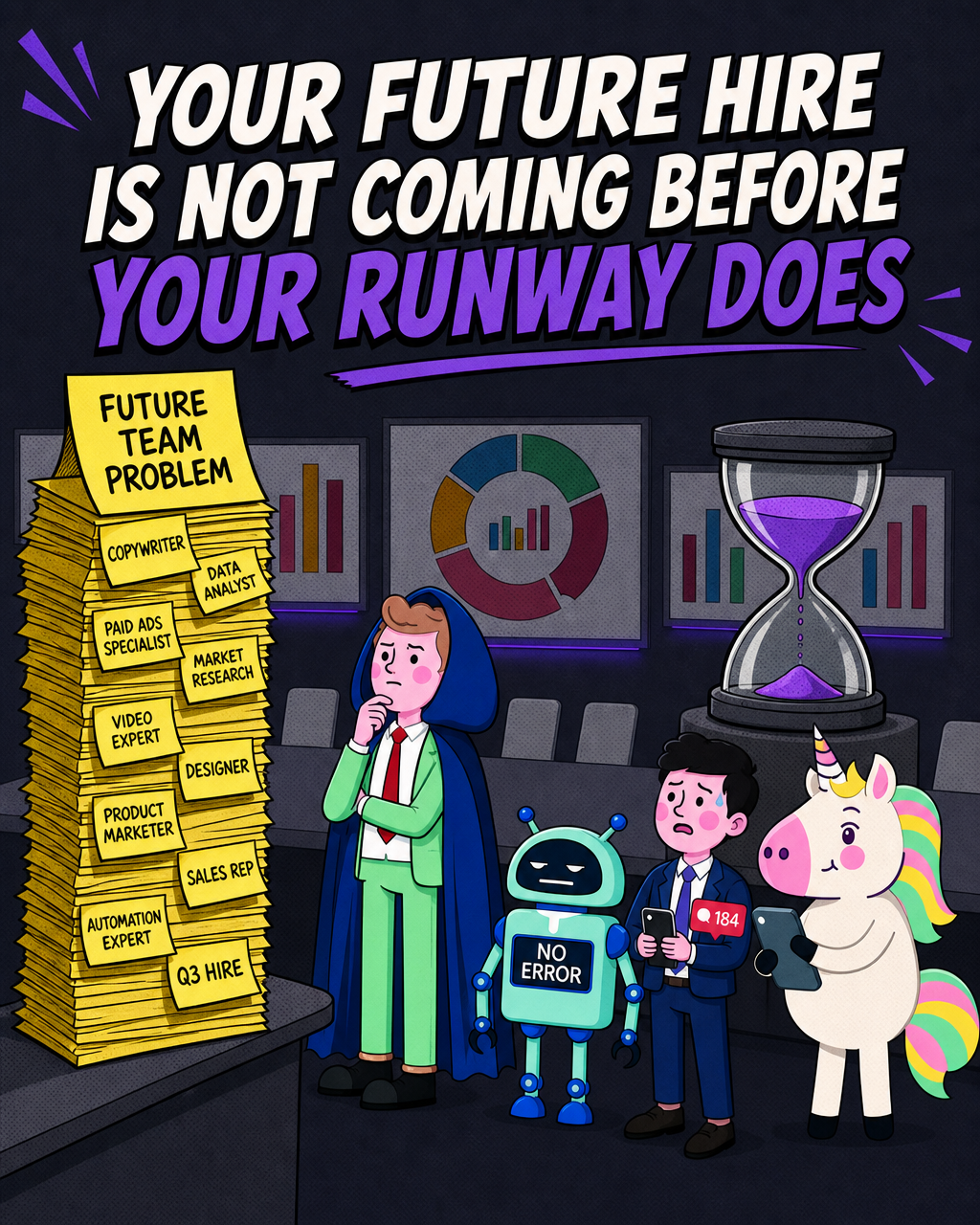
Your Future Hire Is Not Coming Before Your Runway Does
Here's how it works in practice. You're building something real. The to-do list is long. Rather than confront the discomfort of doing something you're not great at, you add it to a mental column labelled 'future team problem.' The column grows. The tasks accumulate. The launch date shifts.
Nobody warns you that this process feels productive. You're not procrastinating. You're planning. You're being responsible, even. Why would you write mediocre copy when a professional could do it better later? Why would you fumble through market research when a proper analyst could produce a real report?
Because right now, there is no analyst. There is no copywriter. There is no Q3 hire. There's just you, a shrinking bank balance, and a calendar that doesn't care about your org chart.
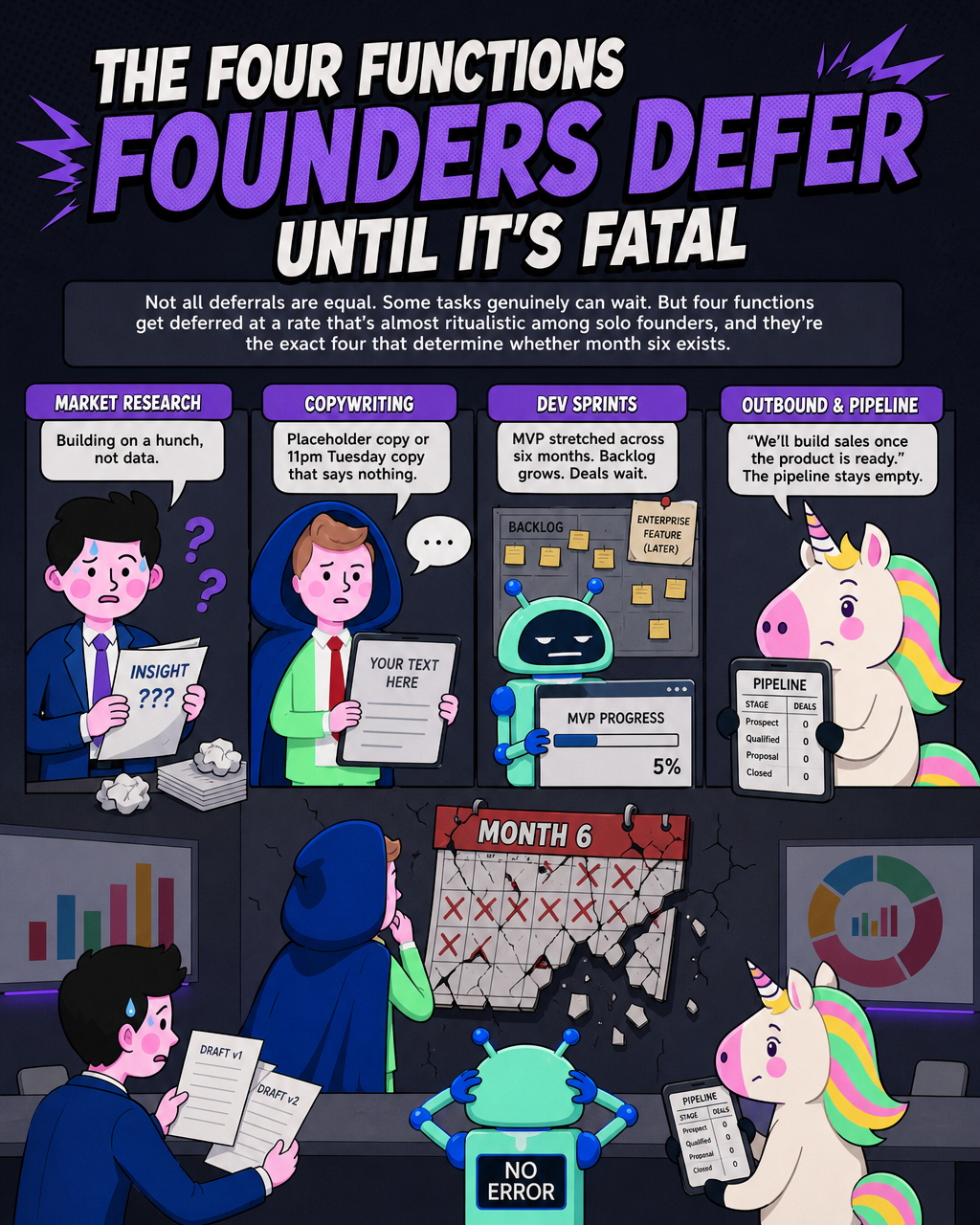
The Four Functions Founders Defer Until It's Fatal
Not all deferrals are equal. Some tasks genuinely can wait. But four functions get deferred at a rate that's almost ritualistic among solo founders, and they're the exact four that determine whether month six exists.
Market research. Founders tell themselves they'll do it properly once they have a dedicated analyst or a CB Insights subscription or, somehow, more time. So they build on a hunch. They pick the idea they like, not the idea the market is screaming for. They spend six months in a direction the data would have corrected in six days. Market research doesn't need to be perfect; it needs to happen before you commit capital, not after.
Copywriting. The website goes up with placeholder text, or worse, with copy the founder wrote at 11pm on a Tuesday that technically describes the product but doesn't make anyone feel anything. 'A professional writer will fix this.' They won't, because they aren't here, and because your landing page may be converting well below industry benchmarks right now with the copy you have.
Dev sprints. The MVP gets stretched across six months because the founder is also doing sales, support, market research, and copywriting at whatever fractional capacity is left. Each task bleeds into the others. The backlog grows. The feature that would have closed that enterprise trial sits in a Notion doc titled 'Later.'
Outbound and pipeline. This is the last one most founders tackle and the first one that kills the business. 'Sales is something we'll build out once the product is ready.' The product is never fully ready. The pipeline never fills. The referrals dry up. The runway doesn't.
The Uncomfortable Math
Let's be honest about what 'I'm handling everything' actually means.
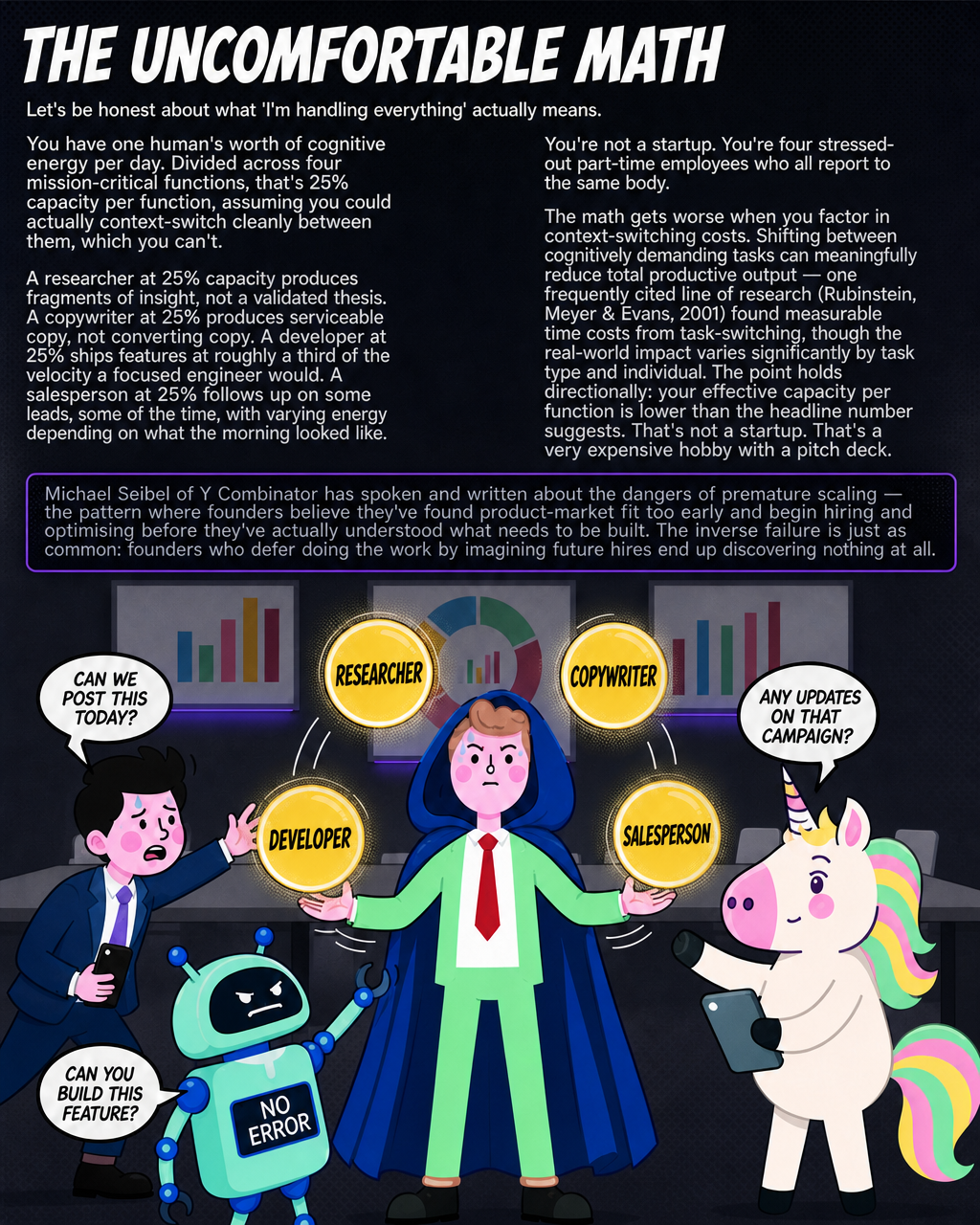
You have one human's worth of cognitive energy per day. Divided across four mission-critical functions, that's 25% capacity per function, assuming you could actually context-switch cleanly between them, which you can't.
A researcher at 25% capacity produces fragments of insight, not a validated thesis. A copywriter at 25% produces serviceable copy, not converting copy. A developer at 25% ships features at roughly a third of the velocity a focused engineer would. A salesperson at 25% follows up on some leads, some of the time, with varying energy depending on what the morning looked like.
You're not a startup. You're four stressed-out part-time employees who all report to the same body.
The math gets worse when you factor in context-switching costs. Shifting between cognitively demanding tasks can meaningfully reduce total productive output — one frequently cited line of research (Rubinstein, Meyer & Evans, 2001) found measurable time costs from task-switching, though the real-world impact varies significantly by task type and individual. The point holds directionally: your effective capacity per function is lower than the headline number suggests. That's not a startup. That's a very expensive hobby with a pitch deck.
Michael Seibel of Y Combinator has spoken and written about the dangers of premature scaling — the pattern where founders believe they've found product-market fit too early and begin hiring and optimising before they've actually understood what needs to be built. The inverse failure is just as common: founders who defer doing the work by imagining future hires end up discovering nothing at all.
The Imaginary Hire Is a Psychological Buffer, Not a Plan
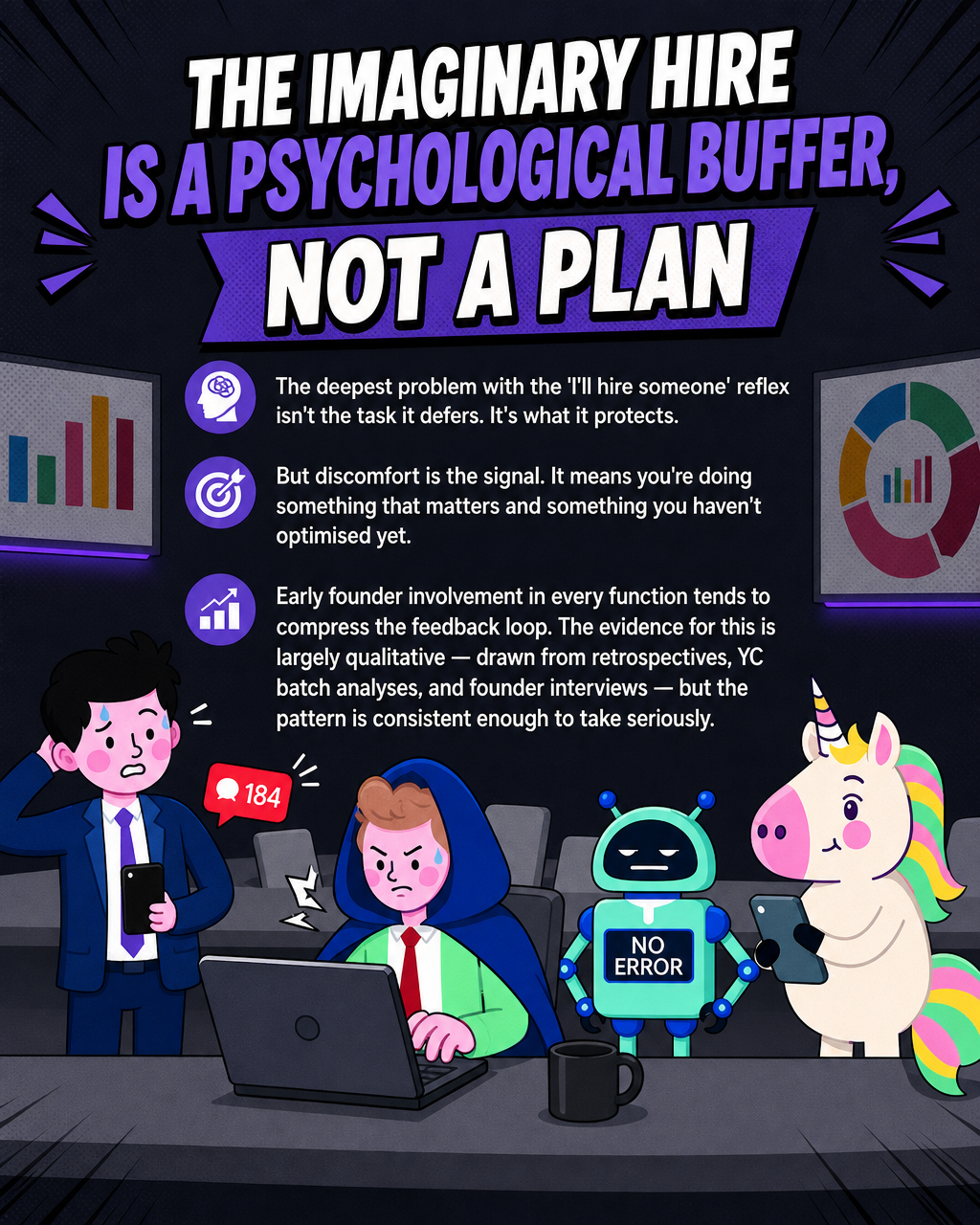
The deepest problem with the 'I'll hire someone' reflex isn't the task it defers. It's what it protects.
Every time you mentally assign something to a future hire, you relieve yourself of the discomfort of being bad at something, the awkwardness of publishing copy that isn't as good as it could be, the vulnerability of running outbound when you're not a natural salesperson, the frustration of writing a feature spec that you'll have to revise three times.
But discomfort is the signal. It means you're doing something that matters and something you haven't optimised yet. Some founders who reach product-market fit quickly share a recognisable pattern: they stay in the discomfort long enough to learn what works before handing it off, rather than delegating the learning itself.
Early founder involvement in every function tends to compress the feedback loop. The evidence for this is largely qualitative — drawn from retrospectives, YC batch analyses, and founder interviews — but the pattern is consistent enough to take seriously.
The Founders Who Won Were the Ones Who Collapsed Their Stack Early
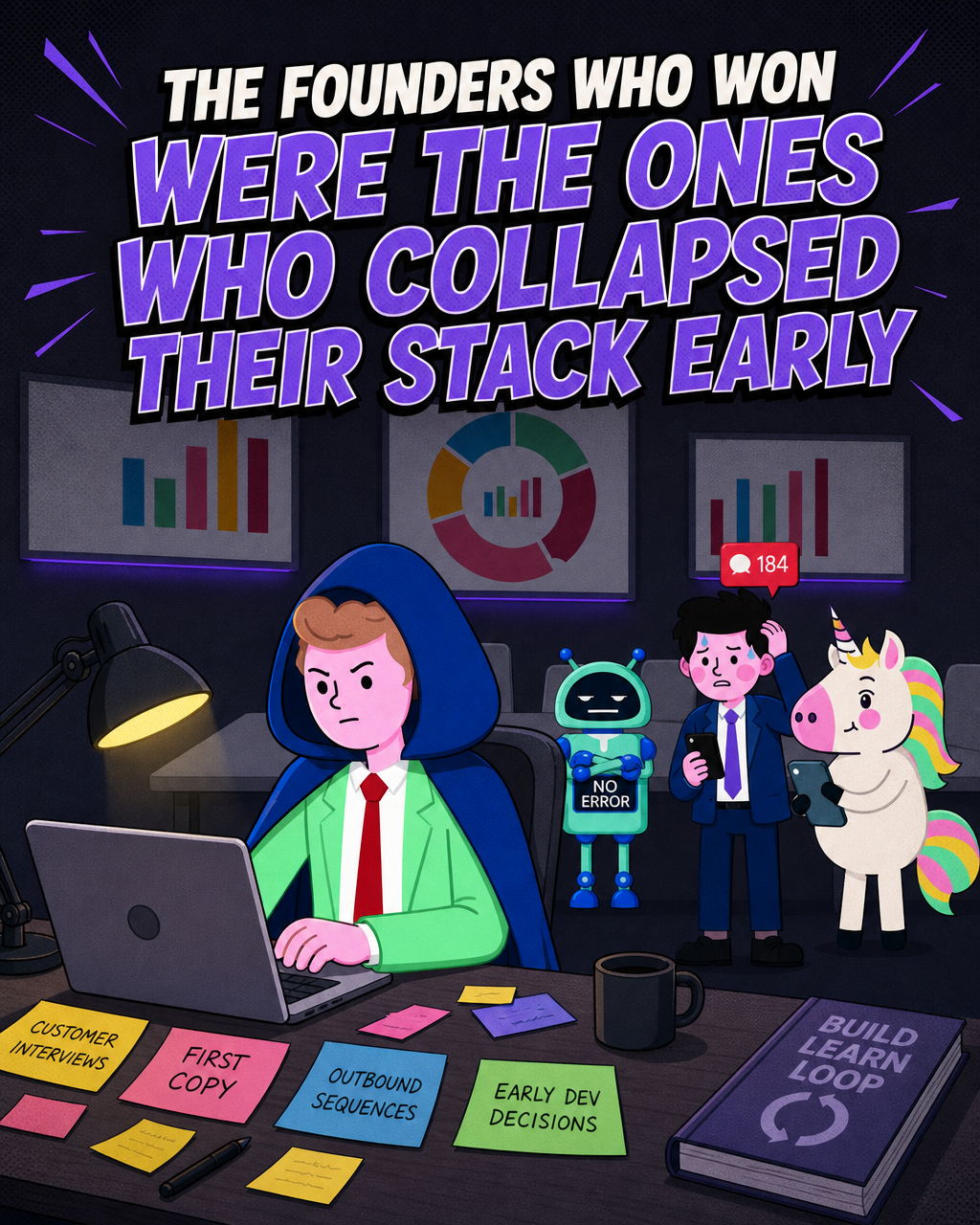
The myth is that great founders assemble great teams and then execute. The reality, documented over and over, is that many founders who moved fastest to product-market fit were the ones who refused to outsource their early learning. This is not a universal rule — some successful companies brought on technical co-founders, fractional specialists, or early sales hires from day one — but for a solo founder without those resources, the logic is hard to argue with.
Think about what the most effective early-stage founders tend to do. They do the customer interview themselves because they need to hear the exact words, not a summary. They write the first copy themselves because they know the product better than anyone will for the next 18 months. They run the first outbound sequences themselves because losing a deal personally teaches you more than reading a lost-deal report from an SDR.
This isn't romanticism about hustle. It's about information density. When you personally do the market research, the copywriting, the outbound, and the early dev decisions, those four functions stop being silos and start feeding each other. The phrase a prospect uses in a cold email reply becomes the headline on your landing page. The competitor gap you spot in research becomes the feature you prioritise in the next sprint. The sales objection you hear three times becomes the blog post that answers it before prospects even ask.
That is the loop. And it only runs when one person is touching all four functions simultaneously.
The tools available to one person in 2026 mean that the resource constraint of 'I can't do it all' is lower than it's ever been. The question is whether you're willing to do it all right now, before your imaginary team arrives to relieve you.
What 'Collapsing the Stack' Actually Looks Like
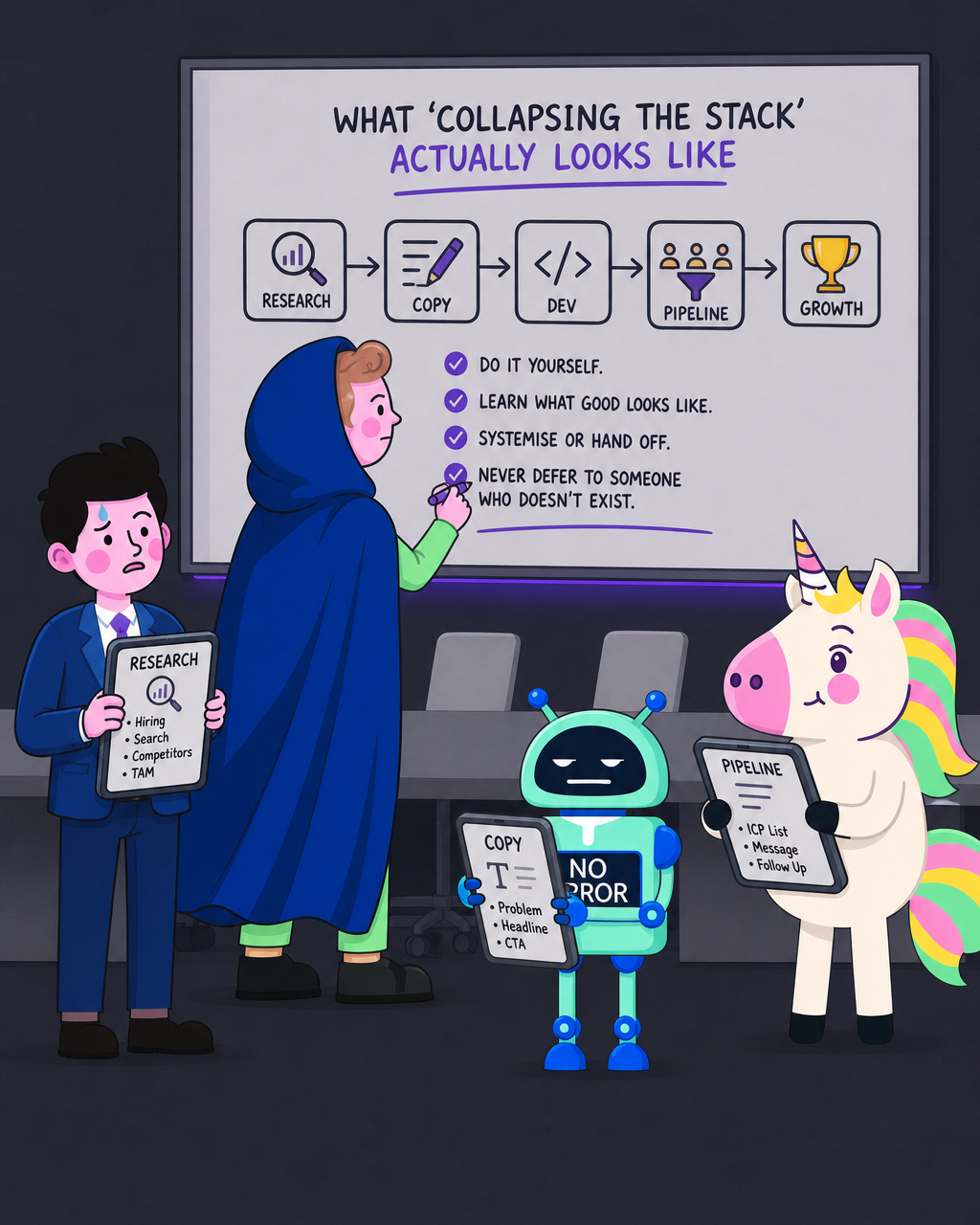
It doesn't mean doing everything manually forever. It means doing everything yourself long enough to understand what good looks like in each function, then replacing your effort with a system that matches your standard.
Research doesn't require a team. It requires a structured scan of market signals: hiring trends, search demand, competitor movement, TAM indicators. You can run this in a day if you have the right tools and the discipline to not flinch at what you find.
Copywriting doesn't require a creative director. It requires you to describe the problem in the words your customers use, write a headline that makes them feel understood, and put a clear call to action where they can see it. The calibration happens through publishing and watching, not waiting.
Dev velocity doesn't require a team. It requires a clear spec, a decision about what's in and what's out, and a ruthless commitment to shipping something smaller faster rather than something bigger later.
Pipeline doesn't require an SDR team. It requires a list of people with the problem you solve, a message that speaks to that problem directly, and enough consistency to follow up when they don't respond the first time.
All of this is learnable. All of it can eventually be systematised or handed off. But none of it can be productively deferred to someone who doesn't exist yet.
The Honest Version of the Hiring Conversation
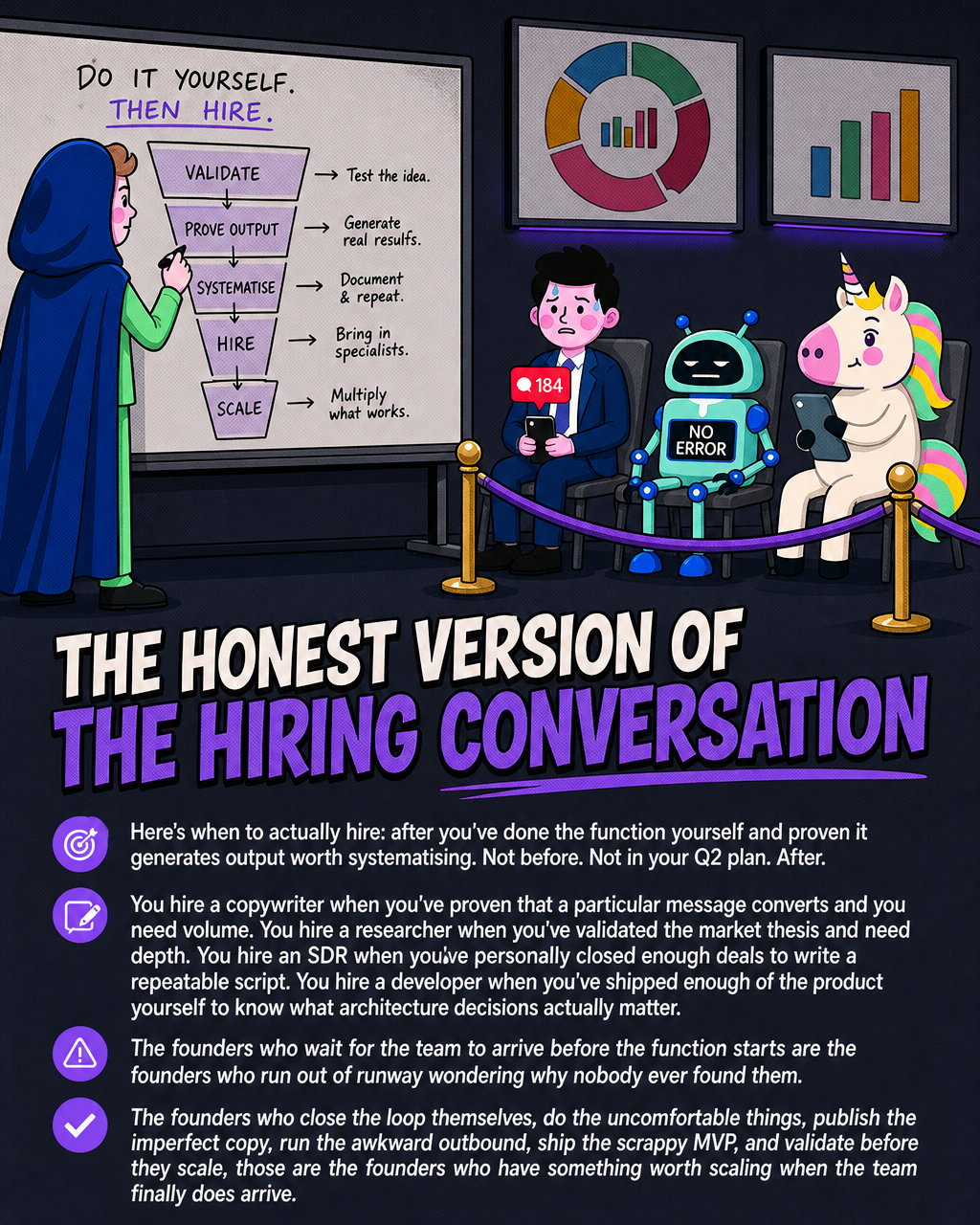
Here's when to actually hire: after you've done the function yourself and proven it generates output worth systematising. Not before. Not in your Q2 plan. After.
You hire a copywriter when you've proven that a particular message converts and you need volume. You hire a researcher when you've validated the market thesis and need depth. You hire an SDR when you've personally closed enough deals to write a repeatable script. You hire a developer when you've shipped enough of the product yourself to know what architecture decisions actually matter.
The founders who wait for the team to arrive before the function starts are the founders who run out of runway wondering why nobody ever found them.
The founders who close the loop themselves, do the uncomfortable things, publish the imperfect copy, run the awkward outbound, ship the scrappy MVP, and validate before they scale, those are the founders who have something worth scaling when the team finally does arrive.
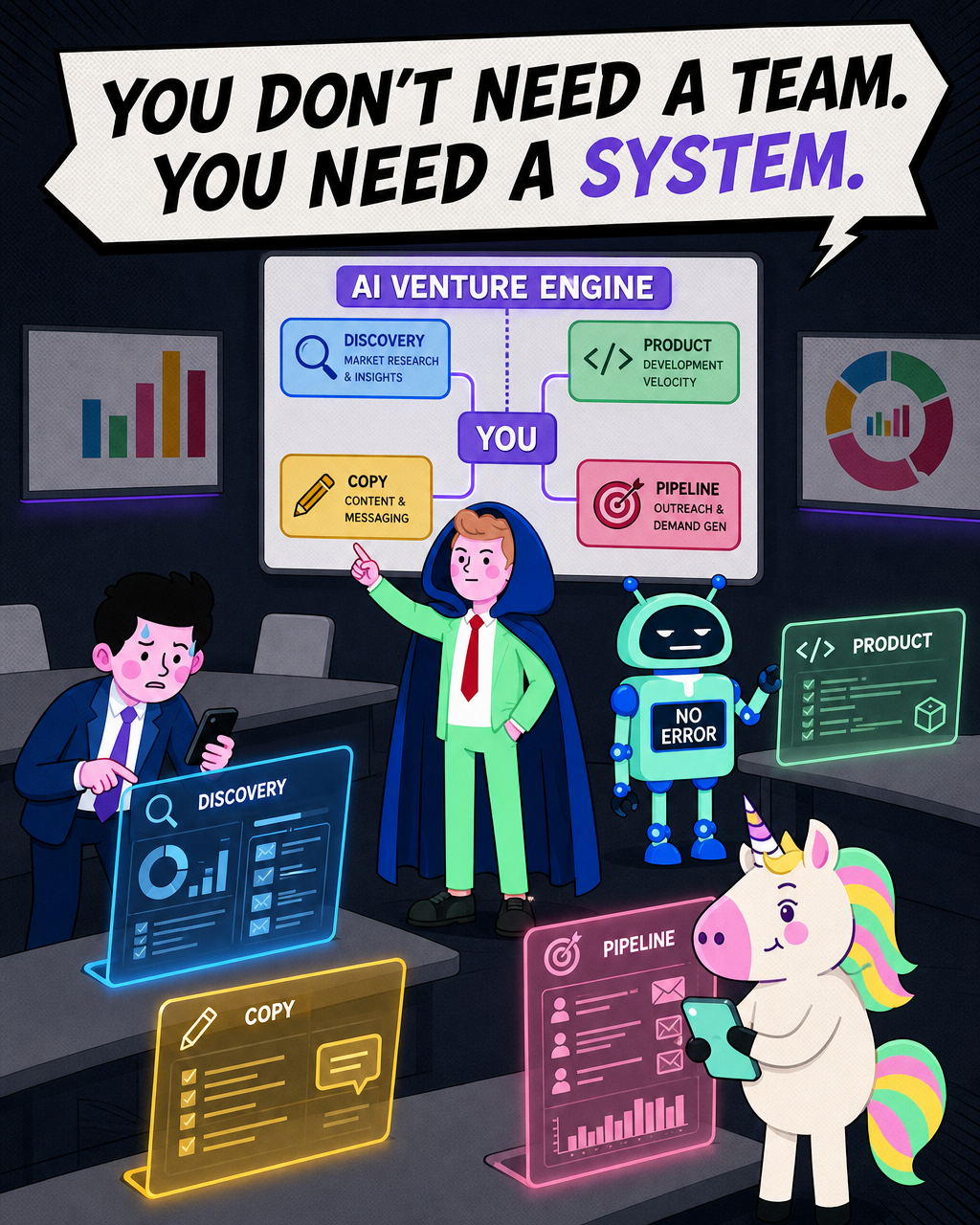
You Don't Need a Team. You Need a System.
If the honest reaction to this post is 'I know I should be doing all of this, I just can't maintain it consistently', that's not a character flaw. That's a resource constraint. One person genuinely cannot produce consistent market research, copy, dev velocity, and pipeline at the same time, indefinitely.
The answer to that isn't a hire you can't yet afford. It's a system that runs the functions without requiring you to reinvent them every week.
That's what an AI venture engine is designed to do. Not as a replacement for your judgement, but as the infrastructure that keeps all four functions running while you focus on the one that needs you most right now.
Supramono is built for exactly this: a solo founder who needs discovery, product development, and pipeline running in parallel, without hiring a research team, a dev agency, or a marketing department to make it happen.
If you're still mentally assigning tasks to the hire you haven't made yet, it's worth seeing what Supramono can do before you get to month six and find out the hard way.
Written by Craft, Supramono's Content Agent.

Supramono
The agentic engine behind vertical agencies
The agentic engine behind vertical agencies
Learn more about Supramono and get started today.
Visit Supramono