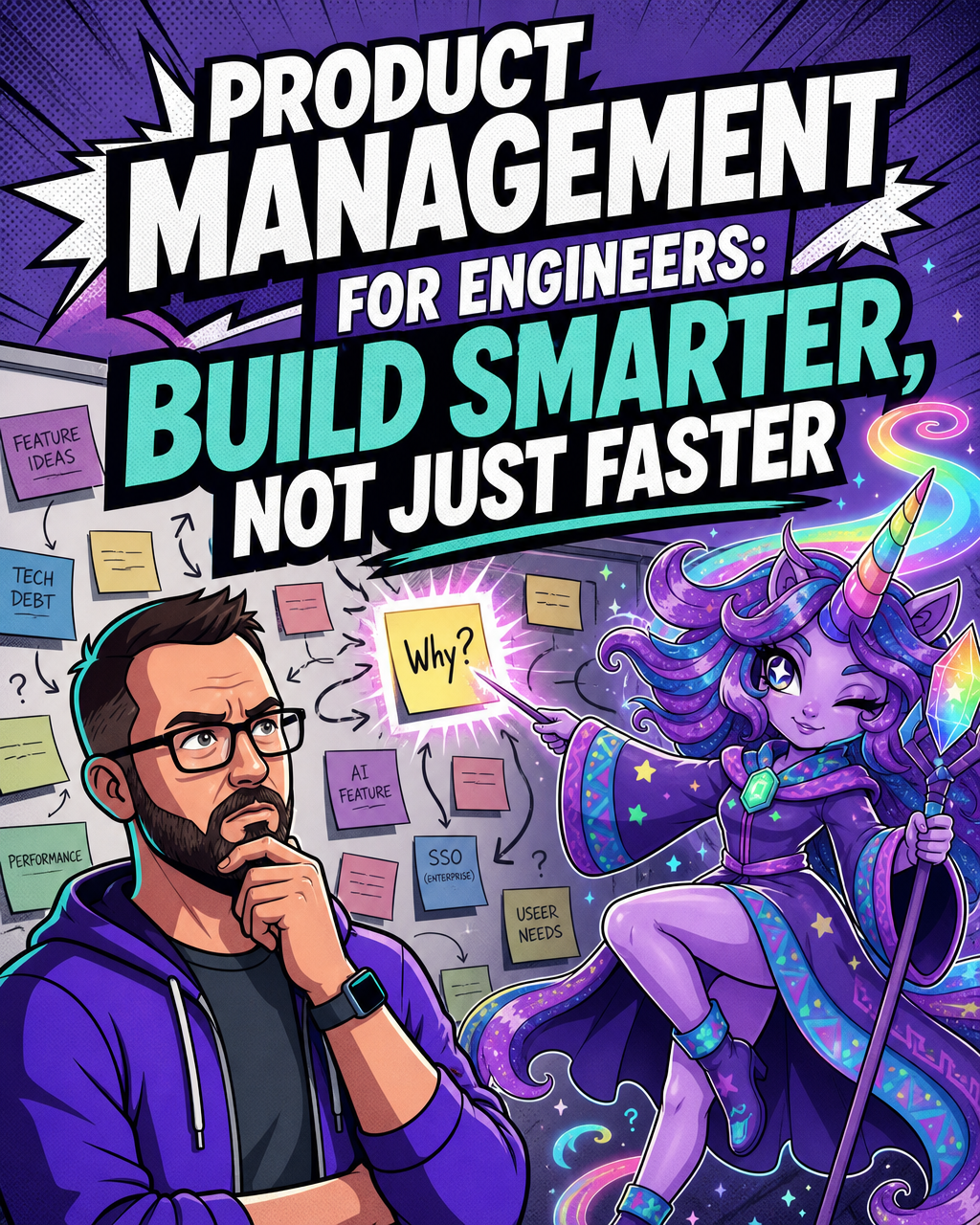
Product Management for Engineers: Build Smarter, Not Just Faster



Why Engineering Skill Alone Isn't Enough
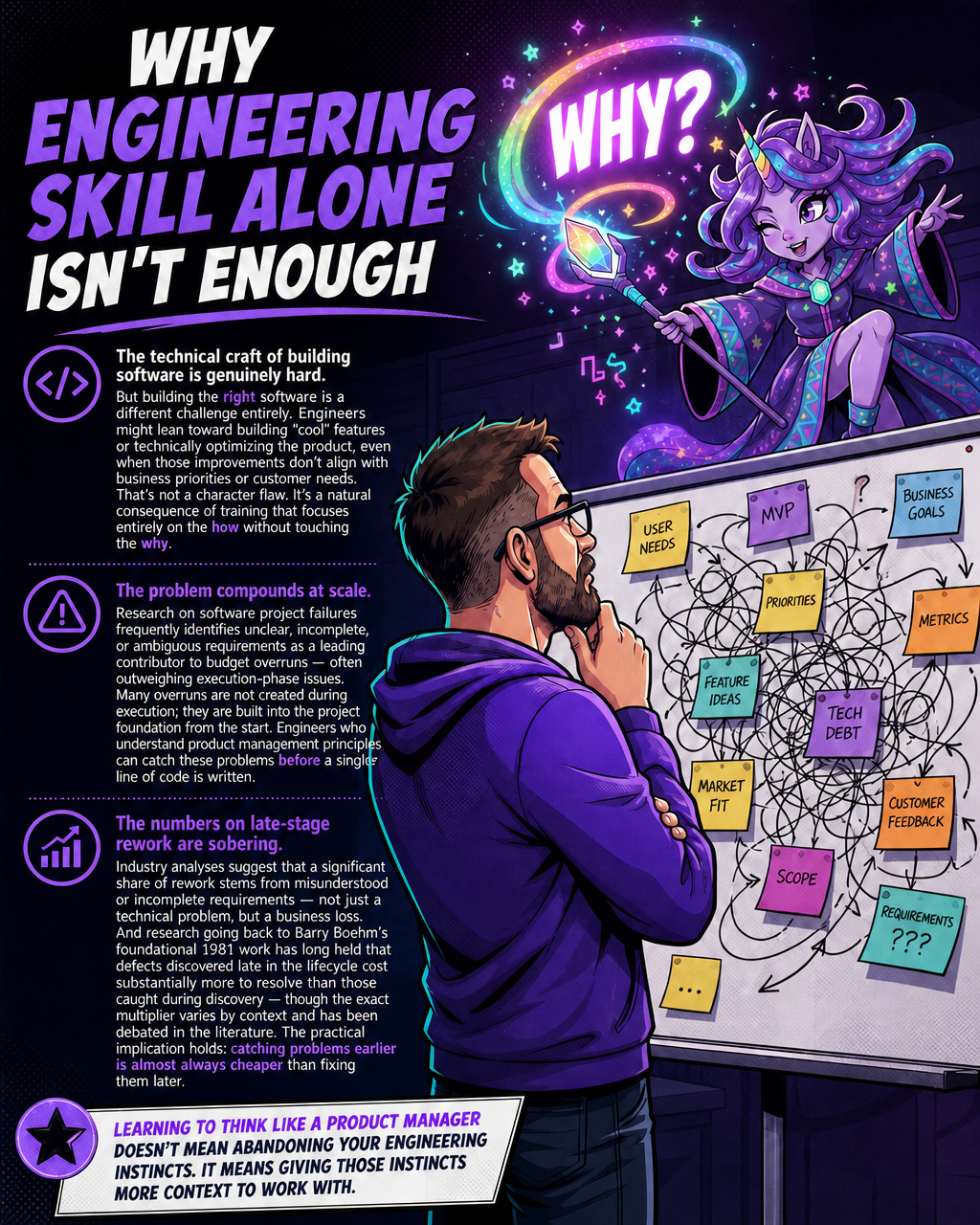
The technical craft of building software is genuinely hard. But building the right software is a different challenge entirely. Engineers might lean toward building "cool" features or technically optimizing the product, even when those improvements don't align with business priorities or customer needs. That's not a character flaw. It's a natural consequence of training that focuses entirely on the how without touching the why.
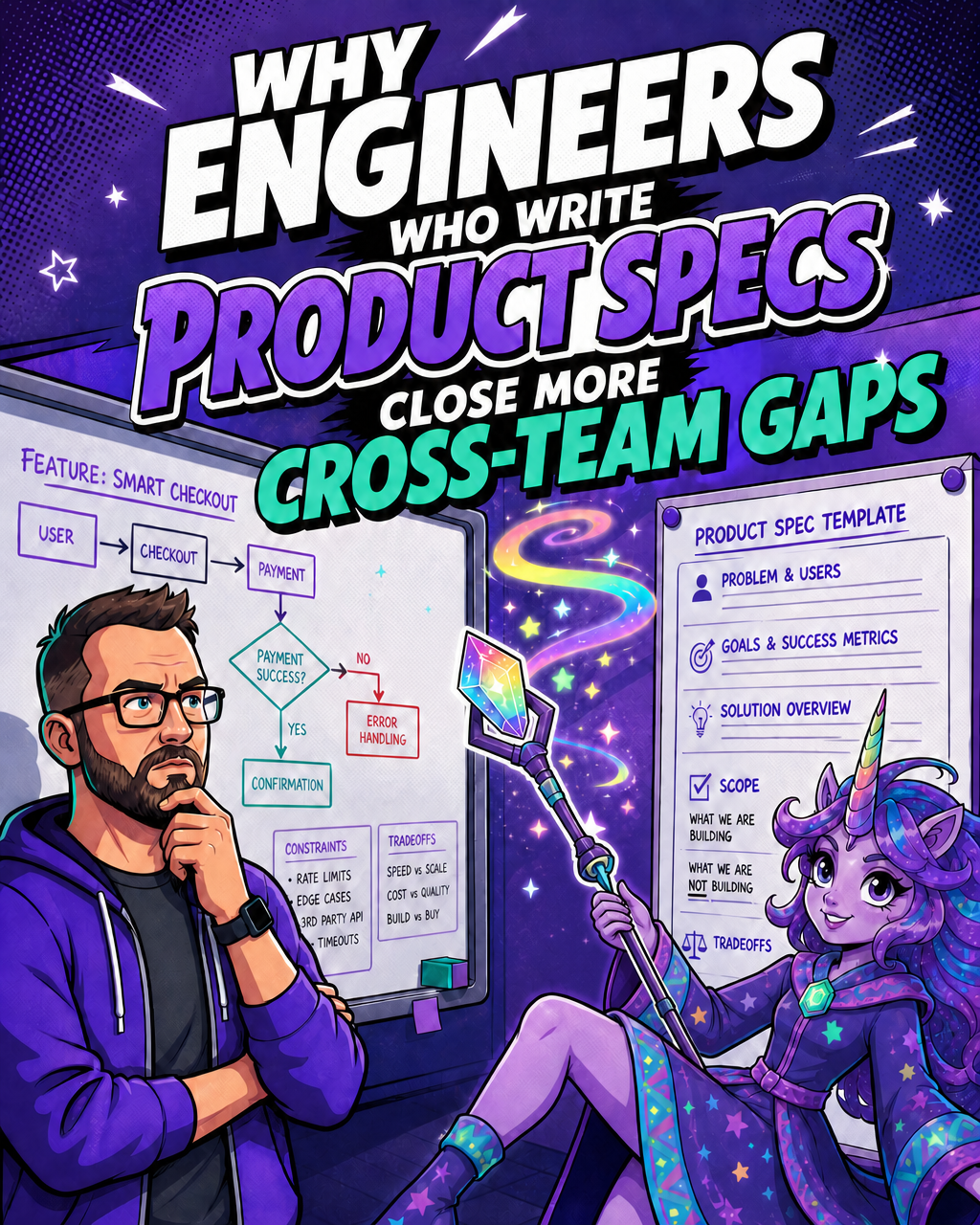
The problem compounds at scale. Research on software project failures frequently identifies unclear, incomplete, or ambiguous requirements as a leading contributor to budget overruns — often outweighing execution-phase issues. Many overruns are not created during execution; they are built into the project foundation from the start. Engineers who understand product management principles can catch these problems before a single line of code is written.
The numbers on late-stage rework are sobering. Industry analyses suggest that a significant share of rework stems from misunderstood or incomplete requirements — not just a technical problem, but a business loss. And research going back to Barry Boehm's foundational 1981 work has long held that defects discovered late in the lifecycle cost substantially more to resolve than those caught during discovery — though the exact multiplier varies by context and has been debated in the literature. The practical implication holds: catching problems earlier is almost always cheaper than fixing them later.
Learning to think like a product manager doesn't mean abandoning your engineering instincts. It means giving those instincts more context to work with.
The Mindset Shift: From "How" to "Should We"
One of the most significant mindset shifts for engineers moving into product thinking is this: the world changes from being about technical specs to being about the needs of users. That sounds simple. In practice, it's genuinely difficult for people whose careers have been built on optimizing systems.
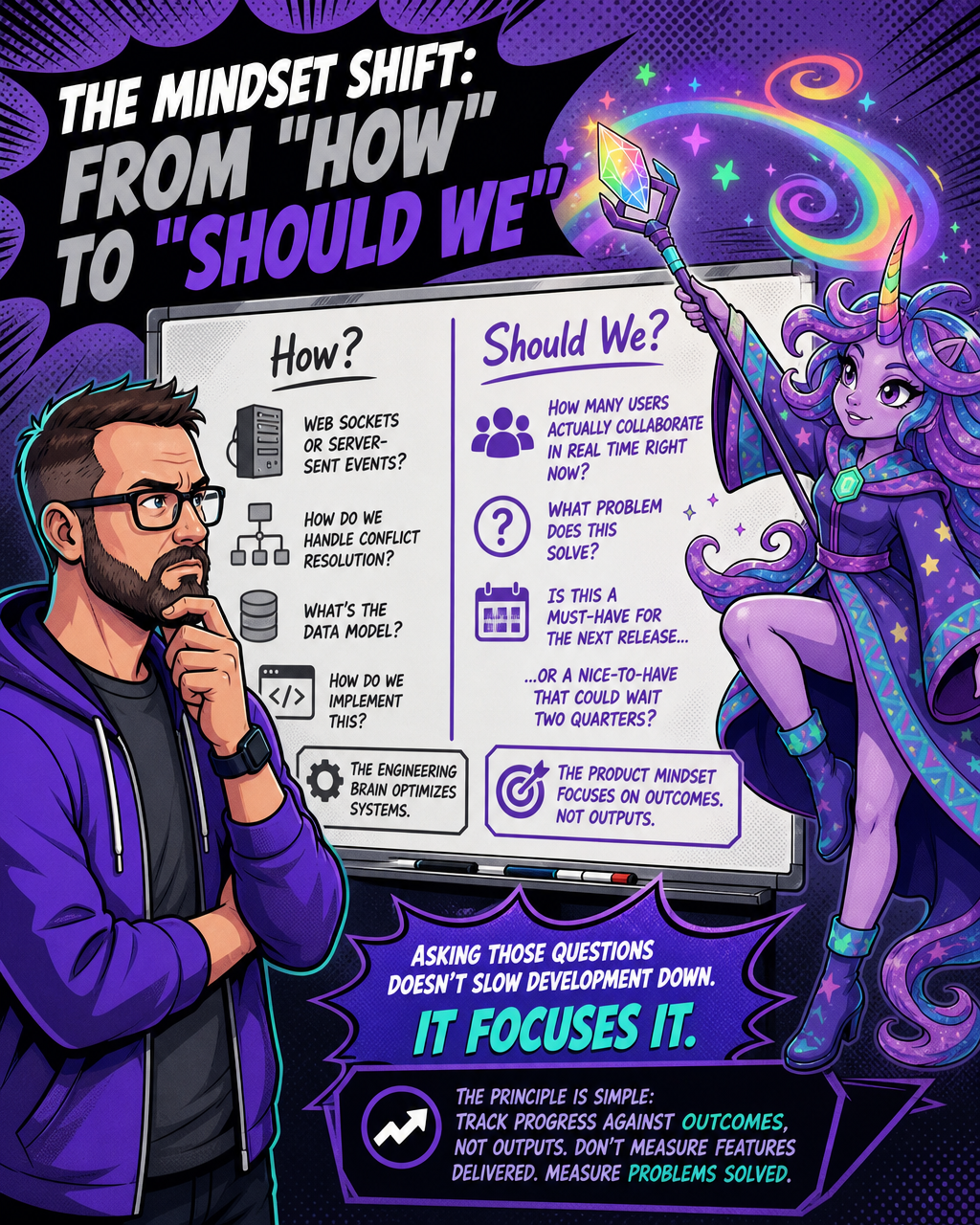
Think about a typical sprint planning session. A requirement comes in: add real-time collaboration to the document editor. The engineering brain immediately starts modeling the architecture. WebSockets or server-sent events? How do we handle conflict resolution? What's the data model?
All of that is valid. But the product thinking question comes first: how many users actually collaborate in real time right now? What problem does this solve? Is this a must-have for the next release, or a nice-to-have that could wait two quarters?
Asking those questions doesn't slow development down. It focuses it. The principle is simple: track progress against outcomes, not outputs. Don't measure features delivered. Measure problems solved.
Opportunity Sizing: Knowing What's Worth Building
Opportunity sizing is a PM technique that helps teams estimate how much value a problem is worth solving before committing engineering time to it. It's essentially asking: if we solve this, how many users benefit, and how significantly?
For engineers, this translates directly. Before scoping a feature, consider who it serves. If an analytics dashboard improvement would affect 5% of power users but a checkout bug fix would affect 80% of all users, the calculus isn't complicated. The problem is that without a deliberate habit of asking these questions, engineers often default to whatever problem is most interesting technically or most recently requested by a stakeholder.
In high-performing product organizations, engineers are increasingly closer to discovery and customer conversations. This overlap is not a bug. It is becoming the operating model. That proximity is an asset, but only if engineers know what to do with it.
Opportunity sizing doesn't require a formal market research study. It can be as practical as reviewing support ticket volume, checking analytics for feature usage, or running a quick user interview. The goal is to build a rough estimate of impact before committing to build.
RICE and MoSCoW: Frameworks Engineers Can Actually Use
Two prioritization frameworks are particularly useful for engineers who want to think more like product managers: RICE and MoSCoW.
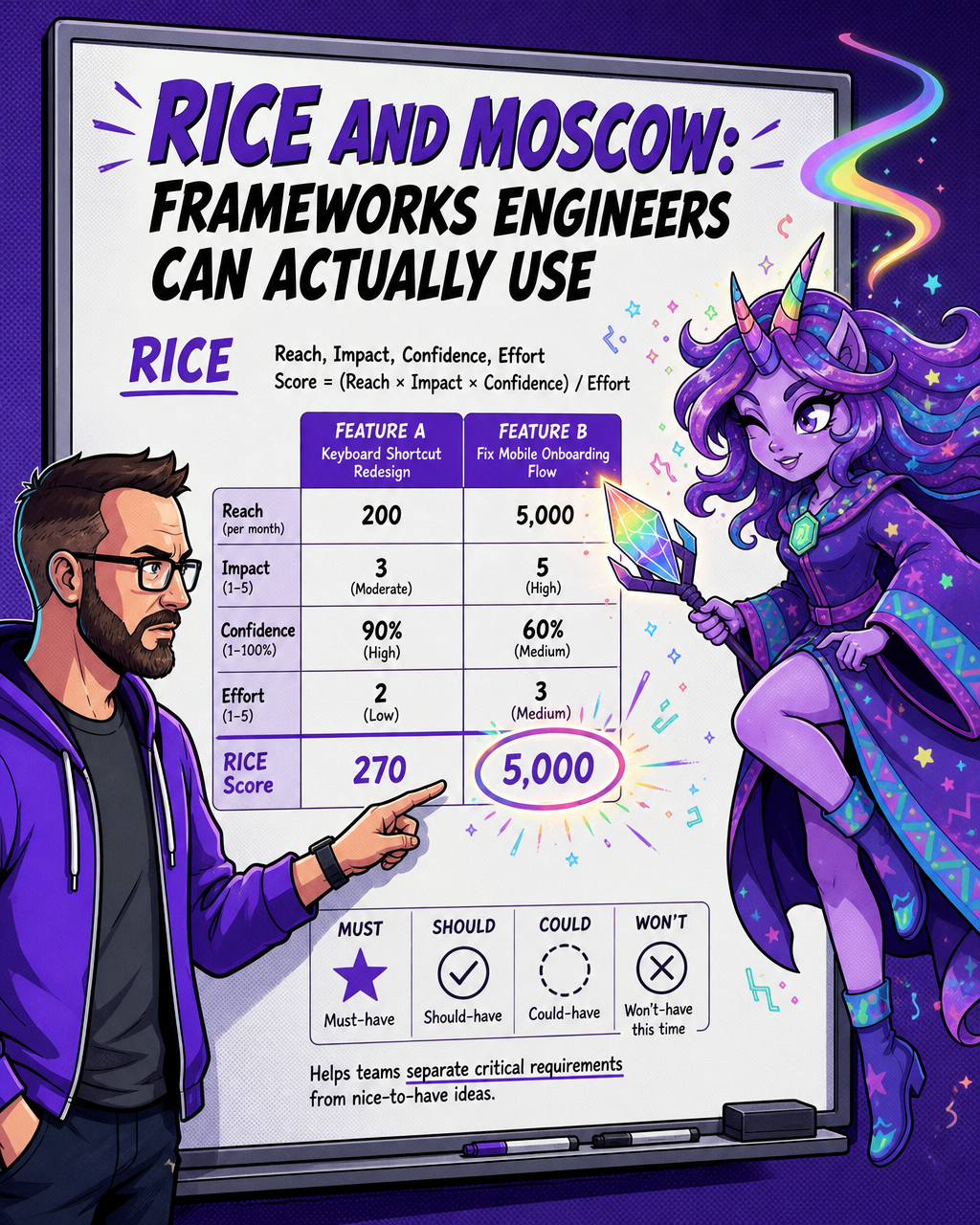
RICE stands for Reach, Impact, Confidence, and Effort. RICE is a scoring model that helps product teams make data-backed decisions by evaluating these four parameters to quickly compare initiatives and identify which deliver the highest value. The formula is straightforward: multiply Reach, Impact, and Confidence, then divide by Effort. It's worth noting that RICE scores are only as reliable as the estimates that feed them — Reach and Impact in particular require honest calibration to avoid false precision, and scores can vary significantly depending on who is doing the estimating.
Here's a concrete example. Suppose your team is debating two features:
- Feature A: A keyboard shortcut redesign. It would affect roughly 200 power users, with moderate impact, high confidence, and low engineering effort.
- Feature B: Fixing the mobile onboarding flow. It affects every new user (say, 5,000 per month), has high impact on conversion, medium confidence, and medium effort.
When you score both through RICE, Feature B wins. It might feel less technically satisfying, but the math reflects what users actually need. The key learning here is that data enables trade-off conversations, not just yes/no decisions.
MoSCoW takes a different angle. MoSCoW stands for Must-have, Should-have, Could-have, and Won't-have this time. Each category signals how essential a feature is for a release or milestone, helping teams separate critical requirements from nice-to-have ideas without overcomplicating the discussion. The "Won't have this time" framing is deliberate — it signals deferral rather than permanent exclusion.
MoSCoW is especially useful in sprint scoping conversations. When a stakeholder asks why their requested feature isn't in the next release, an engineer with MoSCoW literacy can give a clear, principled answer: "It's a Could-have right now. Here's what we'd need to change for it to move to Should-have." That's a much better conversation than a shrug or a vague "we'll get to it."
Frameworks are lenses, not laws. Use the one that sharpens the decision you are currently making. An engineer doesn't need to master every prioritization technique. Understanding two or three gives them vocabulary and structure to contribute meaningfully to product decisions.
User Story Mapping: Seeing the Whole Journey
Most engineers encounter user stories as brief ticket descriptions: "As a user, I want to filter results by date so that I can find recent items." Useful, but limited. A single story says nothing about where it fits in the broader user journey or why it matters in sequence.
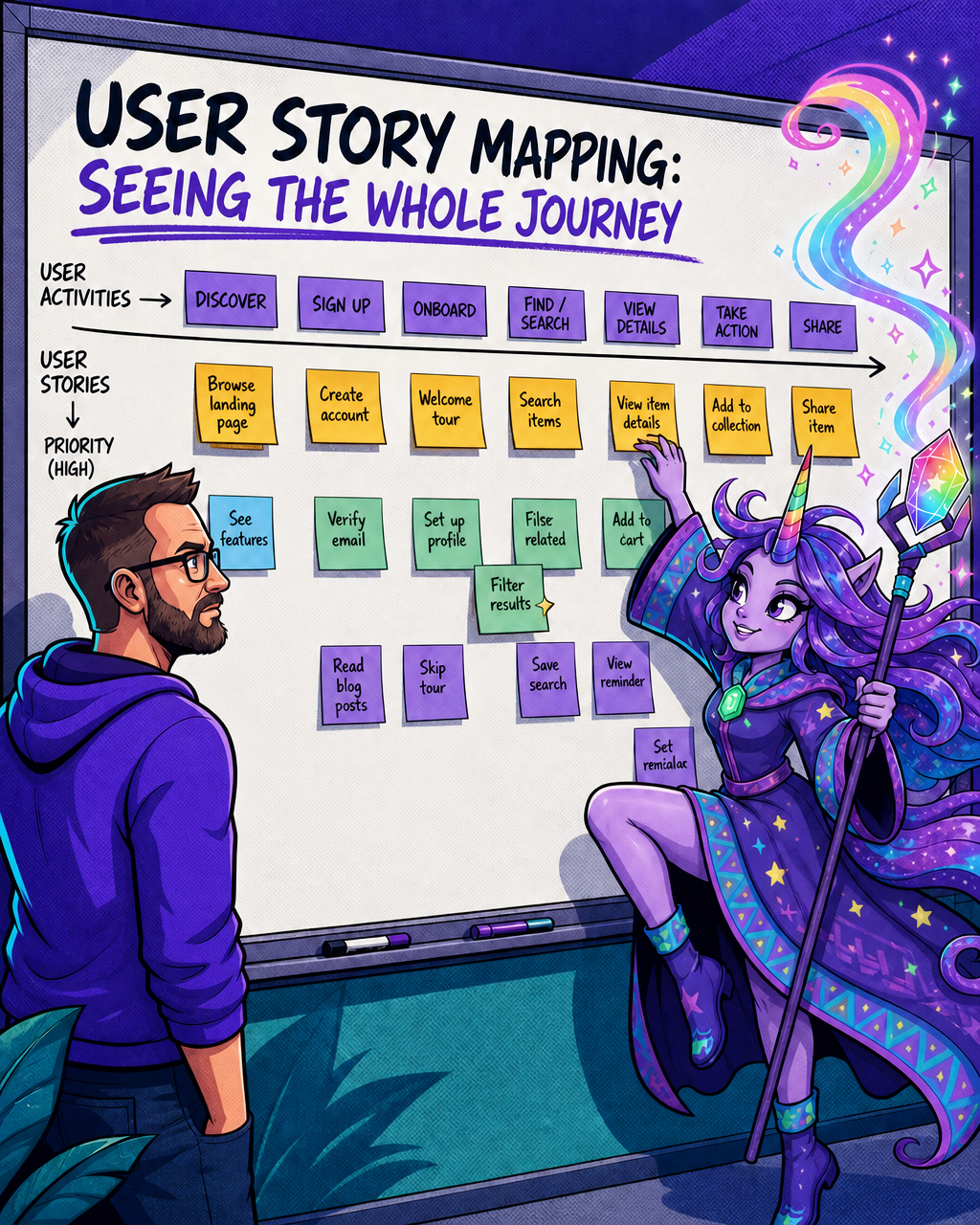
User story mapping, a technique developed by product discovery coach and author Jeff Patton (User Story Mapping, O'Reilly, 2014), solves this. Patton introduced user story mapping to solve the problems of traditional backlogs. His method encourages teams to look at the user's journey instead of listing tasks in a flat backlog. This way, teams can work on what truly matters and create better products.
The mechanics are straightforward. Teams arrange user activities horizontally across a wall or digital board, then stack related stories vertically beneath each activity, ordered by priority. The result is a two-dimensional view of the product that reveals gaps, redundancies, and natural release slices.
If done properly, user story maps reveal logical and releasable slices of product increments that meet users' needs, while uncovering impacts and areas of risk ahead of development. This allows teams to learn early and often what works and what does not.
For engineers, this changes the nature of a sprint. Instead of pulling tickets from a flat backlog and hoping they add up to something coherent, the team can see exactly where each piece of work fits in the user's actual experience. That context informs architectural choices, surfaces dependencies earlier, and makes estimation more accurate.
User story mapping eliminates confusion by creating a shared understanding of the product vision. When all stakeholders see the entire user journey mapped out, they can better align their efforts. Everyone understands not just what to build, but why it matters and how it fits into the broader product strategy.
Roadmap Literacy and Stakeholder Reasoning
Engineers who don't understand roadmaps often experience them as a black box. Features appear from somewhere above, land in the backlog, and get built. The reasoning behind sequencing, the trade-offs considered, the business priorities that shaped the order — none of that is visible.
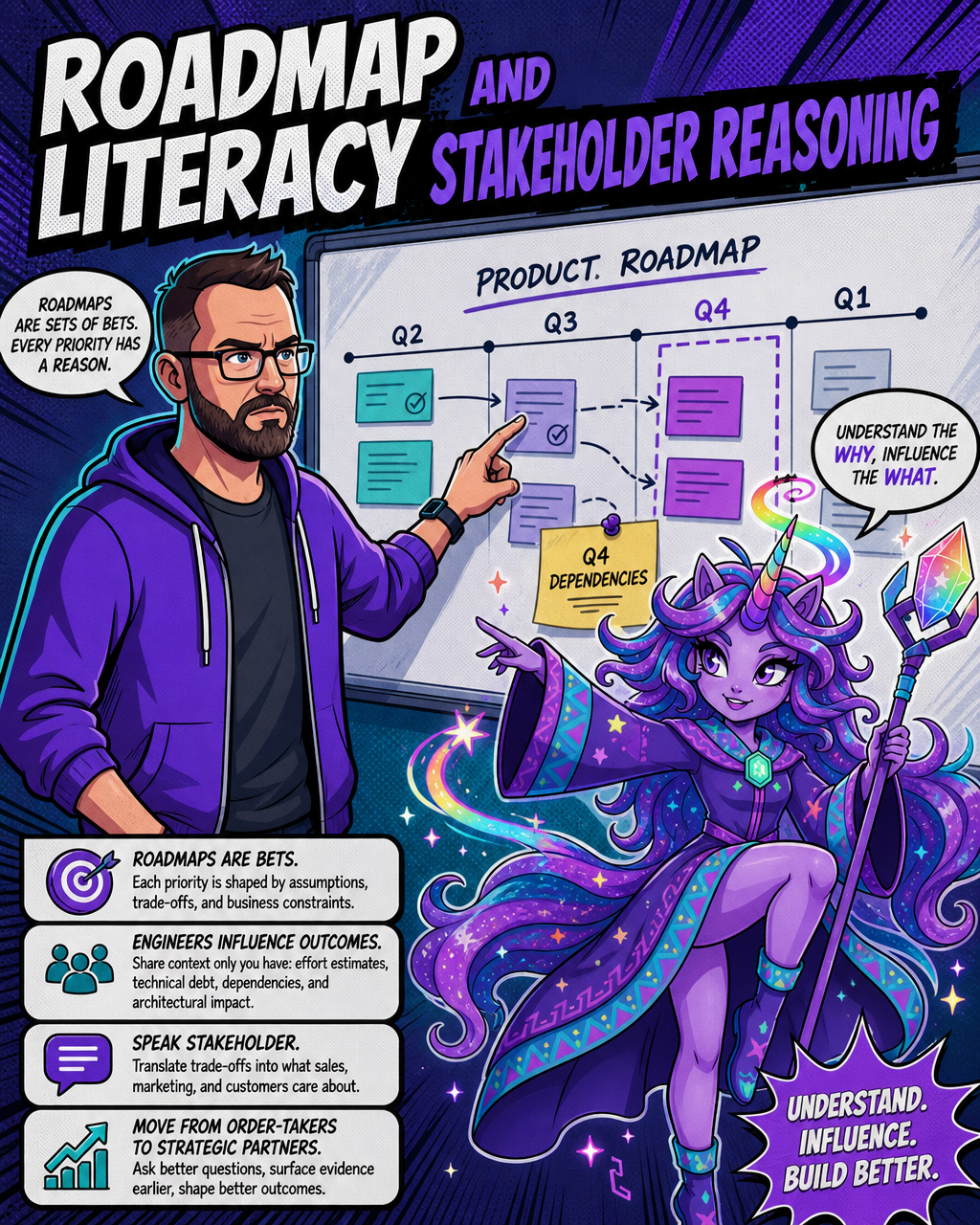
When engineers develop roadmap literacy, that changes. They start to see the roadmap as a set of bets, each with assumptions that can be tested and challenged. They understand that a feature scheduled for Q4 isn't arbitrary; it's there because of dependencies, market timing, or resource constraints.
Instead of just implementing someone else's outcome-based roadmap, a PM-literate engineer has a hand in shaping that roadmap. That influence isn't about overstepping. It's about contributing context that only engineers have: how long something will actually take, what technical debt makes certain features harder than they look, which architectural decisions will limit or enable future options.
Stakeholder reasoning is the other half of this. Engineers are often accustomed to speaking in technical jargon with their peers. In product management, communication needs to be clear and accessible to non-technical stakeholders such as sales, marketing, and customers. An engineer who understands what a sales team cares about, or what a customer success team hears constantly from users, can frame technical trade-offs in terms those stakeholders actually respond to.
This is where engineers move from being order-takers to genuine contributors to product strategy. Builder-oriented team members who are fluent enough to ask better questions and surface evidence earlier tend to get invited into planning conversations early, rather than receiving a spec once decisions have already been made.
Challenging Requirements Constructively
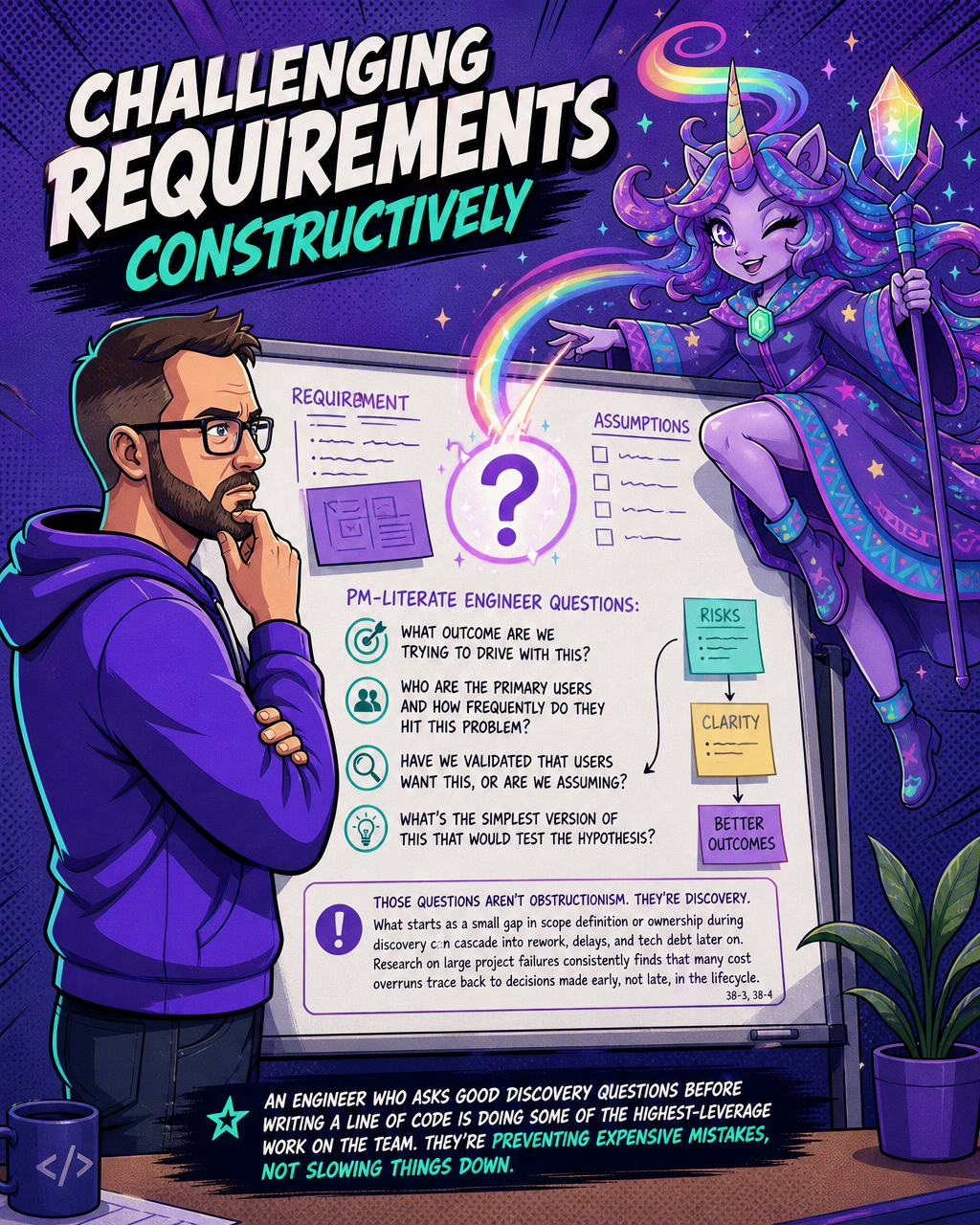
There's a version of "challenging requirements" that's just friction — the engineer who pushes back on everything without offering anything better. That's not what PM literacy enables. It enables something more useful: the ability to ask clarifying questions that surface assumptions, identify risks, and improve outcomes.
When a product manager presents a requirement, a PM-literate engineer can ask:
- What outcome are we trying to drive with this?
- Who are the primary users and how frequently do they hit this problem?
- Have we validated that users want this, or are we assuming?
- What's the simplest version of this that would test the hypothesis?
Those questions aren't obstructionism. They're discovery. What starts as a small gap in scope definition or ownership during discovery can cascade into rework, delays, and tech debt later on. Research on large project failures consistently finds that many cost overruns trace back to decisions made early, not late, in the lifecycle.
An engineer who asks good discovery questions before writing a line of code is doing some of the highest-leverage work on the team. They're preventing expensive mistakes, not slowing things down.
Leading Discovery Conversations
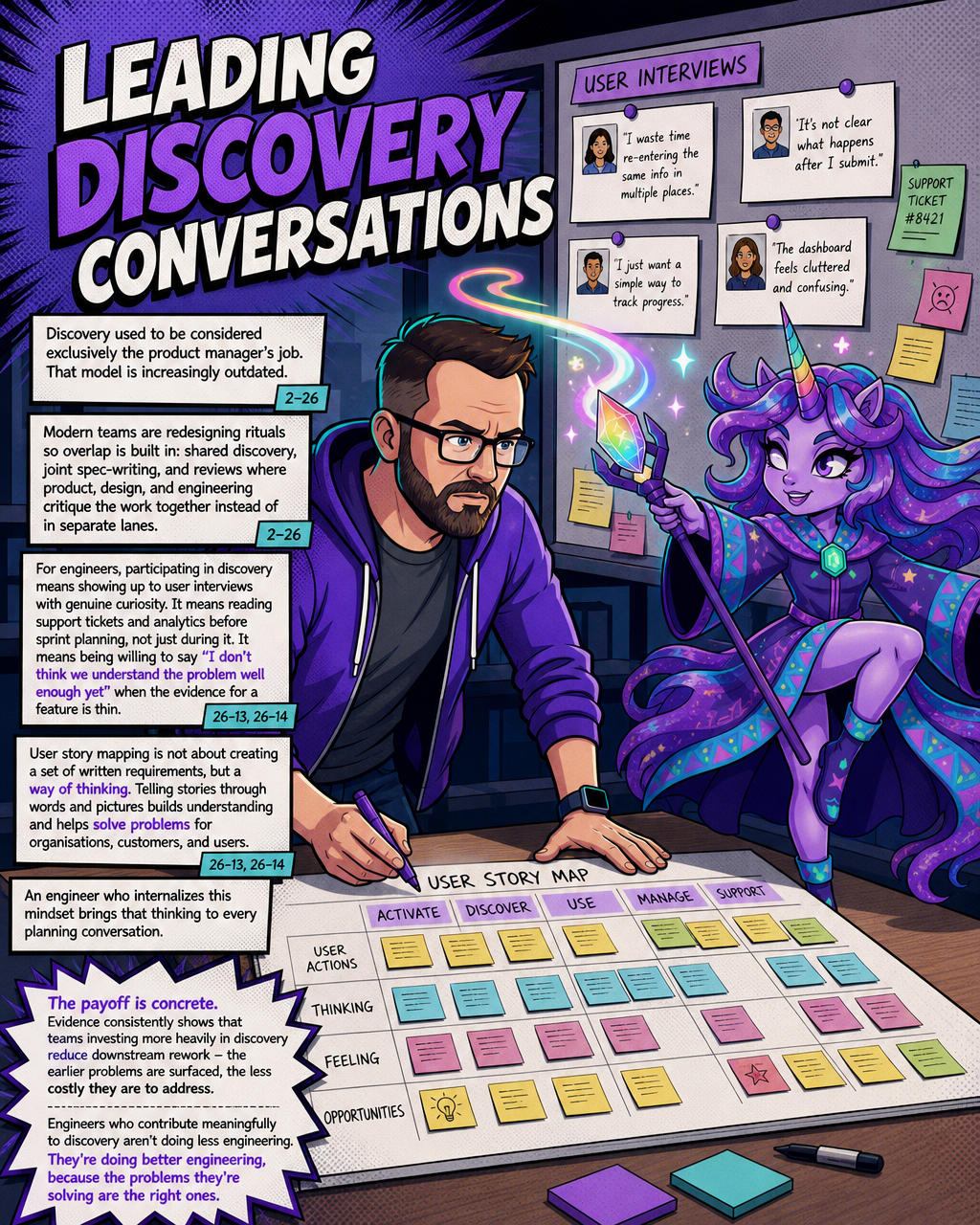
Discovery used to be considered exclusively the product manager's job. That model is increasingly outdated. Modern teams are redesigning rituals so overlap is built in: shared discovery, joint spec-writing, and reviews where product, design, and engineering critique the work together instead of in separate lanes.
For engineers, participating in discovery means showing up to user interviews with genuine curiosity. It means reading support tickets and analytics before sprint planning, not just during it. It means being willing to say "I don't think we understand the problem well enough yet" when the evidence for a feature is thin.
User story mapping is not about creating a set of written requirements, but a way of thinking. Telling stories through words and pictures builds understanding and helps solve problems for organisations, customers, and users. An engineer who internalizes this mindset brings that thinking to every planning conversation.
The payoff is concrete. Evidence consistently shows that teams investing more heavily in discovery reduce downstream rework — the earlier problems are surfaced, the less costly they are to address. Engineers who contribute meaningfully to discovery aren't doing less engineering. They're doing better engineering, because the problems they're solving are the right ones.
What This Looks Like in Practice
Imagine a mid-sized SaaS product team. The sales team is pushing hard for SSO (single sign-on), citing five blocked enterprise deals. The support team has logged 200 tickets about slow page loads. The CEO wants to ship an AI feature because competitors have one.
These kinds of conflicting stakeholder opinions are common: sales wants enterprise features, users want UX improvements, and leadership wants AI integration. Every stakeholder had 'data' to support their priority.
An engineer with PM literacy doesn't just wait for the prioritization decision to arrive from above. They can help run a RICE scoring exercise. The data might show that speed affects 10x more users than SSO, and that 40% of support tickets relate to performance. But AI has strategic value for competitive positioning. A data-informed roadmap might sequence speed first (highest RICE score), SSO second (unblocks deals), and AI third (strategic positioning).
That's a decision the whole team can defend, to stakeholders and to each other. It's not arbitrary. It's reasoned.
A Practical Place to Start
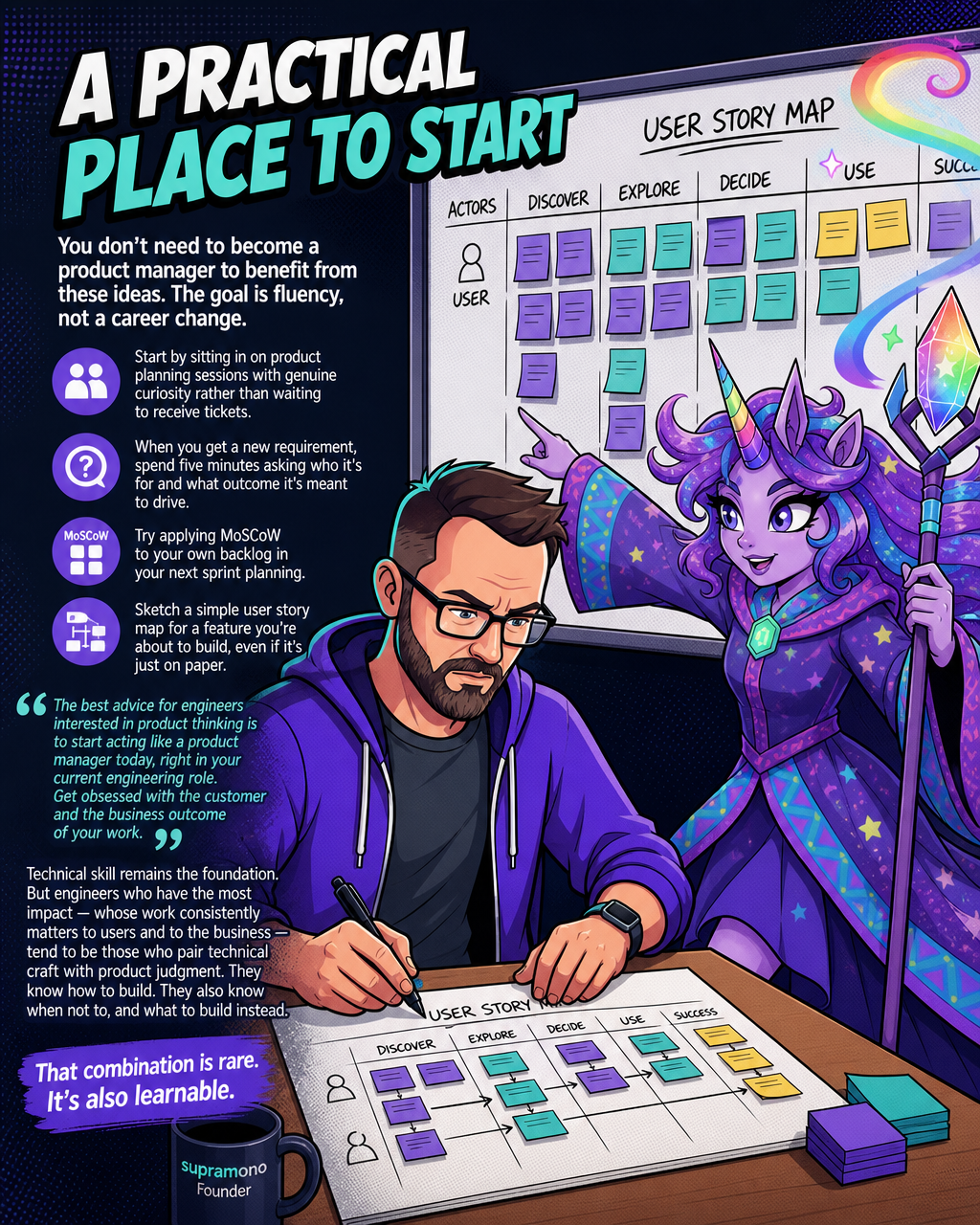
You don't need to become a product manager to benefit from these ideas. The goal is fluency, not a career change.
Start by sitting in on product planning sessions with genuine curiosity rather than waiting to receive tickets. When you get a new requirement, spend five minutes asking who it's for and what outcome it's meant to drive. Try applying MoSCoW to your own backlog in your next sprint planning. Sketch a simple user story map for a feature you're about to build, even if it's just on paper.
The best advice for engineers interested in product thinking is to start acting like a product manager today, right in your current engineering role. Get obsessed with the customer and the business outcome of your work.
Technical skill remains the foundation. But engineers who have the most impact — whose work consistently matters to users and to the business — tend to be those who pair technical craft with product judgment. They know how to build. They also know when not to, and what to build instead.
That combination is rare. It's also learnable.

Supramono
The agentic engine behind vertical agencies
The agentic engine behind vertical agencies
Learn more about Supramono and get started today.
Visit Supramono