10 Great Things About Fractional Hires for SME Owners






If you run a business with 5 to 50 people, you've probably hit that wall. You need someone who actually knows what they're doing in finance, marketing, technology, or operations. But a full-time senior hire feels like a big swing for a role you're not even sure you need five days a week.
That's where fractional hiring comes in. A fractional professional works with your business on a part-time, retainer, or project basis — bringing senior-level capability without a full-time salary, equity package, or benefits overhead. The model isn't new, but it's gained serious momentum since 2020, and it's easy to see why.
Here are ten genuinely useful things about bringing on fractional talent.
1. You get senior expertise you couldn't otherwise afford
A full-time CMO in the US costs well into the hundreds of thousands per year once you factor in salary, benefits, and employer taxes — figures that sit at the higher end for experienced candidates at established companies, and vary considerably for SME-level hires. A full-time CFO sits in a similar range. Most SMEs can't justify those numbers, especially for a role they don't need forty hours a week.
Fractional hires solve this directly. You get someone who has already done the job at a high level, for a retainer that reflects the hours you actually need. The calibre of person available on a fractional basis is often someone who wouldn't consider a full-time role at your company at this stage — they've built companies, led exits, and managed large teams. They bring that experience at a scope and cost that fits where you are now.
Fractional hires can meaningfully reduce costs compared to a full-time hire at the same experience level, depending on the hours and seniority required. That's a significant difference before you've even counted the recruiting fees a full-time search would add.
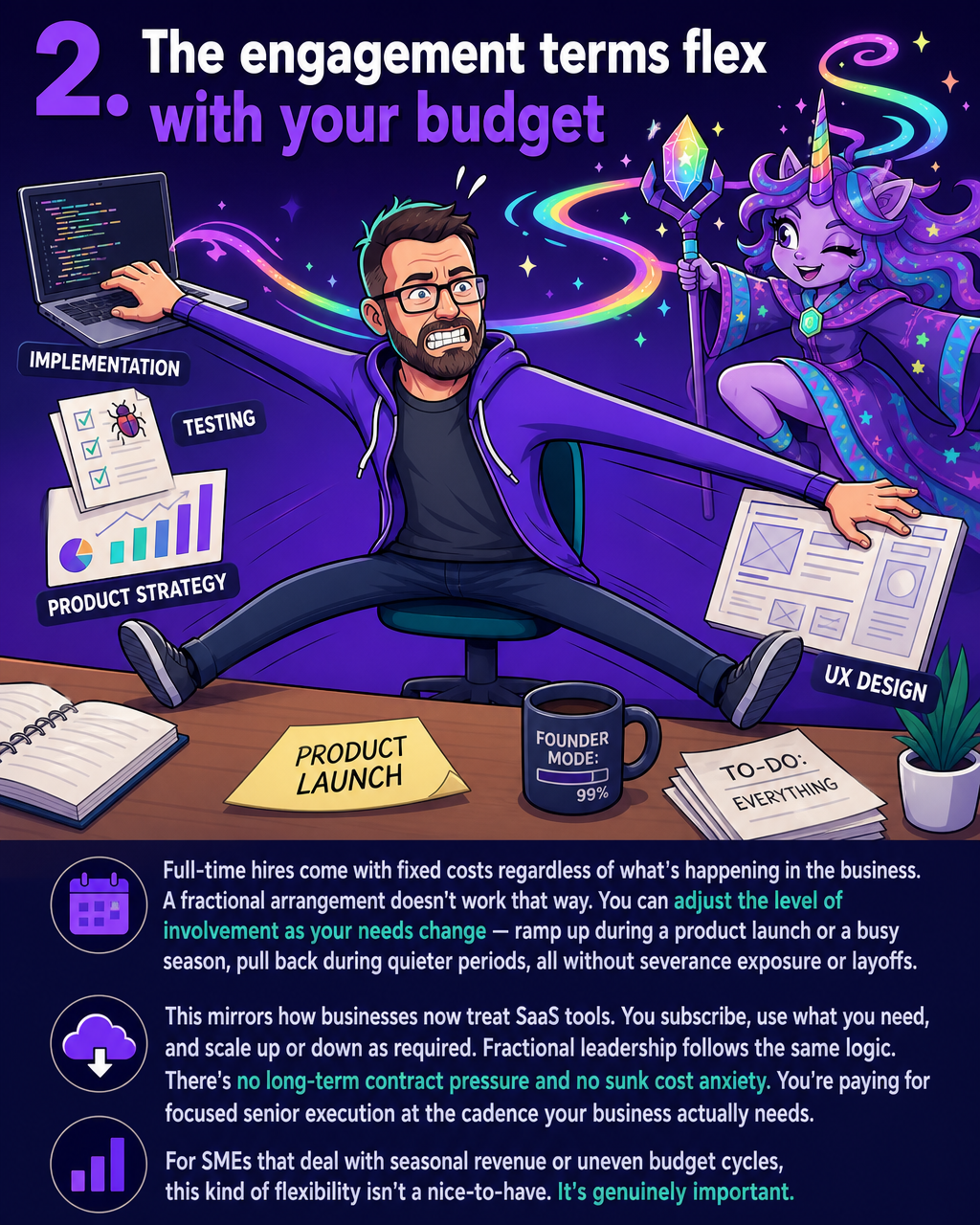
2. The engagement terms flex with your budget
Full-time hires come with fixed costs regardless of what's happening in the business. A fractional arrangement doesn't work that way. You can adjust the level of involvement as your needs change — ramp up during a product launch or a busy season, pull back during quieter periods, all without severance exposure or layoffs.
This mirrors how businesses now treat SaaS tools. You subscribe, use what you need, and scale up or down as required. Fractional leadership follows the same logic. There's no long-term contract pressure and no sunk cost anxiety. You're paying for focused senior execution at the cadence your business actually needs.
For SMEs that deal with seasonal revenue or uneven budget cycles, this kind of flexibility isn't a nice-to-have. It's genuinely important.
3. It reduces the risk of over-relying on one person
Many SMEs rely on a single internal generalist to cover finance, operations, HR, and strategy all at once. That person is almost certainly stretched thin, and when they leave, there's no handover plan.
Bringing in a fractional specialist for a specific function breaks that dependency. Instead of one person holding institutional knowledge across four domains, you have a specialist focused on one — and one who is professionally incentivised to document what they do, because their value is in outcomes, not in being indispensable. Fractional arrangements can create focused accountability, because the engagement is typically scoped around specific deliverables rather than presence.
That said, divided attention is a real trade-off: most fractional executives work across several clients simultaneously, which means your business is not their only priority. That's worth factoring into how you structure the relationship.
The risk of single-person dependency is distributed. The business becomes less brittle.
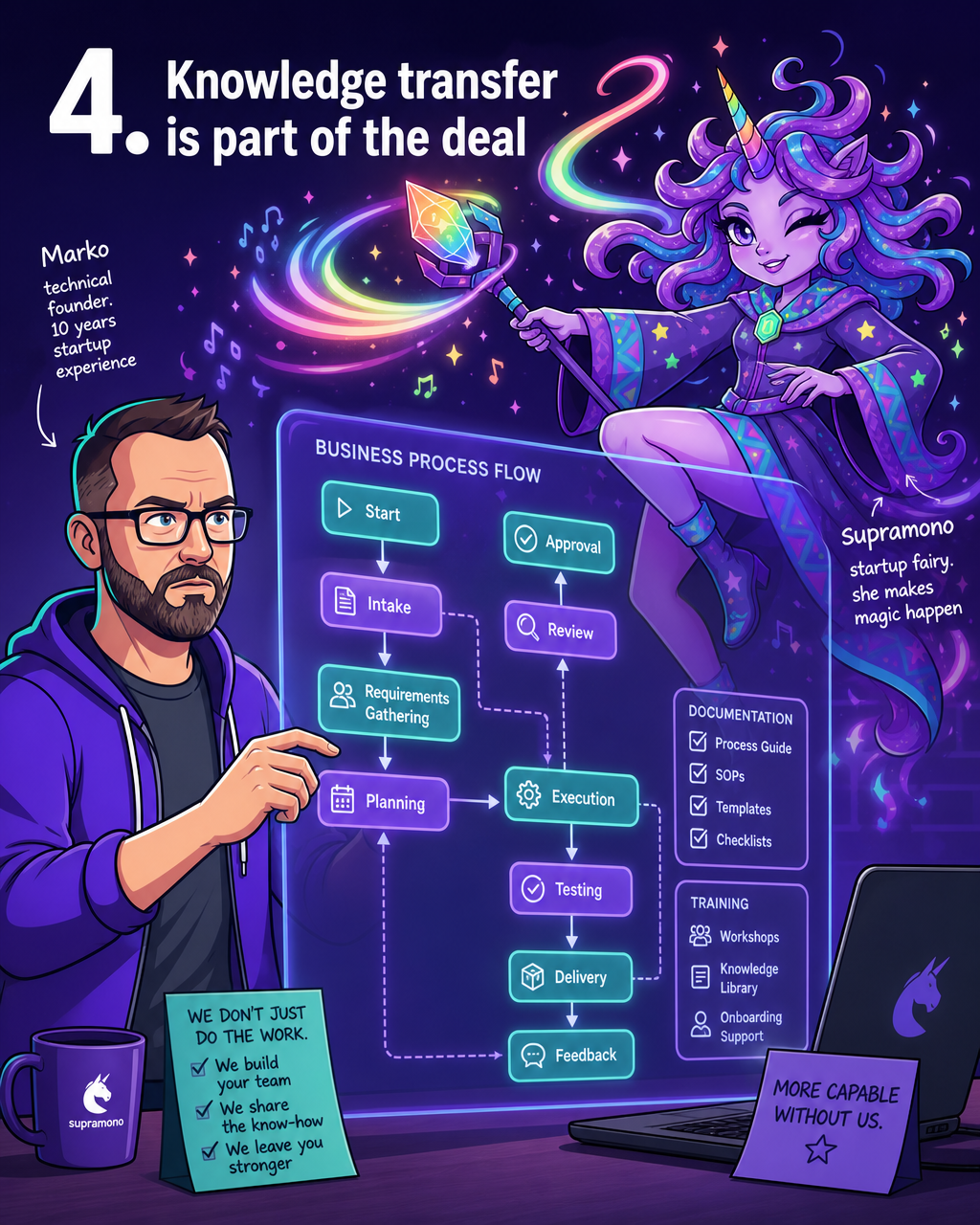
4. Knowledge transfer is part of the deal
Good fractional professionals don't just do the work. They build your team's capacity to handle more of it over time. They document processes, train internal staff, and set up systems that outlast the engagement.
This is different from how most agencies or consultants operate. A consultant advises. A fractional executive leads, manages teams, and is accountable for outcomes — and a meaningful part of that accountability is leaving the business in better shape than they found it. You don't end up dependent on them. You end up more capable without them.
In practice, how well this works varies significantly by individual and by how clearly the engagement is scoped. Knowledge transfer quality is worth building into the brief and contract terms explicitly.
If you're an SME owner who wants to eventually hire full-time, a well-structured fractional engagement can help you define what that role actually needs to be before you commit.
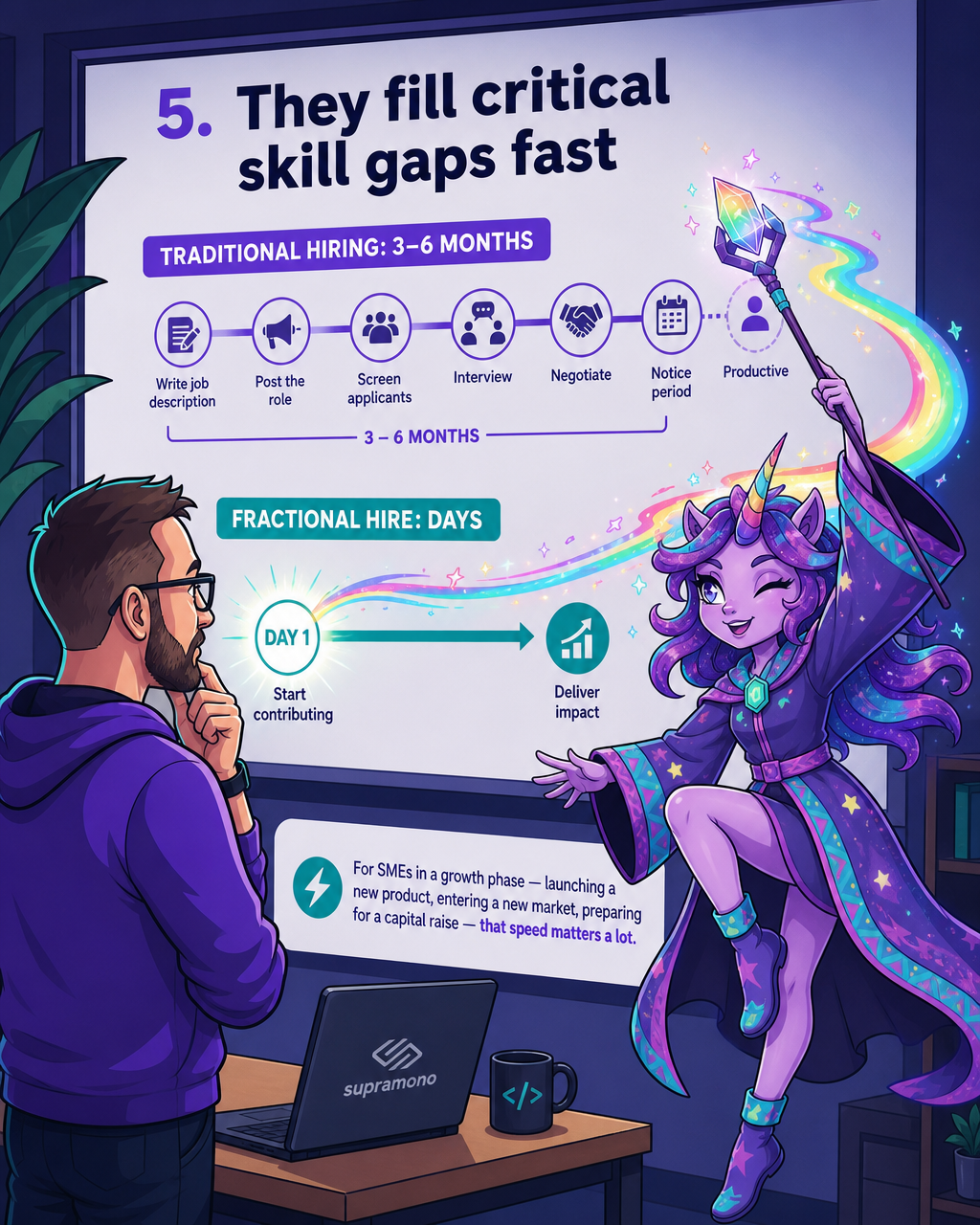
5. They fill critical skill gaps fast
Traditional hiring takes time. Writing the job description, posting it, screening applicants, interviewing, negotiating, waiting out a notice period — you're looking at three to six months before someone is actually productive. For a growing business, that's a long time to operate without a critical function covered.
Fractional hires move faster. A well-matched fractional executive can begin contributing within days. Research suggests senior hires can take six months or more to reach full productivity in a new organisation; fractional executives typically ramp more quickly because they've solved similar problems before. They don't need orientation on how the job is done; they need orientation on your business specifically.
For SMEs in a growth phase — launching a new product, entering a new market, preparing for a capital raise — that speed matters a lot.
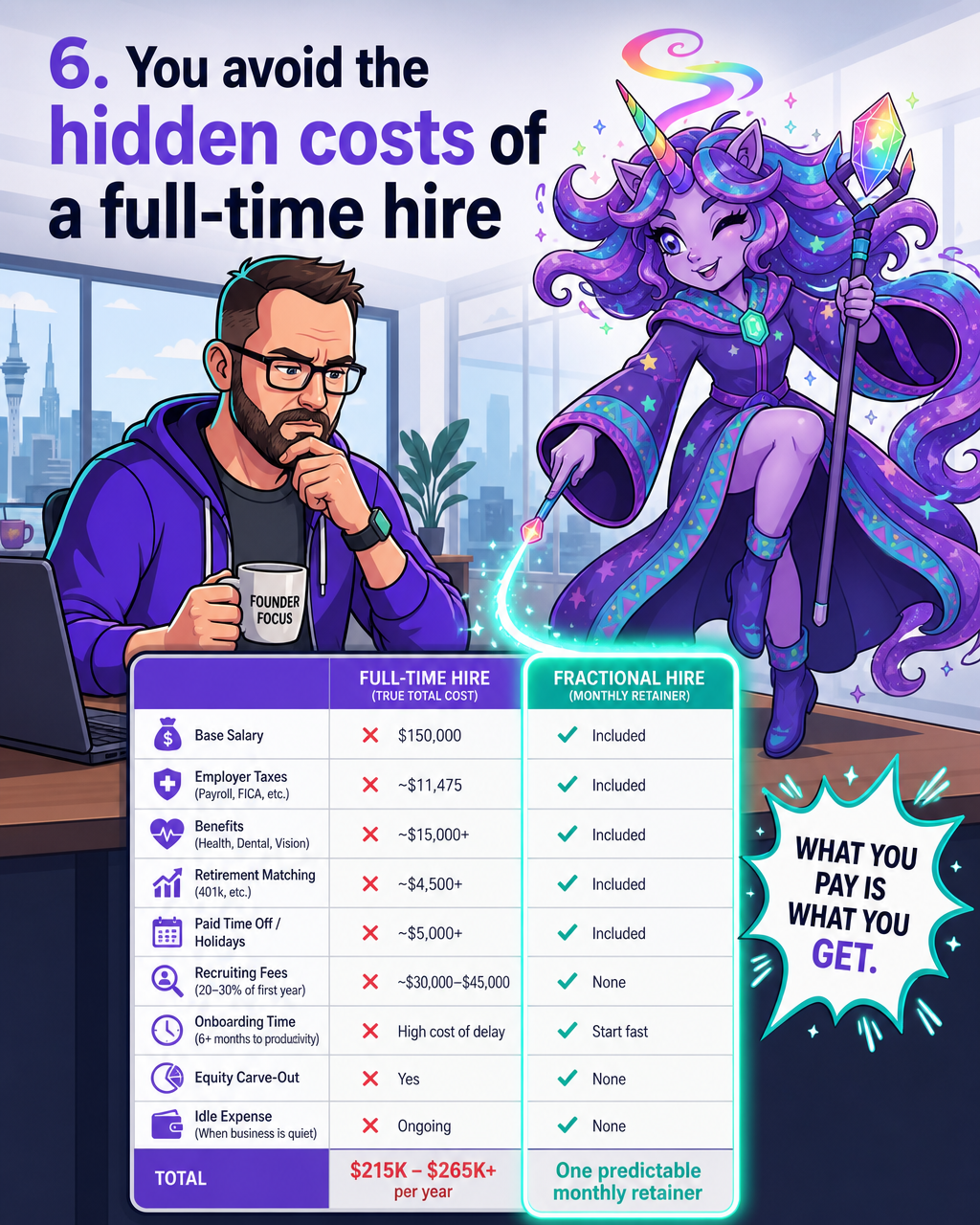
6. You avoid the hidden costs of a full-time hire
The headline salary is only part of what a full-time hire actually costs. Employer-side benefit costs in the US add meaningfully above base salary — covering payroll taxes, health insurance, retirement matching, and paid leave — with figures varying by industry and employer size (the Bureau of Labor Statistics' Employer Costs for Employee Compensation report publishes current breakdowns). Then there are recruiting fees — executive search firms commonly charge in the range of 20 to 30% of the first year's salary, though fees vary by firm type, role seniority, and arrangement. Then onboarding time, where senior hires can take six months or more to reach full productivity.
With a fractional hire, the monthly retainer is the total cost. No employer taxes on top. No recruiting fee. No equity carve-out. No idle expense when the business is quiet. What you pay is what you get.
7. You get an outside perspective, not an internal one
When someone has worked inside your business for a long time, they carry its assumptions. They know why things are done a certain way, even when that way stopped making sense years ago. A fractional hire doesn't have that problem.
They come in with pattern recognition from other businesses and industries. They've seen what works elsewhere and what doesn't. That outside perspective often identifies problems that have been invisible to everyone on the inside — not because those people aren't smart, but because they're too close to see clearly.
It's worth noting that the fractional market is unregulated and heterogeneous. The best fractional executives bring genuine cross-industry experience and hard-won judgment — but vetting track record and references matters, because experience levels vary considerably across practitioners.
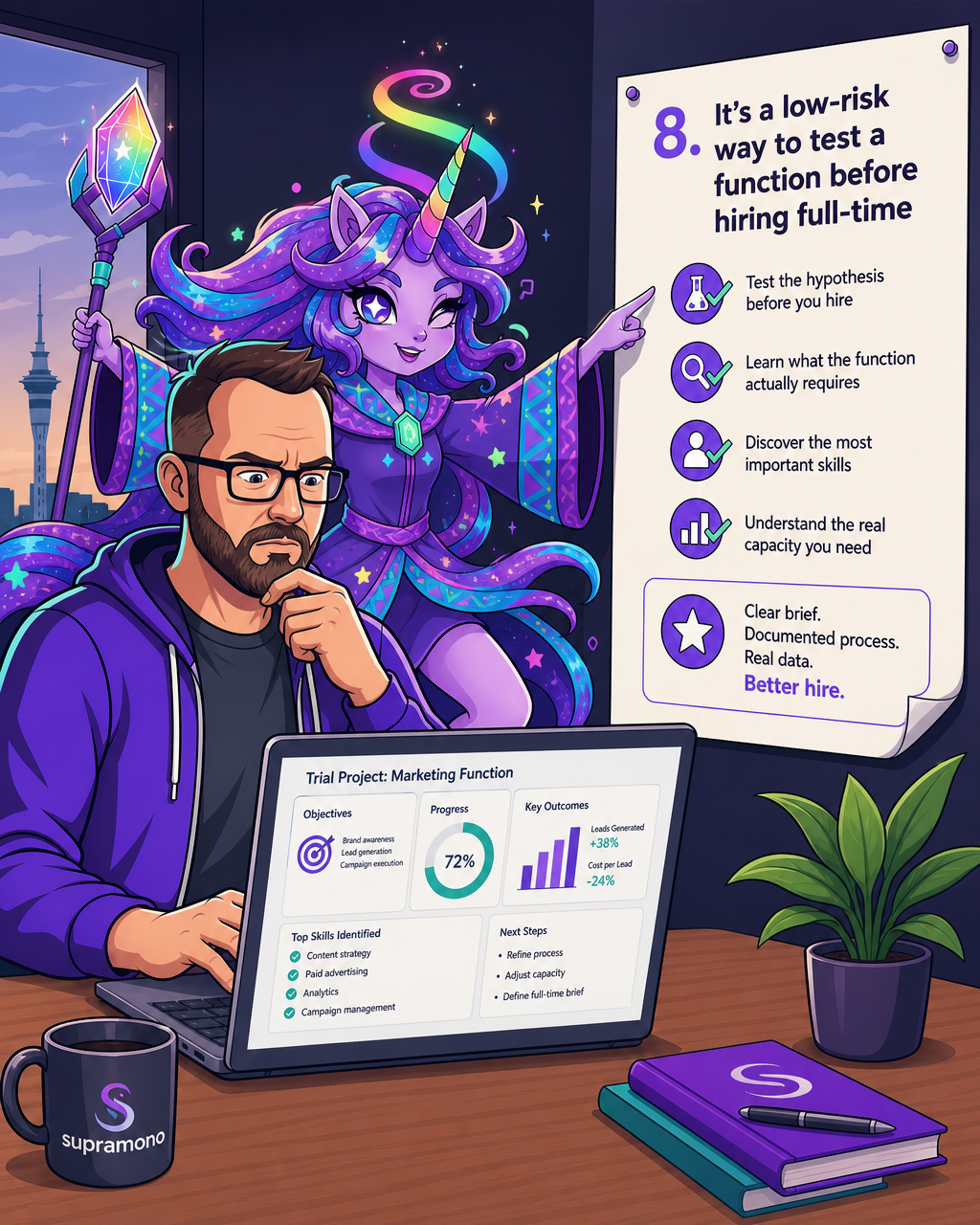
8. It's a low-risk way to test a function before hiring full-time
If you're considering building out a marketing function, a finance team, or a technology capability, a fractional engagement lets you test that hypothesis before committing to a full-time role. You learn what the function actually requires at your stage, what skills matter most, and how much capacity you really need.
By the time you're ready to hire someone full-time, you have a clear brief, a documented process, and real data on what outcomes to expect. A well-structured fractional engagement can help define what a permanent hire needs to look like before you commit. That's a more considered use of early resource than hiring full-time and hoping it works out — particularly when the wrong hire at the executive level can set a business back by months or even years.
9. Access isn't limited by geography
When you hire full-time, you're largely constrained by where your business is located or what candidates are willing to relocate. Fractional engagements work differently. Most fractional executives operate remotely across multiple client relationships, which means you can access talent from a wider pool than your local market would allow.
For SME owners in smaller cities or regions where senior specialist talent is thin on the ground, this is genuinely useful. The best fractional CFO or CMO for your business might not be based locally, and with fractional work structures, that doesn't need to be a barrier.
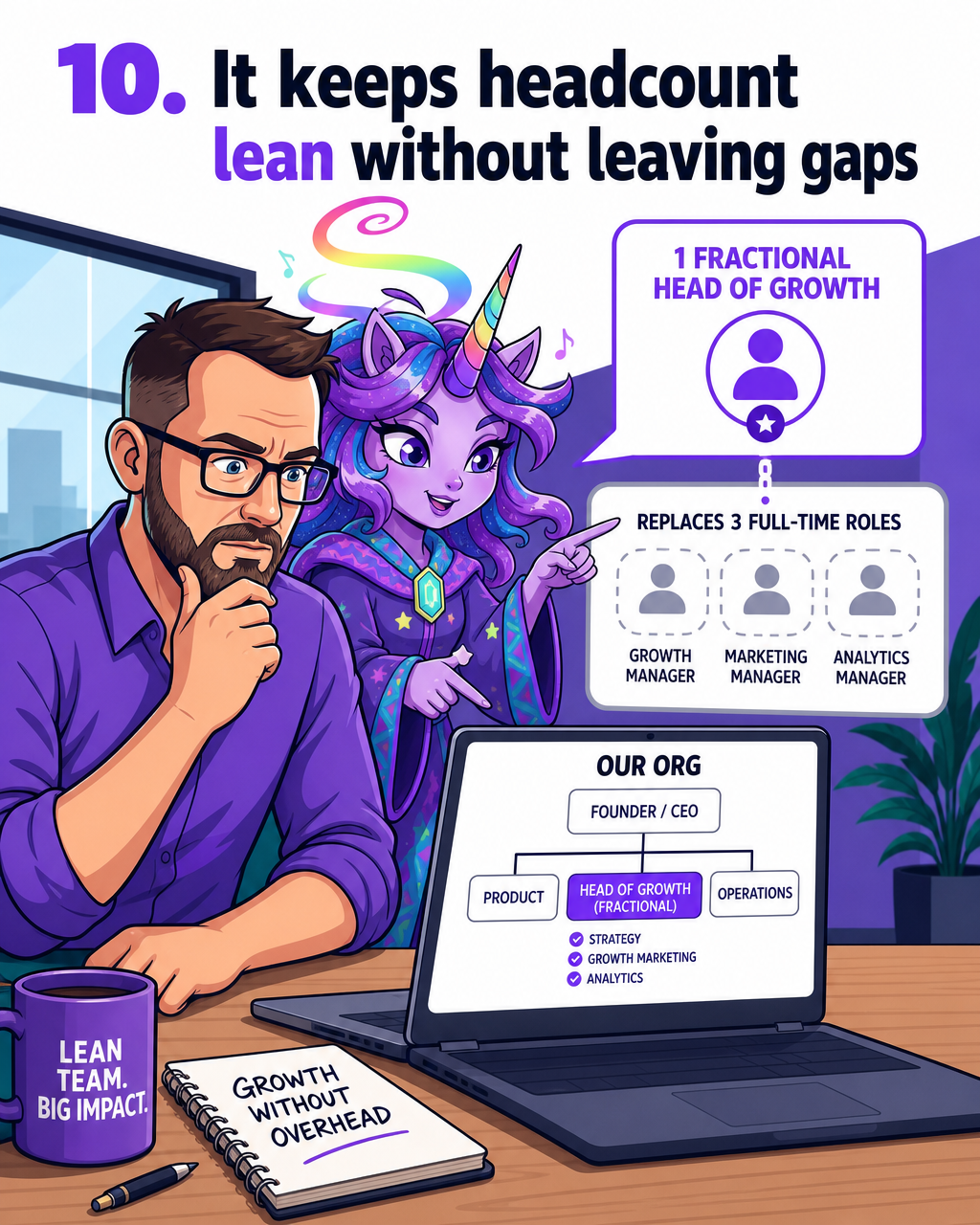
10. It keeps headcount lean without leaving gaps
For most SMEs, headcount is one of the biggest line items on the P&L. Each additional full-time employee adds fixed costs, compliance obligations, management overhead, and in some jurisdictions, increasingly complex employment protections from day one. Fractional hiring can reduce costs meaningfully compared to a full-time role at the same seniority level, with the actual saving depending on hours required and how the engagement is structured.
That saving can be redirected toward product development, marketing, or scaling operations — areas that drive growth rather than just covering it. Lean headcount with targeted fractional expertise is often a better growth model for an SME than a growing payroll of generalists.
If you want the strategic capability without the overhead, fractional hiring is one of the more practical ways to get it.
When fractional hiring doesn't work
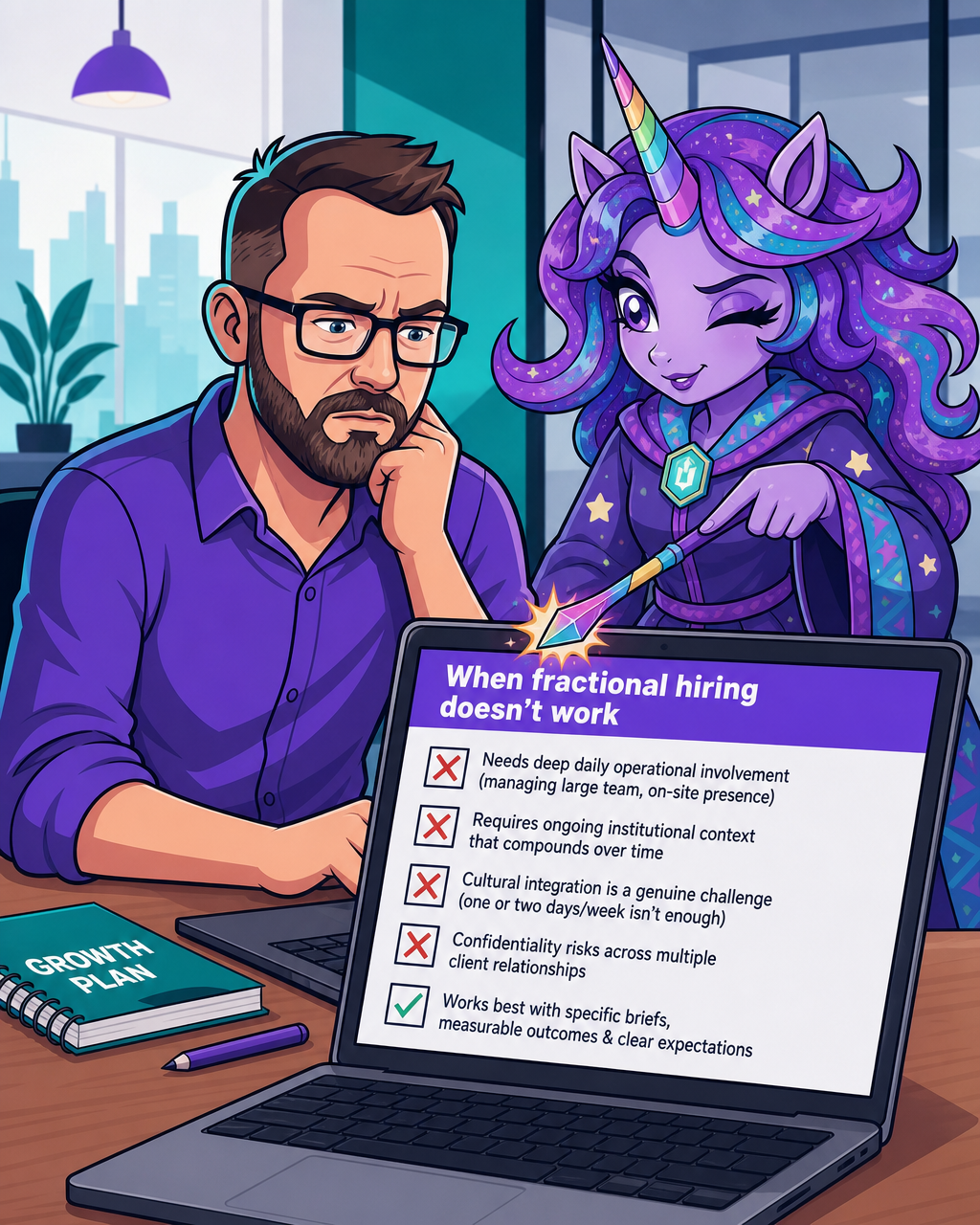
Fractional arrangements aren't the right fit for every situation. Roles that require deep daily operational involvement — managing a large team every day, being physically present on-site, or carrying ongoing institutional context that compounds over time — can be harder to fill fractionally. Cultural integration is also a genuine challenge: someone working one or two days a week sits outside the daily rhythm of the business.
Confidentiality is worth considering too. Fractional executives often work across several client relationships simultaneously, which means sharing sensitive business data with someone who operates in your competitive landscape. Contractual protections help, but the risk is real.
The model works best when the brief is specific, the outcomes are measurable, and the engagement is designed with clear expectations from the start.
A final thought
Fractional hires work best when you're clear about what problem you're solving. The more specific the brief — the gap you need filled, the outcomes you want, the hours required — the better the engagement goes. Vague briefs produce vague results regardless of how good the hire is.
Start with one function, define what success looks like in 90 days, and treat it like any other business investment: with clear expectations and honest assessment at the end.
If you're building a product business alongside your existing operation and want to think about how AI tools can help you cover more ground without adding headcount, Supramono is worth a look. The platform is built for business owners who want to move fast without building a full team from scratch.

Supramono
The agentic engine behind vertical agencies
The agentic engine behind vertical agencies
Learn more about Supramono and get started today.
Visit Supramono