Account-Based Marketing for Engineers: A Systems Thinker's Playbook


If you've ever looked at "account-based marketing" and assumed it was a fancy term for cold email, you're not alone. Most engineers who end up running their own GTM have the same reaction: vague, jargon-heavy, and suspiciously unmeasurable. But ABM is among the marketing strategies most compatible with an engineering mindset, because it's built on the same principles you already use: define your inputs precisely, instrument your system, measure outputs, and iterate based on feedback.
This article breaks ABM down for engineers and technical founders. Not as a marketing concept, but as a system you can design, build, and run.
ABM Flips the Funnel, and That's the Point
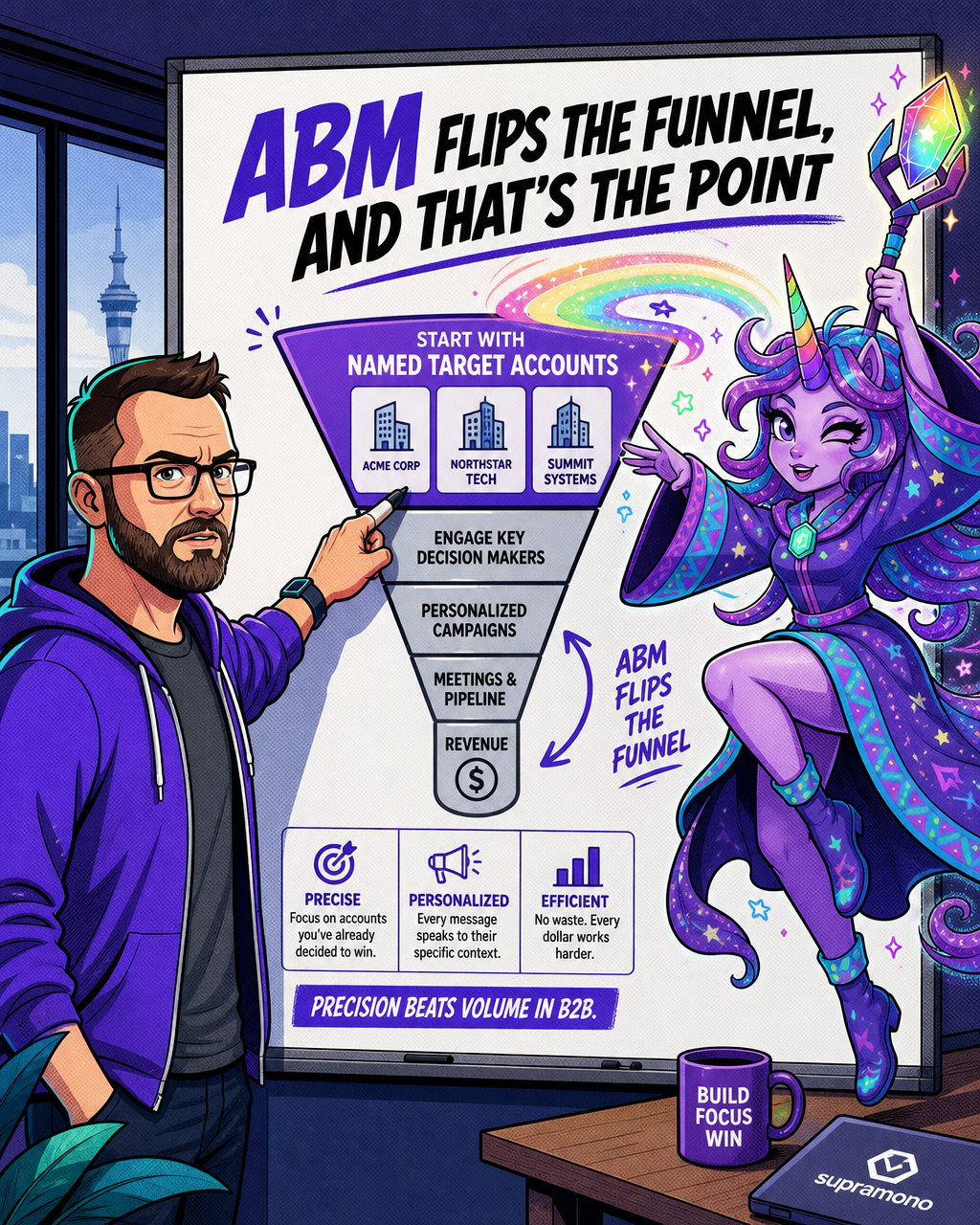
Instead of casting a wide net and hoping the right prospects engage, ABM flips the funnel: identify your highest-value target accounts first, then build personalized campaigns designed to engage the specific people who make buying decisions at those companies.
This is the core inversion. Traditional demand gen says "attract as many people as possible, then filter." ABM says "decide who you want, then go get them." For engineers, this should feel immediately familiar. You don't design a system to accept arbitrary input and then figure out what to do with it. You define your schema first.
The practical difference is significant. When you start with a precise list of named target accounts, every piece of content, every outbound message, and every ad dollar gets pointed at organizations you've already decided are worth winning. There's no waste baked into the model.
ABM practitioners and research firms including ITSMA have long argued that precision targeting delivers stronger ROI than broad demand generation in B2B contexts — the intuition being that focused effort on pre-qualified accounts reduces wasted spend. Independent verification of specific figures varies by study, so treat any single number as directional rather than definitive. That logic isn't surprising once you understand why: precision beats volume in B2B, especially when your product has a narrow ideal customer profile.
Think of It as a System Architecture Problem
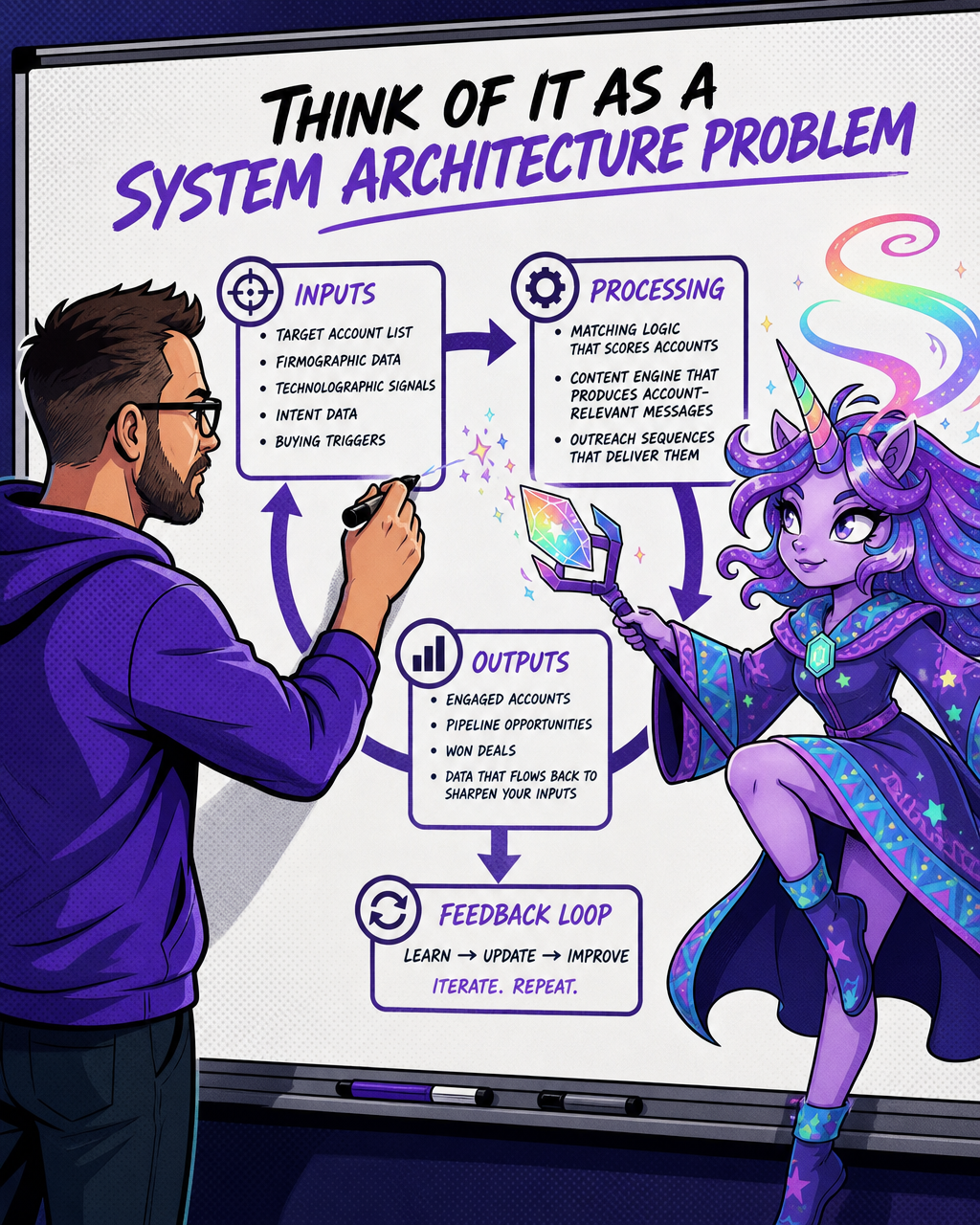
Here's a mental model that might help. An ABM program is a closed-loop system with three core components:
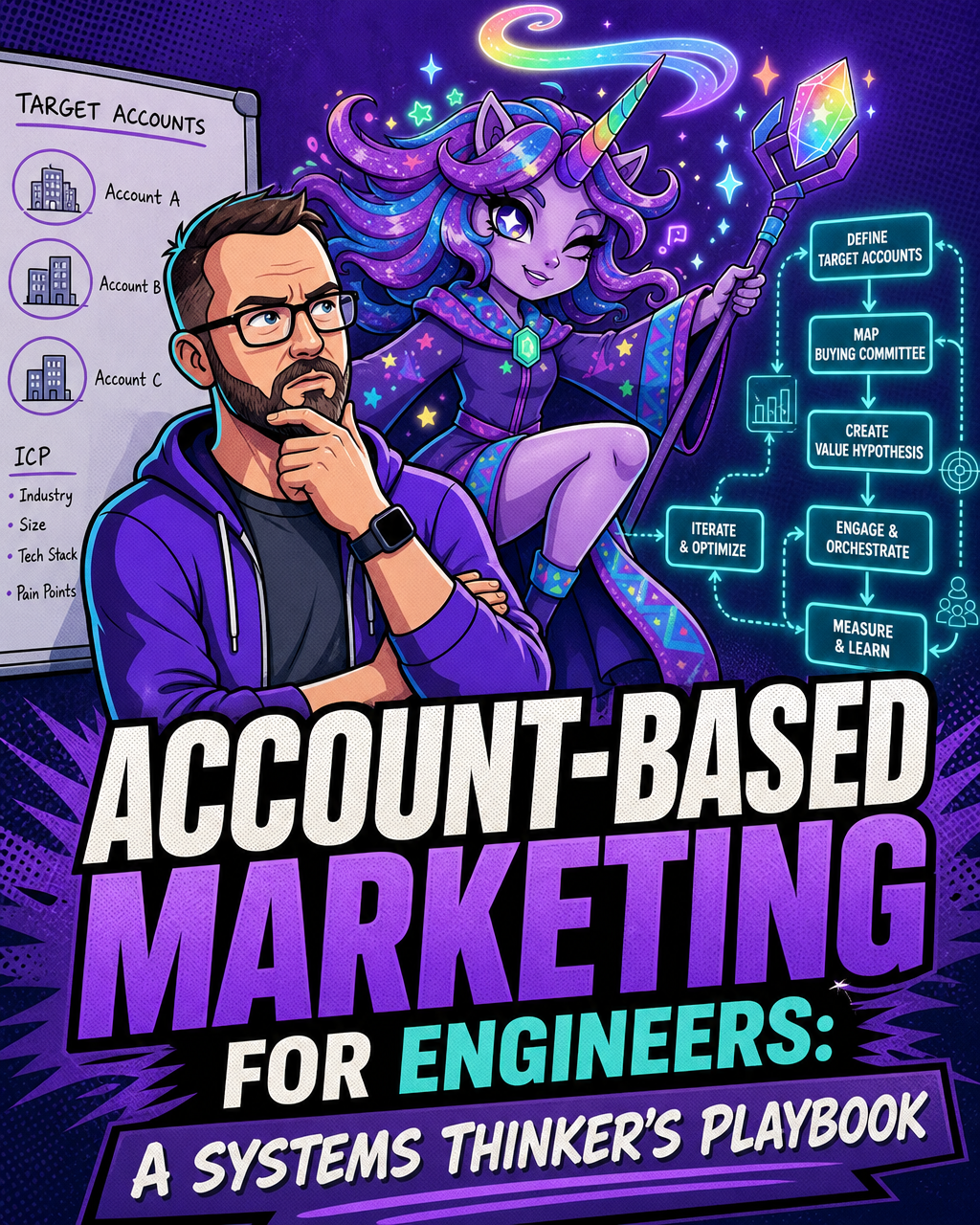
Inputs: your target account list, firmographic data, technographic signals, intent data, buying triggers.
Processing: the matching logic that scores accounts, the content engine that produces account-relevant messages, the outreach sequences that deliver them.
Outputs: engaged accounts, pipeline opportunities, won deals, and, critically, data that flows back to sharpen your inputs.
Account-based marketing isn't a one-off campaign; it's an always-on, data-driven system. It's an architecture designed for efficiency, precision, and scalability. By applying engineering principles, defining a clear schema, building a clean database, using the right tools, and establishing feedback loops, you can build a B2B marketing machine that's as elegant and effective as a well-written piece of code.
The feedback loop is where most early ABM programs break down. Marketers run campaigns, see some results, and don't systematically update the account list or scoring model. Engineers tend to be better at this instinctively: you ran a test, you got a result, now you update the model. That's all iteration in ABM is.
Account Selection Is Requirements Gathering
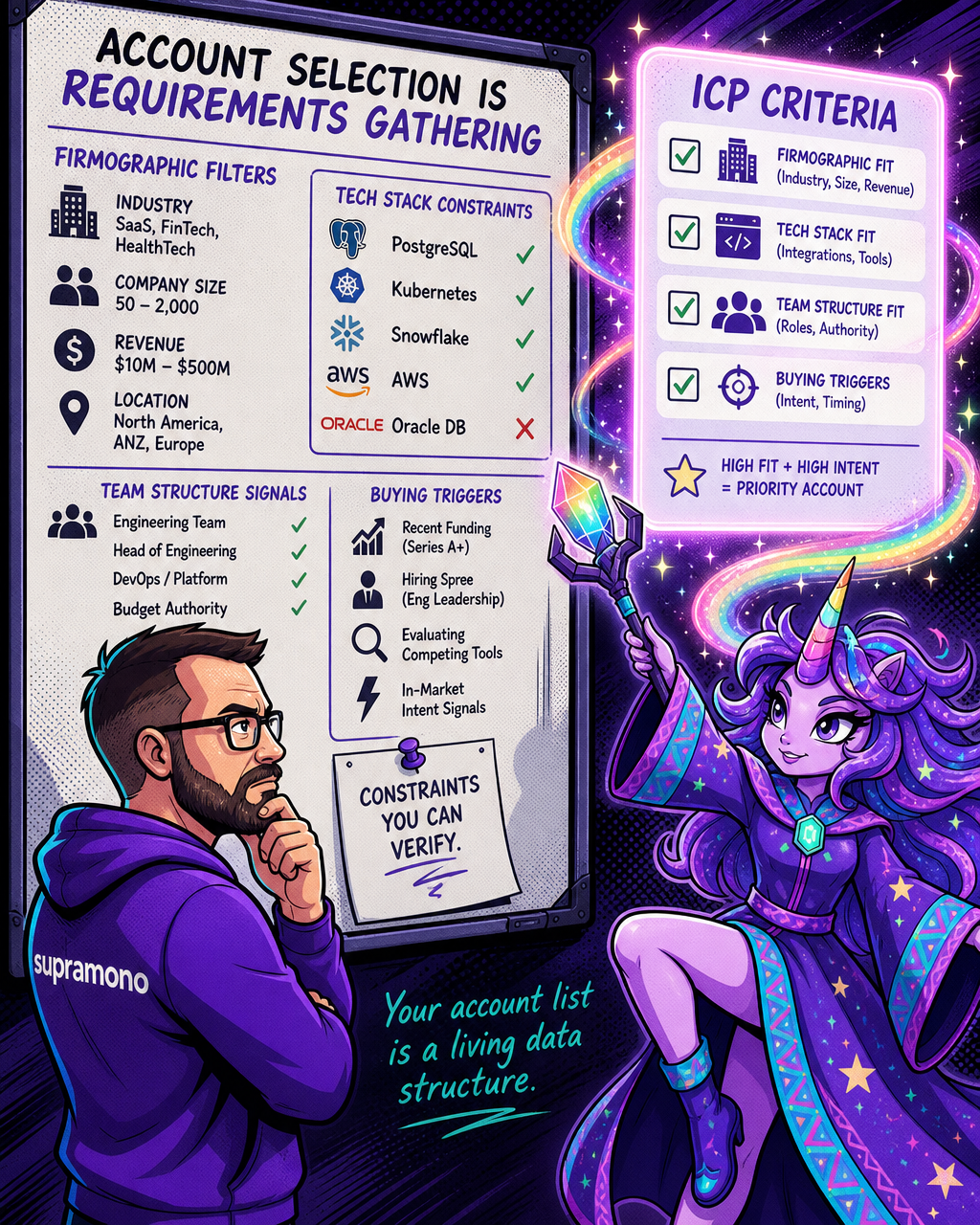
Building your target account list isn't a sales job. It's requirements gathering. You're defining the constraints that a qualifying account must satisfy before you invest time in it.
Think of it like writing acceptance criteria for your ideal customer. What's the minimum viable firmographic spec? What does their tech stack tell you about fit? What team structure signals that they have budget authority and a real problem you can solve?
Firmographic data provides the foundation, identifying high-value firms through company attributes such as industry, size, and revenue. Technographic data offers insights into the technology stack and tools target accounts use, enabling pitches that align with existing systems.
For a technical founder, the technographic layer is often the most natural starting point. If your product integrates with Postgres, there's no point targeting companies running Oracle at their core. If you solve a problem in Kubernetes deployments, your ICP probably has a certain kind of engineering team. These aren't guesses. They're constraints you can verify.
Buying triggers add a time dimension to your selection criteria. A company that just raised a Series A, posted three engineering leadership roles, or started evaluating competing tools isn't just a fit account. It's a fit account that's probably in-market right now. Intent data in ABM means understanding which accounts are actively researching problems you solve, so you can time your outreach to when they're most receptive. Industry practitioners commonly estimate that only a small fraction of B2B accounts — often cited as roughly 5% — are actively in a buying mode at any given time, which means identifying and reaching the right accounts at the right moment is far more valuable than reaching the others with a generic sequence.
Your account list is a living data structure, not a static spreadsheet. Accounts enter when they meet criteria, get tiered by fit and intent score, and exit when the signal drops or the deal is closed.
Personalization Is a Data Pipeline Problem
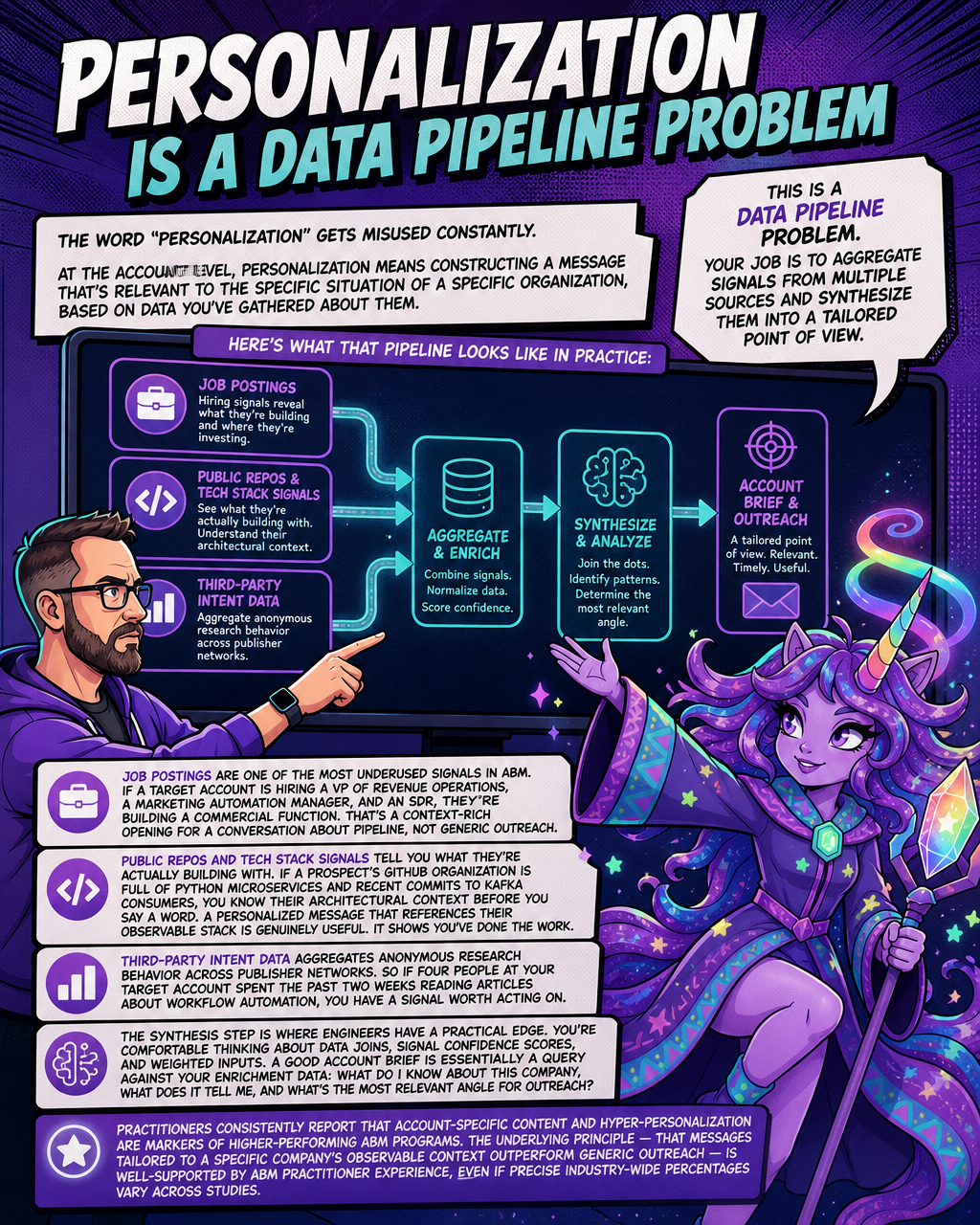
The word "personalization" gets misused constantly. Most people think it means putting someone's first name in a subject line. At the account level, personalization means constructing a message that's relevant to the specific situation of a specific organization, based on data you've gathered about them.
This is a data pipeline problem. Your job is to aggregate signals from multiple sources and synthesize them into a tailored point of view.
Here's what that pipeline looks like in practice:
Job postings are one of the most underused signals in ABM. If a target account is hiring a VP of Revenue Operations, a Marketing Automation Manager, and an SDR, they're building a commercial function. That's a context-rich opening for a conversation about pipeline, not generic outreach. B2B intent data is behavioral information that shows which companies and individuals are actively researching a problem your product solves. It tracks signals like website visits, content consumption, keyword research, job postings, and technology changes to help sales and marketing teams focus on accounts that are actually in-market right now.
Public repos and tech stack signals tell you what they're actually building with. If a prospect's GitHub organization is full of Python microservices and recent commits to Kafka consumers, you know their architectural context before you say a word. A personalized message that references their observable stack is genuinely useful. It shows you've done the work.
Third-party intent data aggregates anonymous research behavior across publisher networks. Third-party intent providers aggregate anonymous research activity across a network of publisher sites. When employees at a target company consume content related to specific topics, that activity is reported at the account level. So if four people at your target account spent the past two weeks reading articles about workflow automation, you have a signal worth acting on.
The synthesis step is where engineers have a practical edge. You're comfortable thinking about data joins, signal confidence scores, and weighted inputs. A good account brief is essentially a query against your enrichment data: what do I know about this company, what does it tell me, and what's the most relevant angle for outreach?
Practitioners consistently report that account-specific content and hyper-personalization are markers of higher-performing ABM programs. The underlying principle — that messages tailored to a specific company's observable context outperform generic outreach — is well-supported by ABM practitioner experience, even if precise industry-wide percentages vary across studies.
The Cross-Functional Challenge (Especially When You're the Whole Function)
ABM requires that whoever understands the product and whoever owns the customer relationship work from the same account list, the same signals, and the same playbook. Sales and marketing alignment is widely cited as a core prerequisite for ABM success — surveys from vendors and analysts alike consistently place it near the top of success factors, even if exact figures differ by study.
For a two-person team or a solo founder, this might sound irrelevant. But it's actually where the model gets cleaner, not messier. If you're the engineer and the GTM lead, you have zero coordination overhead. The challenge is that you have to play both roles explicitly, and most technical founders default to product thinking even when they need to be in sales mode.
The practical implication: ABM forces you to build a shared system of record. Your account list, enrichment data, touchpoint history, and next actions need to live somewhere both "marketing" and "sales" can see them, even when both are you. This is the forcing function that makes founders stop managing deals in their head.
Research from ABM platform vendors and analyst firms suggests that well-aligned ABM programs tend to produce meaningfully higher win rates and retention than misaligned ones. Treat specific figures from any single vendor study as indicative rather than universal — methodology and sample composition vary significantly. What the pattern consistently shows is that when the account context sales has gets shared with the people crafting the message, and vice versa, outcomes improve.
For founders running lean, this shared-system discipline is especially valuable. When you're using AI tools to help run your pipeline, the quality of the account context you feed those tools determines the quality of what comes out. Garbage-in, garbage-out applies to ABM just as it applies to any model.
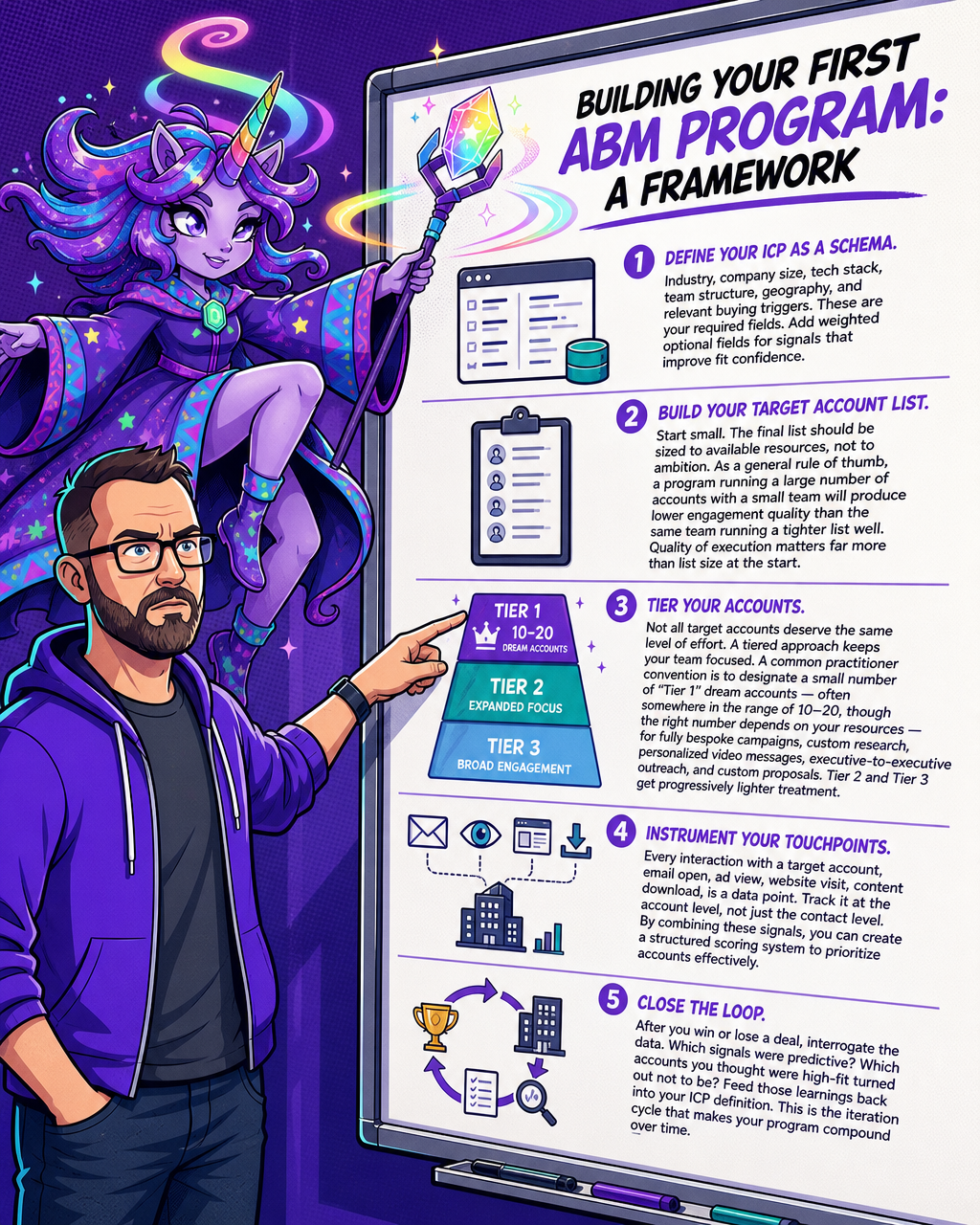
Building Your First ABM Program: A Framework
Here's a starting point that should feel comfortable to an engineering brain:
Step 1: Define your ICP as a schema. Industry, company size, tech stack, team structure, geography, and relevant buying triggers. These are your required fields. Add weighted optional fields for signals that improve fit confidence.
Step 2: Build your target account list. Start small. The final list should be sized to available resources, not to ambition. As a general rule of thumb, a program running a large number of accounts with a small team will produce lower engagement quality than the same team running a tighter list well. Quality of execution matters far more than list size at the start.
Step 3: Tier your accounts. Not all target accounts deserve the same level of effort. A tiered approach keeps your team focused. A common practitioner convention is to designate a small number of "Tier 1" dream accounts — often somewhere in the range of 10–20, though the right number depends on your resources — for fully bespoke campaigns, custom research, personalized video messages, executive-to-executive outreach, and custom proposals. Tier 2 and Tier 3 get progressively lighter treatment.
Step 4: Instrument your touchpoints. Every interaction with a target account, email open, ad view, website visit, content download, is a data point. Track it at the account level, not just the contact level. By combining these signals, you can create a structured scoring system to prioritize accounts effectively.
Step 5: Close the loop. After you win or lose a deal, interrogate the data. Which signals were predictive? Which accounts you thought were high-fit turned out not to be? Feed those learnings back into your ICP definition. This is the iteration cycle that makes your program compound over time.
The Compounding Advantage
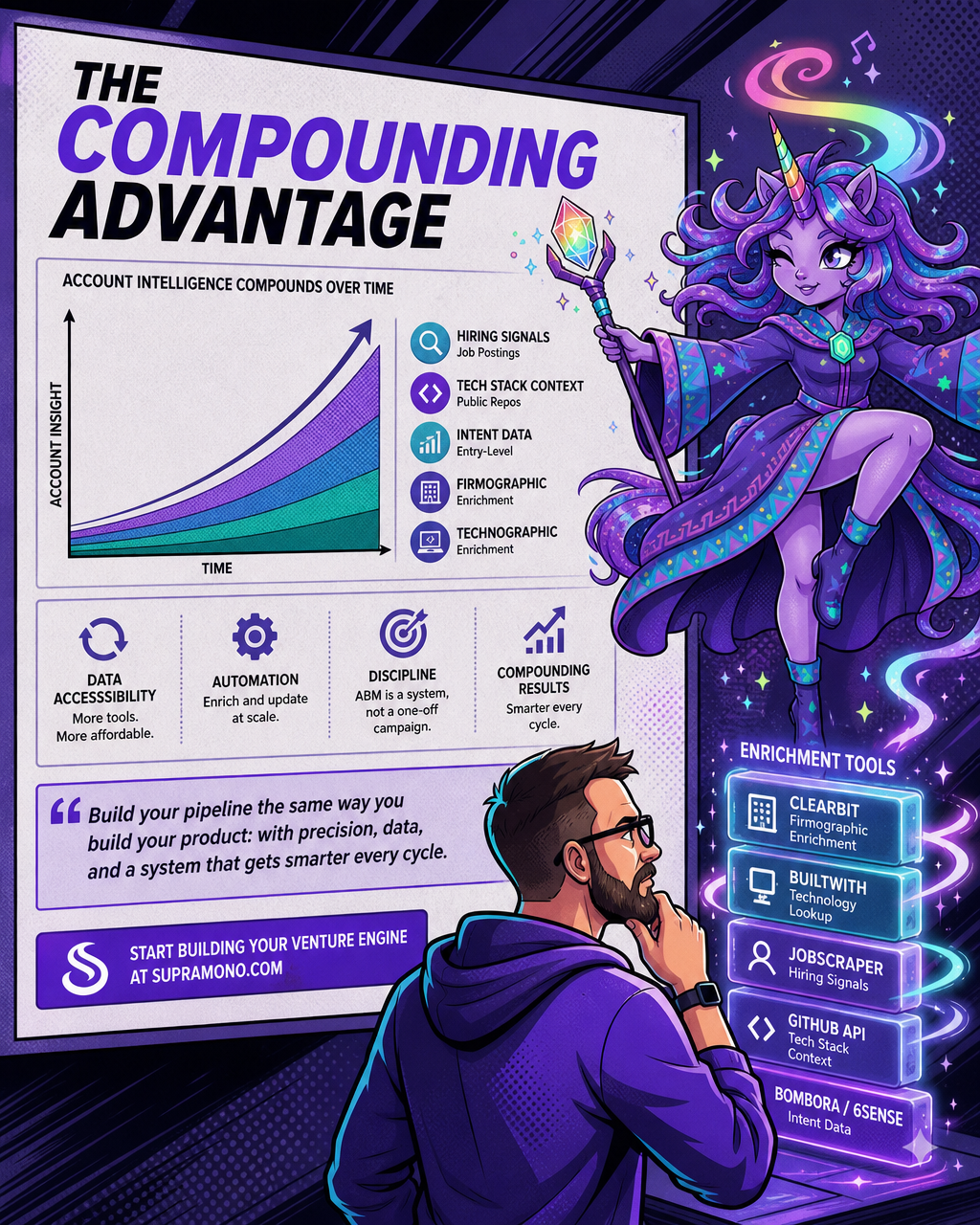
Here's what makes ABM particularly well-suited to technical founders building in 2026: the tools to run a credible ABM program have become meaningfully more accessible than they were a few years ago. You can scrape job postings for hiring signals. You can check public repos for tech stack context. Entry-level intent data is available at lower price points than it once was, though full-featured providers like Bombora or 6sense still carry price tags that may be prohibitive for bootstrapped founders. Firmographic and technographic enrichment tools have similarly expanded in range and cost. You can automate enrichment through tools that aggregate this data at a range of price points.
It's worth being honest about where the real constraint lies: for some very early-stage or pre-revenue founders, data access and tooling cost genuinely are barriers. But in our experience, once founders have cleared those thresholds, the more common failure mode is discipline — treating ABM like a campaign that runs once rather than a system that needs ongoing maintenance.
Industry surveys conducted in recent years consistently show growing investment in ABM and optimism about AI's role in improving ABM ROI. The directional trend is clear: more organizations are adopting structured account-based approaches, and AI tooling is expanding what lean teams can execute. Whether that gap between founders who understand this model and those still running spray-and-pray outreach widens will depend on how quickly adoption spreads — but the structural advantage of the approach is well-established.
If you're building a product, you already know how to define requirements, instrument a system, and iterate on data. ABM is just that, applied to your go-to-market. The mental model transfers almost directly.
The question is whether you build the system now, or wait until you need pipeline badly enough that you're building under pressure.
A note on when ABM isn't the right fit: ABM works best when you have a reasonably clear ICP and can afford a 6–18 month horizon before the program fully pays off. If you're still searching for product-market fit, your ICP is undefined, or you need near-term revenue urgently, ABM's longer feedback loops can be the wrong tradeoff. The concentration risk of a small account list also means a few lost deals can disproportionately affect results. It's worth being clear-eyed about these tradeoffs before committing to the model.
Build your pipeline the same way you build your product: with precision, data, and a system that gets smarter every cycle. Supramono gives solo founders and lean teams the AI-powered sales and marketing infrastructure to run account-based outreach without hiring a team. Discover, build, and sell, with agents that work the pipeline while you focus on the product.

Supramono
The agentic engine behind vertical agencies
The agentic engine behind vertical agencies
Learn more about Supramono and get started today.
Visit Supramono