The Marketing Funnel for Engineers: Why Stage Mismatch Kills GTM

You Built the Product. Nobody's Buying. Here's the Real Problem.
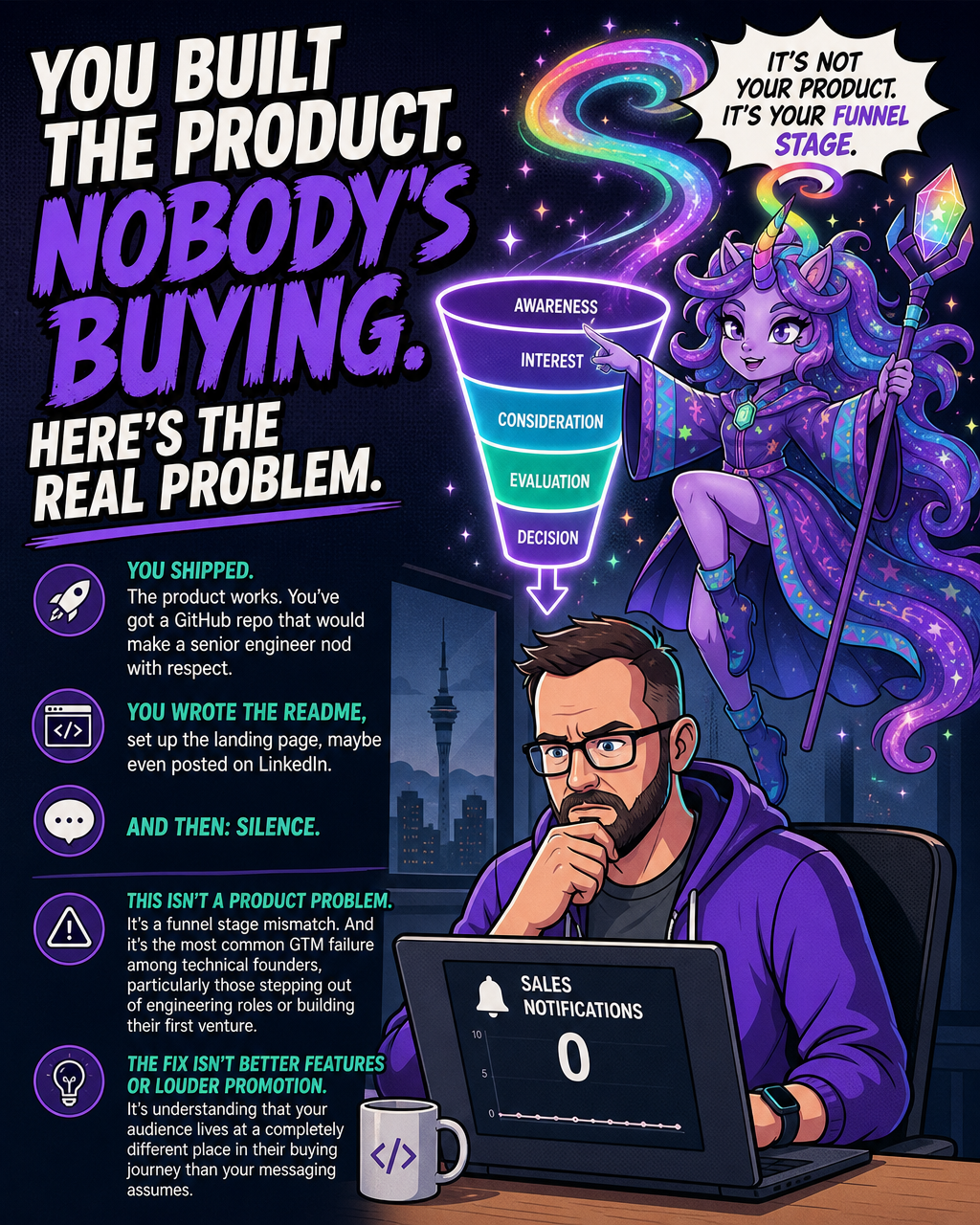
You shipped. The product works. You've got a GitHub repo that would make a senior engineer nod with respect. You wrote the README, set up the landing page, maybe even posted on LinkedIn.
And then: silence.
This isn't a product problem. It's a funnel stage mismatch. And it's the most common GTM failure among technical founders, particularly those stepping out of engineering roles or building their first venture.
The fix isn't better features or louder promotion. It's understanding that your audience lives at a completely different place in their buying journey than your messaging assumes.
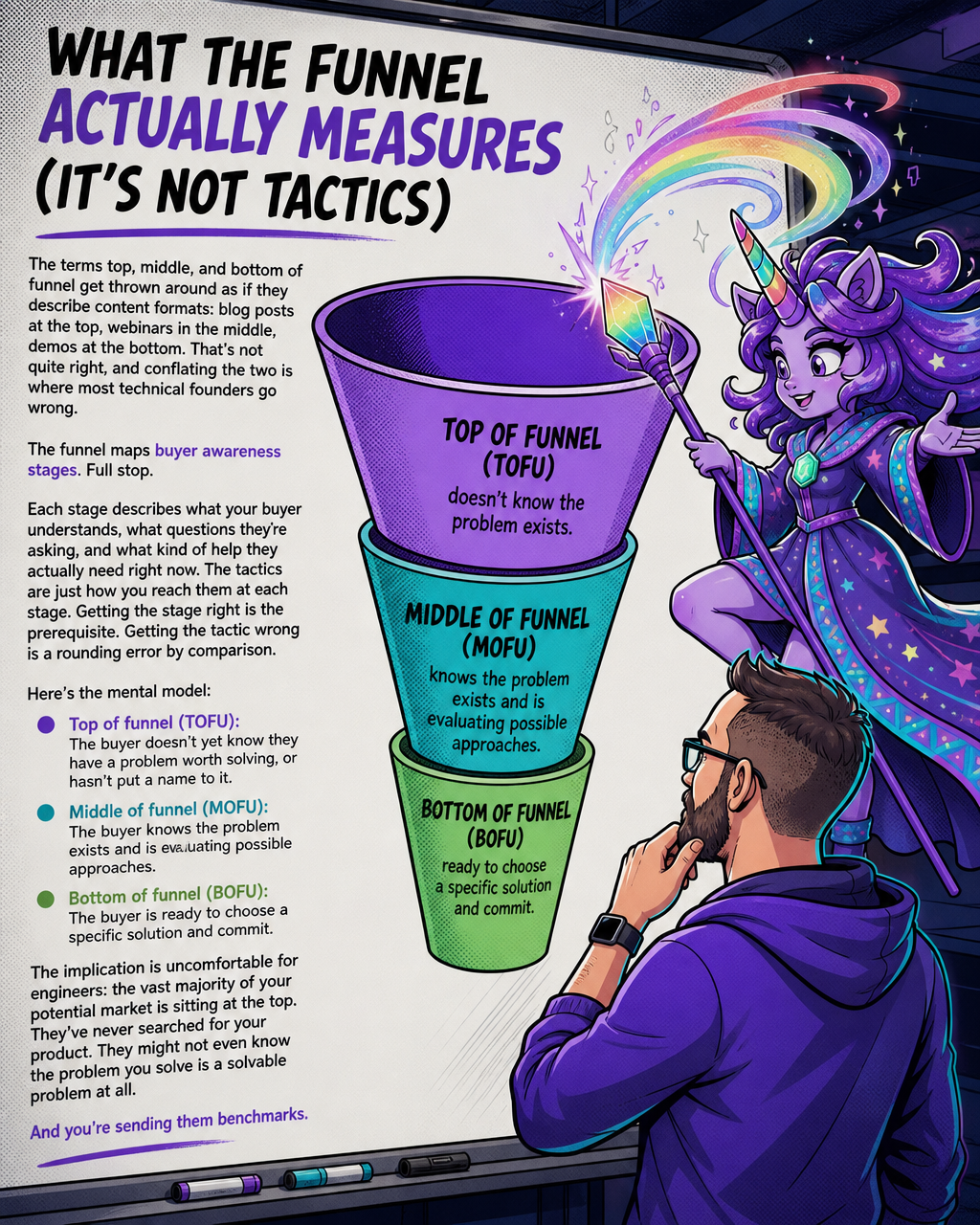
What the Funnel Actually Measures (It's Not Tactics)
The terms top, middle, and bottom of funnel get thrown around as if they describe content formats: blog posts at the top, webinars in the middle, demos at the bottom. That's not quite right, and conflating the two is where most technical founders go wrong.
The funnel maps buyer awareness stages. Full stop.
Each stage describes what your buyer understands, what questions they're asking, and what kind of help they actually need right now. The tactics are just how you reach them at each stage. Getting the stage right is the prerequisite. Getting the tactic wrong is a rounding error by comparison.
Here's the mental model:
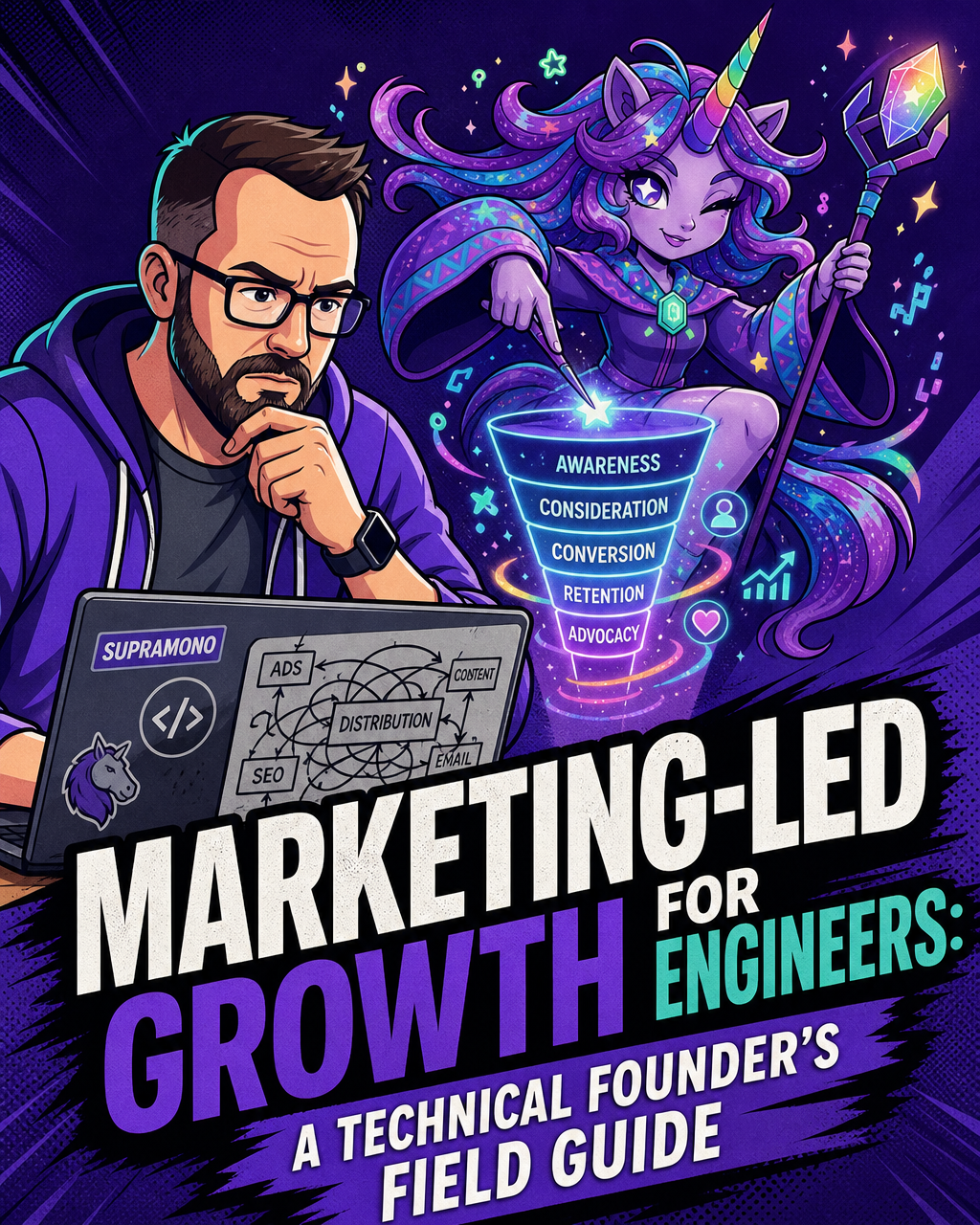
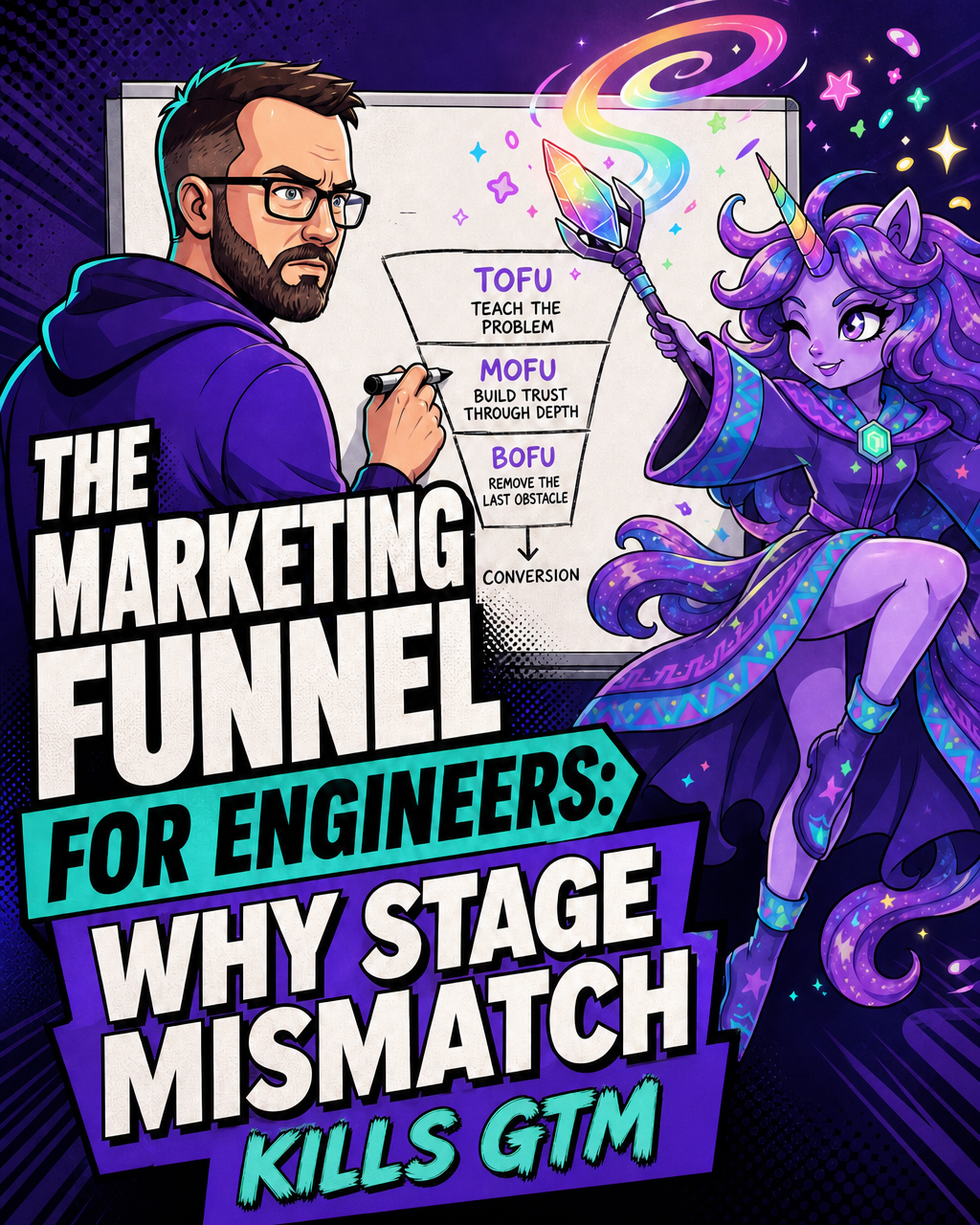
- Top of funnel (TOFU): The buyer doesn't yet know they have a problem worth solving, or hasn't put a name to it.
- Middle of funnel (MOFU): The buyer knows the problem exists and is evaluating possible approaches.
- Bottom of funnel (BOFU): The buyer is ready to choose a specific solution and commit.
The implication is uncomfortable for engineers: the vast majority of your potential market is sitting at the top. They've never searched for your product. They might not even know the problem you solve is a solvable problem at all.
And you're sending them benchmarks.
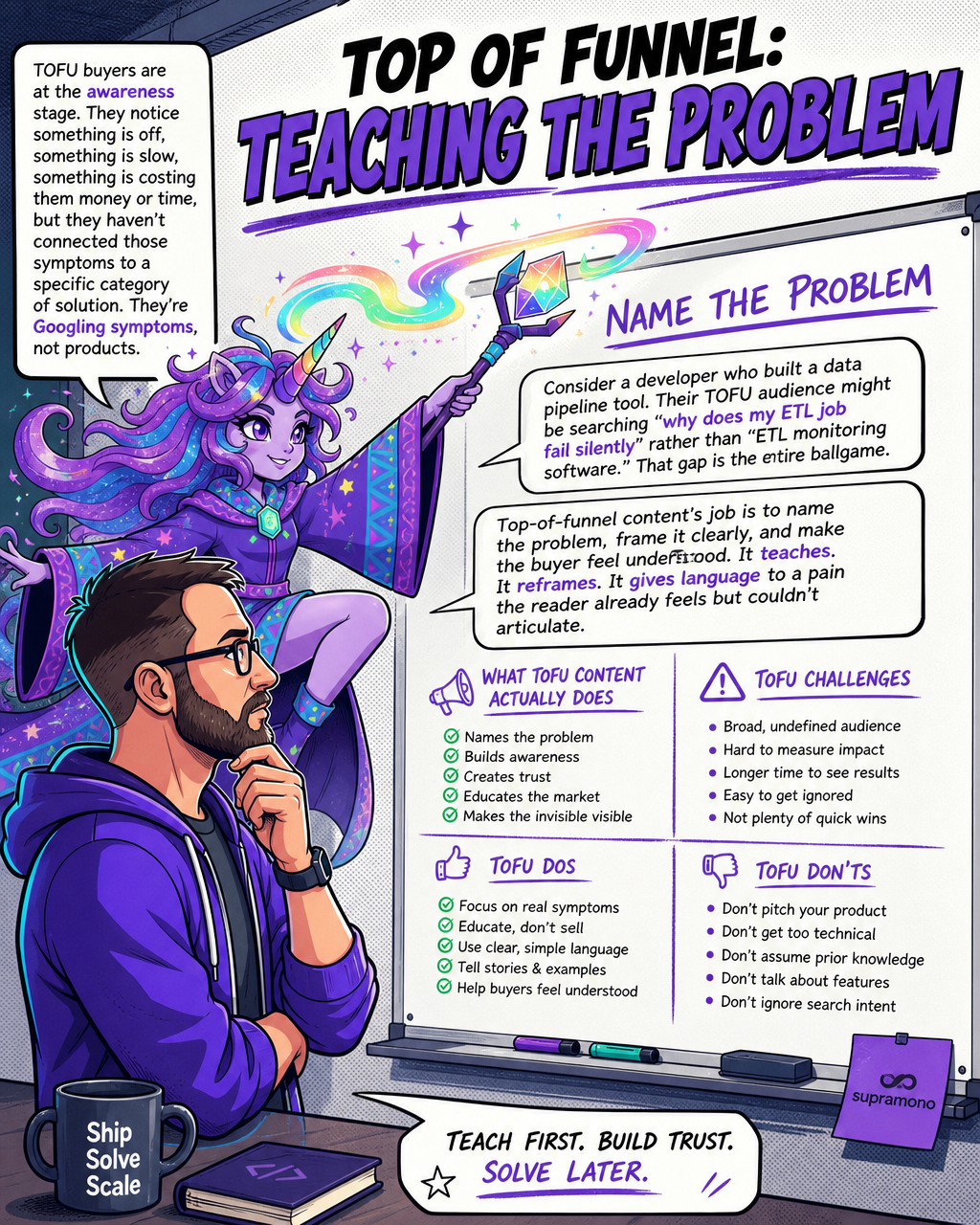
Top of Funnel: Teaching the Problem
TOFU buyers are at the awareness stage. They notice something is off, something is slow, something is costing them money or time, but they haven't connected those symptoms to a specific category of solution. They're Googling symptoms, not products.
Consider a developer who built a data pipeline tool. Their TOFU audience might be searching "why does my ETL job fail silently" rather than "ETL monitoring software." That gap is the entire ballgame.
Top-of-funnel content's job is to name the problem, frame it clearly, and make the buyer feel understood. It teaches. It reframes. It gives language to a pain the reader already feels but couldn't articulate.
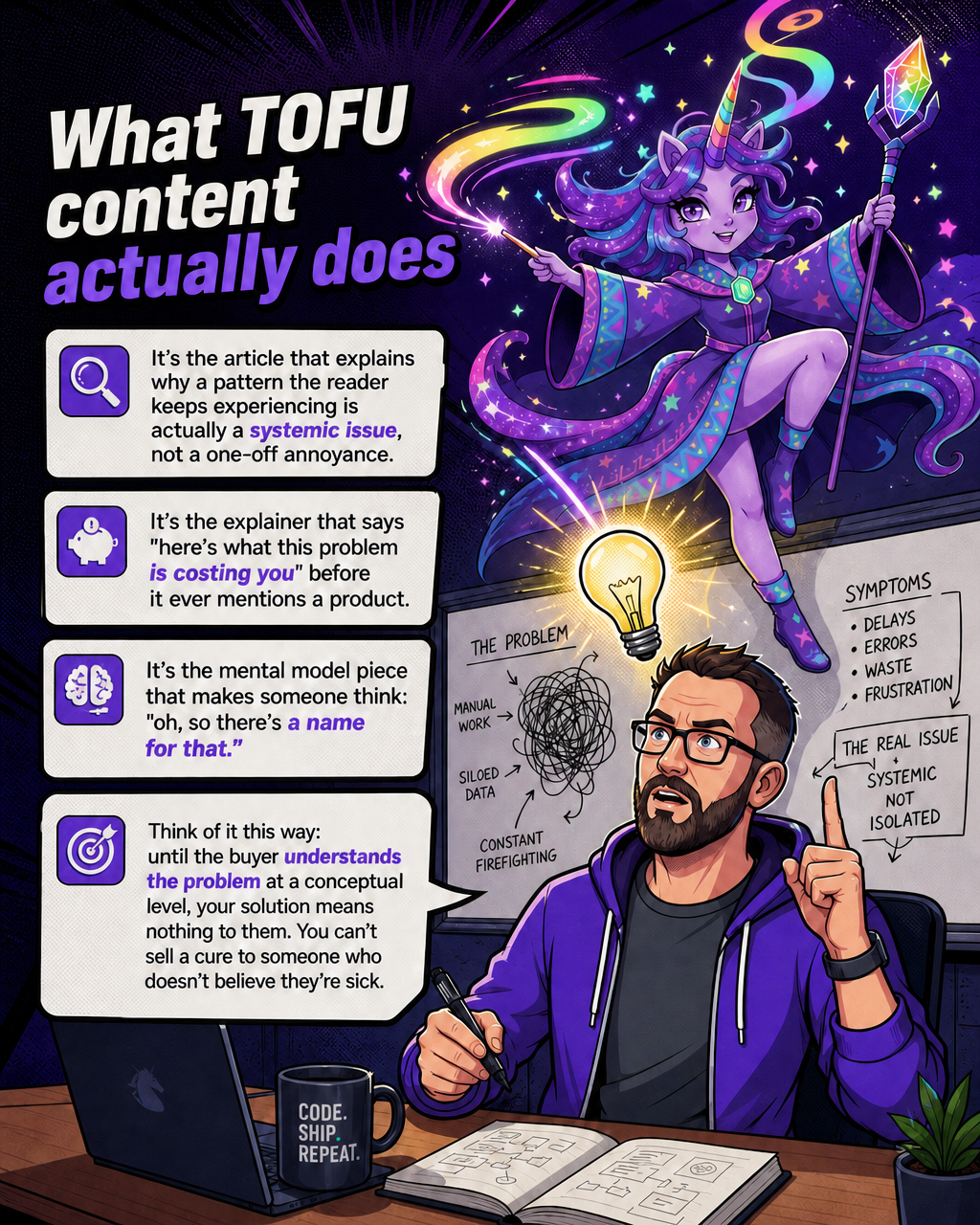
What TOFU content actually does
It's the article that explains why a pattern the reader keeps experiencing is actually a systemic issue, not a one-off annoyance. It's the explainer that says "here's what this problem is costing you" before it ever mentions a product. It's the mental model piece that makes someone think: "oh, so there's a name for that."
Think of it this way: until the buyer understands the problem at a conceptual level, your solution means nothing to them. You can't sell a cure to someone who doesn't believe they're sick.
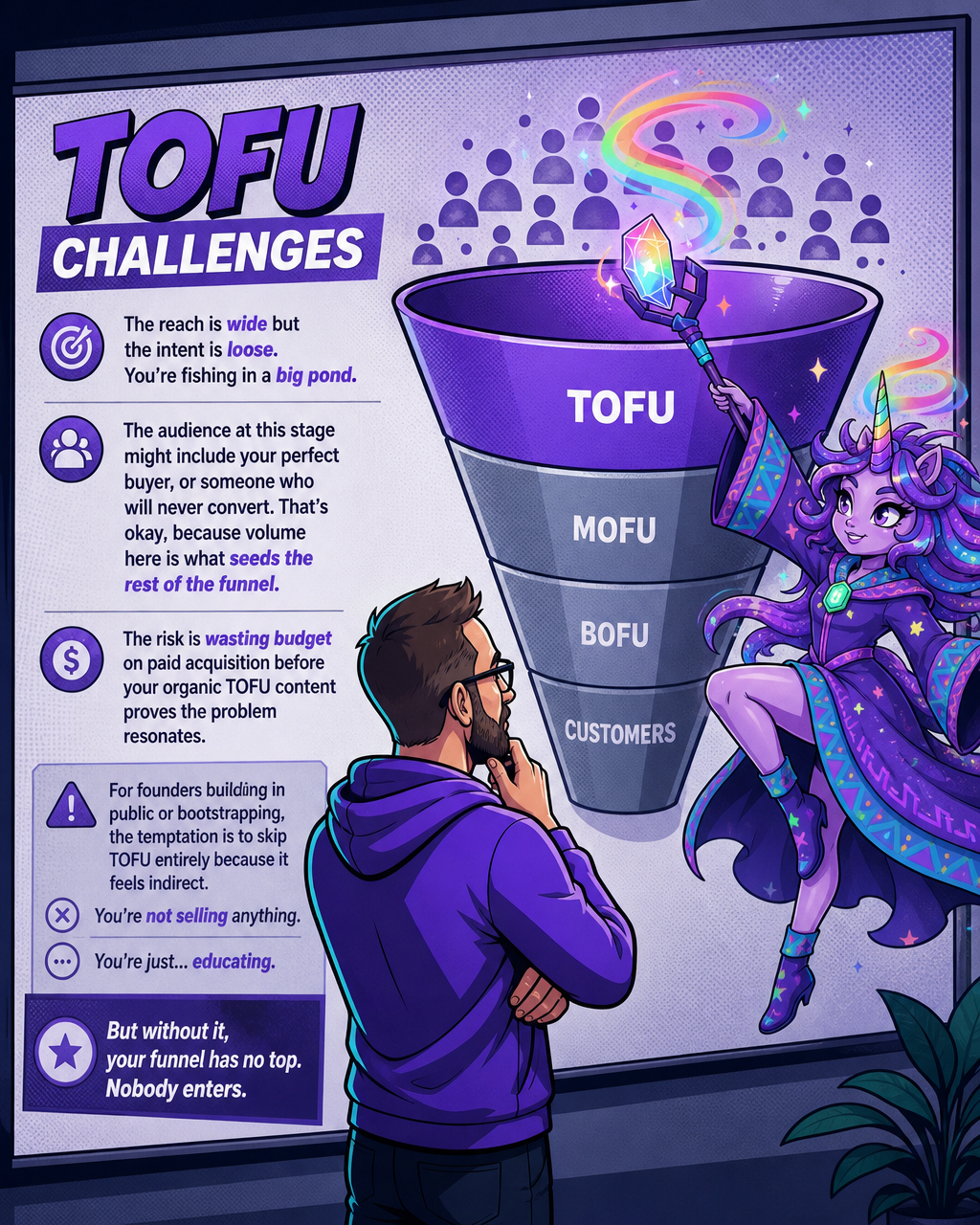
TOFU challenges
The reach is wide but the intent is loose. You're fishing in a big pond. The audience at this stage might include your perfect buyer, or someone who will never convert. That's okay, because volume here is what seeds the rest of the funnel. The risk is wasting budget on paid acquisition before your organic TOFU content proves the problem resonates.
For founders building in public or bootstrapping, the temptation is to skip TOFU entirely because it feels indirect. You're not selling anything. You're just... educating. But without it, your funnel has no top. Nobody enters.
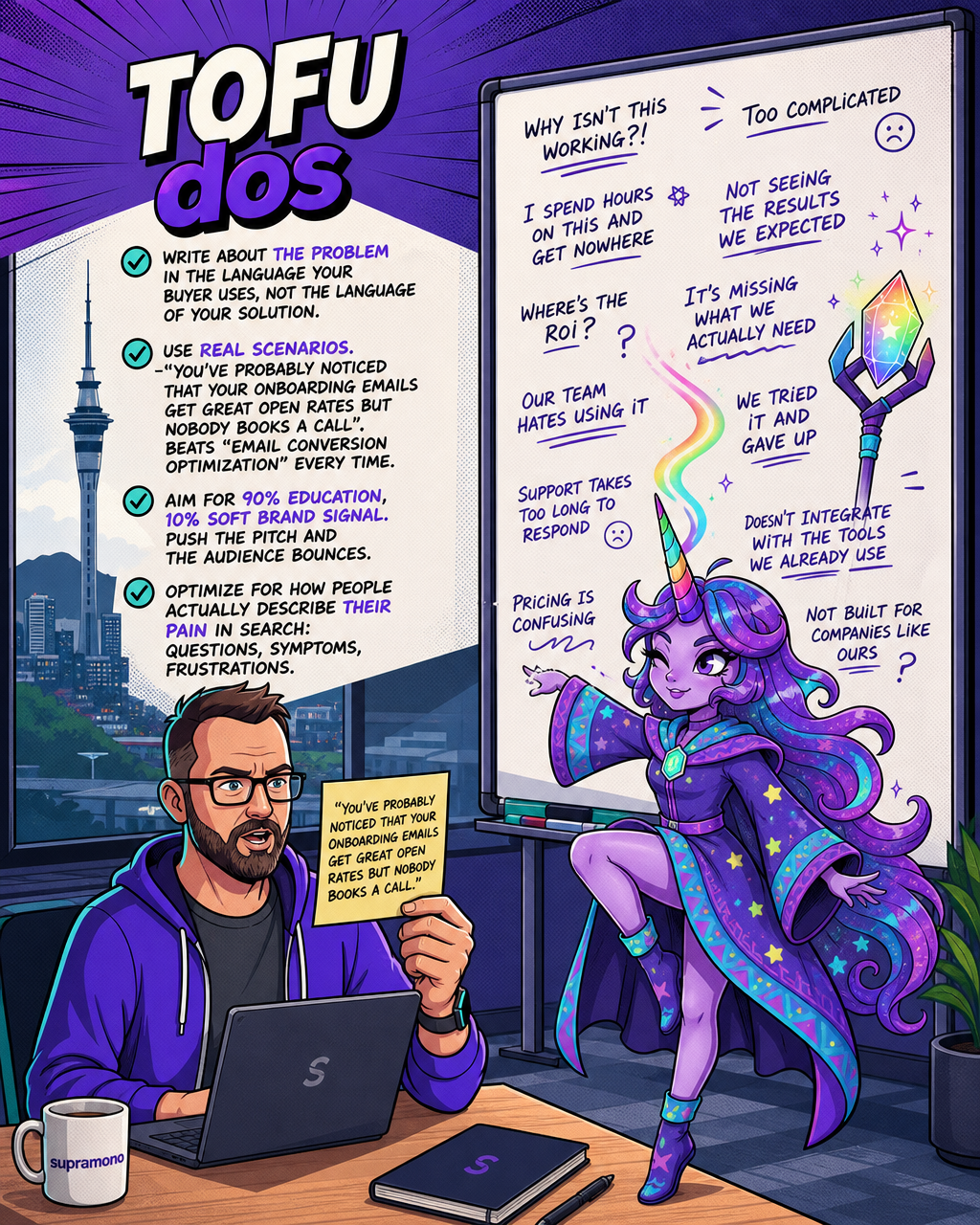
TOFU dos
- Write about the problem in the language your buyer uses, not the language of your solution.
- Use real scenarios. "You've probably noticed that your onboarding emails get great open rates but nobody books a call" beats "email conversion optimization" every time.
- Aim for 90% education, 10% soft brand signal. Push the pitch and the audience bounces.
- Optimize for how people actually describe their pain in search: questions, symptoms, frustrations.
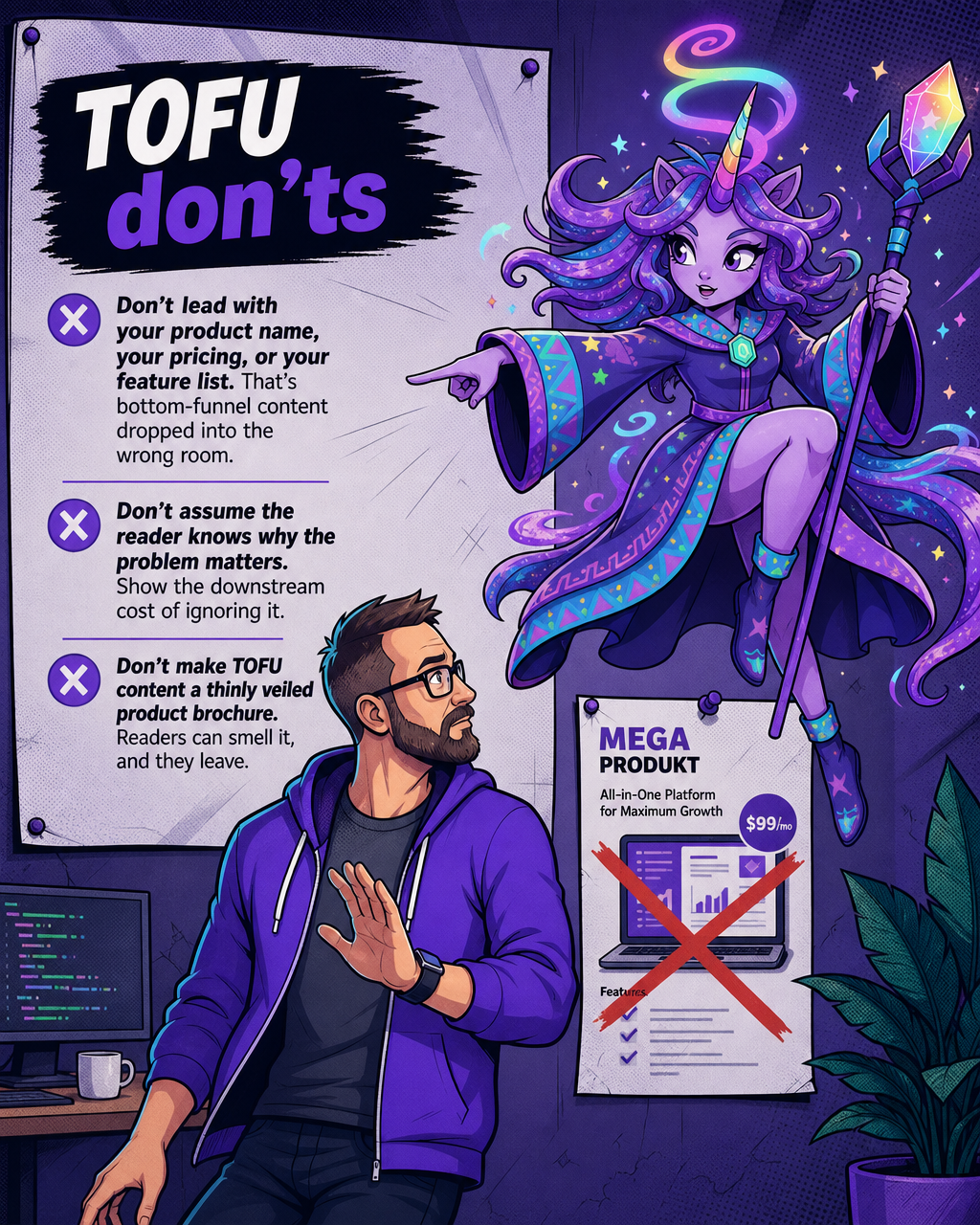
TOFU don'ts
- Don't lead with your product name, your pricing, or your feature list. That's bottom-funnel content dropped into the wrong room.
- Don't assume the reader knows why the problem matters. Show the downstream cost of ignoring it.
- Don't make TOFU content a thinly veiled product brochure. Readers can smell it, and they leave.
Middle of Funnel: Building Trust Through Depth
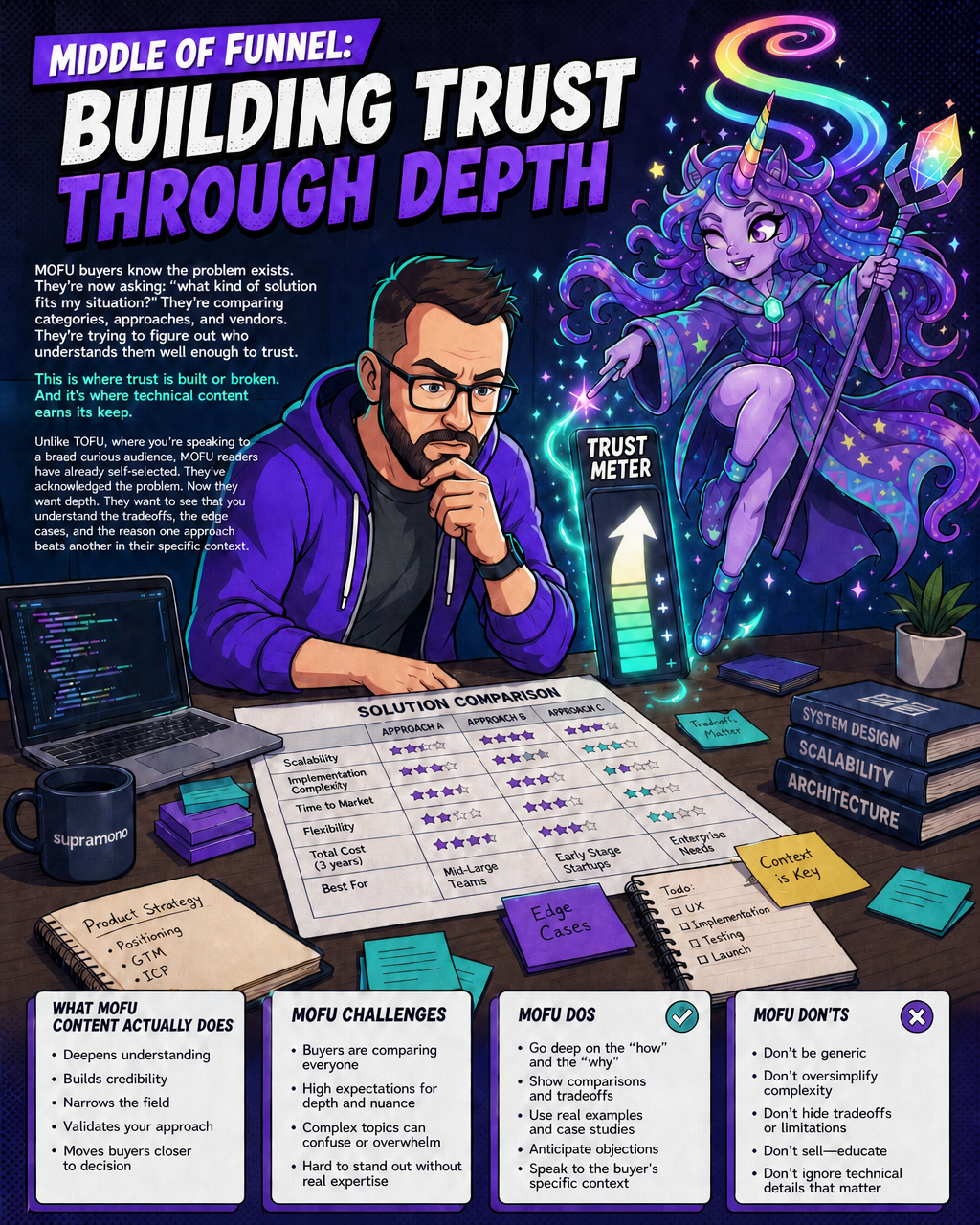
MOFU buyers know the problem exists. They're now asking: "what kind of solution fits my situation?" They're comparing categories, approaches, and vendors. They're trying to figure out who understands them well enough to trust.
This is where trust is built or broken. And it's where technical content earns its keep.
Unlike TOFU, where you're speaking to a broad curious audience, MOFU readers have already self-selected. They've acknowledged the problem. Now they want depth. They want to see that you understand the tradeoffs, the edge cases, and the reason one approach beats another in their specific context.
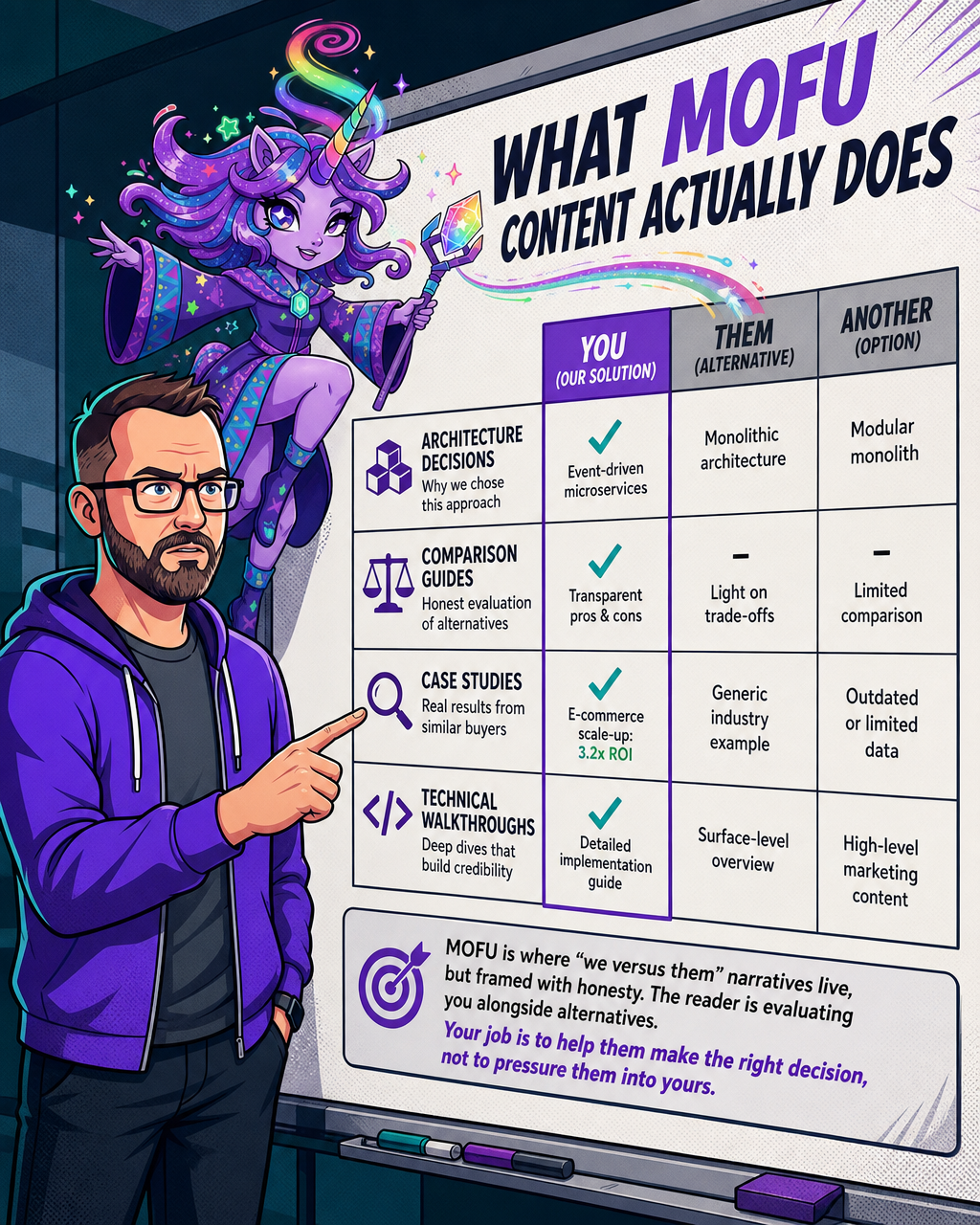
What MOFU content actually does
It's the "why we chose X architecture" post. The comparison guide that respects the reader's intelligence and doesn't pretend competitors don't exist. The case study that shows, with specifics, how a similar buyer solved a similar problem. The deep technical walkthrough that builds credibility without turning into a pitch.
MOFU is where "we versus them" narratives live, but framed with honesty. The reader is evaluating you alongside alternatives. Your job is to help them make the right decision, not to pressure them into yours.
MOFU challenges
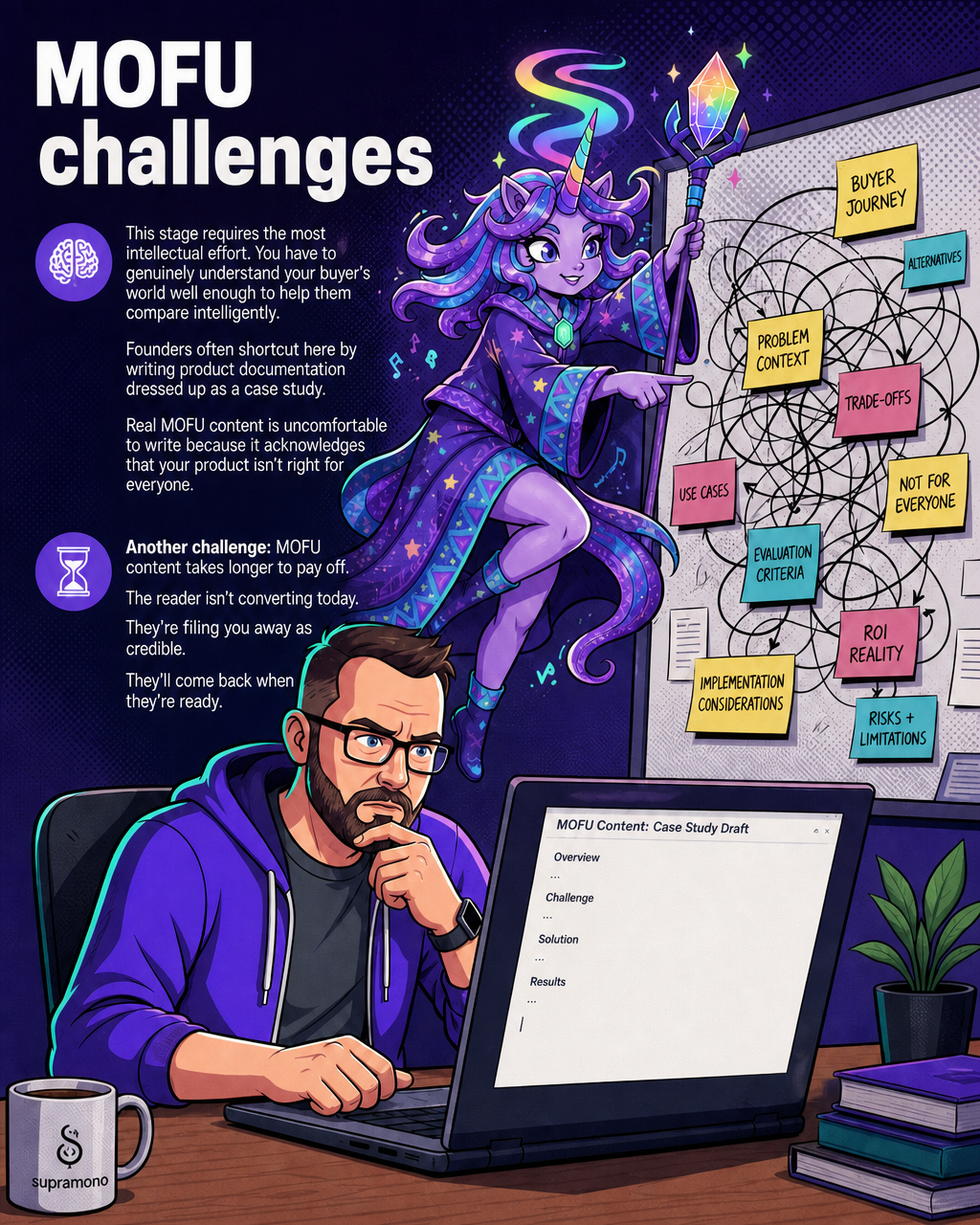
This stage requires the most intellectual effort. You have to genuinely understand your buyer's world well enough to help them compare intelligently. Founders often shortcut here by writing product documentation dressed up as a case study. Real MOFU content is uncomfortable to write because it acknowledges that your product isn't right for everyone.
Another challenge: MOFU content takes longer to pay off. The reader isn't converting today. They're filing you away as credible. They'll come back when they're ready.
MOFU dos
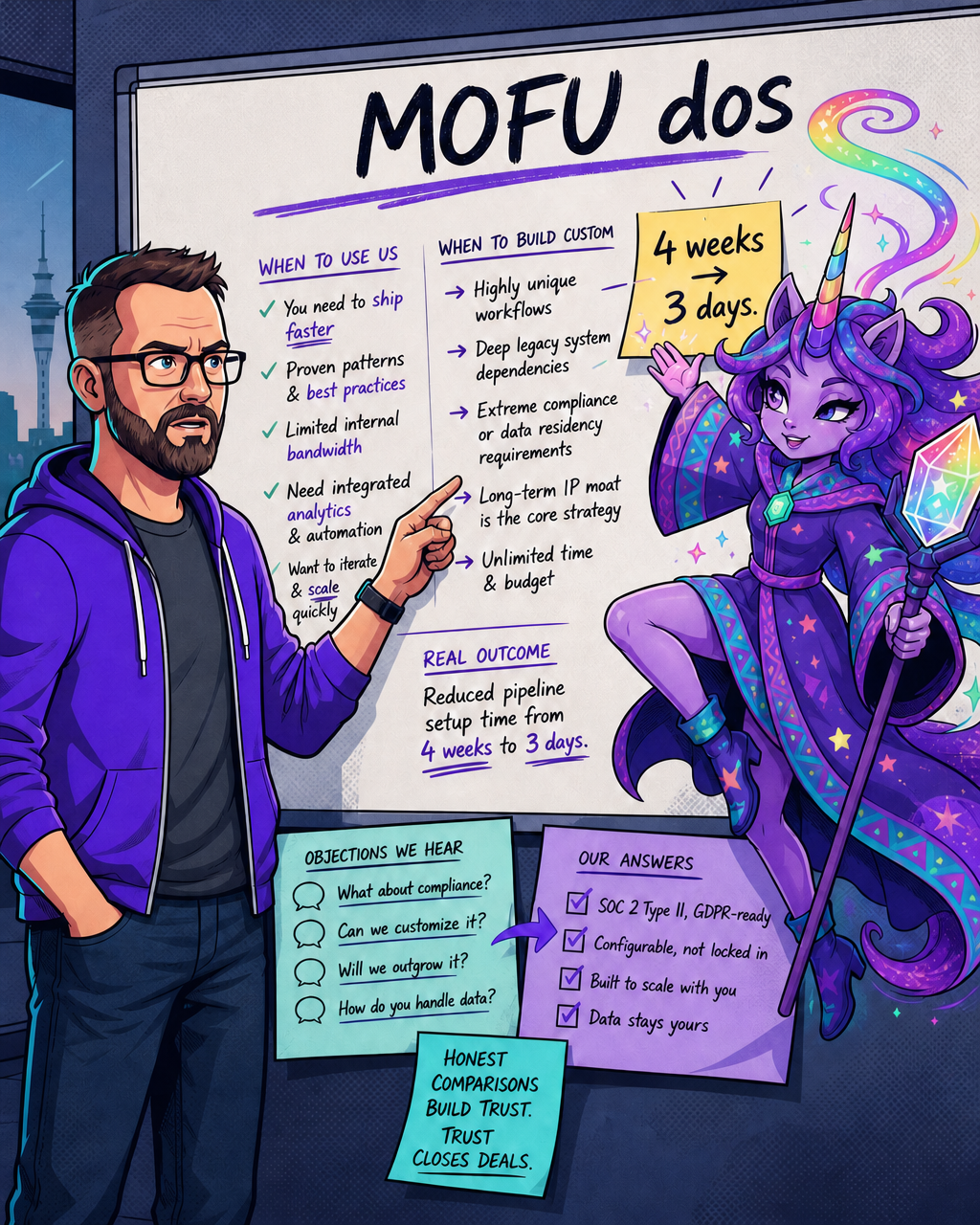
- Write honest comparisons. "When to use us vs. a custom build" is more trust-building than a one-sided feature matrix.
- Go deep on one specific scenario or use case rather than trying to cover everything.
- Use concrete numbers from real outcomes. "Reduced pipeline setup time from 4 weeks to 3 days" beats "dramatically faster."
- Address the objections your sales conversations surface. If buyers always ask "but what about compliance", write the piece that answers it thoroughly.
MOFU don'ts
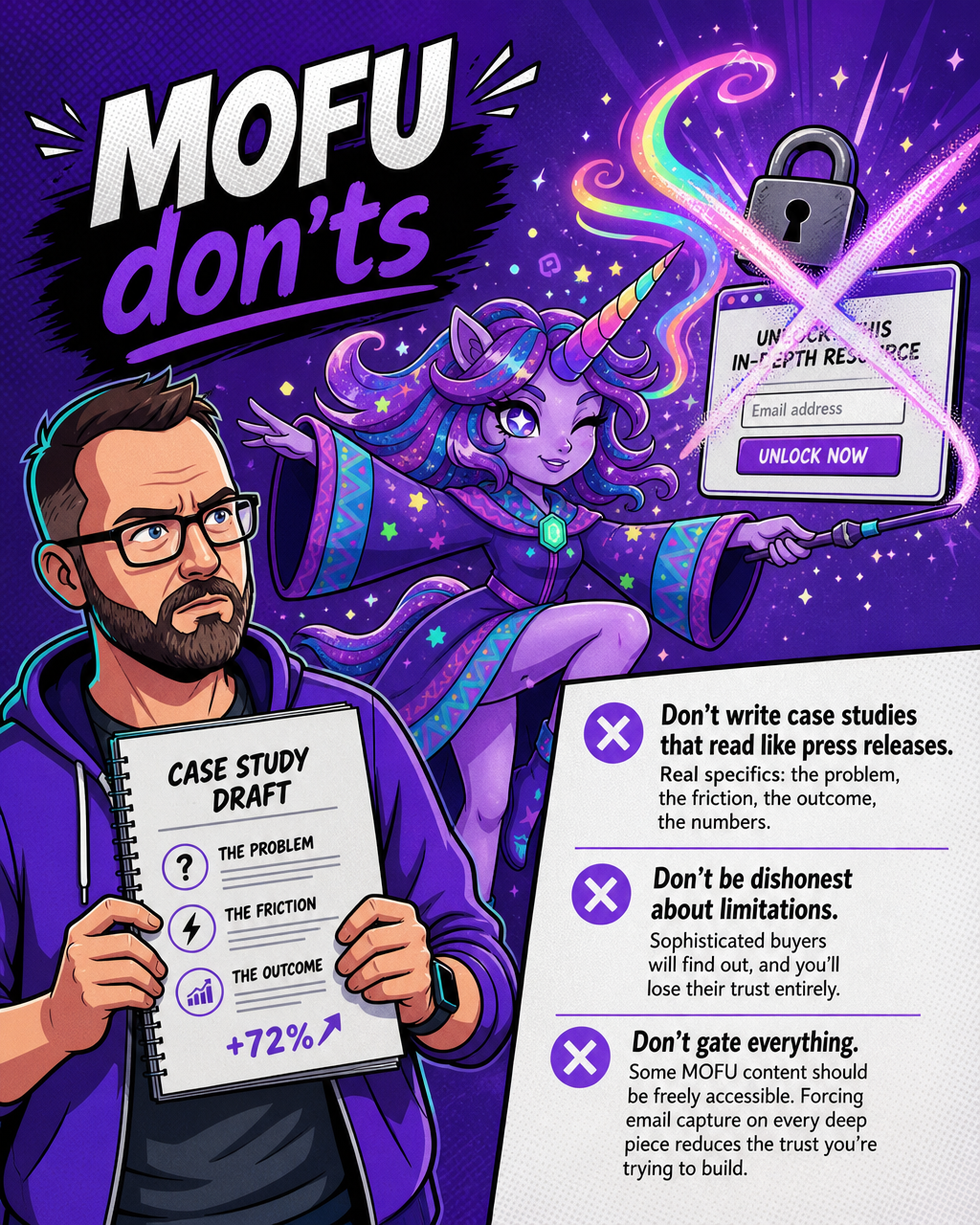
- Don't write case studies that read like press releases. Real specifics: the problem, the friction, the outcome, the numbers.
- Don't be dishonest about limitations. Sophisticated buyers will find out, and you'll lose their trust entirely.
- Don't gate everything. Some MOFU content should be freely accessible. Forcing email capture on every deep piece reduces the trust you're trying to build.
Bottom of Funnel: Removing the Last Obstacle
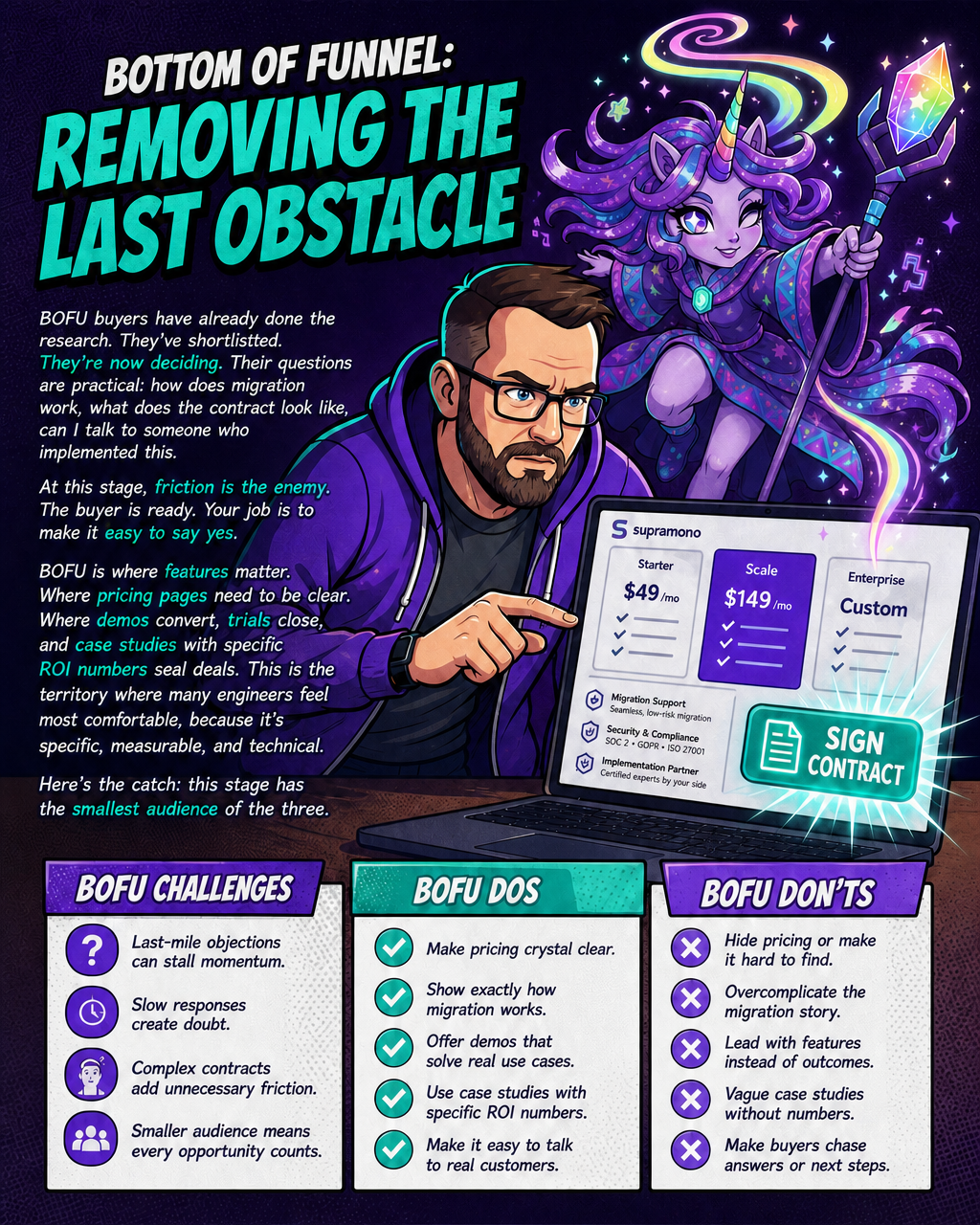
BOFU buyers have already done the research. They've shortlisted. They're now deciding. Their questions are practical: how does migration work, what does the contract look like, can I talk to someone who implemented this.
At this stage, friction is the enemy. The buyer is ready. Your job is to make it easy to say yes.
BOFU is where features matter. Where pricing pages need to be clear. Where demos convert, trials close, and case studies with specific ROI numbers seal deals. This is the territory where many engineers feel most comfortable, because it's specific, measurable, and technical.
Here's the catch: this stage has the smallest audience of the three.
BOFU challenges
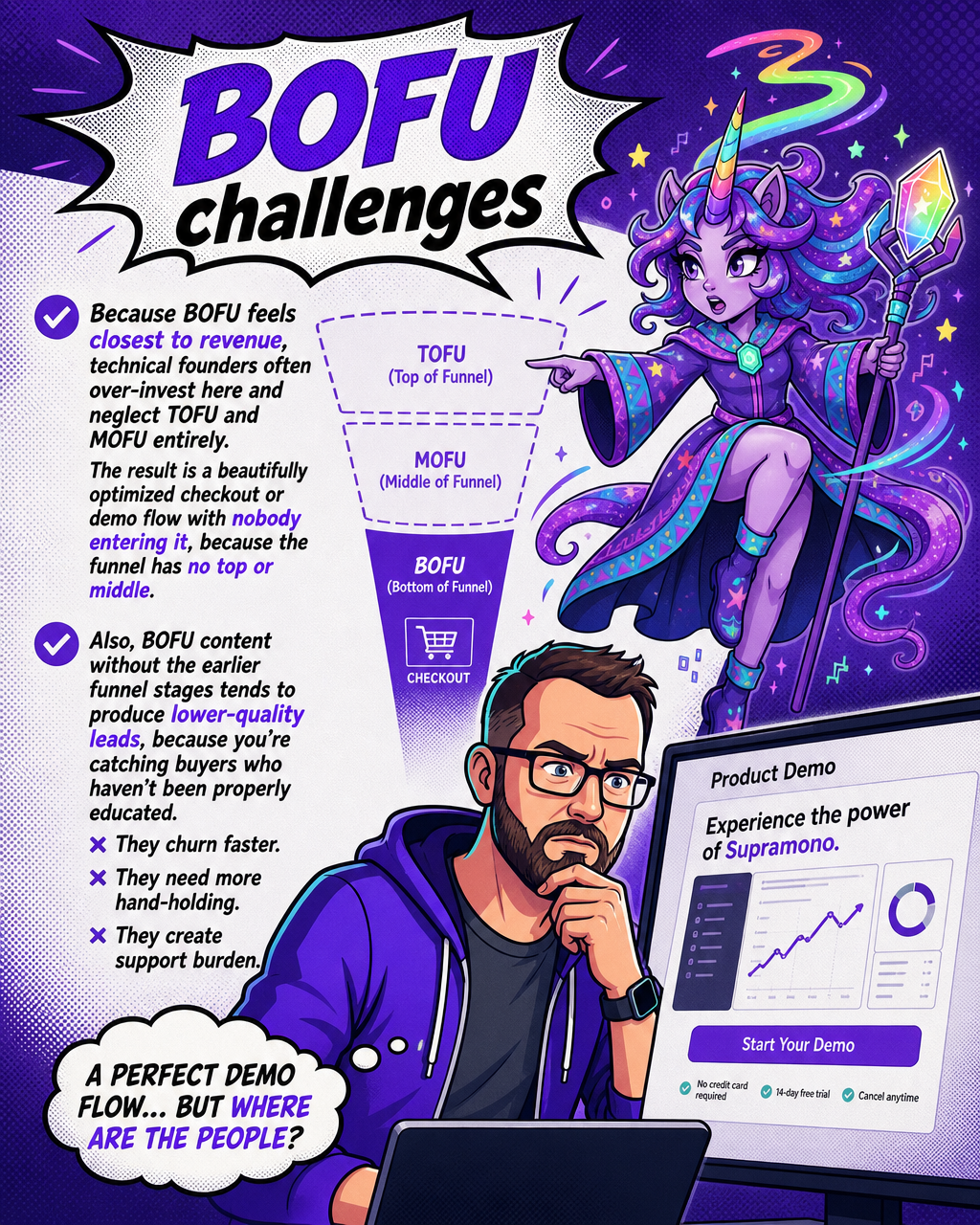
Because BOFU feels closest to revenue, technical founders often over-invest here and neglect TOFU and MOFU entirely. The result is a beautifully optimized checkout or demo flow with nobody entering it, because the funnel has no top or middle.
Also, BOFU content without the earlier funnel stages tends to produce lower-quality leads, because you're catching buyers who haven't been properly educated. They churn faster. They need more hand-holding. They create support burden.
BOFU dos
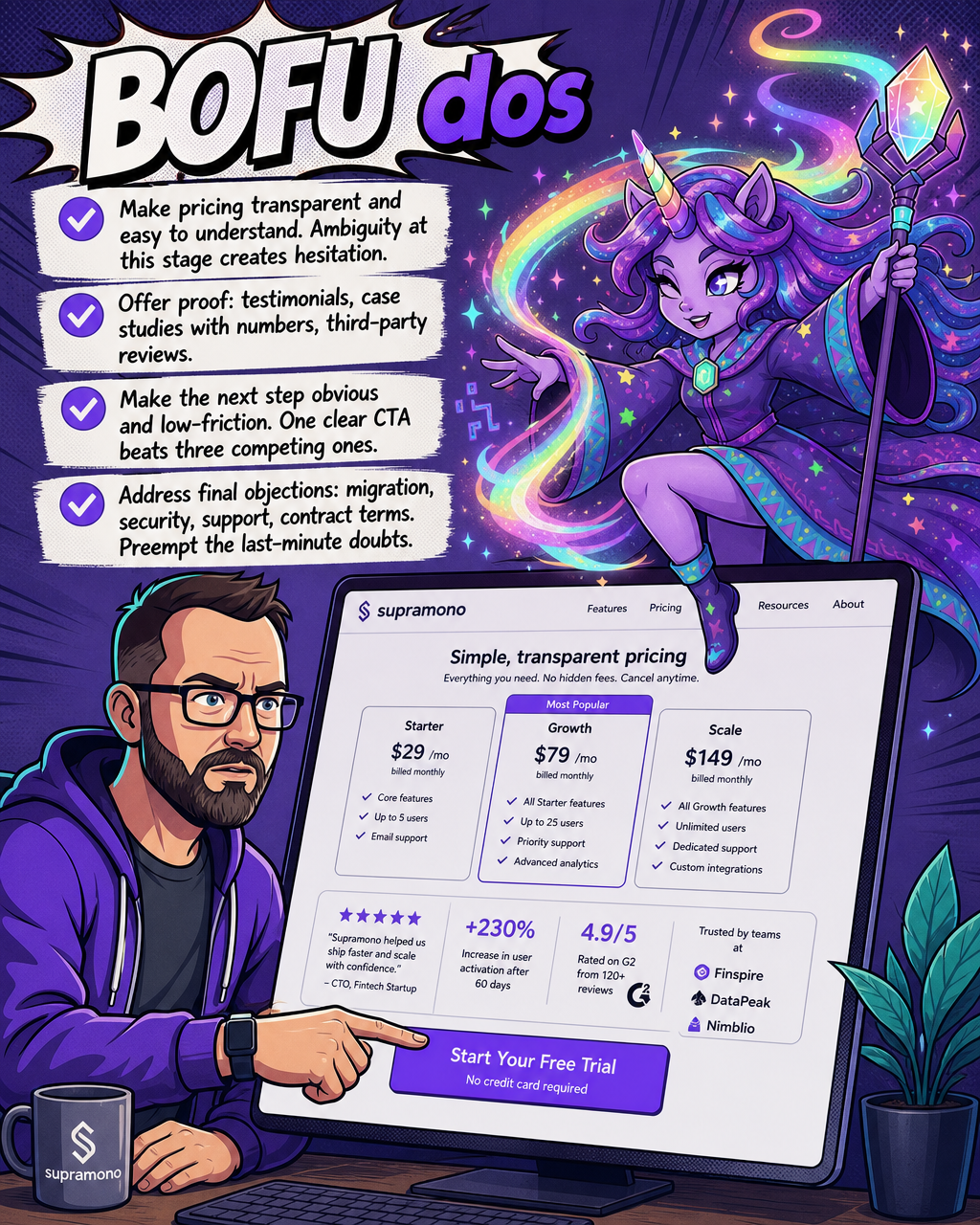
- Make pricing transparent and easy to understand. Ambiguity at this stage creates hesitation.
- Offer proof: testimonials, case studies with numbers, third-party reviews.
- Make the next step obvious and low-friction. One clear CTA beats three competing ones.
- Address final objections: migration, security, support, contract terms. Preempt the last-minute doubts.
BOFU don'ts
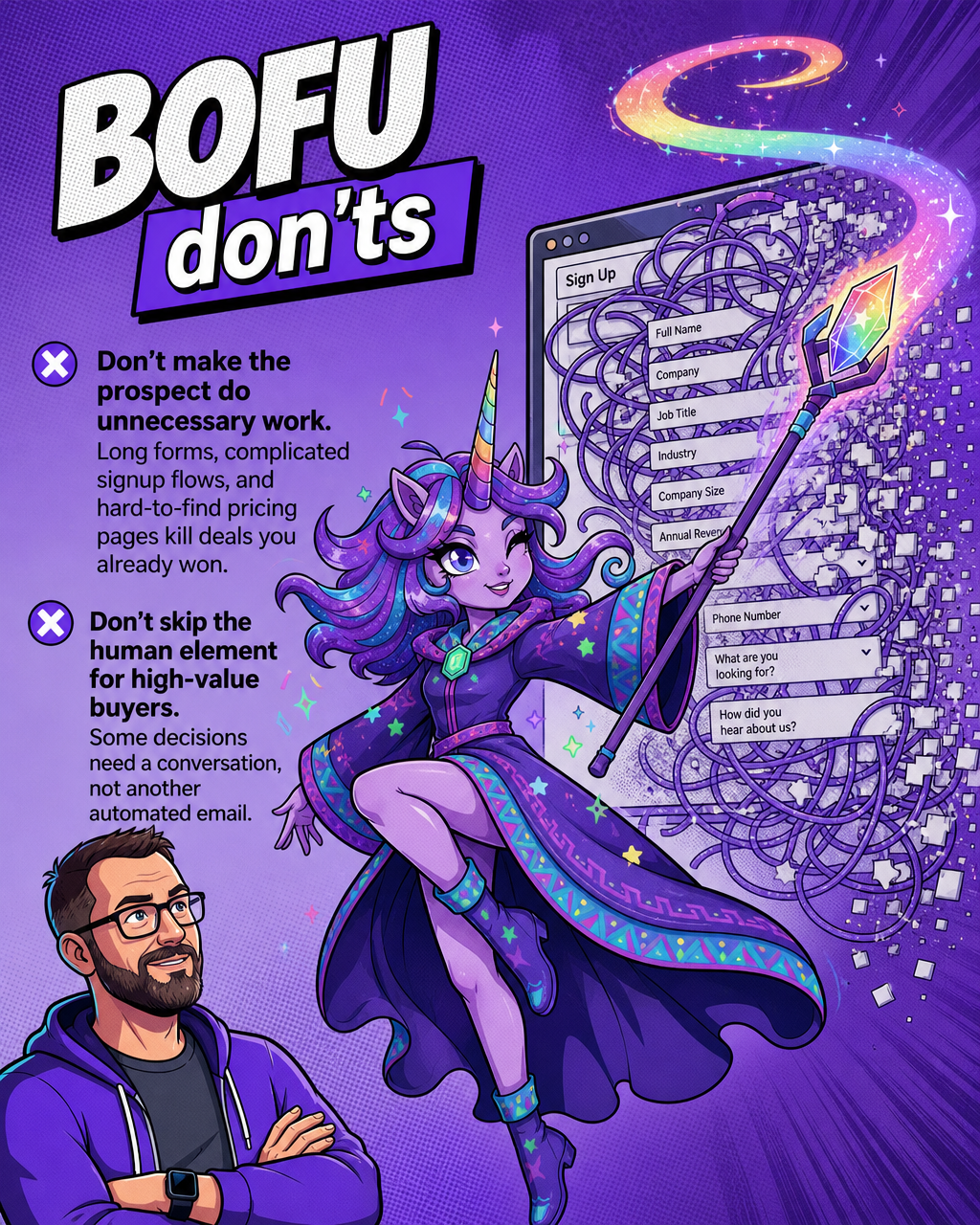
- Don't make the prospect do unnecessary work. Long forms, complicated signup flows, and hard-to-find pricing pages kill deals you already won.
- Don't skip the human element for high-value buyers. Some decisions need a conversation, not another automated email.
The Engineer's Default Problem: Bottom-Funnel Brain
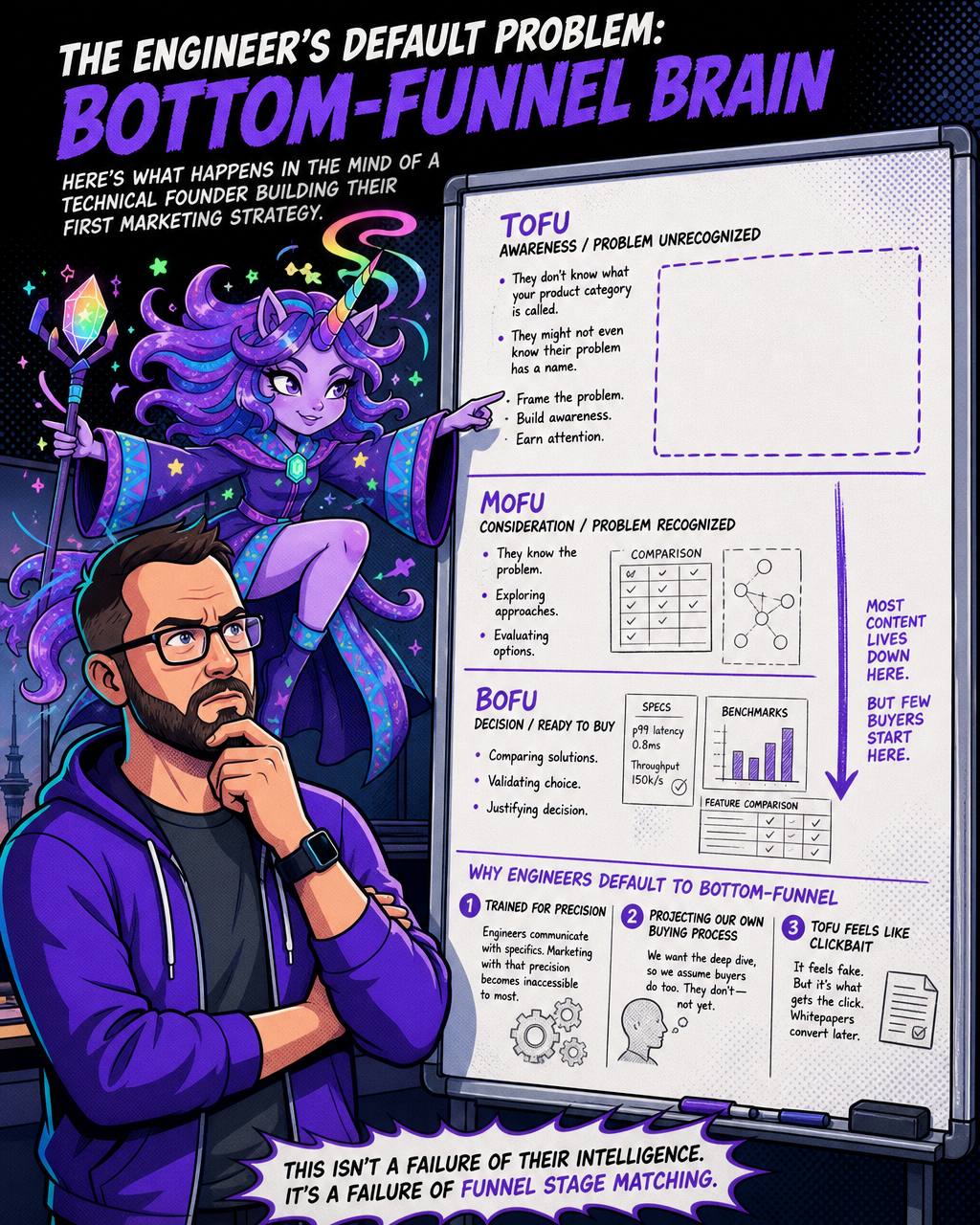
Here's what happens in the mind of a technical founder building their first marketing strategy.
You know your product better than anyone. You spent six months shipping it. You can explain every architectural decision, every performance tradeoff, every feature your competitors don't have. When you sit down to write content, what comes out is what you know: specs, benchmarks, feature comparisons, architecture diagrams.
All of that is BOFU content. It's written for a buyer who already understands the problem, already knows your category, and is comparing you against a shortlist. It's written for a small fraction of your potential market — the minority already ready to decide.
The vast majority haven't reached that stage yet. They don't know what your product category is called. They might not even know their problem has a name. They'll land on your page, read a sentence about "distributed tracing with sub-millisecond latency" and click away because nothing there speaks to a problem they consciously recognize.
This isn't a failure of their intelligence. It's a failure of funnel stage matching.
Why engineers default to bottom-funnel
A few reasons stack on top of each other.
First, engineers are trained to communicate with precision. Precision in technical communication means specifics: version numbers, performance metrics, architecture decisions. That precision is a superpower in engineering. Applied to marketing, it produces content that's technically accurate and largely inaccessible to anyone who hasn't already bought into the category.
Second, engineers speak to buyers the way they'd want to be sold to. They'd want the benchmark. They'd want the architecture deep-dive. They assume their buyer operates the same way. But most buyers, even technical ones, aren't living inside the problem yet. They need the problem framed first.
Third, TOFU content feels fake to engineers. Writing "5 signs your data pipeline might be costing you more than you think" feels clickbait-adjacent to someone who'd rather write a whitepaper. But that piece is what gets a frustrated analyst to click. The whitepaper is what converts them three months later.
A Real Example: The Funnel Stage Mismatch in Action
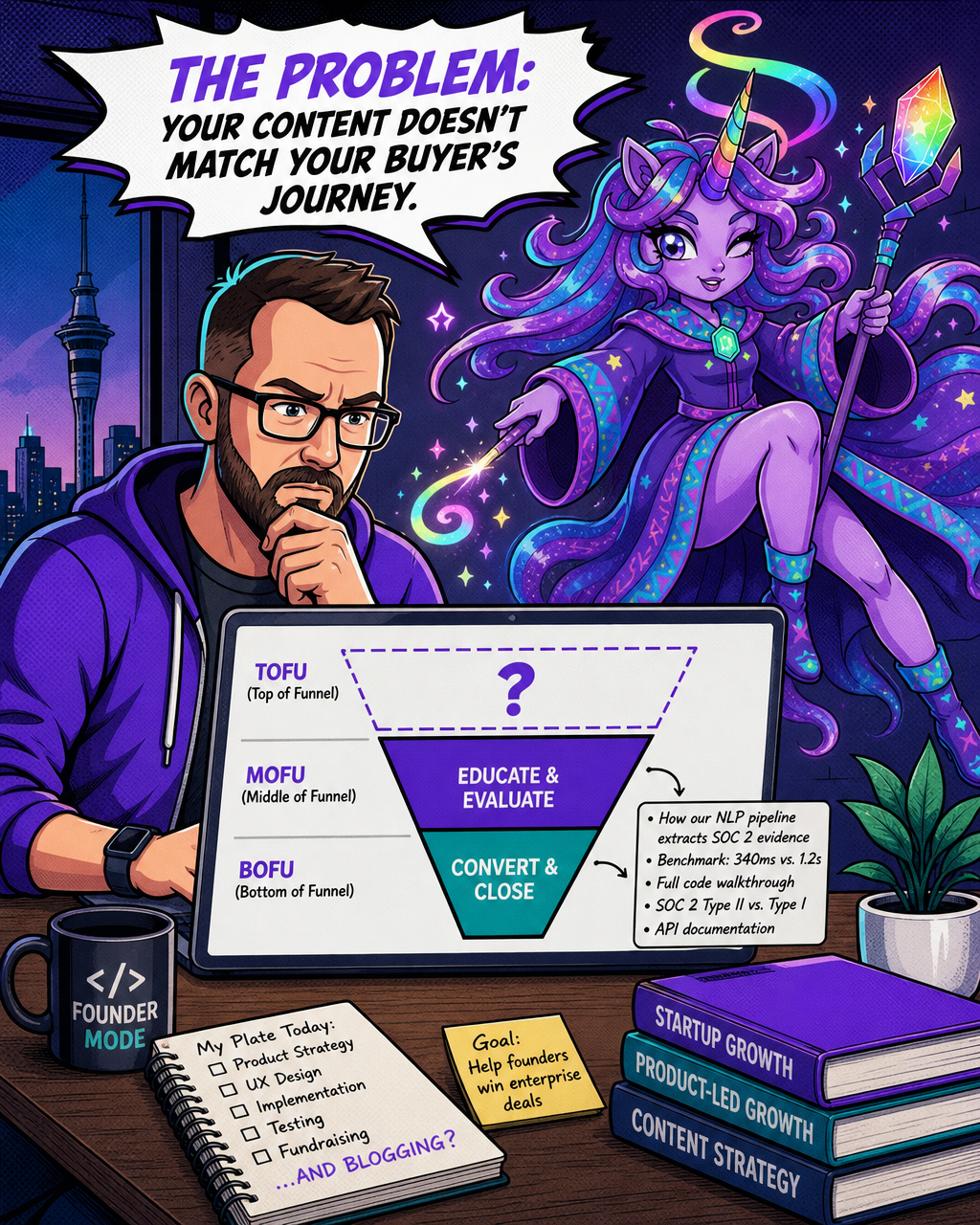
Take a hypothetical founder — call them Marko, a composite of a pattern we see repeatedly — who left a senior dev role to build a tool that automates compliance documentation for SaaS startups. The product genuinely solves a real, expensive problem.
Marko launches a blog. The first five posts are:
- "How our NLP pipeline extracts SOC 2 evidence from GitHub commits"
- "Benchmark: our compliance check runs in 340ms vs. competitor's 1.2s"
- "Full code walkthrough: our evidence collection architecture"
- "SOC 2 Type II vs. Type I: a technical comparison"
- "API documentation for our evidence collection endpoint"
Every single piece is either BOFU or pure product documentation. There's nothing wrong with any of it. But none of it reaches the founder who's currently Googling "do I actually need SOC 2 to close enterprise deals" or "why is my sales process stalling with large companies."
That founder is Marko's best potential customer. They're sitting at the top of the funnel, trying to understand whether they even have a problem worth solving. Marko's content doesn't exist in their world.
The fix isn't complicated. It's just counterintuitive. Marko needs to write the piece called "Why enterprise deals stall at the security review stage", and the piece called "The compliance requirement your sales team isn't telling you about." Those pieces reach the unaware buyer, frame the problem, and naturally lead to Marko's solution once the reader gets there.
The architecture benchmark post? That's still valuable. It belongs at BOFU, where it can close a buyer who's already been educated through the earlier stages.
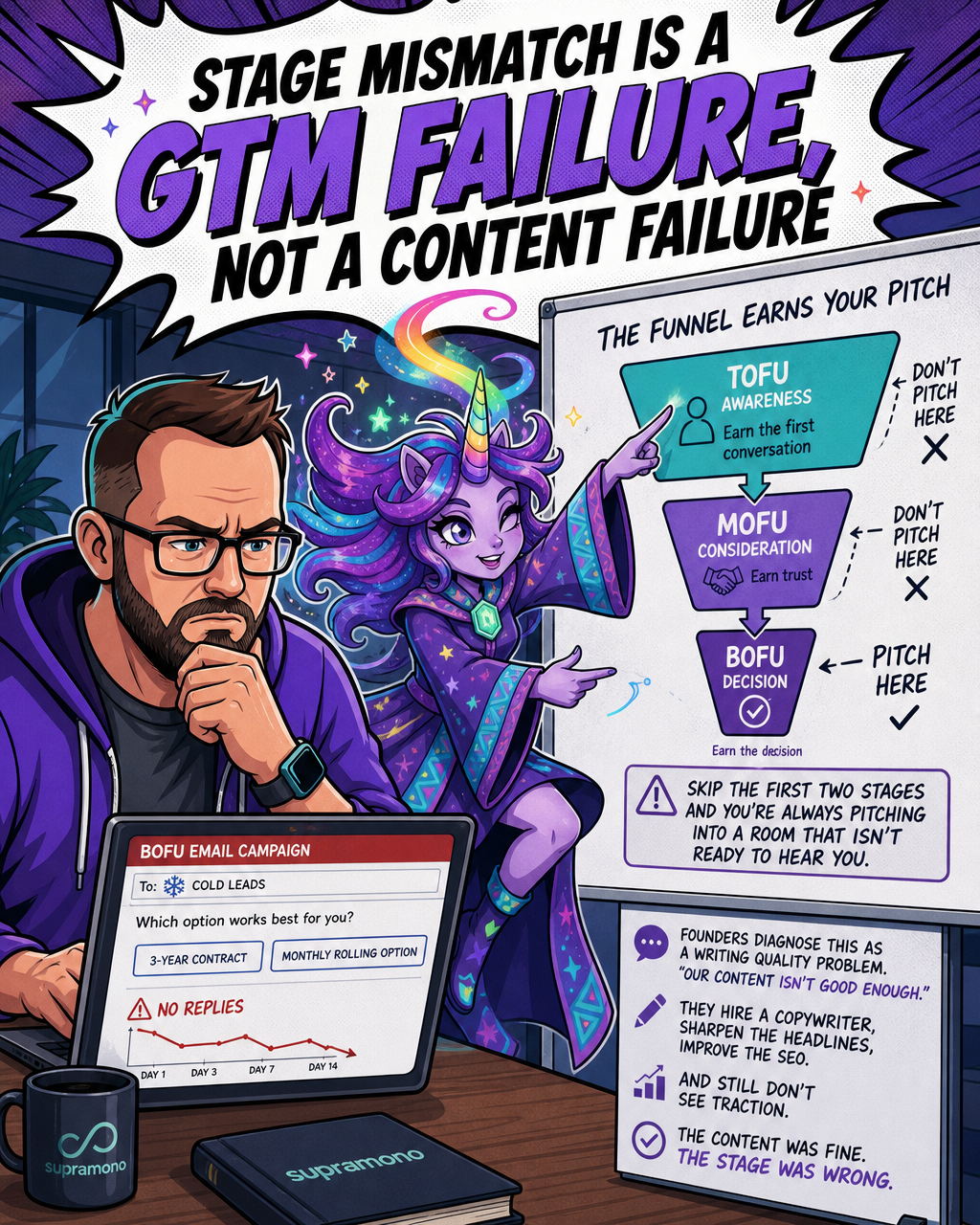
Stage Mismatch Is a GTM Failure, Not a Content Failure
Founders often diagnose this as a writing quality problem. "Our content isn't good enough." They hire a copywriter, sharpen the headlines, improve the SEO, and still don't see traction.
The content was fine. The stage was wrong.
Sending BOFU content to a TOFU audience is like walking up to someone at a party who just met you and opening with: "So, should we go with the 3-year contract or the monthly rolling option?" They don't know you. They don't know if they like you. They haven't agreed there's a reason to have this conversation at all.
The funnel forces you to earn the right to make your pitch. TOFU earns the first conversation. MOFU earns trust. BOFU earns the decision.
Skip the first two stages and you're always pitching into a room that isn't ready to hear you.
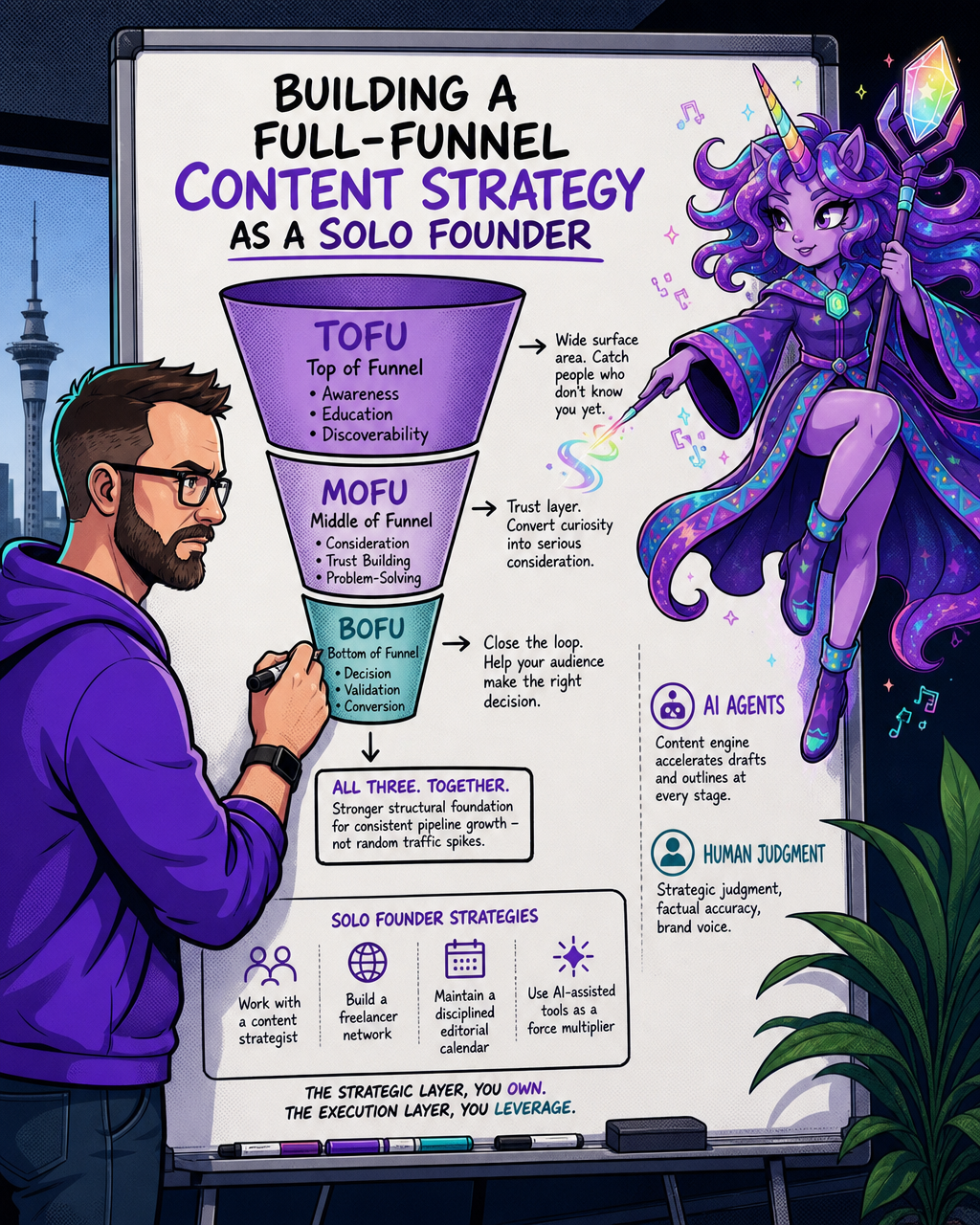
Building a Full-Funnel Content Strategy as a Solo Founder
The obvious objection: you don't have a content team. You're one person. Writing across all three stages feels impossible on top of building the product.
This is exactly where AI agents can change the equation — not as a magic wand, but as leverage. The same way you'd use CI/CD to automate your deployment pipeline, a content engine can accelerate production of drafts and outlines at each funnel stage. That said, strategic judgment, factual accuracy, and brand voice still require human review. Think of it as infrastructure that reduces the per-piece effort, not one that eliminates your involvement.
There are several ways to approach this as a solo founder: working with a content strategist, building a freelancer network, maintaining a disciplined editorial calendar yourself, or using AI-assisted tools as a force multiplier. The right mix depends on your budget, time, and how central content is to your distribution strategy.
The strategic layer, you still own: knowing what stage your audience is at, what problem they're navigating, what questions they're asking. That's the signal. The execution layer is where you find leverage.
Think of it as building a discoverability system. Your TOFU content is the wide surface area that catches people who don't know you yet. Your MOFU content is the trust layer that converts curiosity into serious consideration. Your BOFU content closes the loop.
None of it works if one stage is missing. All three compounding gives you a stronger structural foundation for consistent pipeline growth — rather than relying on unpredictable traffic spikes from isolated pieces.
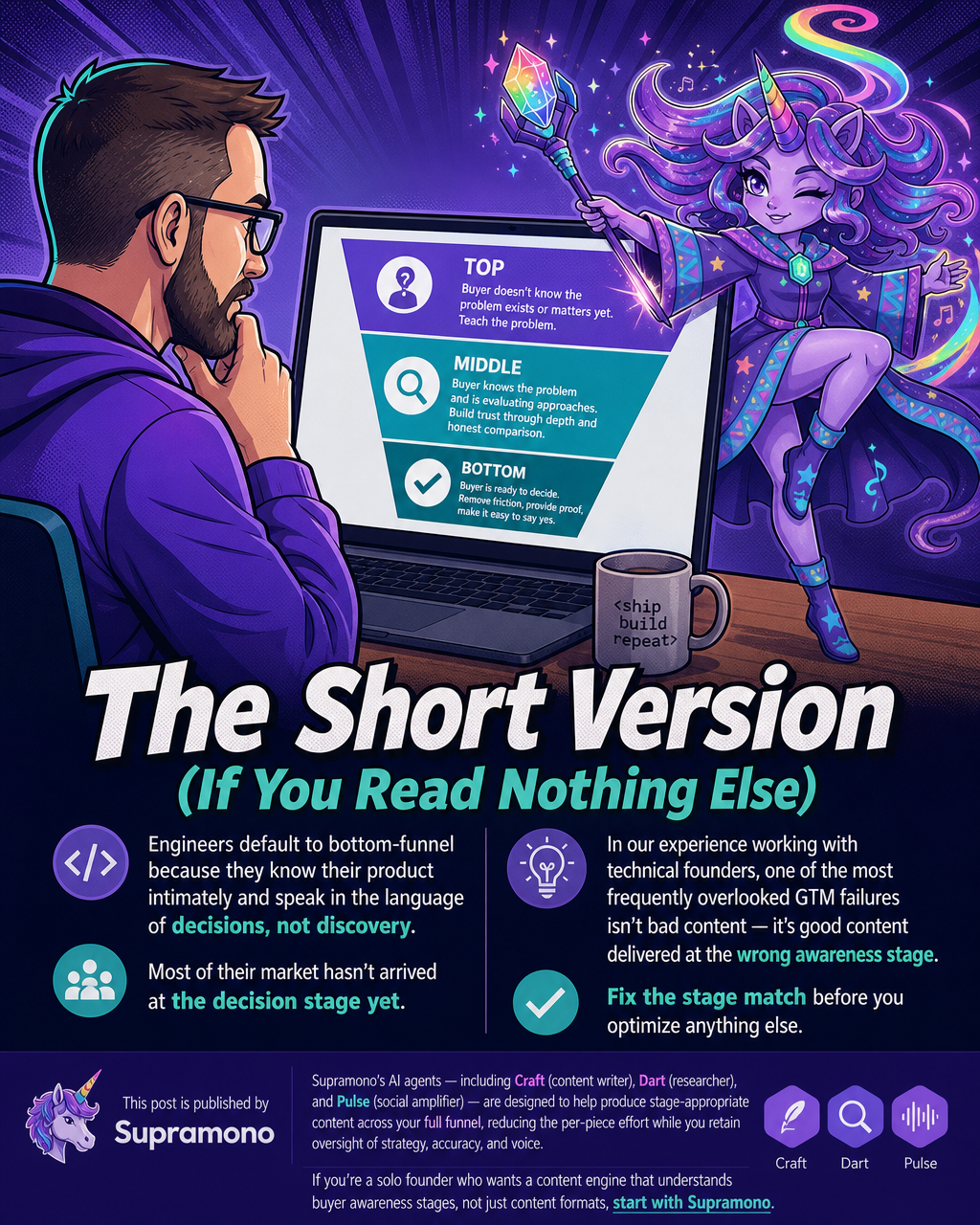
The Short Version (If You Read Nothing Else)
The three stages of the marketing funnel are buyer awareness levels, not content formats:
- Top: Buyer doesn't know the problem exists or matters yet. Teach the problem.
- Middle: Buyer knows the problem and is evaluating approaches. Build trust through depth and honest comparison.
- Bottom: Buyer is ready to decide. Remove friction, provide proof, make it easy to say yes.
Engineers default to bottom-funnel because they know their product intimately and speak in the language of decisions, not discovery. Most of their market hasn't arrived at the decision stage yet.
In our experience working with technical founders, one of the most frequently overlooked GTM failures isn't bad content — it's good content delivered at the wrong awareness stage.
Fix the stage match before you optimize anything else.
This post is published by Supramono. Supramono's AI agents — including Craft (content writer), Dart (researcher), and Pulse (social amplifier) — are designed to help produce stage-appropriate content across your full funnel, reducing the per-piece effort while you retain oversight of strategy, accuracy, and voice. If you're a solo founder who wants a content engine that understands buyer awareness stages, not just content formats, start with Supramono.

Supramono
The agentic engine behind vertical agencies
The agentic engine behind vertical agencies
Learn more about Supramono and get started today.
Visit Supramono