Why Engineers Say Yes to Every Feature Request (and How to Stop)
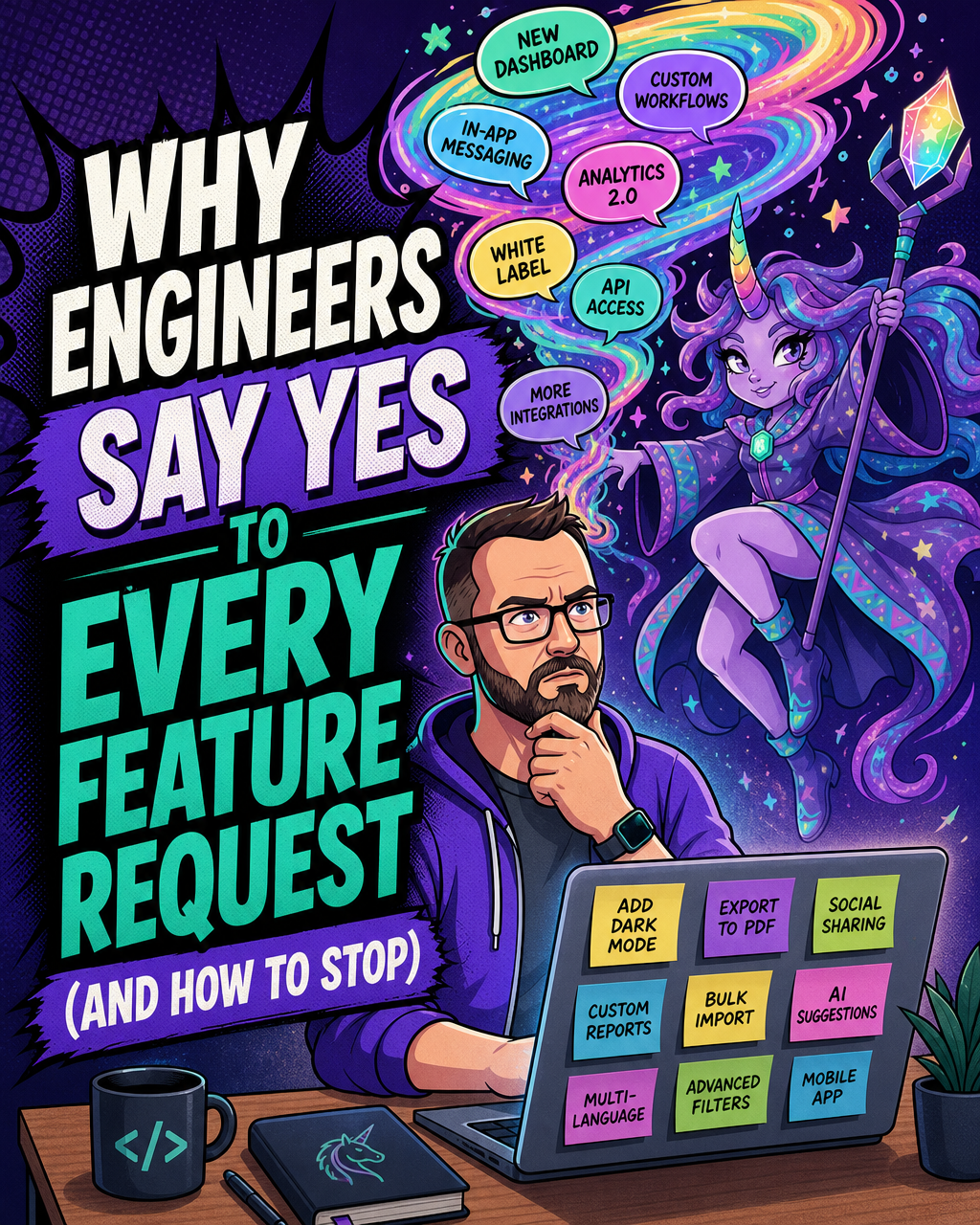

There's a version of this scene that plays out on engineering teams everywhere. A stakeholder drops a feature idea in Slack. It sounds interesting. Technically solvable. Maybe even fun to build. So the engineer says yes, or at least "sure, I can look into that" — and just like that, the sprint has a new passenger nobody invited.
If you've been on a software team for any amount of time, you know this pattern. And if you're honest with yourself, you've probably contributed to it. This post is about why that happens, what product managers do differently, and how you can borrow that same lens to protect your focus and ship work that actually matters.
The Psychological Pull Behind That Automatic Yes
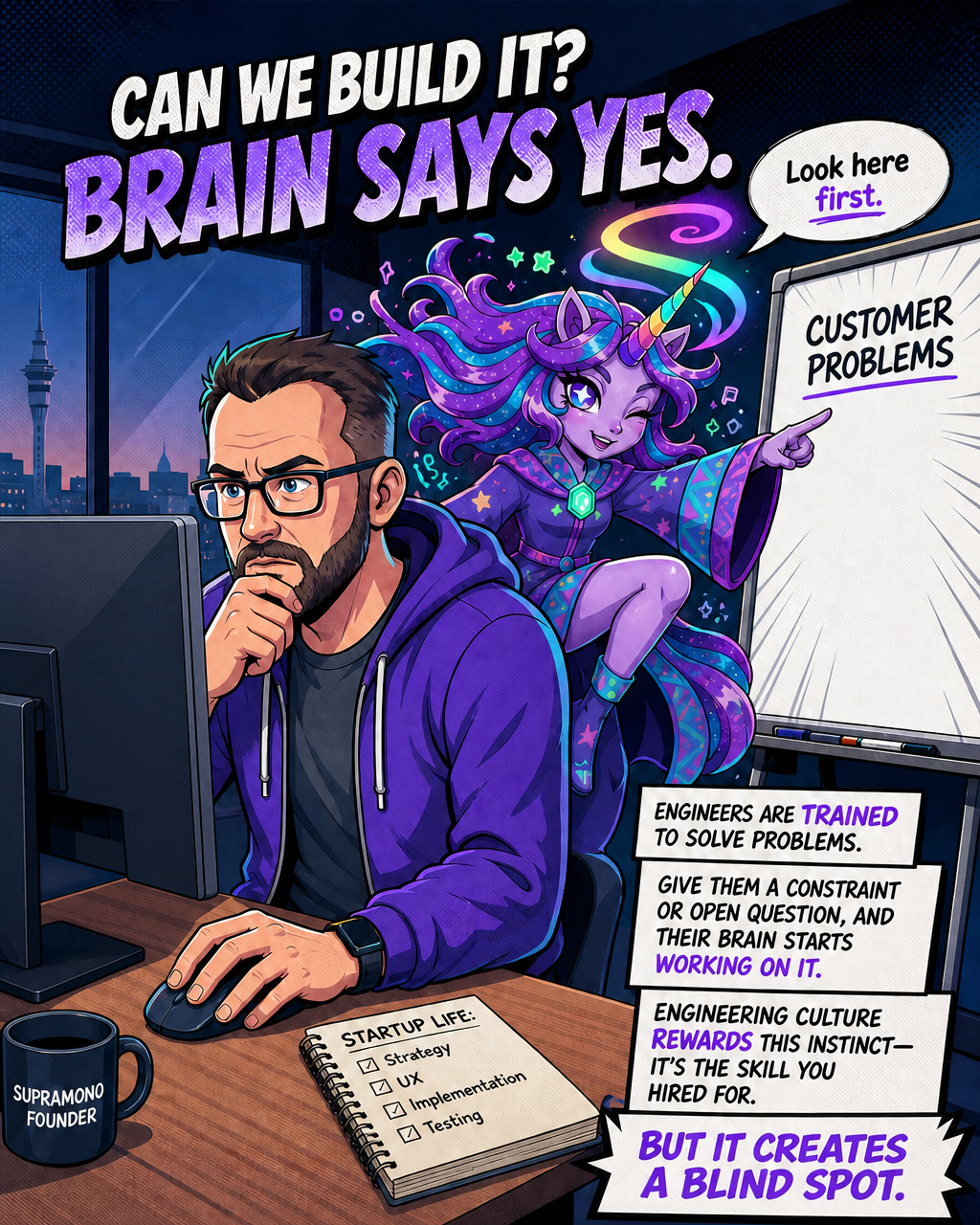
Many engineers are trained, almost by definition, to solve problems. Give a skilled engineer a constraint, an interesting system, or an open question, and their brain starts working on it. Engineering culture often rewards this instinct — it's the skill you hired for.
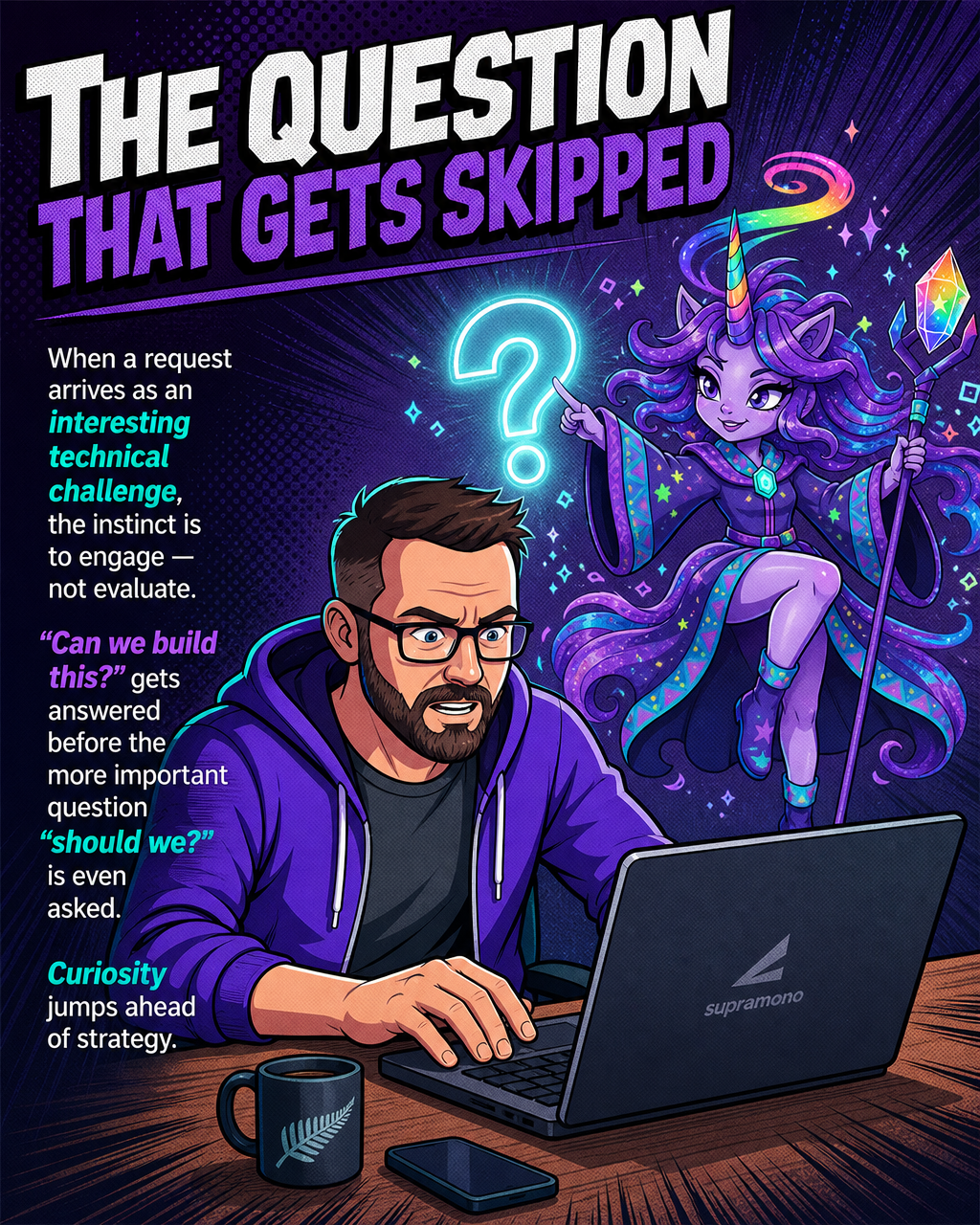
But this same drive that makes engineers effective can also make them vulnerable to feature requests. When a request arrives framed as an interesting technical challenge, the instinct is to engage with it rather than evaluate it. The question "can we build this?" gets answered before the more important question "should we?" is even asked.
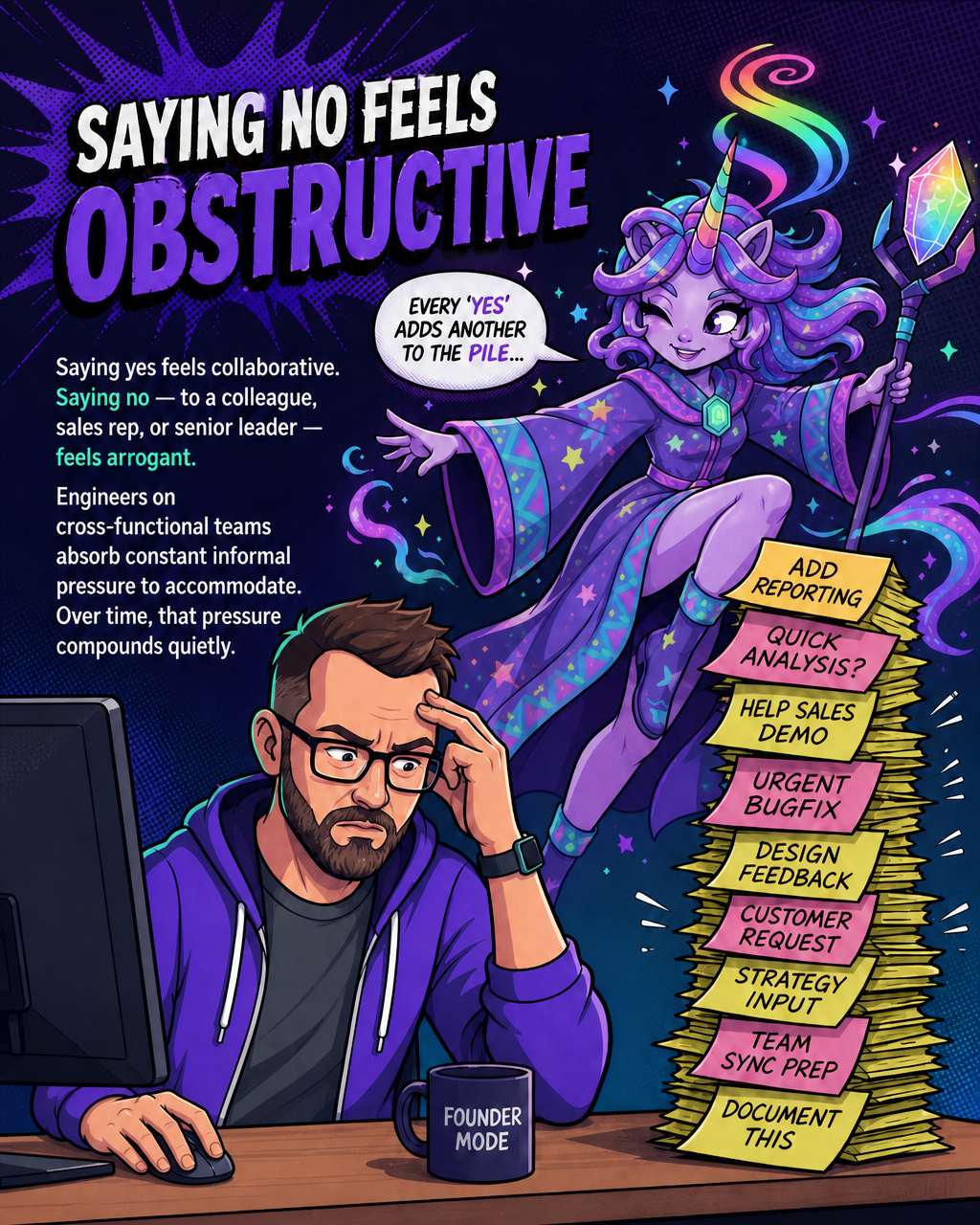
There's also a social dimension. Saying yes feels collaborative and helpful. Saying no — especially to a colleague, a sales rep, or a senior leader — can feel obstructive, even arrogant. Engineers who are embedded in cross-functional teams often absorb a lot of informal pressure to be accommodating. Over time, that pressure compounds. The backlog grows. The sprint gets fractured. The roadmap quietly stops reflecting strategy and starts reflecting whoever asked last.
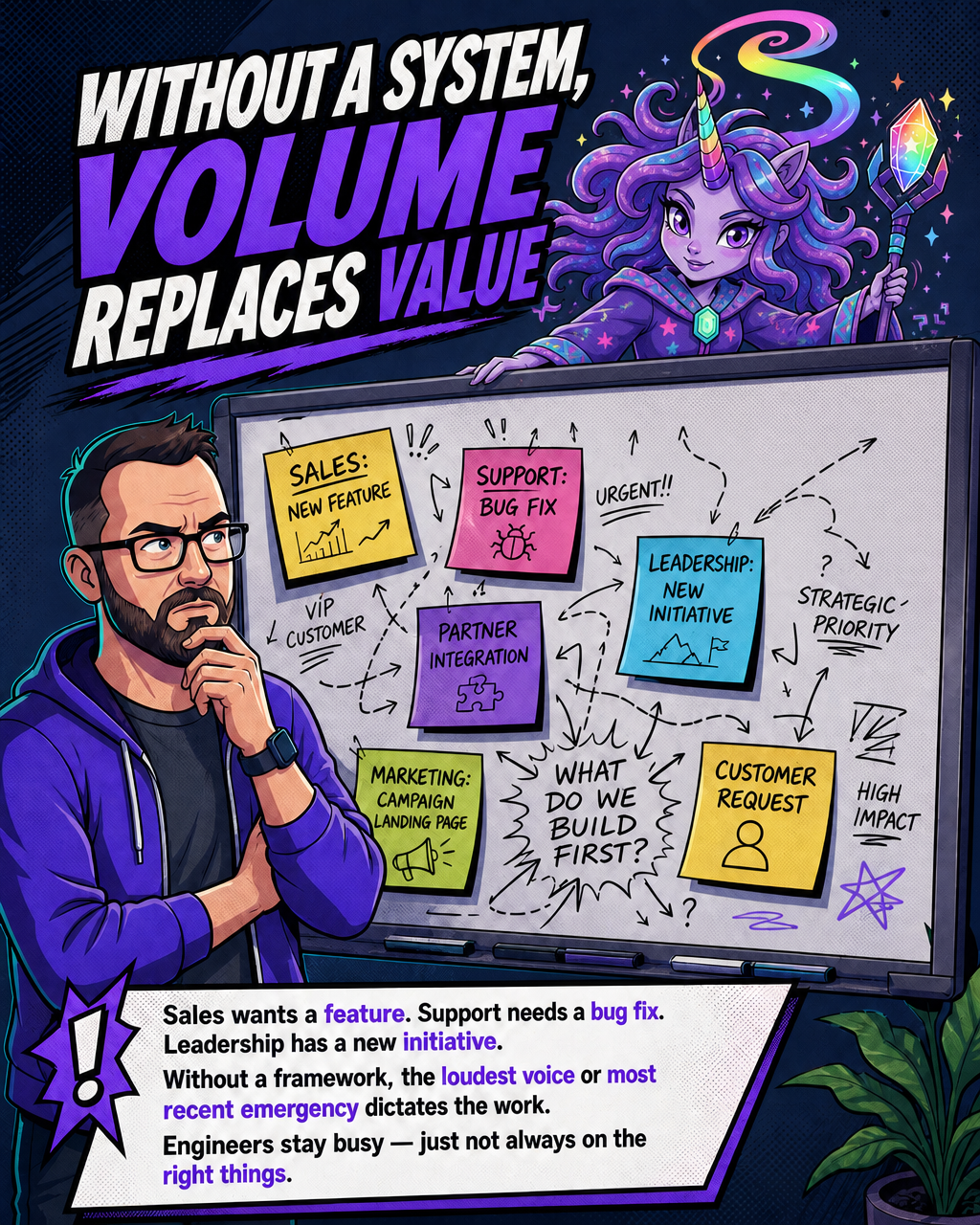
Development teams face a constant flood of requests from every direction. Sales wants a feature to close a deal, support needs urgent bug fixes, and leadership has a new strategic initiative. Without a system to manage this influx, teams get stuck firefighting, where the loudest voice or the most recent emergency dictates the work.
That last phrase is important: "the loudest voice." Without a framework, volume and urgency replace value as the primary sorting mechanism. Engineers end up busy. They're just not always busy on the right things.
What Product Managers Actually Do Differently
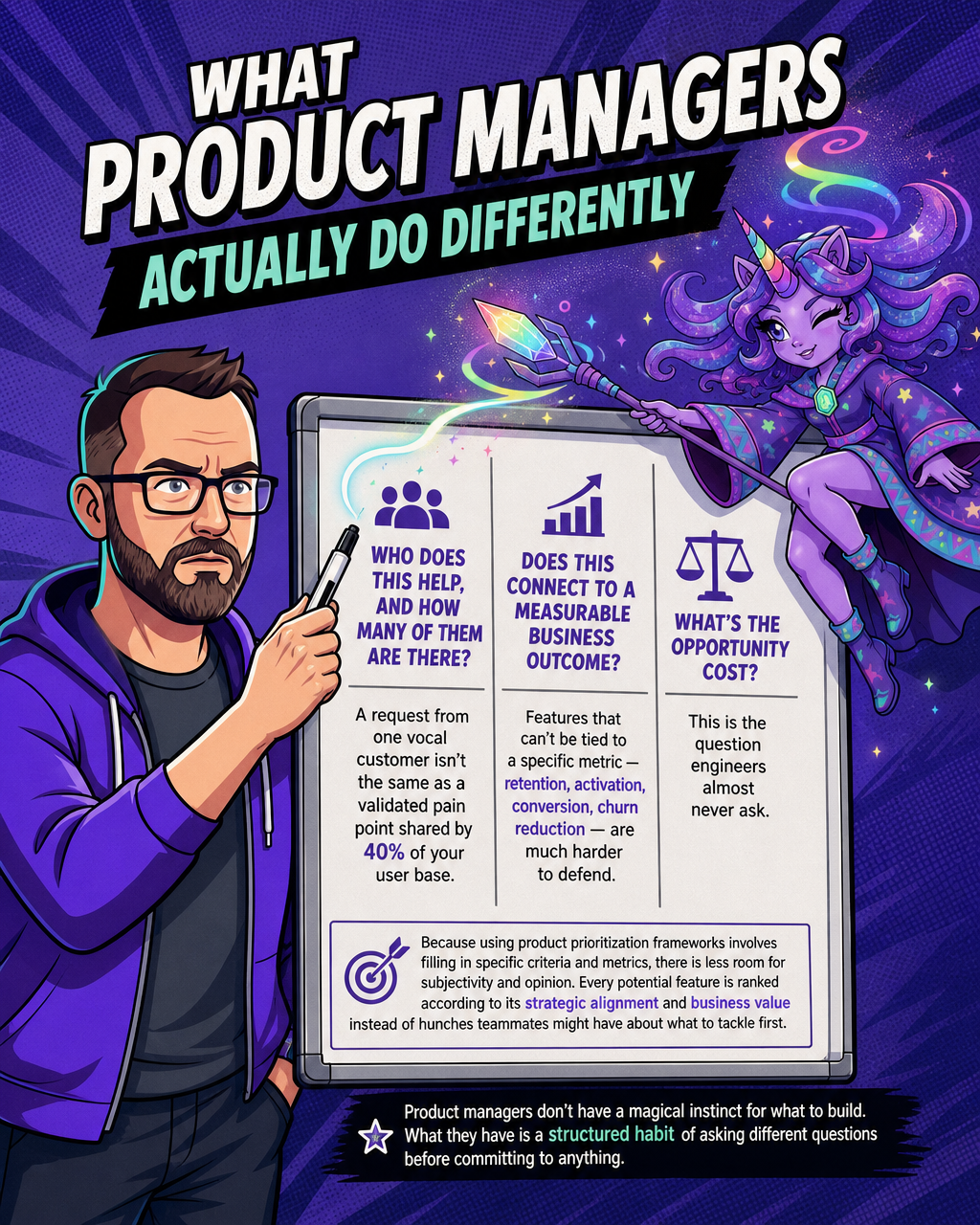
Product managers don't have a magical instinct for what to build. What they have is a structured habit of asking different questions before committing to anything. It's worth noting that PMs are also subject to stakeholder pressure, HiPPO (highest-paid person's opinion) dynamics, and roadmap bloat — these prioritization failures are often organizational rather than role-specific. But the frameworks PMs use to push back are worth borrowing.
PMs don't make preference-based decisions when they prioritize, but rather, their decisions are constraint-based. Instead of saying "I prefer this idea," they are saying "If we do this now, we can't do that." That reframe is deceptively simple, but it changes everything about how a request gets evaluated.
A PM receiving a feature request runs it through a mental checklist that most engineers skip entirely. The checklist isn't intuitive, but it can be learned:
Who does this help, and how many of them are there? A request from one vocal customer isn't the same as a validated pain point shared by 40% of your user base. Prioritization decisions are frequently made based on incomplete information, such as not knowing which features users will actually adopt, whether a request represents a real problem or just a loud minority, or whether it will significantly improve a metric.
Does this connect to a measurable business outcome? Features that can't be tied to a specific metric — retention, activation, conversion, churn reduction — are much harder to defend. Metrics like activation rate, churn, feature adoption, retention, session duration, and Daily Active Users help PMs understand if and where the product is underperforming.
What's the opportunity cost? This is the question engineers almost never ask. Because using product prioritization frameworks involves filling in specific criteria and metrics, there is less room for subjectivity and opinion. Every potential feature is ranked according to its strategic alignment and business value instead of hunches teammates might have about what to tackle first.
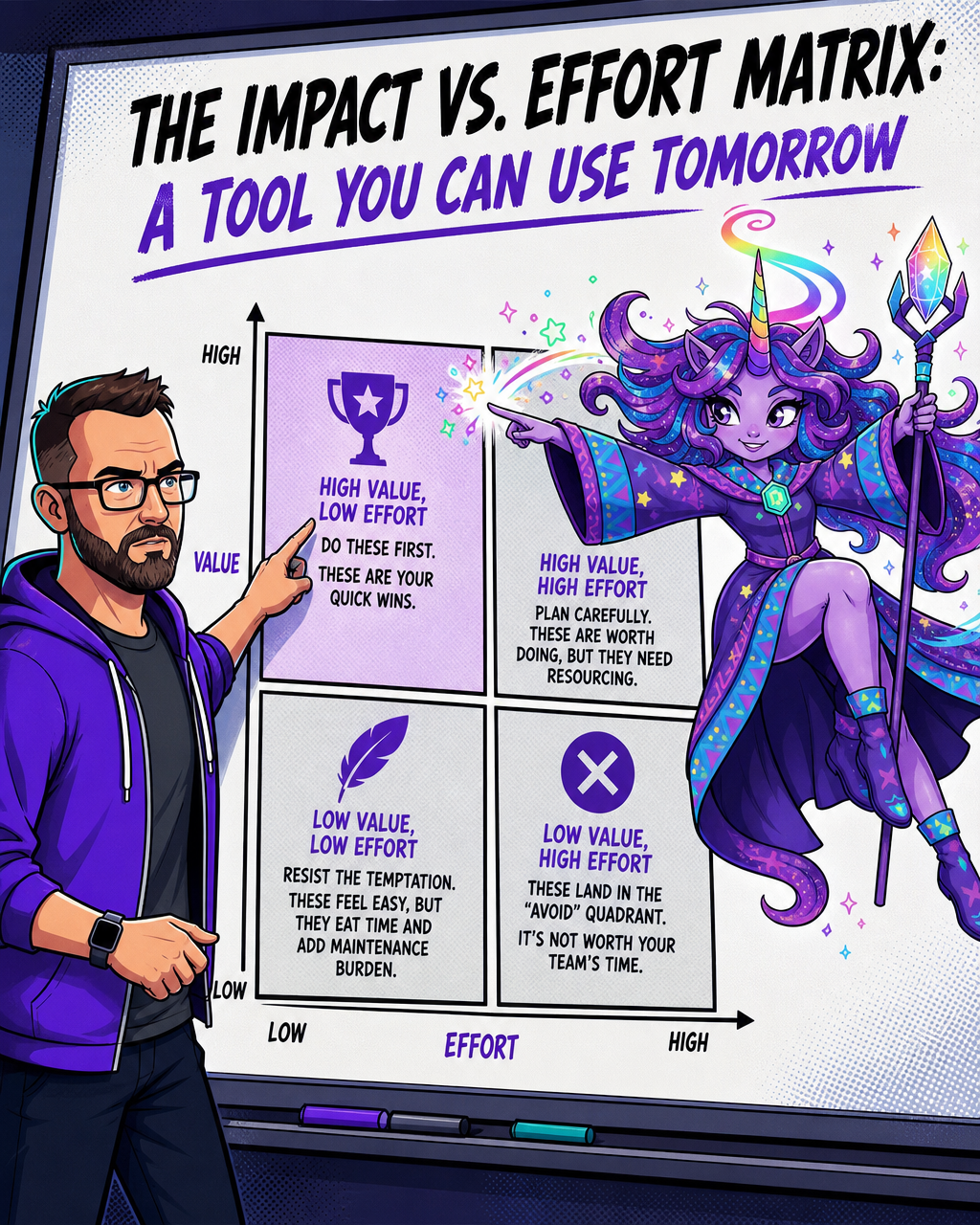
The Impact vs. Effort Matrix: A Tool You Can Use Tomorrow
If you want one framework to start with, the impact vs. effort matrix is the most immediately accessible.
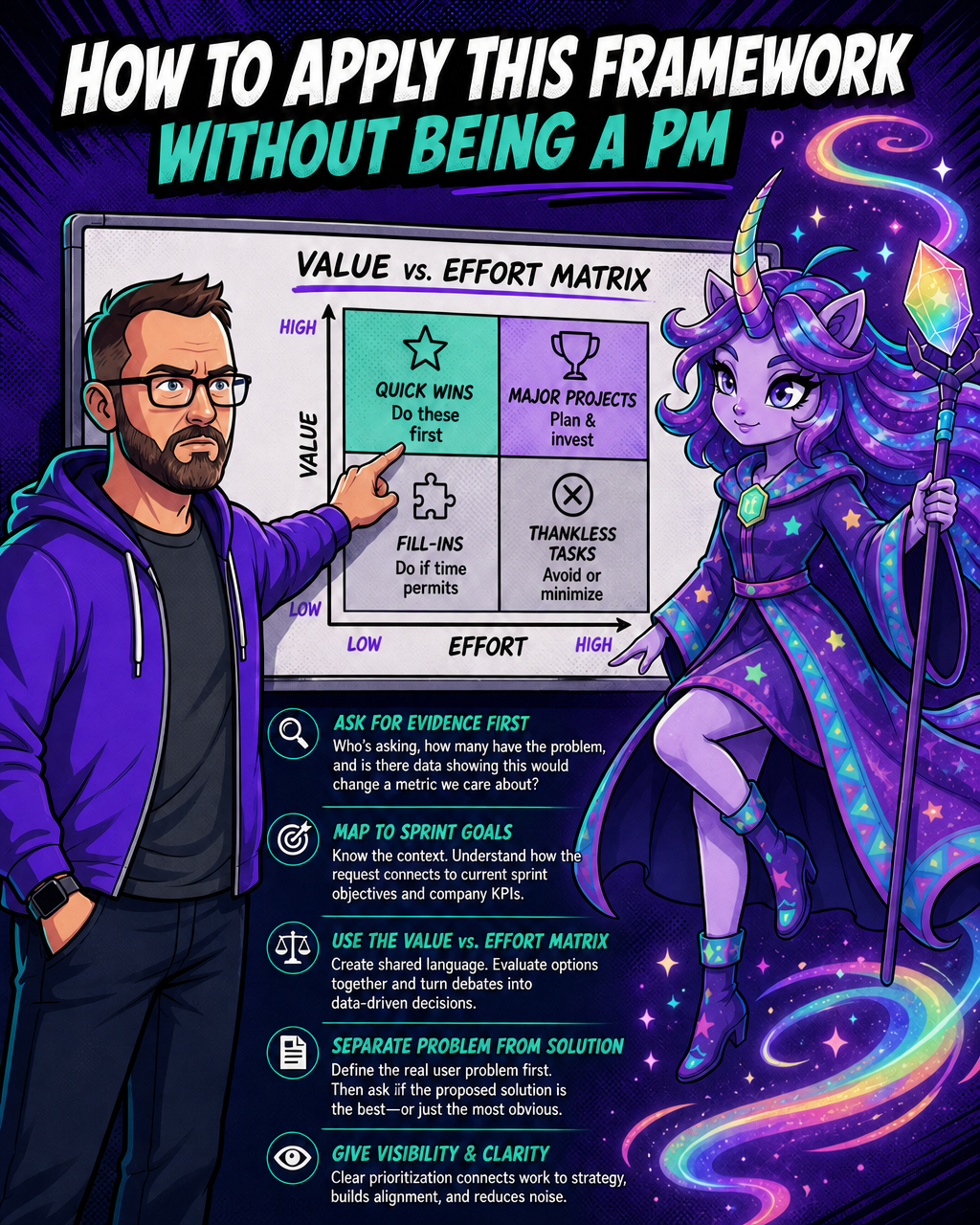
The value vs. effort matrix prioritizes features based on their probable value and the effort necessary to implement them. A 2x2 matrix, measuring value on one axis and effort on the other, helps with the decision-making process. It divides every potential piece of work into four buckets:
- High value, low effort. Do these first. These are your quick wins.
- High value, high effort. Plan carefully. These are worth doing, but they need resourcing.
- Low value, low effort. Resist the temptation. These feel easy, but they eat time and add maintenance burden.
- Low value, high effort. These land in the "avoid" quadrant. It's not worth your team's time.
The third bucket is where engineers most often get derailed. Low-effort requests feel harmless. "It'll only take an afternoon." But an afternoon pulled from planned sprint work is an afternoon that wasn't spent on something strategic. Research on task-switching and cognitive load — including well-established work by Rubinstein, Meyer, and Evans on executive control of cognitive processes — has consistently found that context-switching carries measurable performance costs, even when individual tasks seem minor.
For teams that want more rigour, the RICE framework adds two more dimensions: Reach (how many users are affected) and Confidence (how certain are you of your estimates). The RICE scoring framework helps product teams prioritize items on a product roadmap by scoring them according to four criteria: reach, impact, confidence, and effort. When the team combines its total scores across all four criteria, each initiative will have a single score to weigh its relative value to the product and the organization.
The formula is: (Reach × Impact × Confidence) ÷ Effort. The resulting score gives you a number you can compare across competing requests, which reduces reliance on pure opinion by anchoring discussions in explicit, shared estimates — though it's worth noting that inputs like Impact and Confidence still involve judgment calls, so the framework structures subjectivity rather than eliminating it.
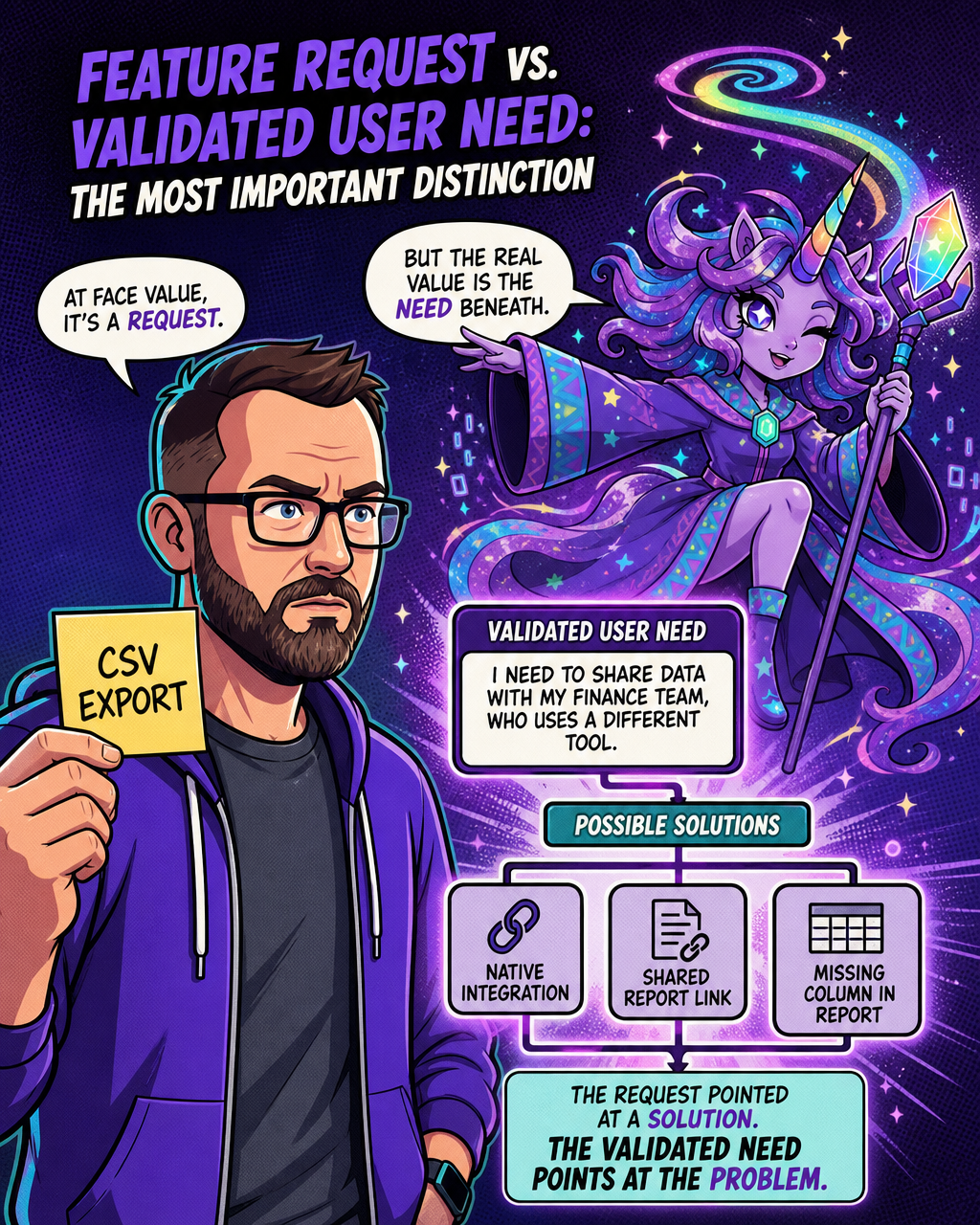
Feature Request vs. Validated User Need: The Most Important Distinction
This is where a lot of engineers — and, frankly, a lot of PMs — get tripped up. A feature request and a validated user need are not the same thing.
A feature request is what someone asks for. A validated user need is the underlying problem they're actually experiencing. The difference matters enormously, because the solution to the actual problem is often not the solution the requester described.
At face value, user feedback consists of solutions and not problems. A PM won't just take these requests as they are but will ask why, how, and what. After asking these questions, the PM evaluates that users requested dark mode because, apart from personal preference, they struggle to use the product for long periods especially at night, and that dark mode is one possible solution among others.
This matters practically. Say a user asks for an export-to-CSV button. That's the request. The validated need might be: "I need to share data with my finance team, who uses a different tool." Once you know that, the solution space opens up. Maybe a native integration is better than an export button. Maybe a shared report link solves it with less engineering effort. Maybe the real problem is that your reporting module is missing a column. The feature request pointed you at a solution. The validated need pointed you at the problem.
Features are implementations that are linked to problems or opportunities. You should be focused on prioritizing problems and opportunities that are tied to higher level goals and strategies.
For engineers, getting into the habit of asking "what problem does this actually solve?" before engaging with any technical solution is a meaningful shift. It doesn't slow you down. It stops you from building the wrong thing fast.
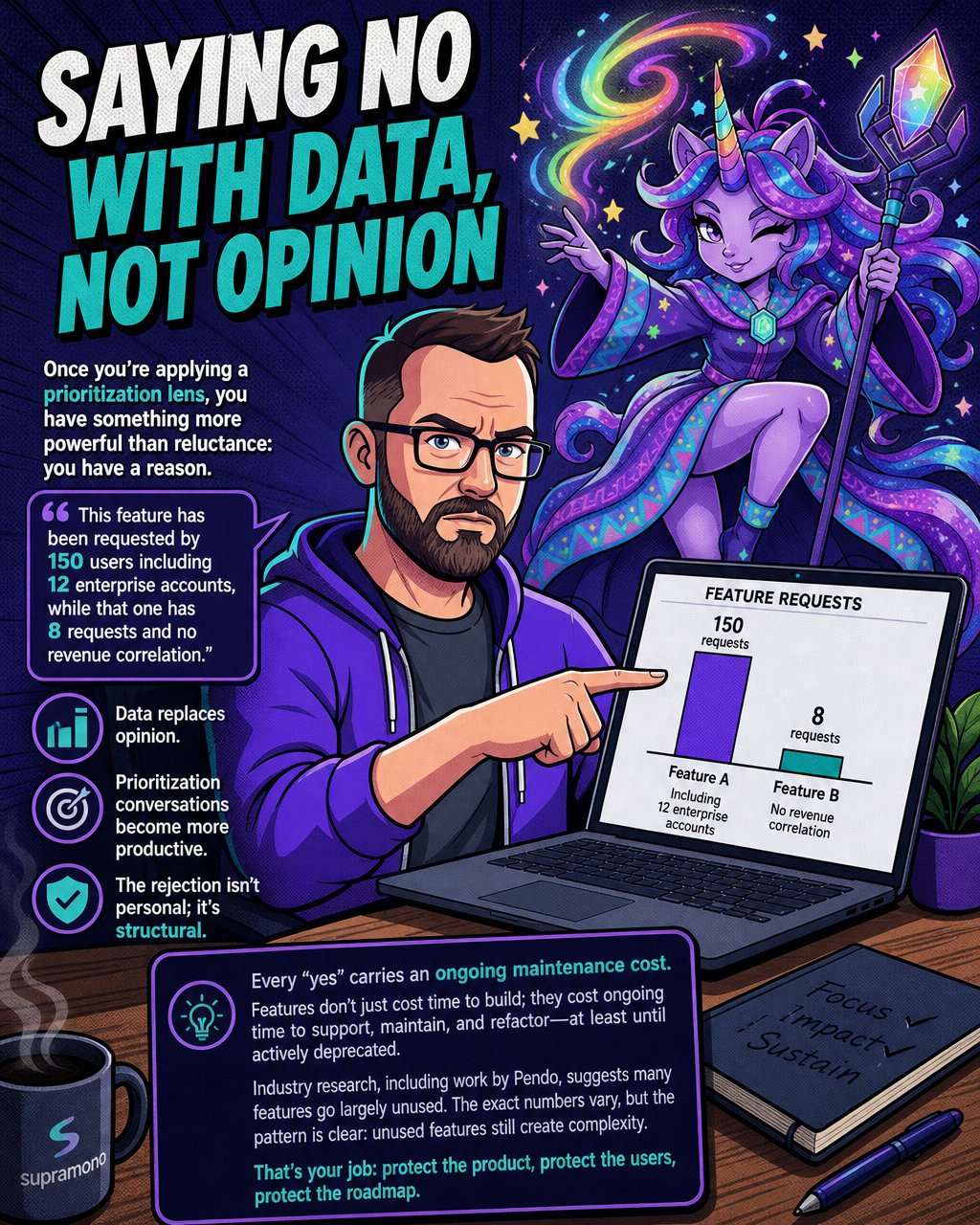
Saying No With Data, Not Opinion
Here's the practical part. Once you're applying a prioritization lens, you have something more powerful than reluctance: you have a reason.
For example, imagine being able to say: "This feature has been requested by 150 users including 12 enterprise accounts, while that one has 8 requests and no revenue correlation." Data replaces opinion, and prioritization conversations become more productive. That's what "saying no with data" means in practice. It's not "I don't want to build that." It's "here's the scoring, here's the evidence, here's what it would cost us to prioritize this over what we've already committed to." The rejection isn't personal; it's structural. And that's a much easier conversation to have.
Every "yes" carries an ongoing maintenance cost. That's a point worth repeating to anyone who pushes back on a rejection. Features don't just cost the time to build them; they cost the ongoing time to support, maintain, and refactor around them — at least until actively deprecated. A feature that nobody uses still sits in the codebase, accumulating complexity. Industry research, including work published by Pendo, has suggested that a significant proportion of software features go largely unused — though methodologies vary across studies and the figures have not been independently replicated.
That pattern is worth taking seriously regardless of the precise number. When a stakeholder pushes for a low-priority feature and you say "we don't have evidence this solves a real problem for more than a handful of users," you're not being obstructionist. You're doing your job.
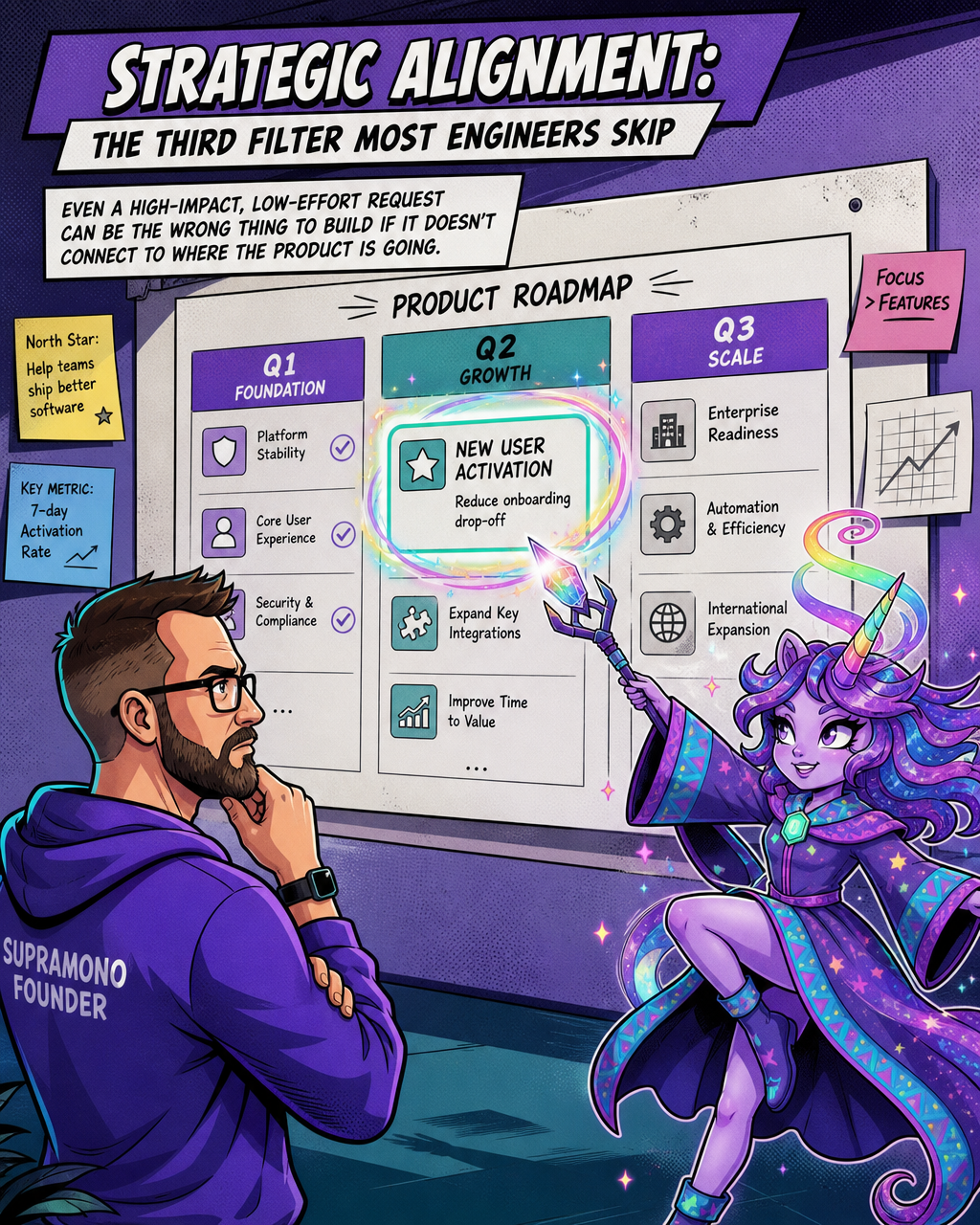
Strategic Alignment: The Third Filter Most Engineers Skip
Even a high-impact, low-effort request can be the wrong thing to build if it doesn't connect to where the product is going.
Prioritization ensures that teams work on the right things at the right time by evaluating options through various lenses, such as customer impact, business goals, technical feasibility, and effort required. That phrase "business goals" is the one that often gets dropped in engineering discussions. Engineers are comfortable talking about feasibility. They're less practiced at asking: does this feature support the product direction for this quarter?
A concrete example: suppose your team is focused on reducing onboarding drop-off. A sales rep asks for a bulk-import feature that power users have been requesting. It's technically clean, the code would be interesting to write, and the request is legitimate. But it serves existing users, not new ones. Building it during a quarter where the strategic priority is new user activation means your sprint is partly working against its own goal.
Strong product teams regularly re-evaluate their priorities as new user feedback comes in, competitors launch updates, or internal goals shift. Maintaining that discipline requires deliberate organizational effort — it doesn't happen by default.
This is where engineers who've internalized product thinking start to look different from their peers. They don't just estimate tickets. They ask: what are we actually trying to move this sprint, and how does this request relate to that?
How to Apply This Framework Without Being a PM
You don't need a title change to start thinking this way. Here's what it looks like as a working engineer:
When a request arrives, ask for the evidence before you engage with the solution. "Who's asking for this, how many people have the problem, and is there data showing this would change a metric we care about?" This isn't deflection. It's the same question a competent PM asks every time.
Map requests to current sprint goals before estimating effort. Know the context: understand how a task or feature fits with the KPIs of the company, the market trends, and related upcoming considerations. If you can't explain how a new request connects to the current sprint objective, that's information worth surfacing before anyone writes a line of code.
Use the value vs. effort matrix as a shared language in conversations. Product prioritization frameworks transform chaos into clarity by creating shared language and objective criteria. When everyone evaluates features using the same scoring model, political debates become data-driven discussions. Frameworks establish common ground between product, engineering, and business teams.
Separate the problem from the proposed solution in every request. Before you start designing an implementation, write down what user problem the request is trying to solve. Then ask: is this the best solution to that problem, or just the most obvious one?
Clear prioritization gives everyone visibility into what's being built and why. Executives see how work connects to strategy, engineers understand the reasoning behind roadmap decisions, and stakeholders can track their requests without constant check-ins.
What Changes When Engineers Think Like PMs
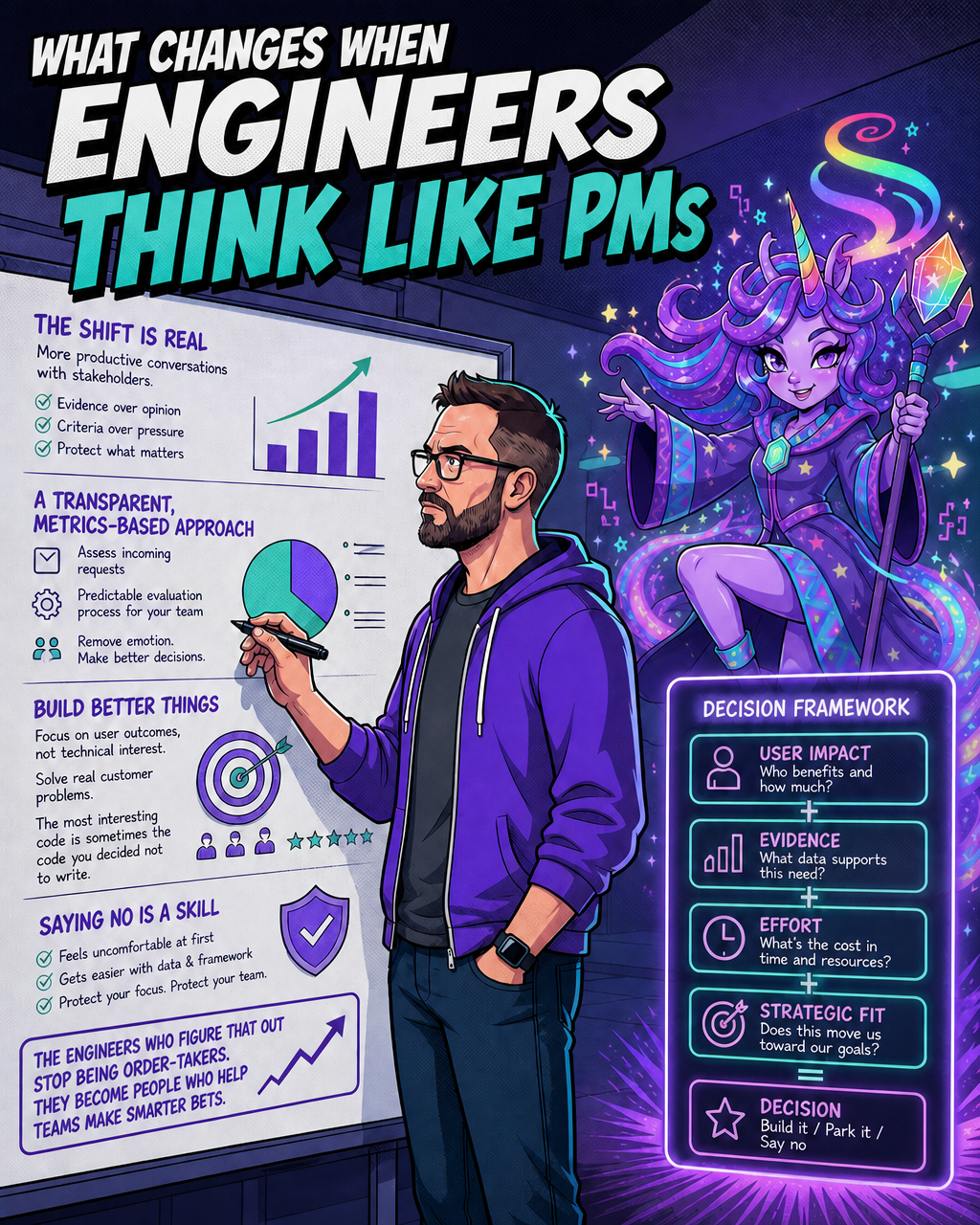
The shift is real, and it's not just about protecting your sprint. Engineers who develop this habit tend to have more productive conversations with stakeholders because they're bringing evidence and criteria to discussions that used to be driven by opinion and pressure.
A transparent, metrics-based approach helps you assess incoming requests. It also provides a predictable evaluation process for your team. When everyone is reviewing features and making decisions using the same method, you can remove emotion from the process and make more informed decisions.
They also build better things. Not because they're smarter, but because they've stopped optimizing for technical interest and started optimizing for user outcomes. The most interesting code is sometimes the code you decided not to write.
You must prioritize solving real customer problems. All too often, organizations don't stick to this central tenet of product development, possibly because they're prioritizing innovation above value.
Saying no is a skill. Like most skills, it feels uncomfortable the first few times. But it gets easier when you have data, a framework, and the clarity that comes from knowing exactly what you're protecting.
The engineers who figure that out stop being order-takers. They become people who help teams make smarter bets.

Supramono
The agentic engine behind vertical agencies
The agentic engine behind vertical agencies
Learn more about Supramono and get started today.
Visit Supramono