Ideal Customer Profile for Engineers: A GTM Primer

What an ideal customer profile actually is (and what it isn't)
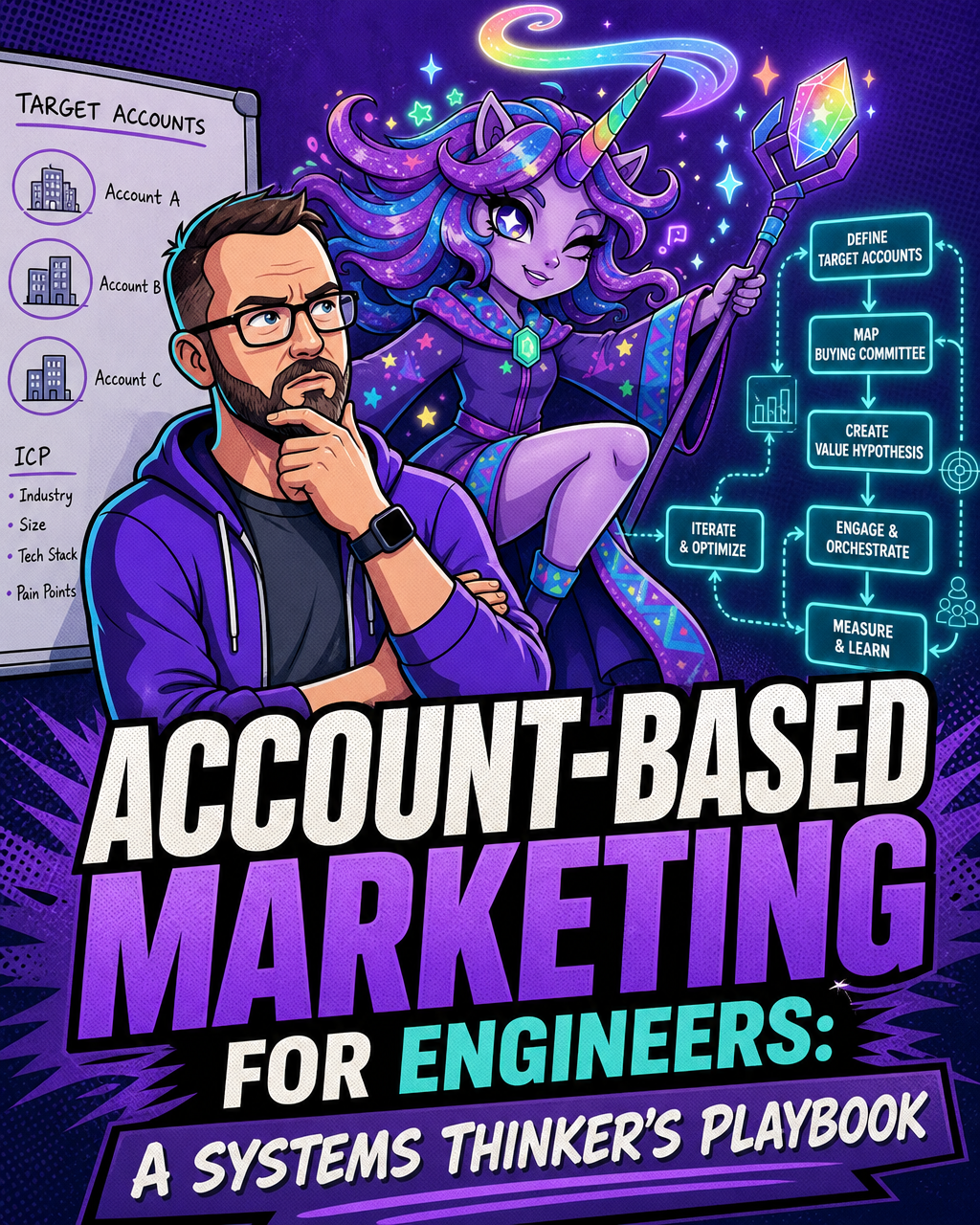
If you're an engineer stepping into go-to-market work for the first time, you've probably heard "ICP" dropped in every sales meeting, product review, and investor update. Most people treat it like a synonym for "target market." It isn't.
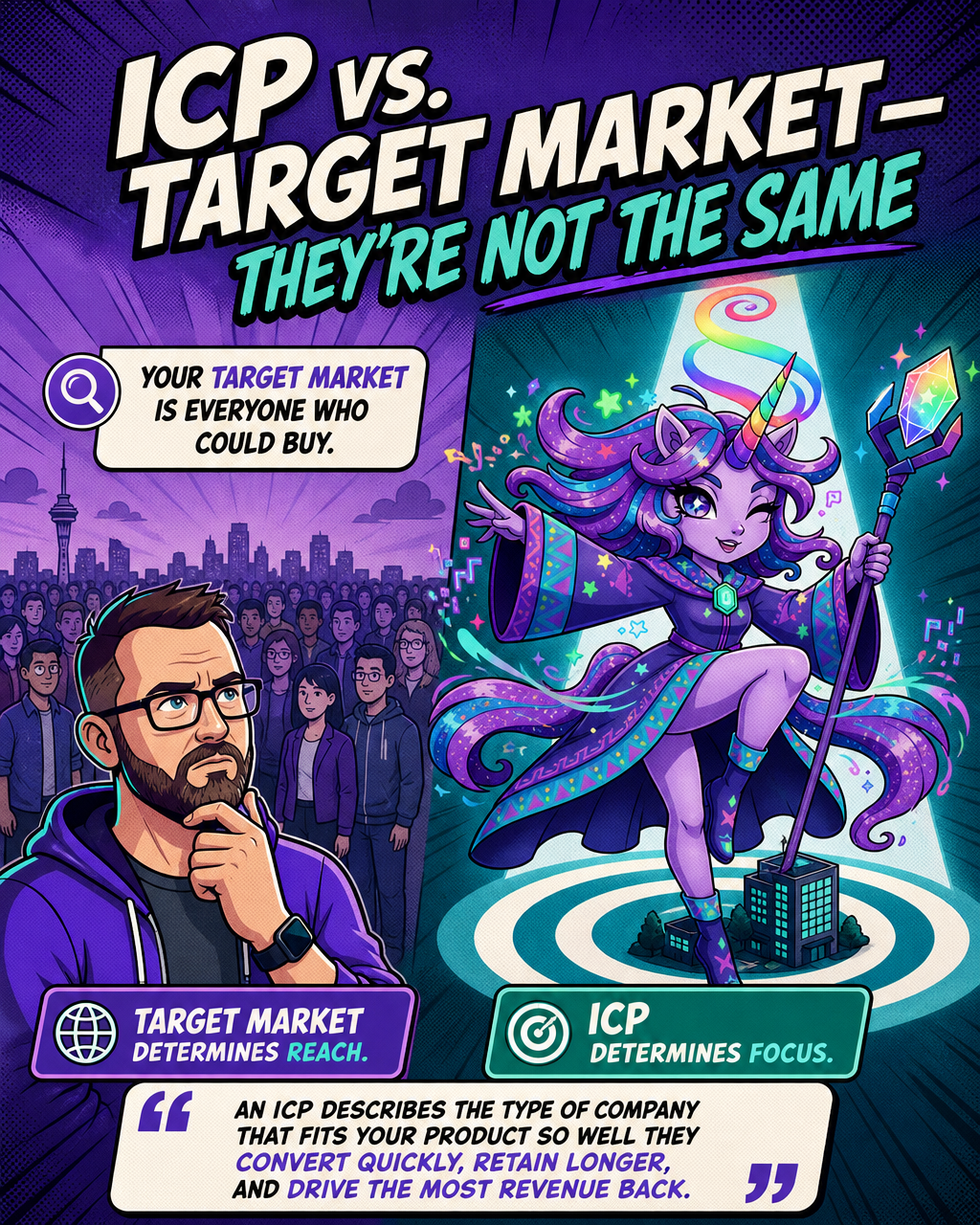
Your target market is the universe of people who could, in theory, buy what you build. Target market determines reach. ICP determines focus. More precisely, an ICP is a detailed description of the type of company that fits your product so well they convert quickly, retain longer, and drive the most revenue back. It's most commonly used in B2B marketing to focus sales and marketing on a defined list of high-fit accounts rather than a broad audience.
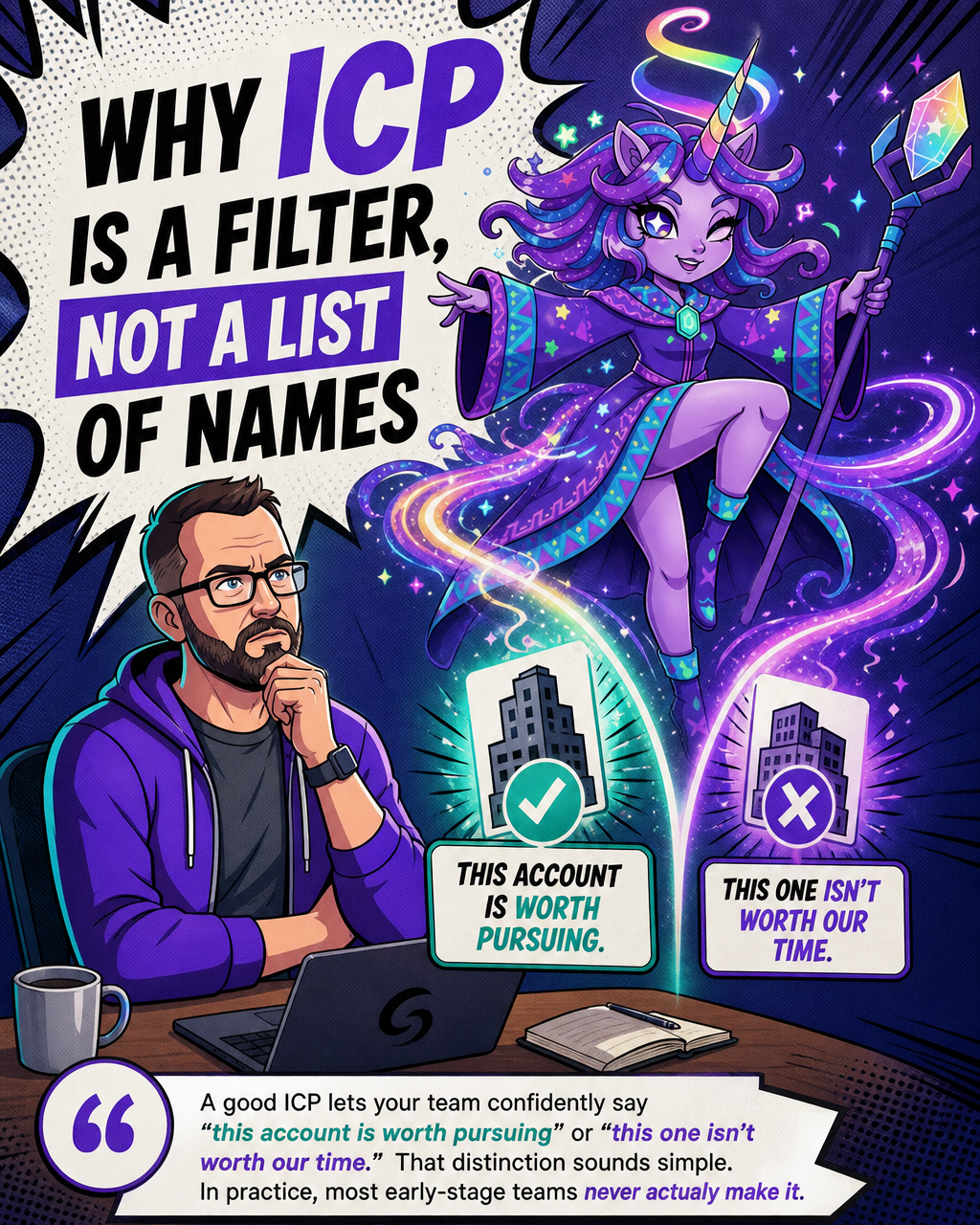
Think of it as a filter, not a list. A good ICP lets your team confidently say "this account is worth pursuing" or "this one isn't worth our time." That distinction sounds simple. In practice, most early-stage teams never actually make it.
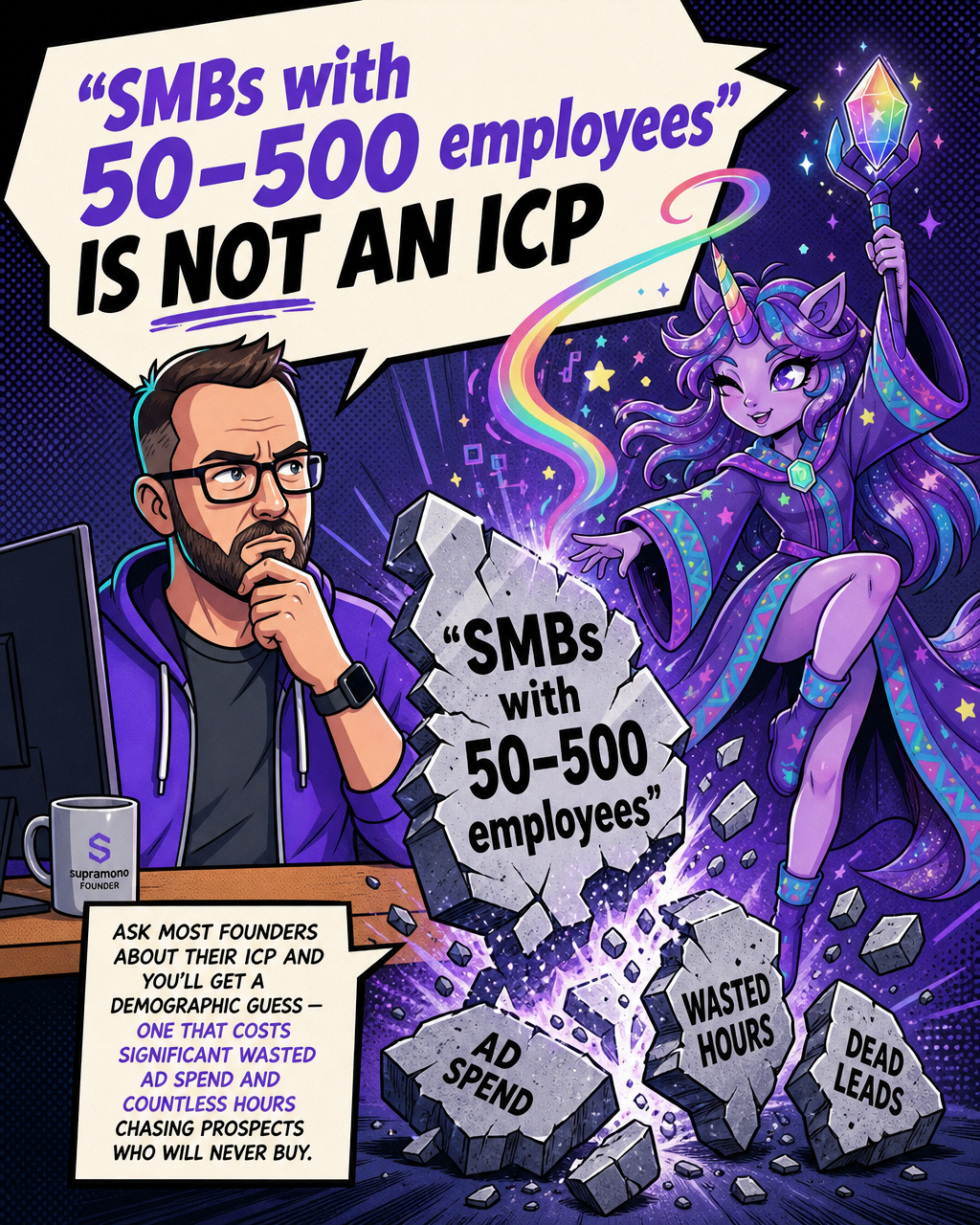
Ask most founders about their ICP, and you'll get something like "small to medium businesses" or "companies with 50-500 employees." That's not an ICP. That's a demographic guess that will cost you significant wasted ad spend and countless hours chasing prospects who will never buy.
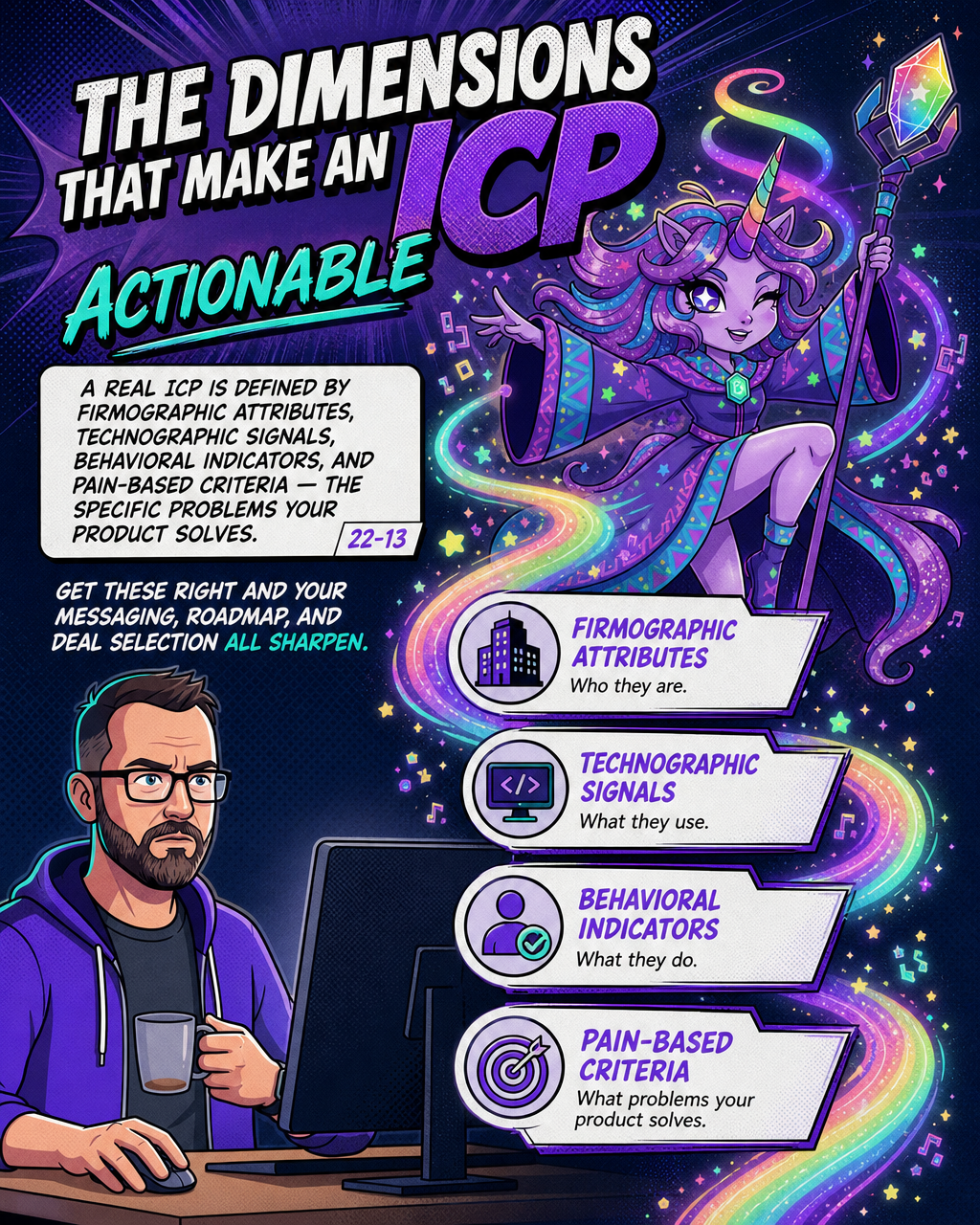
A real ICP is defined by observable attributes, not gut feeling. Industry, company size, revenue range, tech stack, growth stage, buying triggers. It's defined by firmographic attributes, technographic signals, behavioral indicators, and pain-based criteria — the specific problems your product solves. When you get those dimensions right, it changes things downstream: your messaging, your product roadmap, which deals to work and which to walk away from.
Why technical fit is only one dimension
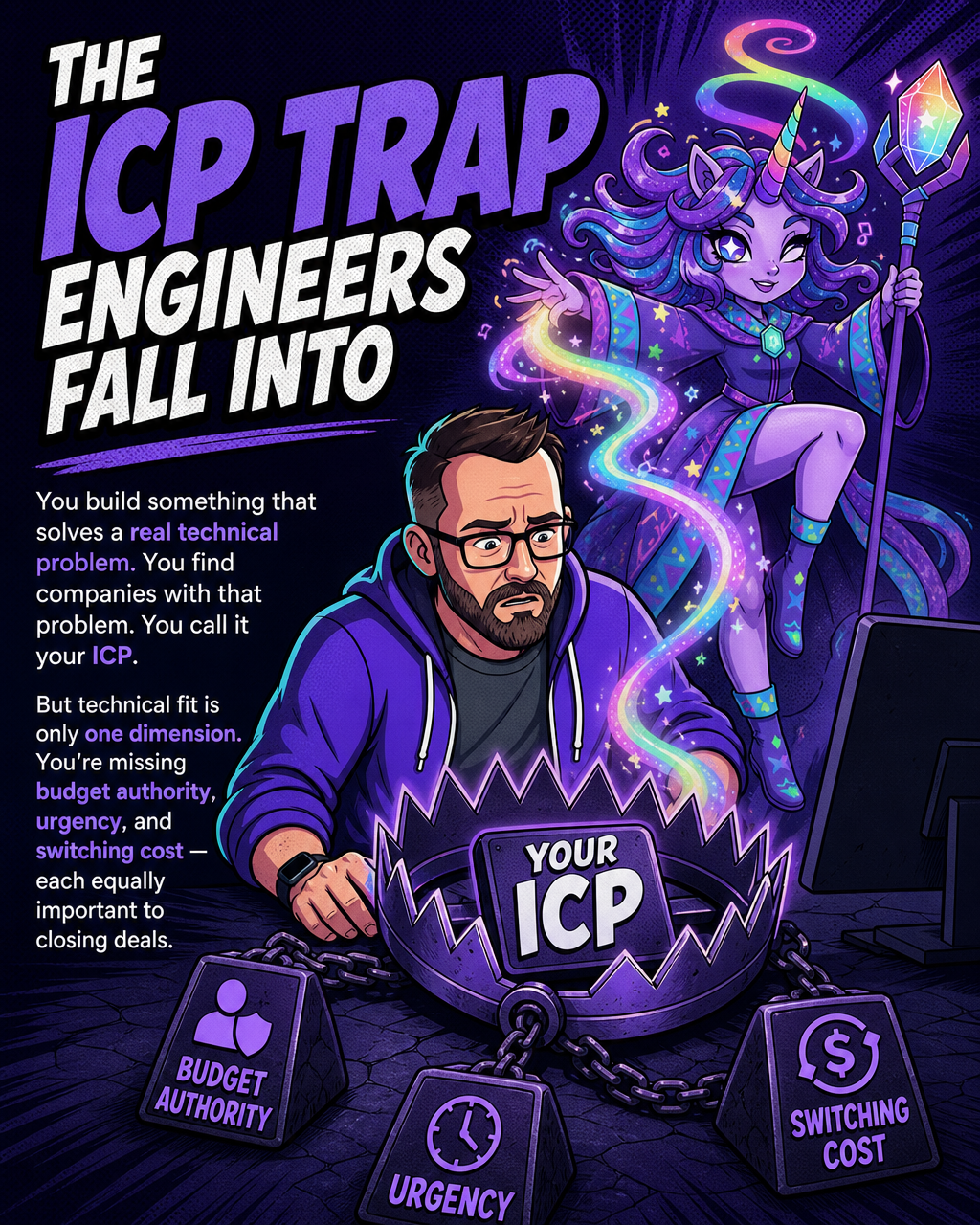
Here's the trap engineers fall into almost universally. You build something that solves a real technical problem. You identify companies that have that problem. You call it your ICP. You're missing at least three other dimensions that are equally important: budget authority, urgency, and switching cost.
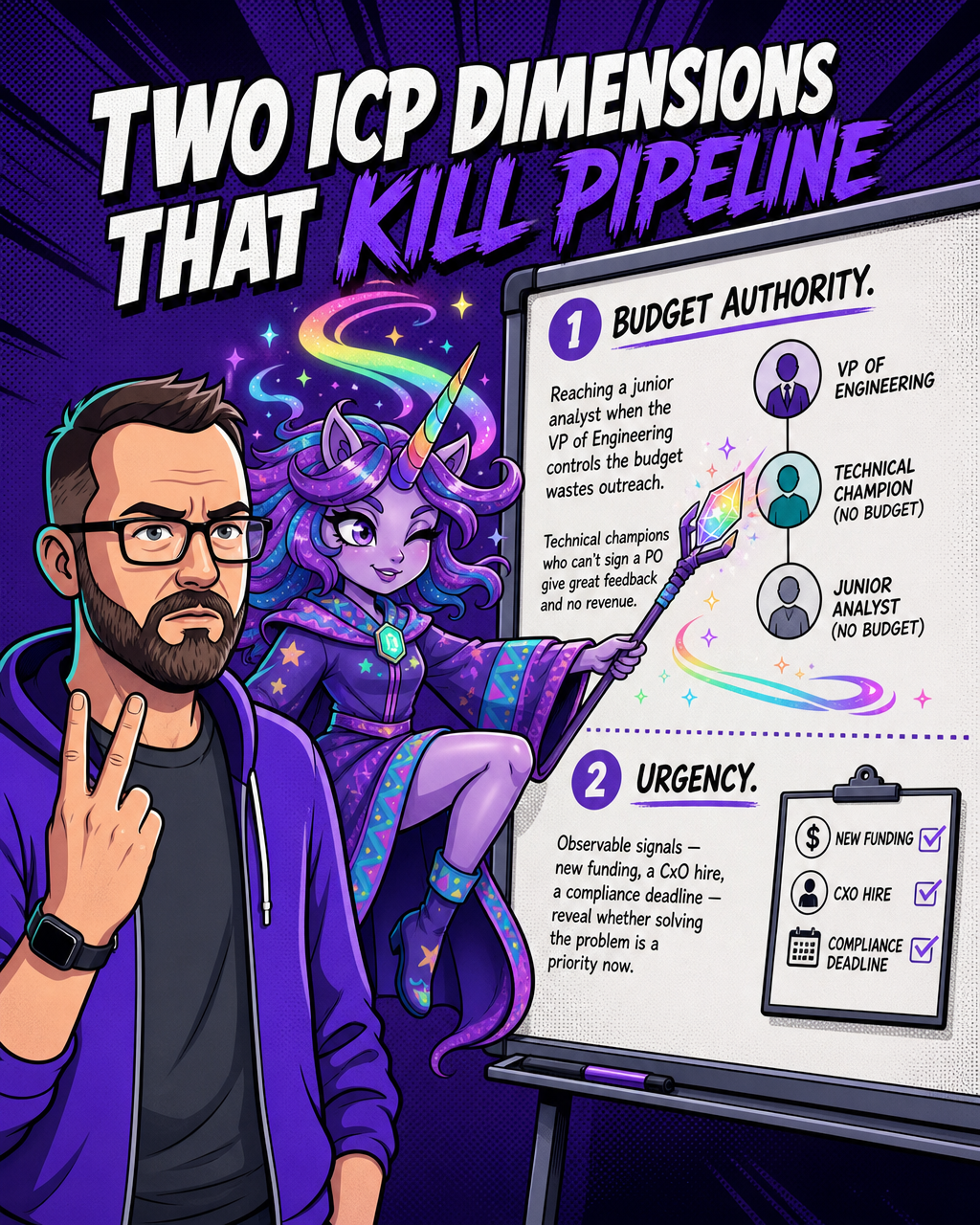
Budget authority. Targeting the right accounts but reaching only a junior analyst when the VP of Engineering controls the budget wastes outreach cycles on conversations that cannot advance. A mid-level Product Manager at a SaaS company might be roughly interested in the value of a new API product. But will they have budget authority to actually buy? Technical champions who can't sign a PO will give you great feedback and no revenue.
Urgency. A company can have your exact problem and zero urgency to solve it right now. A B2B software tool that addresses a "nice-to-have" instead of a critical pain point creates a situation where even if users like the product, they won't make it a budget priority, and your startup risks being sidelined. Urgency shows up in observable signals: recent funding, a new executive hire, a compliance deadline, a competitor announcement. A new CxO hire paired with aggressive recruiting in a specific function signals both budget authority and operational urgency.
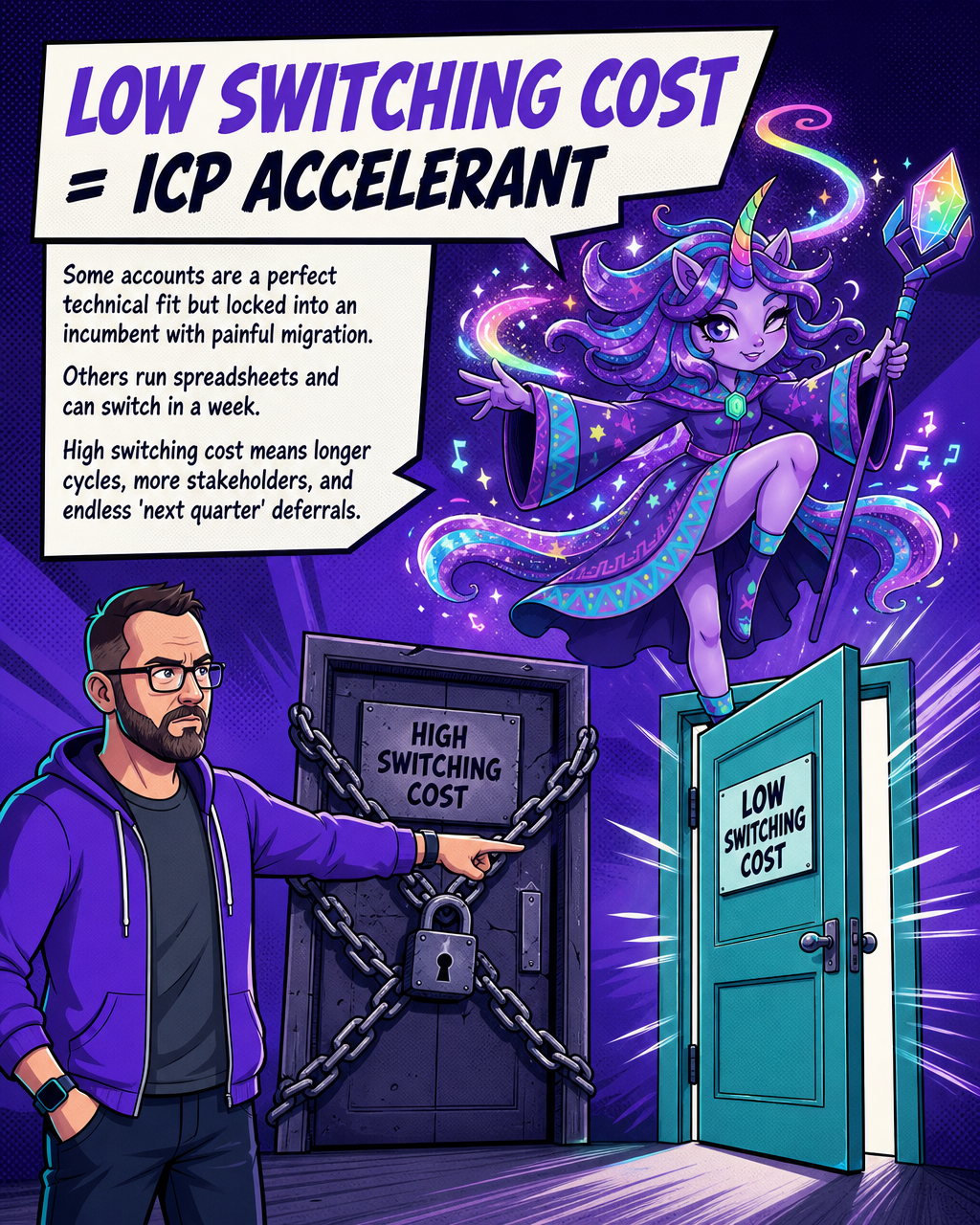
Switching cost. Some accounts are a perfect technical fit but are locked into an incumbent tool with painful migration costs. Others are running spreadsheets and can switch in a week. Low switching cost is an ICP accelerant. High switching cost means a longer sales cycle, more stakeholders, and a higher chance of "we'll do it next quarter" forever.
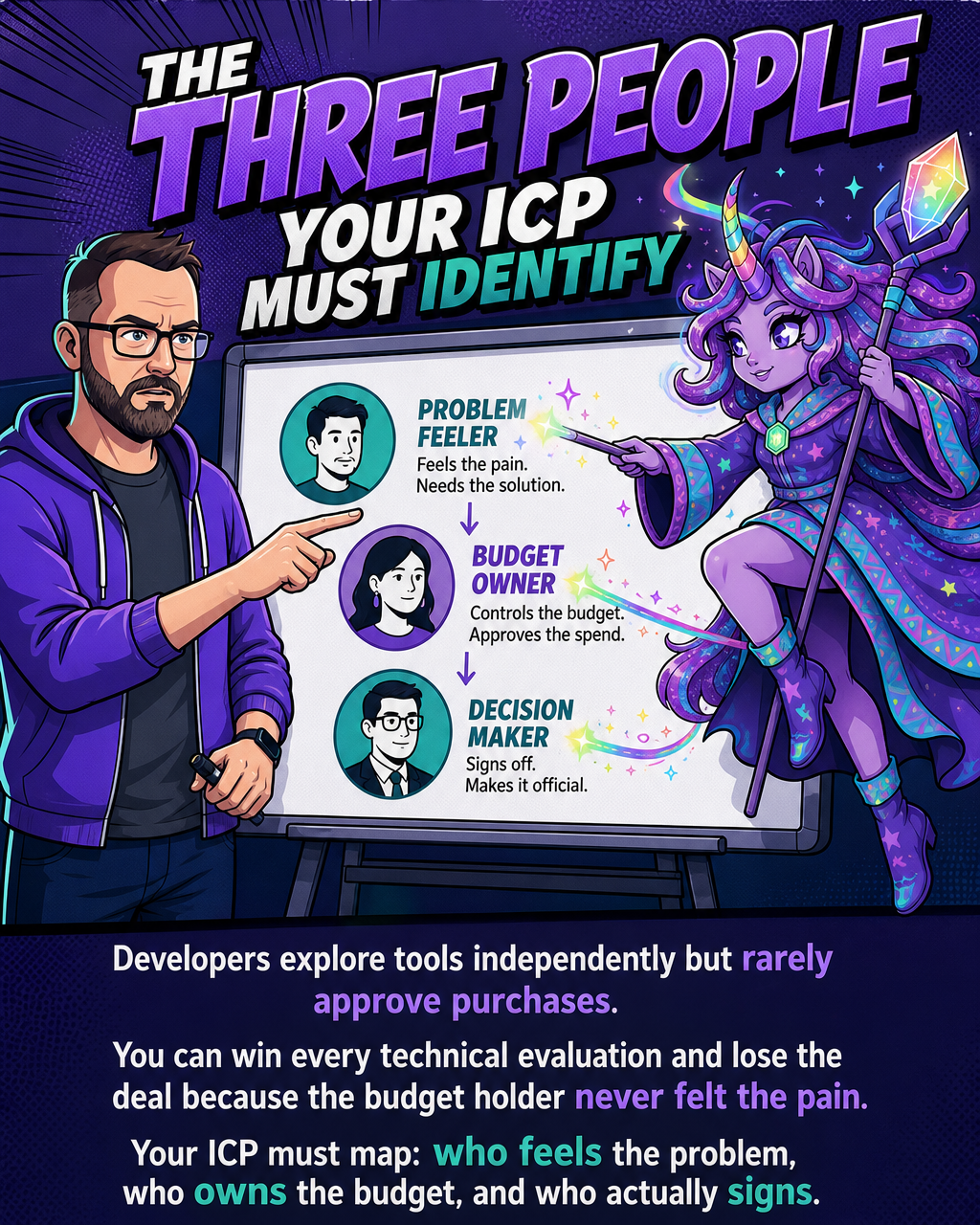
Developers buy differently than traditional B2B customers. They explore tools independently, prioritize technical fit, and often aren't the ones approving purchases. That last part is the one that stings. You can win every technical evaluation and still lose the deal because the person with the budget never felt the pain directly. Your ICP needs to account for who feels the problem, who owns the budget, and who actually signs.
Reverse-engineering your ICP from real conversations
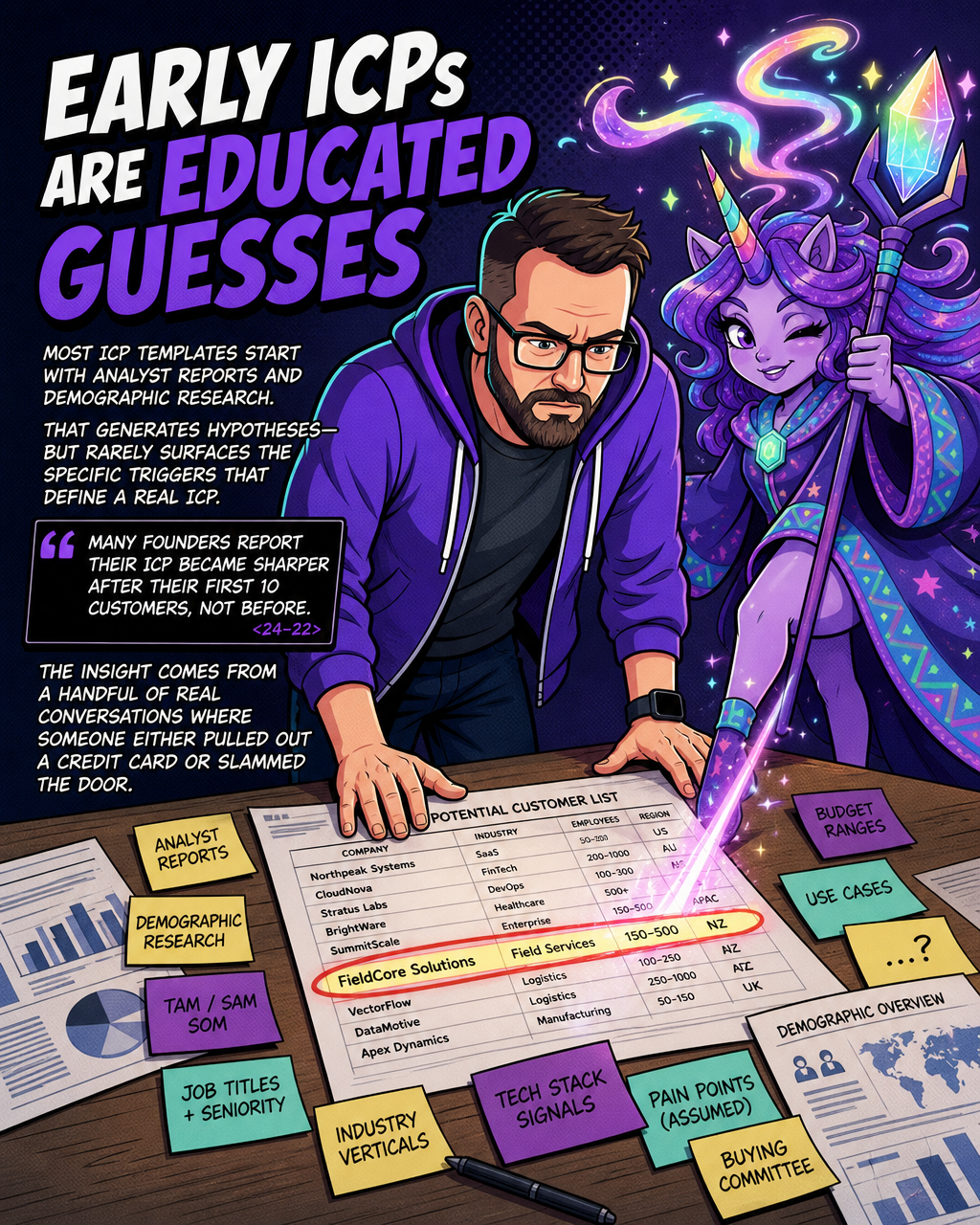
Most ICP templates suggest starting with analyst reports, market sizing data, and demographic research. That's a reasonable way to generate hypotheses. Analyst data can corroborate patterns you find in conversations, but it rarely surfaces the specific triggers and contexts that define a real ICP — and it works best alongside direct customer evidence, not instead of it.
Many founders report their ICP became sharper after their first 10 customers, not before. Early ICPs are educated guesses. The insight doesn't come from reading research. It comes from a handful of real conversations where someone either pulled out a credit card or slammed the door.
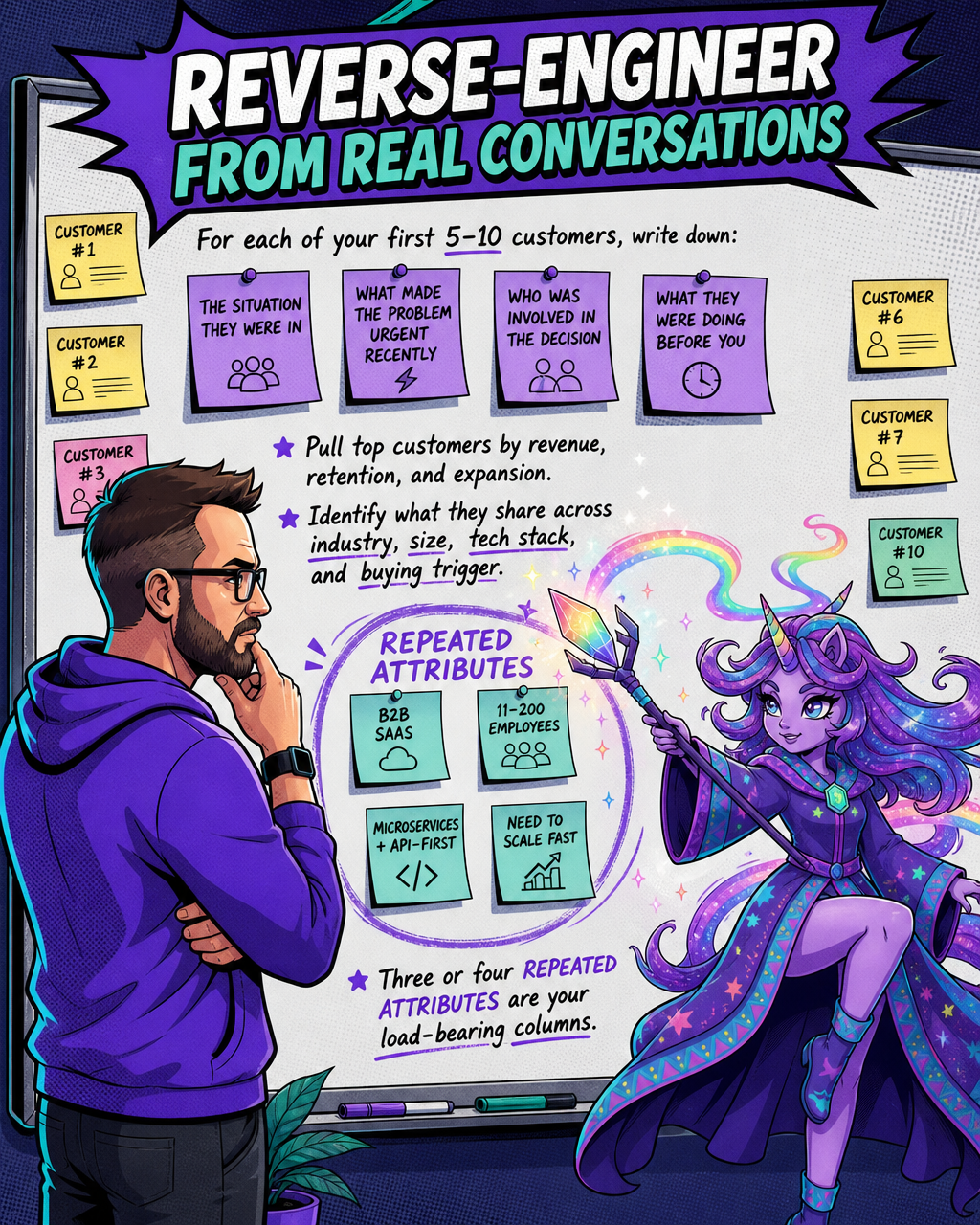
Here's a practical method. Take your first 5 to 10 customers or serious conversations. For each one, write down what made them move. Not the product features they mentioned. The situation they were in. What happened recently that made the problem urgent. Who else was involved in the decision. What they were doing before you came along and why that wasn't good enough anymore.
Pull your top customers by revenue, retention, and expansion. Identify what they have in common across industry, size, tech stack, and buying trigger. When you map those patterns, three or four attributes will appear repeatedly. Those are the load-bearing columns of your ICP.
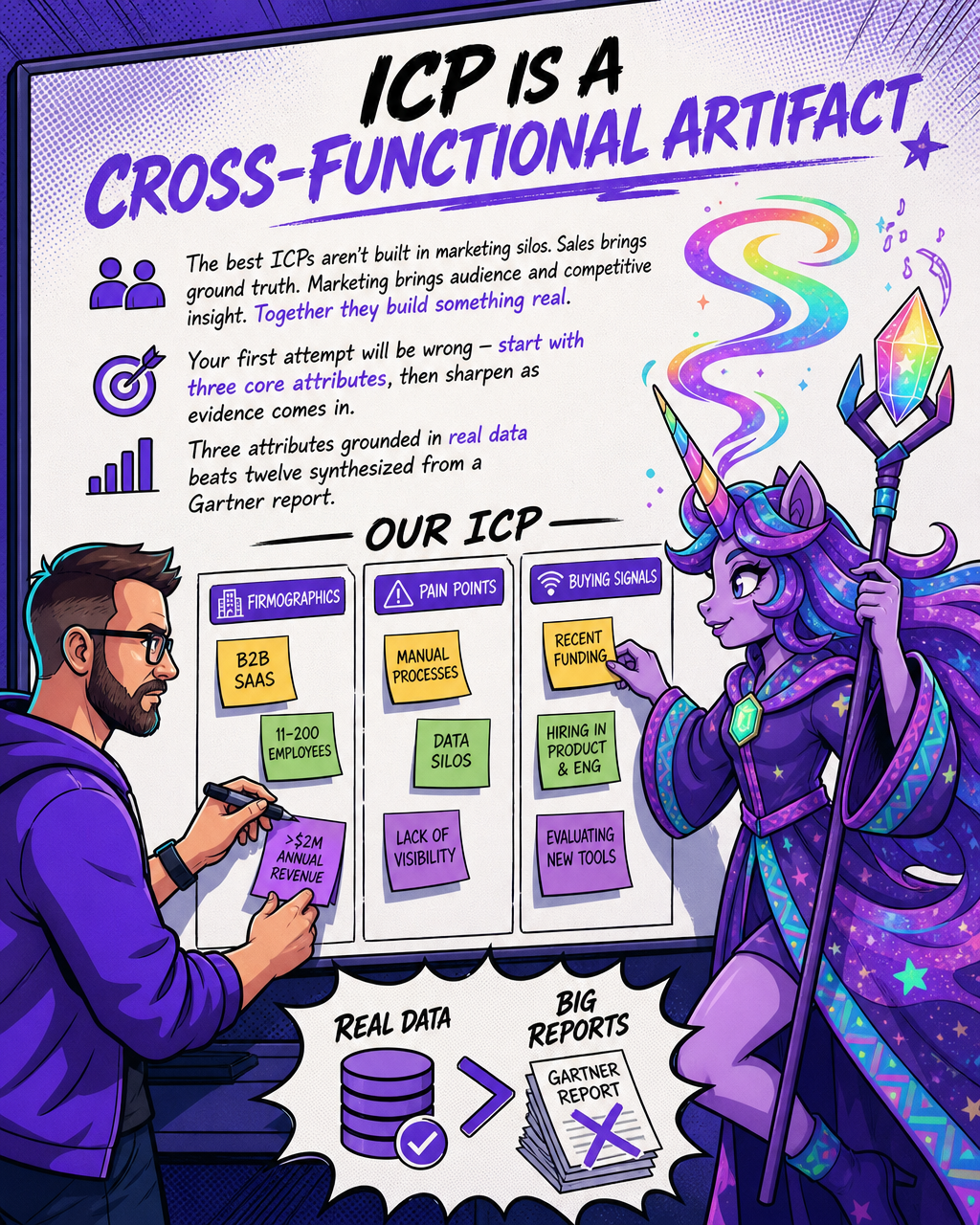
The best ICPs aren't created in marketing silos or executive retreats. Sales brings the ground truth from actual customer conversations. Marketing brings audience insights and competitive research. Together, they build something that reflects reality, not fantasy. For a solo founder or small team, that means you need both hats on: the person building and the person listening to buyers.
Your first attempt will be wrong, so don't overthink it. A reasonable starting point is three core attributes — enough to be actionable without being speculative — then sharpen from there as evidence comes in. Three attributes grounded in real data beats twelve attributes synthesized from a Gartner report you didn't fully trust anyway.
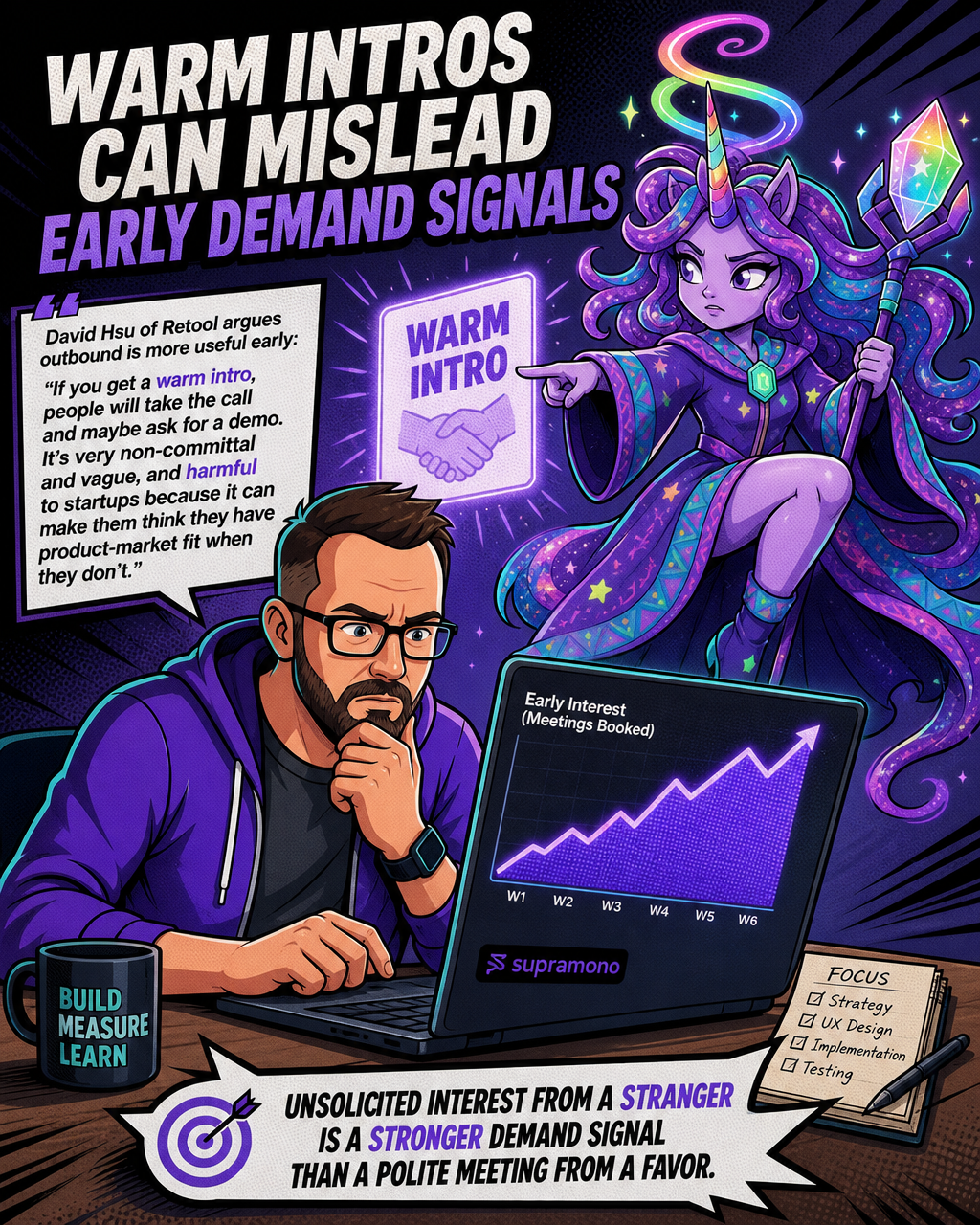
One more thing worth noting: inbound conversations aren't always honest. David Hsu, founder of Retool, believes outbound is very useful for early-stage startups because interest generated this way is more honest. "On the other hand, if you get a warm intro, people will take the call and maybe ask for a demo. It's very non-committal and vague, and [it's] harmful to startups because it can make them think they have product-market fit when they don't." All else being equal, unsolicited interest from a stranger tends to be a stronger demand signal than a polite meeting from a warm intro — though the quality of the outreach and the specificity of the response both matter.
The power of defining who doesn't belong
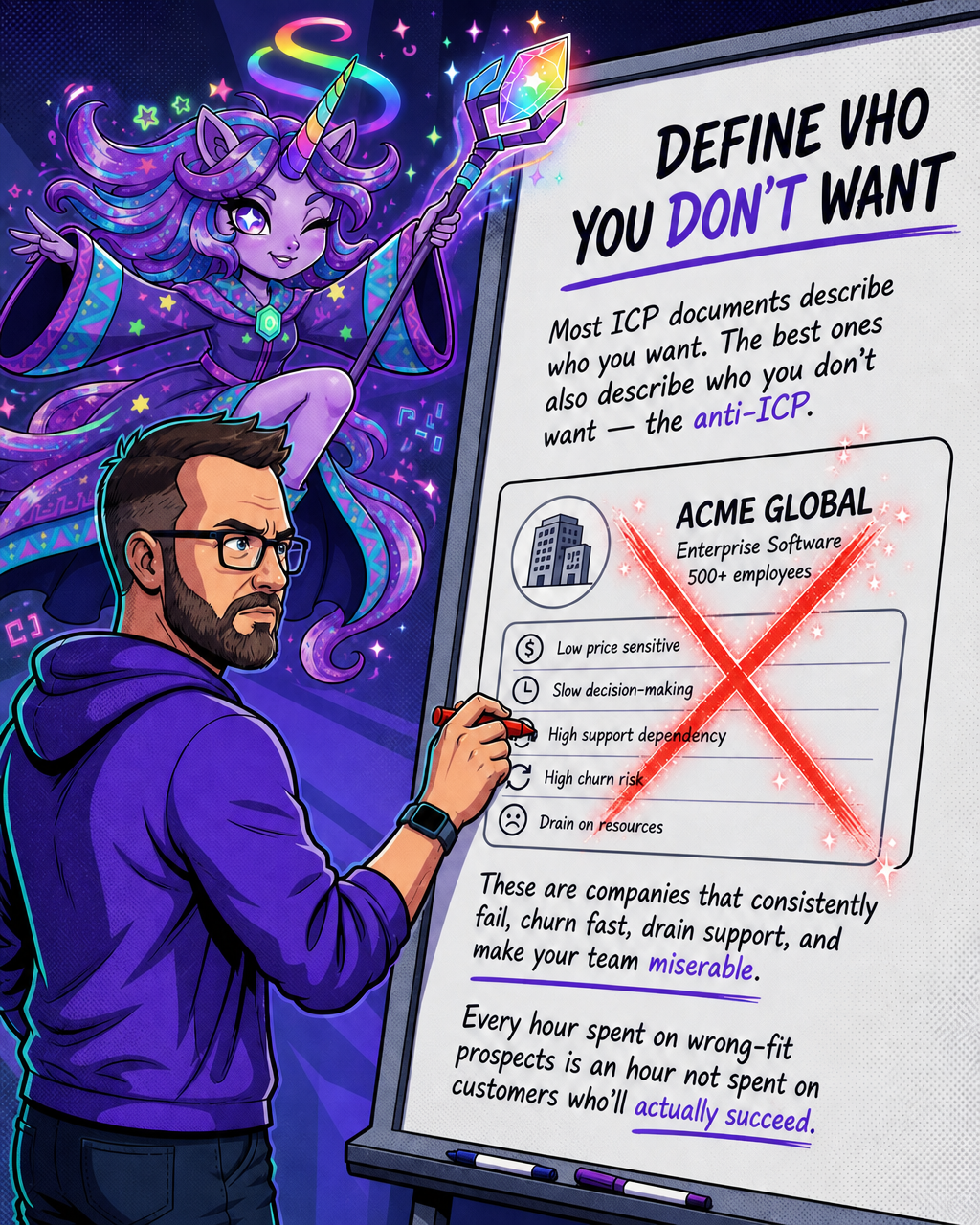
Most ICP documents describe who you want. The best ones also describe who you don't want. This is the negative ICP, sometimes called the anti-ICP or anti-target, and it's where engineers often find the most immediate value.
Every hour spent on wrong-fit prospects is an hour not spent on customers who'll actually succeed. Your anti-ICP describes companies that consistently fail, churn fast, drain support resources, and make your team miserable.
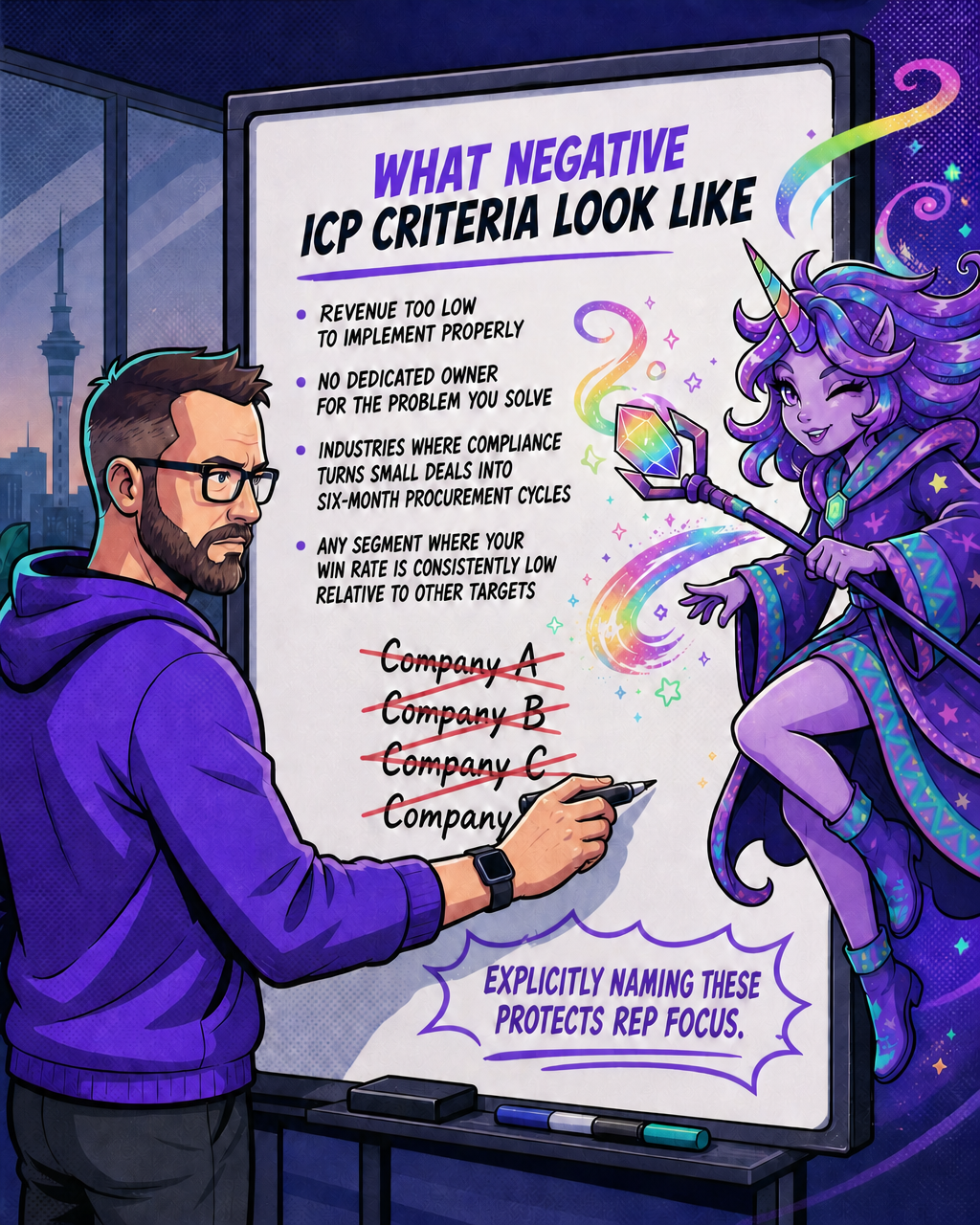
Here's what negative ICP criteria look like in practice. Companies under a certain revenue threshold who can't afford to implement properly. Organizations without a dedicated person who owns the problem your product solves. Accounts in industries where compliance makes procurement a six-month process on a deal too small to justify it. Any segment where your win rate is consistently low relative to your other targets — keeping in mind that what counts as "low" depends significantly on deal size and sales motion.
Just as important as who you target, explicitly name account types you will NOT pursue. This protects rep focus.
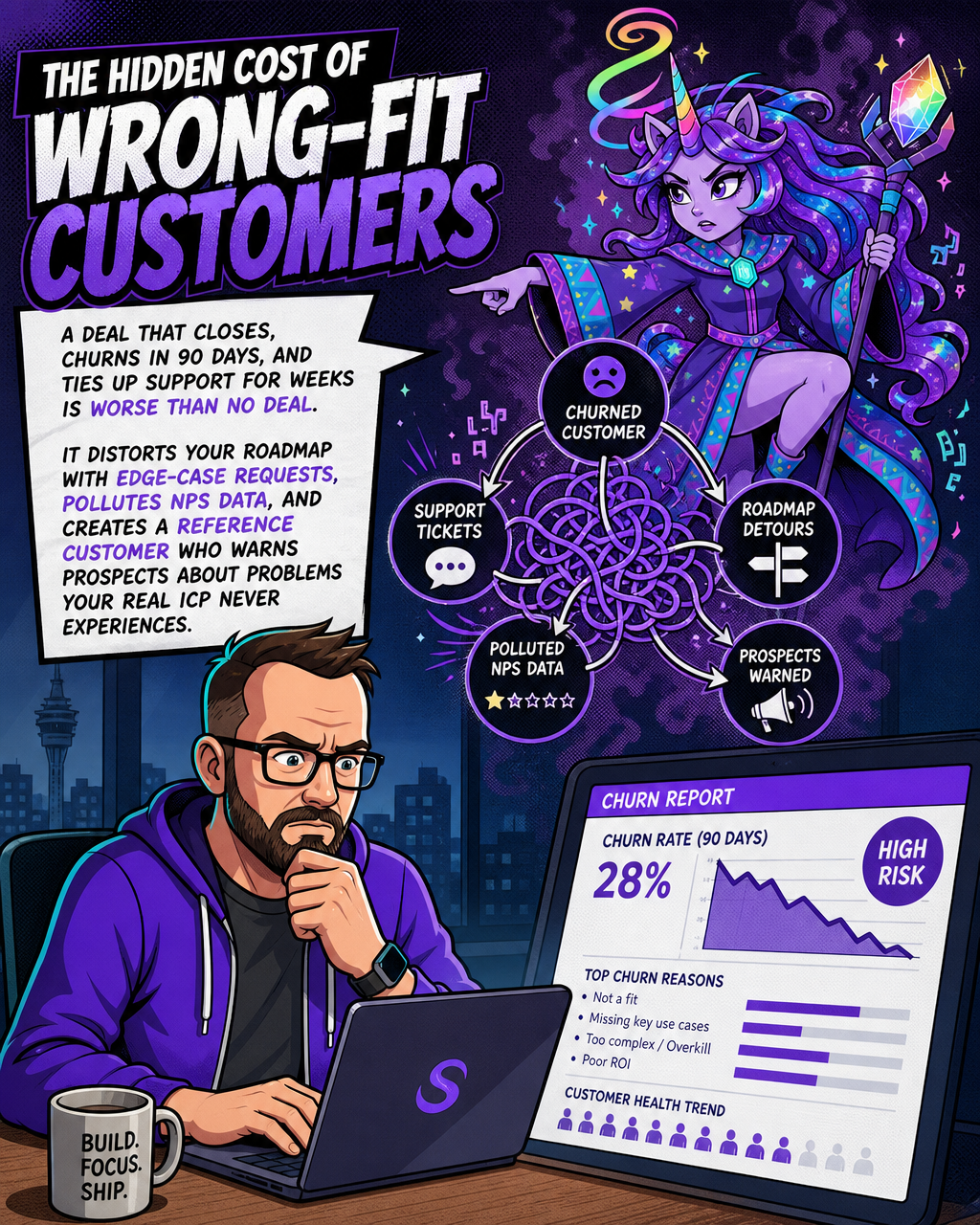
The reason engineers resist this is the same reason they resist deleting code: it feels like waste. If your product technically works for a segment, why rule them out? Because a deal that closes, churns in three months, and ties up your support team for weeks is worse than no deal. It distorts your roadmap with edge-case requests, pollutes your NPS data, and creates a reference customer who tells other prospects about problems your actual ICP never experiences.
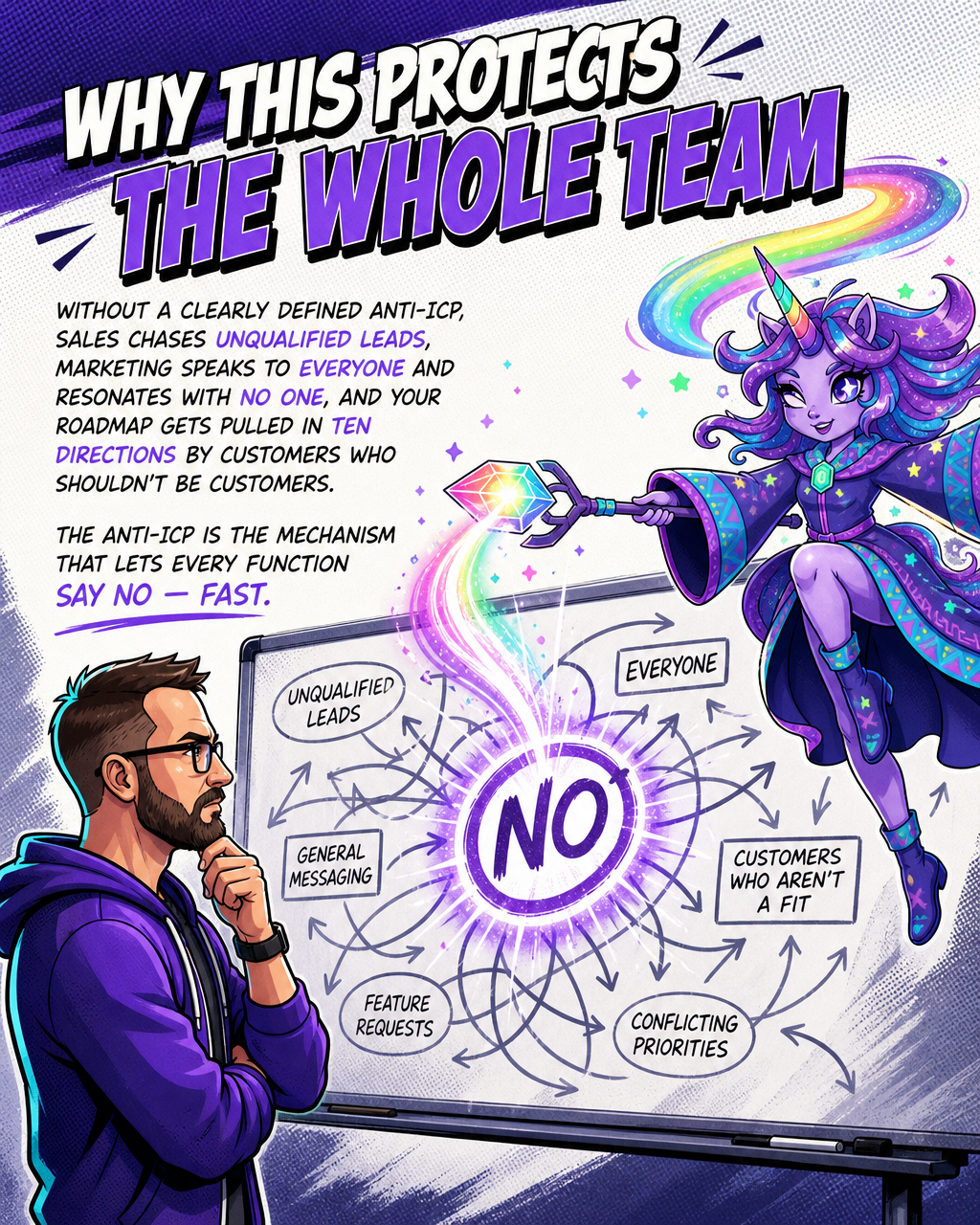
Without a clearly defined ICP, your sales team chases unqualified leads, your marketing speaks to everyone and resonates with no one, and your product roadmap gets pulled in ten different directions by customers who shouldn't be customers. The negative ICP is the mechanism that prevents this. It gives everyone on the team permission to say no, fast.
ICP as a versioned, living document
Engineers understand versioning. Code gets refactored as requirements change, as you learn more about the system, as edge cases emerge that the original design didn't anticipate. Your ICP should work exactly the same way.
Most ICPs are static slide decks that gather dust. A growing approach treats ICP as a living data model — one that accounts for acquisition and expansion, omnichannel behavior, and real-time intent signals.
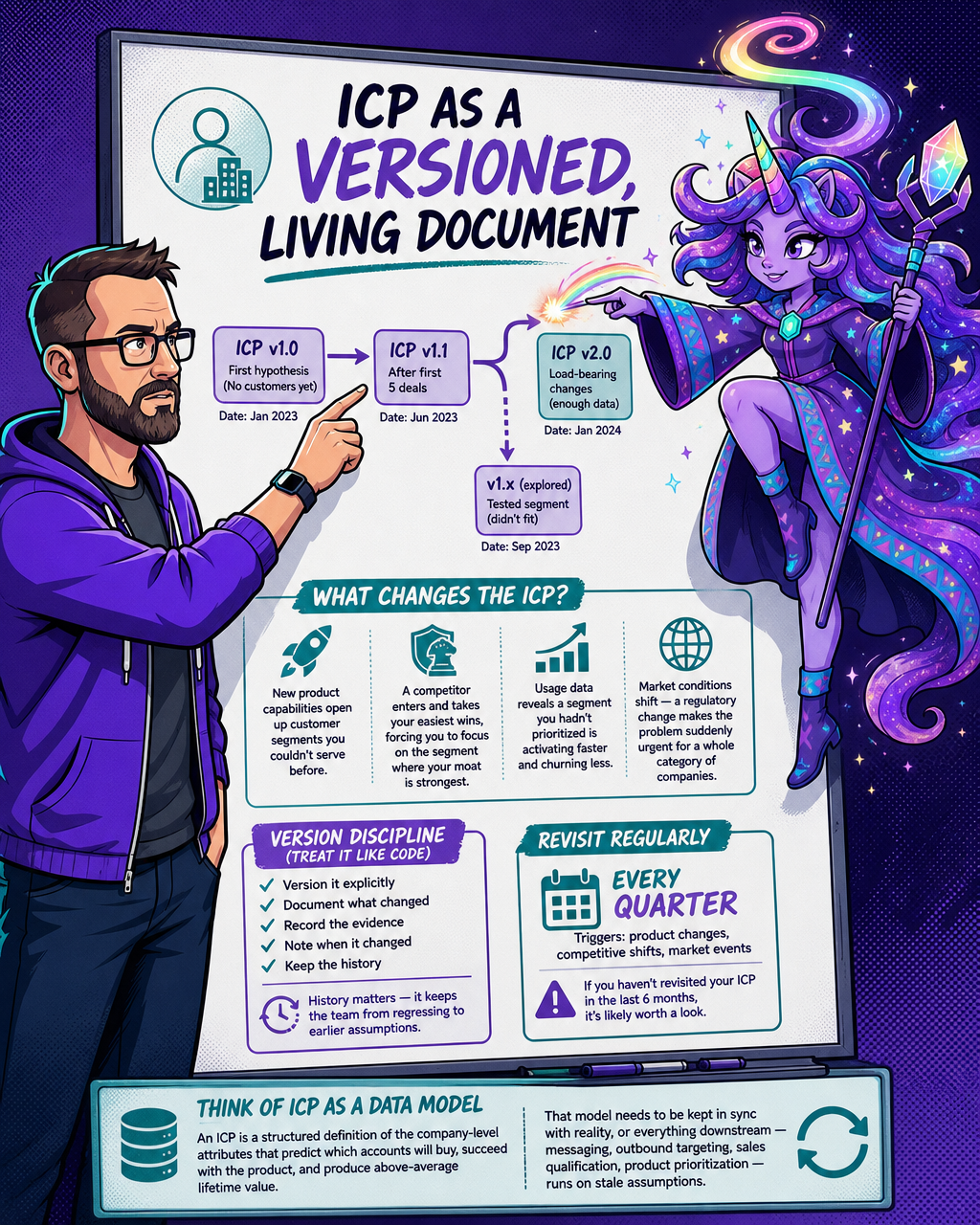
As a rule of thumb, consider reviewing your ICP every quarter — significant product changes, competitive shifts, or market events are all triggers for a refresh. If you haven't revisited your ICP in the last 6 months, it's likely worth a look. What changes the ICP? New product capabilities open up customer segments you couldn't serve before. A competitor enters and takes your easiest wins, forcing you to focus on the segment where your moat is strongest. Usage data reveals that a segment you hadn't prioritized is activating faster and churning less. Market conditions shift — a regulatory change makes the problem suddenly urgent for a whole category of companies.
The practical way to treat ICP like code is to version it explicitly. ICP v1.0 was your first hypothesis before you had customers. ICP v1.1 was after your first five deals. ICP v2.0 is when you had enough data to change a load-bearing attribute. Document what changed, what evidence drove the change, and when. That history matters — it keeps the team from regressing to earlier assumptions when a shiny new segment comes along.
You should revisit and revise your ICP whenever your business undergoes change. This could include launching a new product, entering a new market, or noticing shifts in customer behavior.
Think of it the way you'd think of a data model. An ideal customer profile is a structured definition of the company-level attributes that predict which accounts will buy, succeed with the product, and produce above-average lifetime value. That model needs to be kept in sync with reality, or everything downstream — messaging, outbound targeting, sales qualification, product prioritization — runs on stale assumptions.
Putting it into practice
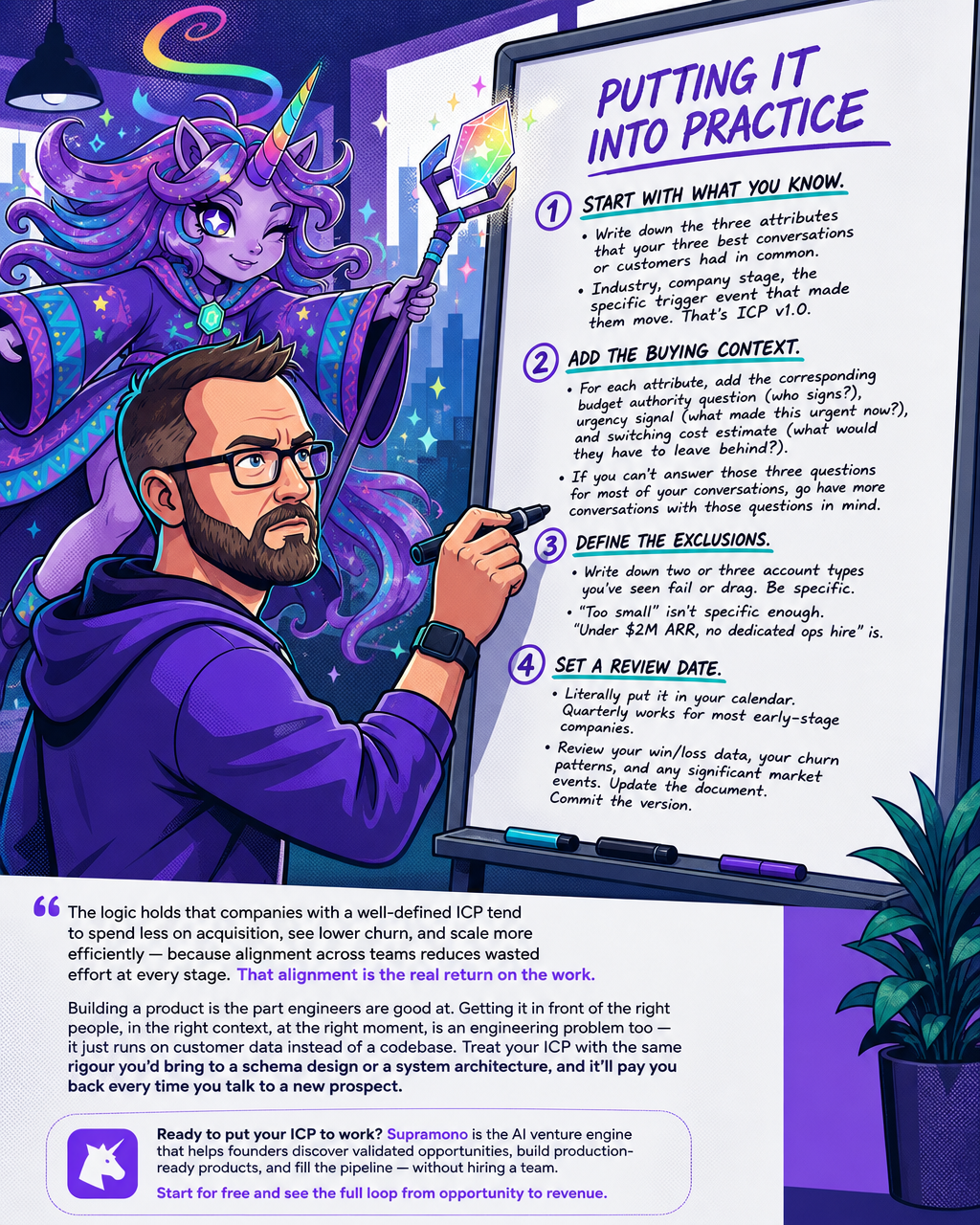
If you're starting now, here's the sequence that works.
Start with what you know. Write down the three attributes that your three best conversations or customers had in common. Industry, company stage, the specific trigger event that made them move. That's ICP v1.0.
Add the buying context. For each attribute, add the corresponding budget authority question (who signs?), urgency signal (what made this urgent now?), and switching cost estimate (what would they have to leave behind?). If you can't answer those three questions for most of your conversations, go have more conversations with those questions in mind.
Define the exclusions. Write down two or three account types you've seen fail or drag. Be specific. "Too small" isn't specific enough. "Under $2M ARR, no dedicated ops hire" is.
Set a review date. Literally put it in your calendar. Quarterly works for most early-stage companies. Review your win/loss data, your churn patterns, and any significant market events. Update the document. Commit the version.
The logic holds that companies with a well-defined ICP tend to spend less on acquisition, see lower churn, and scale more efficiently — because alignment across teams reduces wasted effort at every stage. That alignment is the real return on the work.
Building a product is the part engineers are good at. Getting it in front of the right people, in the right context, at the right moment, is an engineering problem too — it just runs on customer data instead of a codebase. Treat your ICP with the same rigour you'd bring to a schema design or a system architecture, and it'll pay you back every time you talk to a new prospect.
Ready to put your ICP to work? Supramono is the AI venture engine that helps founders discover validated opportunities, build production-ready products, and fill the pipeline — without hiring a team. Start for free and see the full loop from opportunity to revenue.

Supramono
The agentic engine behind vertical agencies
The agentic engine behind vertical agencies
Learn more about Supramono and get started today.
Visit Supramono