Validate Your Product Idea in 7 Days Without Writing a Line of Code

You got laid off six months ago. Or you finally burned out on a job that stopped making sense. Either way, you've got a business idea — probably a few of them — scribbled in a Notion doc or rattling around your head on morning walks. The question isn't whether the idea is interesting. The question is whether real people will pay for it.
Here's what most first-time founders do: they spend weeks designing a product, months building it, and then discover that nobody actually wants it. The problem isn't the product. It's the sequence. They built before they validated.
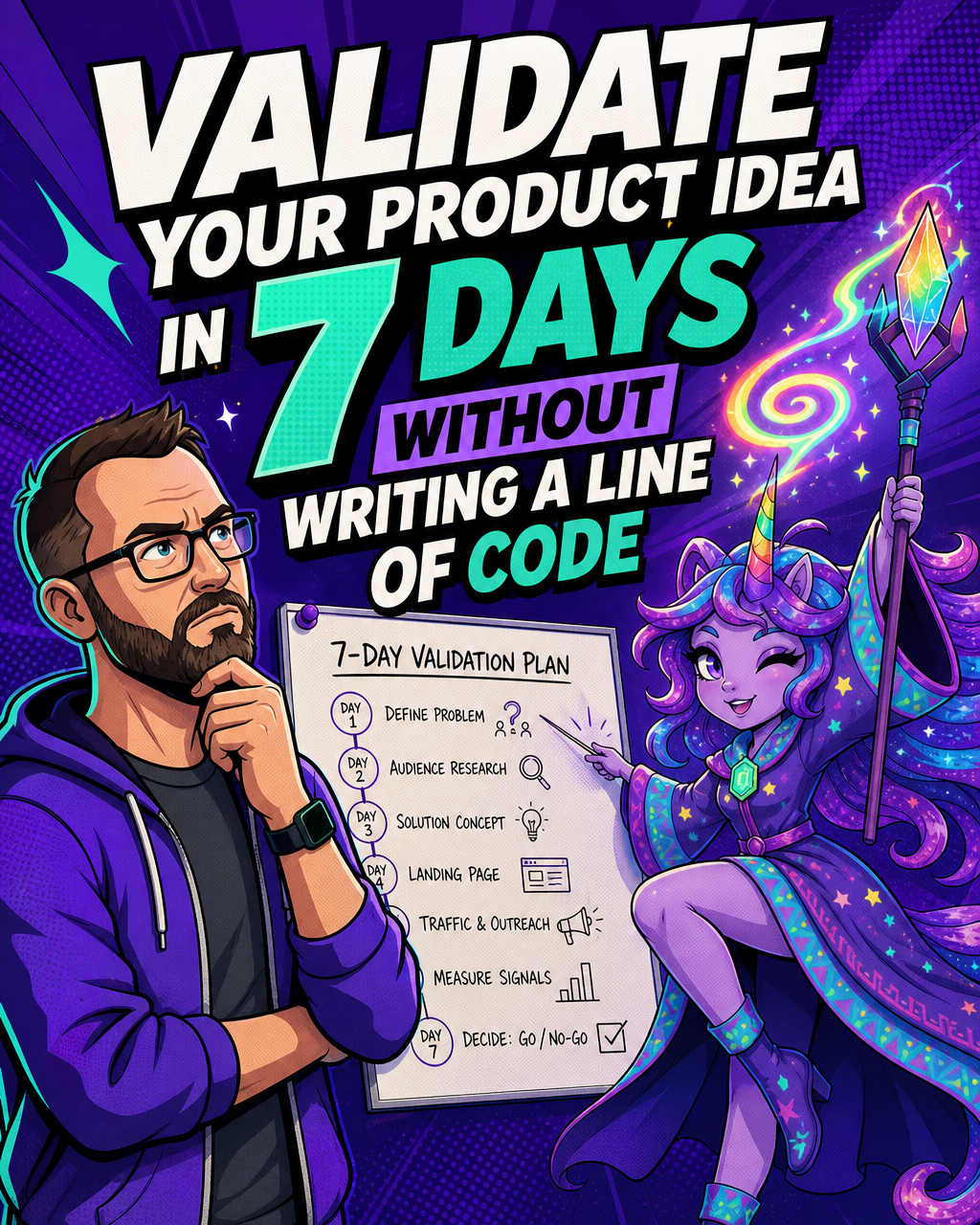
You can avoid that. In seven days, using no-code tools and a small ad budget, you can get enough signal to make a go/no-go decision — before you spend a dollar on development.
Here's how.
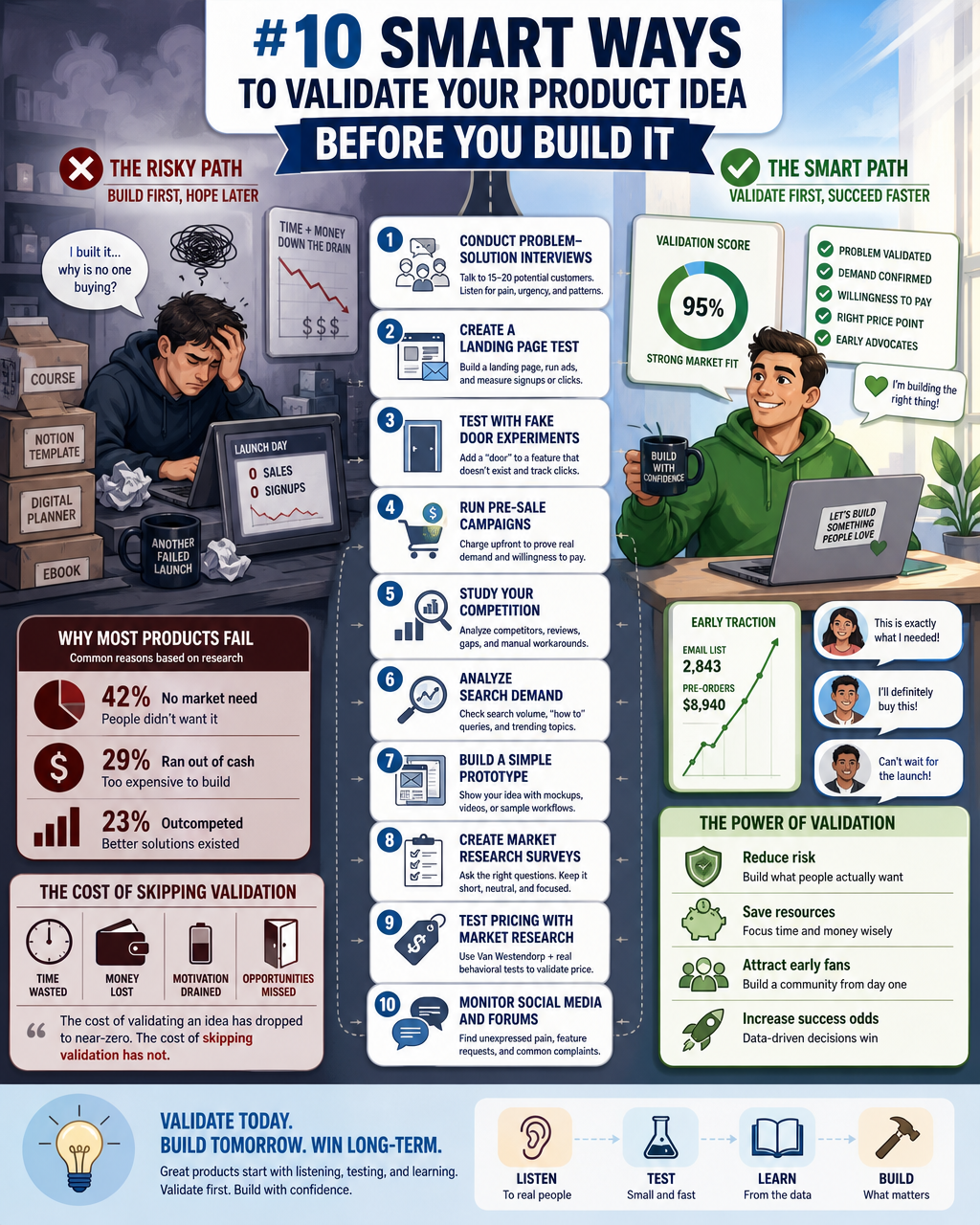
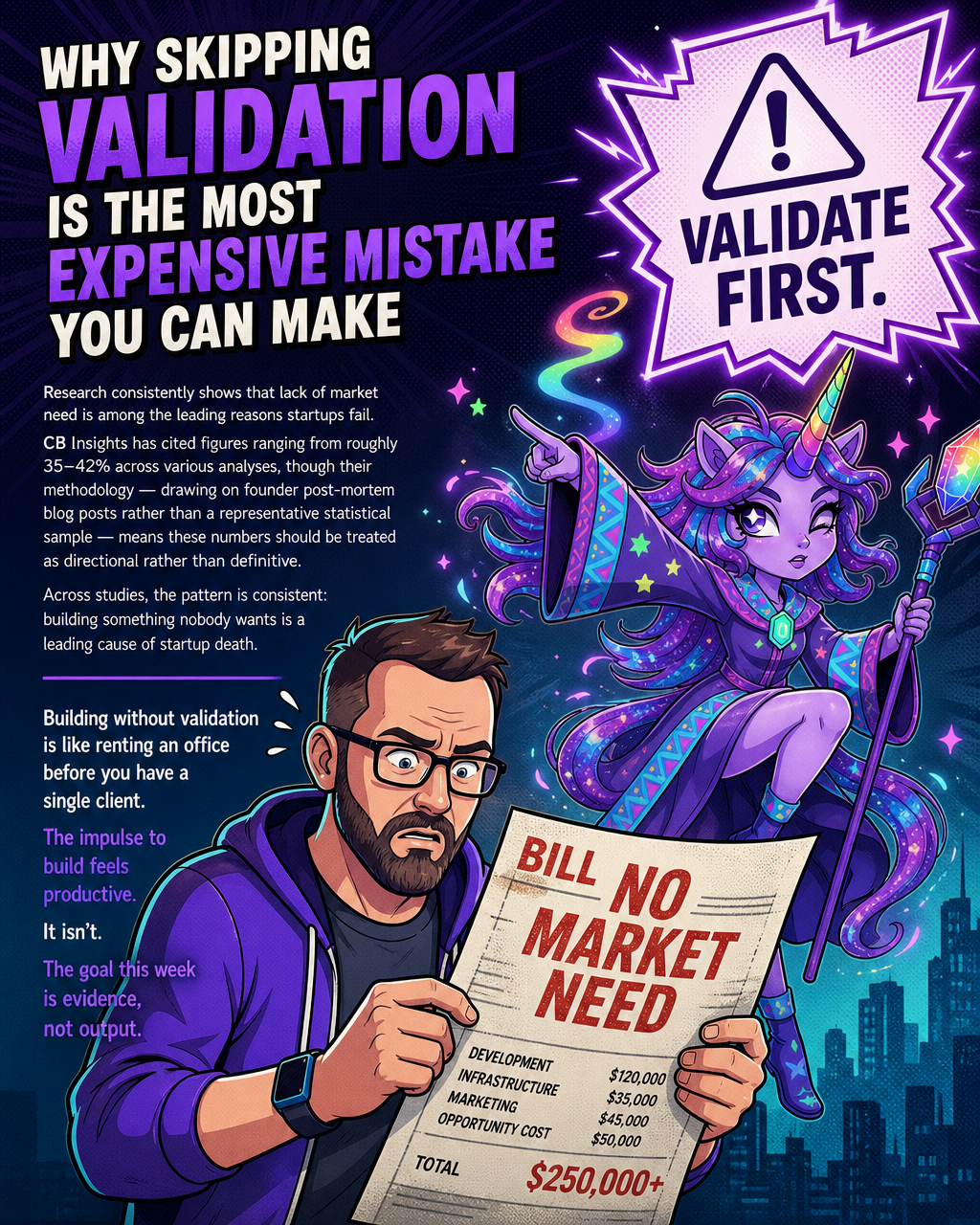
Why skipping validation is the most expensive mistake you can make
Research consistently shows that lack of market need is among the leading reasons startups fail. CB Insights has cited figures ranging from roughly 35–42% across various analyses, though their methodology — drawing on founder post-mortem blog posts rather than a representative statistical sample — means these numbers should be treated as directional rather than definitive. Across studies, the pattern is consistent: building something nobody wants is a leading cause of startup death.
Building without validation is like renting an office before you have a single client. The impulse to build feels productive. It isn't. The goal this week is evidence, not output.
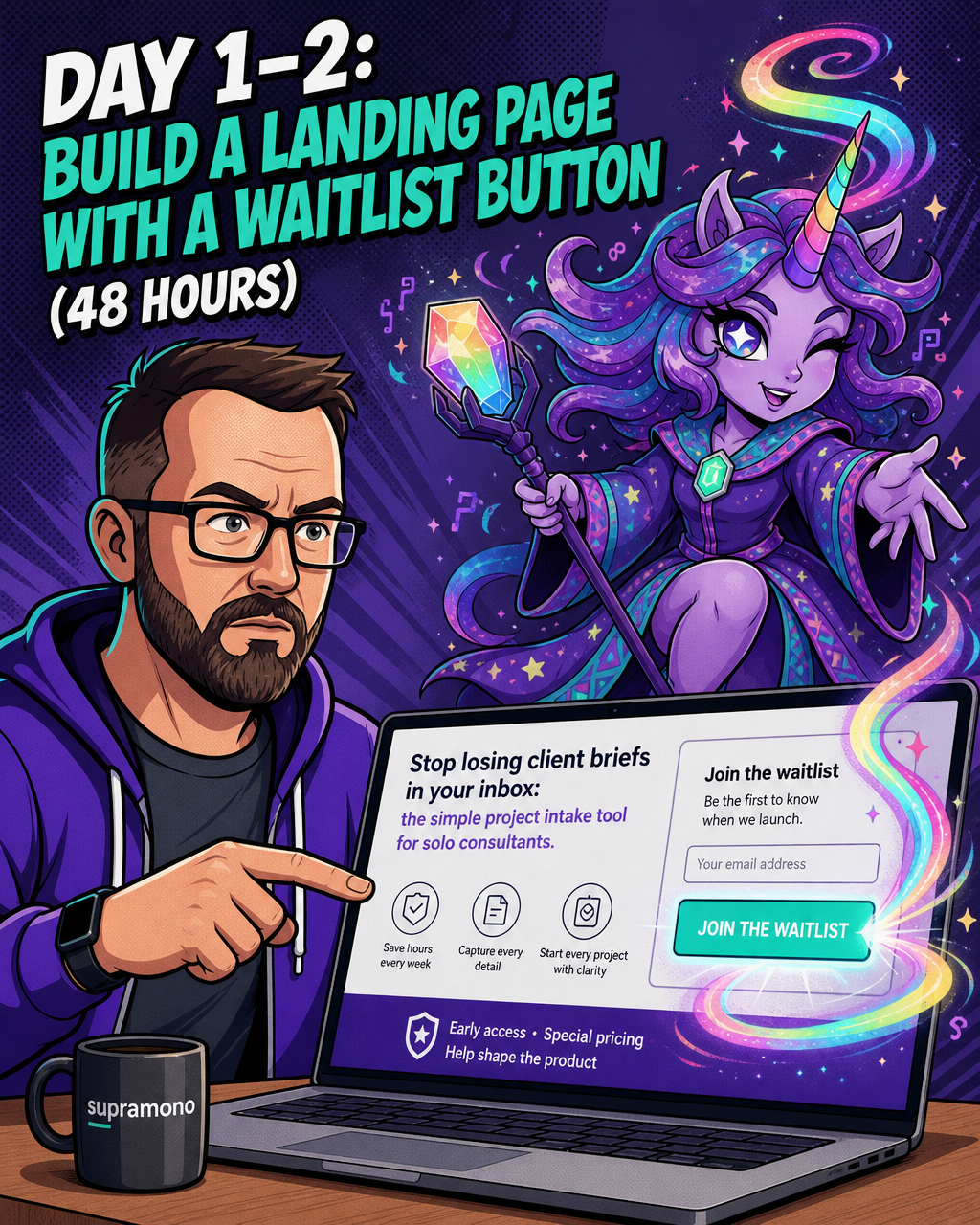
Day 1–2: Build a landing page with a waitlist button (48 hours)
Your first job is to translate your idea into the clearest possible value proposition — one sentence that describes the outcome your product delivers — and put it on a page where strangers can respond to it.
This doesn't require a developer. Tools like Carrd, Framer, or Webflow let you publish a clean, professional page in a few hours. (Note that the no-code landscape evolves quickly — tool pricing and feature sets shift regularly, so it's worth checking current plans before committing.) For the waitlist or sign-up form, you can launch a waitlist in under five minutes by choosing a template, customising it with a drag-and-drop editor, and sharing the link — no coding or technical skills required.
The page itself needs three things and three things only:
- A specific headline about the problem you solve. Not "AI for productivity" but something like "Stop losing client briefs in your inbox: the simple project intake tool for solo consultants."
- A single call to action — join the waitlist, request early access, or pre-order. Keep the form short. Research consistently shows that reducing form fields tends to improve conversion rates — keeping it to just an email address at this stage is best practice. Ask for an email address. Nothing else at this stage.
- A concrete benefit — what does the person get by signing up? Early access, a discount, a free trial, an invitation to shape the product? Make it specific.
For validation landing pages targeting problem-aware audiences, concrete outcome-focused headlines generally outperform abstract ones. "Automate your website" is vague. "Publish conversion-focused pages in hours without code" gives the visitor a concrete result — though emotional or curiosity-driven approaches can also work depending on your audience.
Once the page is live, share it in three or four relevant communities: a LinkedIn post, a Reddit thread in your niche, a Slack group, a Facebook group for your target industry. Don't pitch. Describe the problem and ask whether it resonates.
After 48 hours, look at your conversion rate. For cold traffic, 2–5% is typical; for warm or highly targeted traffic to a focused validation page, 10–20% can be achievable. Above 20% on cold traffic would be exceptional. If you're well below those ranges, your headline or targeting is off — not necessarily the idea itself. Try rewriting the value proposition before giving up.
Day 2–3: Run a small ad test to measure stranger interest
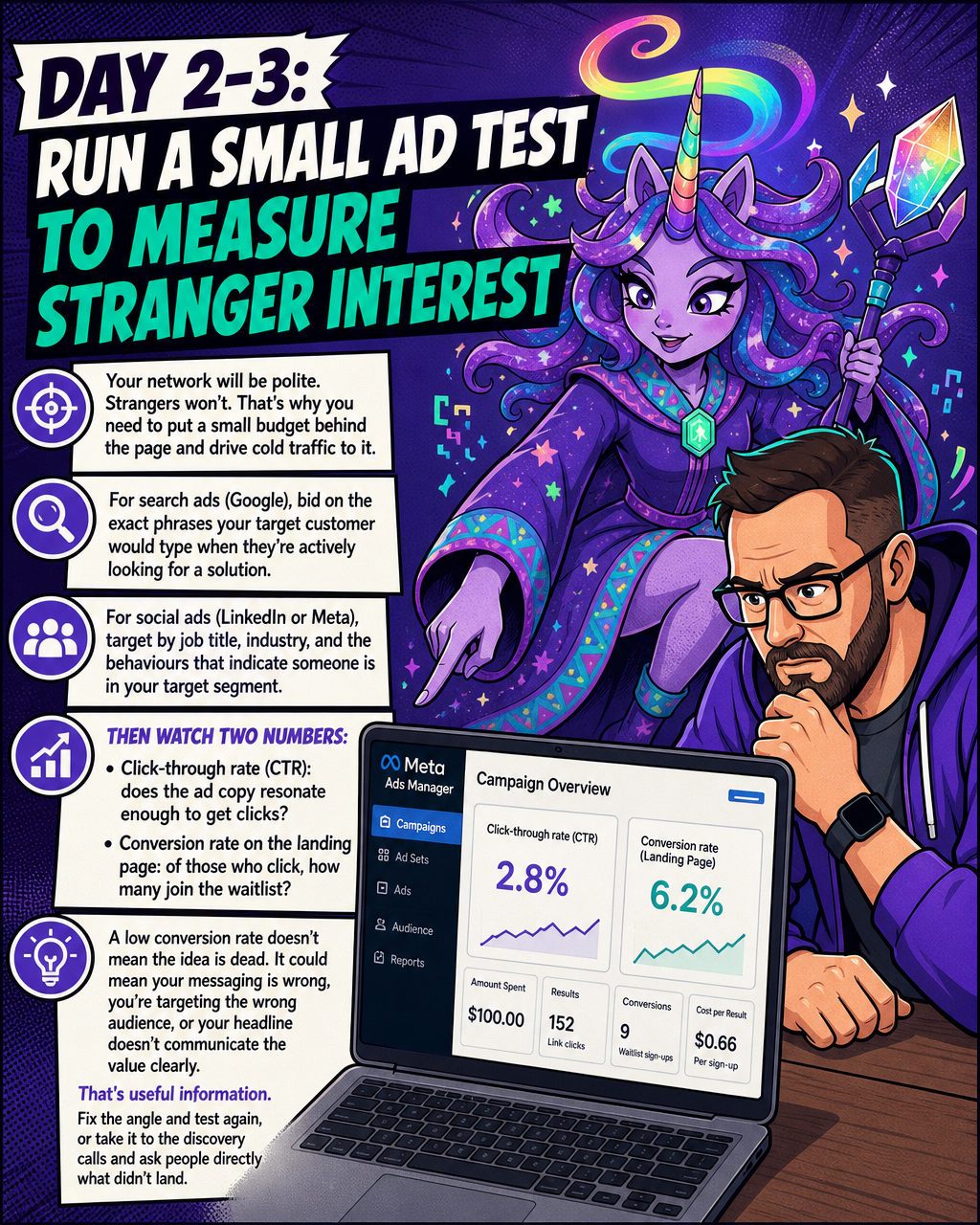
Your network will be polite. Strangers won't. That's why you need to put a small budget behind the page and drive cold traffic to it.
Driving traffic with targeted ads on Google or Meta is the standard approach, but budget requirements vary significantly by niche. Depending on your targeting, $50–$100 may generate 50–200 clicks on Meta or as few as 10–50 on competitive Google Search terms. For the 200–500 visitors that give you meaningful directional signal, you may need $200–$500, or consider lower-CPC channels like Reddit Ads or Meta broad targeting.
For search ads (Google), bid on the exact phrases your target customer would type when they're actively looking for a solution. If you're building a tool for freelance accountants, try "client invoice tracking for freelancers" or "bookkeeping tool for solo accountants" — not broad terms like "accounting software."
For social ads (LinkedIn or Meta), target by job title, industry, and the behaviours that indicate someone is in your target segment.
Then watch two numbers:
- Click-through rate (CTR): does the ad copy resonate enough to get clicks?
- Conversion rate on the landing page: of those who click, how many join the waitlist?
As a rough heuristic used by some practitioners, a conversion rate above 5% from paid traffic is a positive signal that people want what you're describing; below 2% may indicate your positioning is off or the problem isn't urgent enough; between 2% and 5%, dig deeper with interviews to understand the hesitation. These thresholds vary widely by industry, offer type, and platform, so treat them as directional rather than definitive benchmarks.
A low conversion rate doesn't mean the idea is dead. It could mean your messaging is wrong, you're targeting the wrong audience, or your headline doesn't communicate the value clearly. That's useful information. Fix the angle and test again, or take it to the discovery calls and ask people directly what didn't land.
Day 1–3 (overlapping): Run 5–8 customer discovery calls
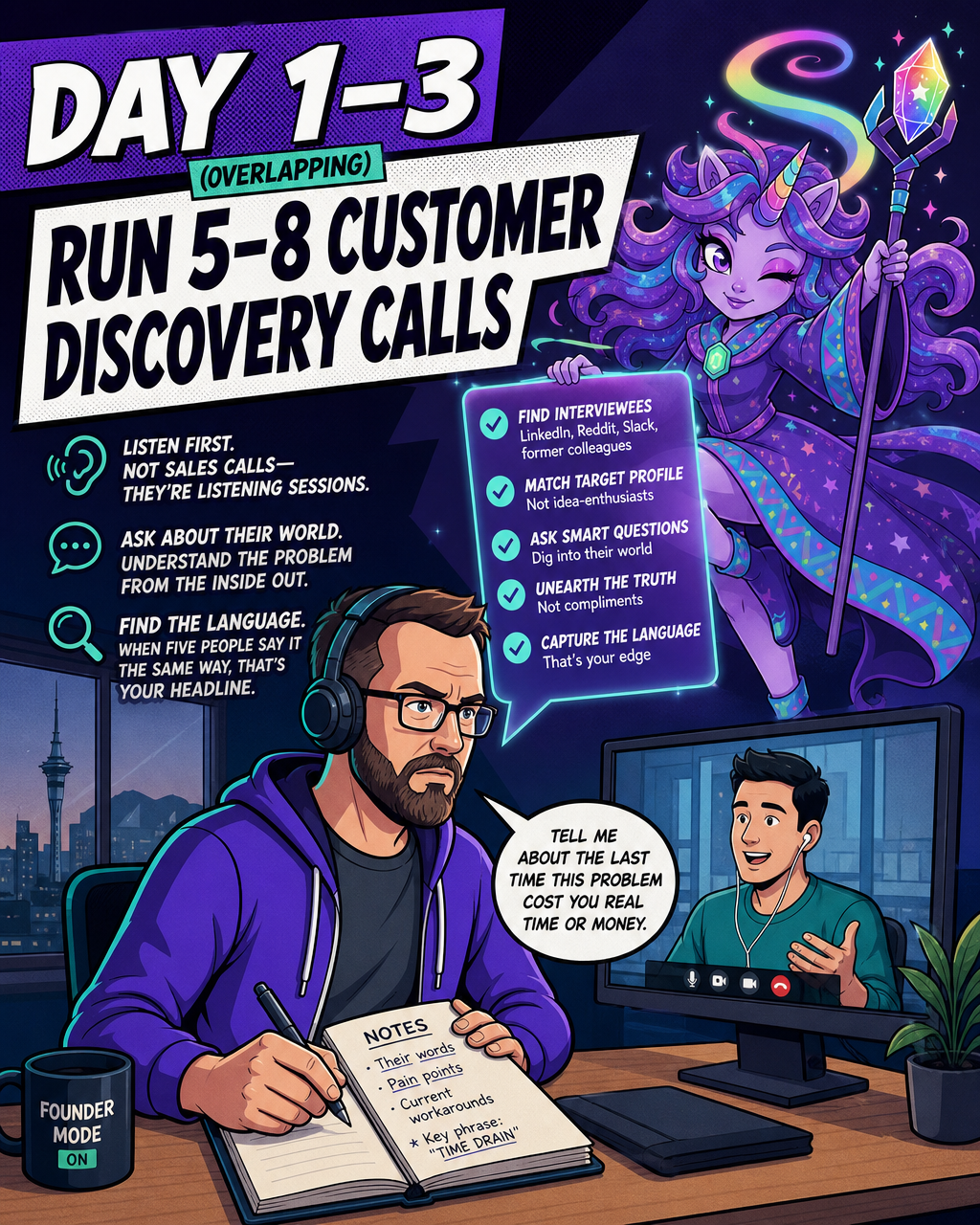
While the page is gathering data, you need to get on calls. These are not sales calls. They're listening sessions. Your job is to understand the problem from the inside — in the exact words real buyers use — before you've built a single feature.
A common rule of thumb in qualitative research is that patterns begin emerging after 5–8 interviews within a relatively homogeneous segment, though this varies by problem complexity and audience diversity — the more varied your target customers, the more interviews you'll need before patterns stabilise. For a seven-day sprint, five to eight calls is a realistic and sufficient starting target.
Find your interviewees in the same places you found your early audience: LinkedIn, Reddit, industry Slack groups, former colleagues. You're looking for people who match your target profile, not people who are already excited about your idea. The warm, enthusiastic friend will tell you what you want to hear. A semi-interested stranger will tell you the truth.
When you're on the call, resist every urge to pitch. Customer discovery is where you speak directly with the people who might buy or use your product. Don't pitch first. Ask about their world.
Start with context: what does their day look like? What tools do they already use? Then move to the problem: when did this issue last cause them real grief? What did they do about it? Most people say yes to be polite. A better question is: "How are you solving this right now?" If users are already spending money, time, or effort on the problem, that is a stronger signal.
Four questions that reliably surface useful data:
- "Tell me about the last time this problem cost you real time or money."
- "What have you already tried? What didn't work about it?"
- "If this problem disappeared tomorrow, what would that mean for you?"
- "What would make you trust a new solution enough to try it?"
Notice you're not asking "would you pay for this?" Rather than asking hypothetically "would you pay for this?", look for concrete actions like pre-orders, deposits, or letters of intent that demonstrate genuine purchasing intent. Save the pricing conversation for later in the call, after rapport is built.
What you're really mining here is language. The precise words customers use should be in your marketing material. When five different people describe the same frustration using the same phrase, you've found your headline.
Day 4–6: Fulfil the promise manually (the Wizard of Oz test)
By now you have some waitlist sign-ups, ad data, and notes from your discovery calls. The next question is the hardest one: will people actually use this, and will they pay?
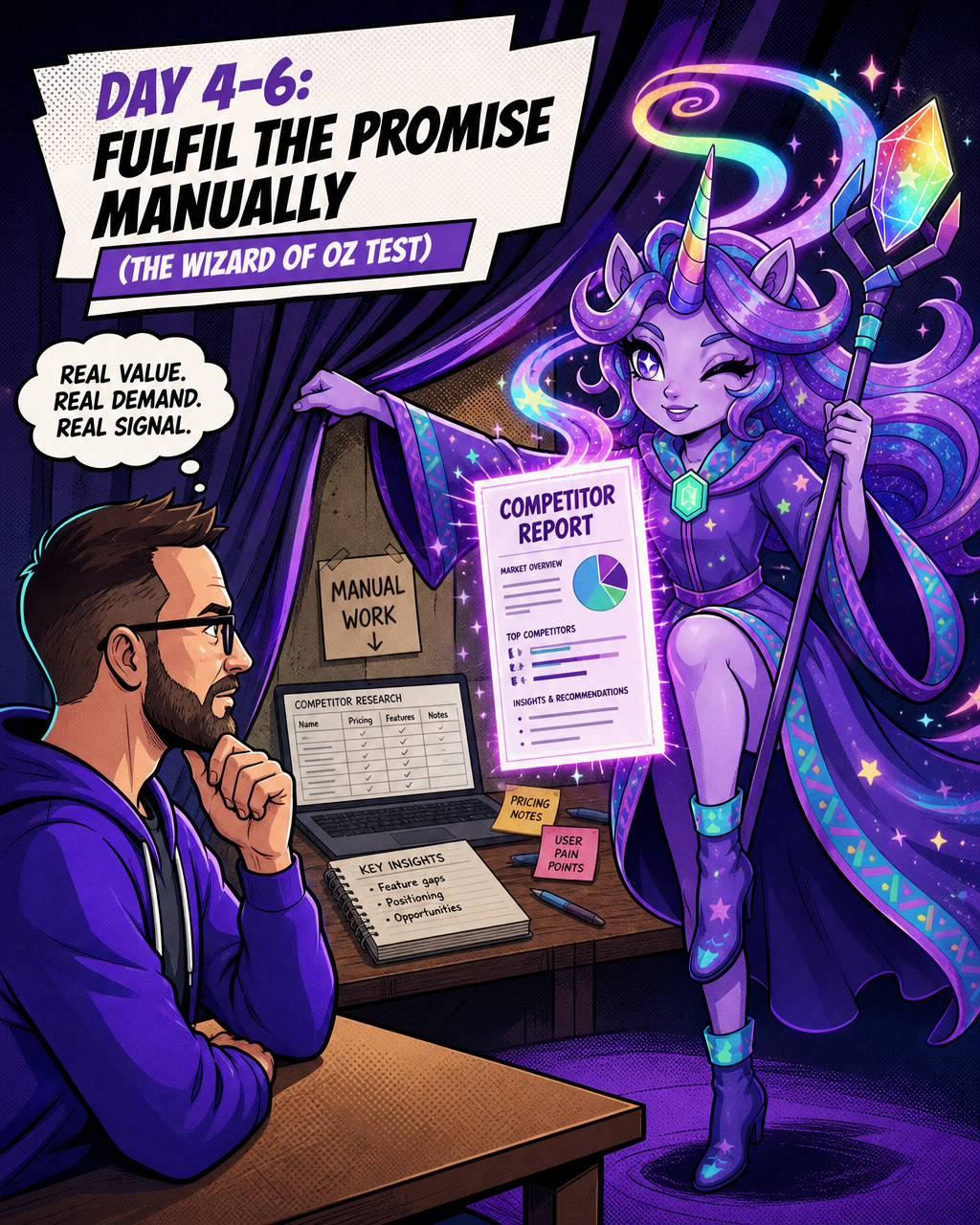
The fastest way to answer it is the Wizard of Oz approach. You offer the outcome your product would deliver — but you fulfil it manually, behind the scenes, without any automation.
This isn't a shortcut. It's one of the more durable methods in early-stage validation. Zapier is frequently cited in startup circles as an example of manually delivering the core service before building the automation layer — the narrative being that the founders ran integrations by hand to confirm demand before scaling. If you're drawing on this example, it's worth verifying it against a primary source such as a founder interview, as the specific details of early-stage founding stories can evolve in retelling. The broader principle — deliver the outcome manually first, build the automation second — is sound regardless.
For you, this might look like:
- You're building a competitive intelligence tool for e-commerce founders. Manually research and compile a competitor report for three waitlist sign-ups who agreed to a free trial. Charge a nominal fee or ask for a paid commitment upfront before you do the work.
- You're building a scheduling platform for physios. Manually manage one clinic's bookings for a week using a shared spreadsheet and a calendar link.
- You're building an AI copywriting tool for accountants. Write three sample posts manually in their voice and send them back.
The concierge approach works because it validates willingness to pay while simultaneously teaching you exactly how the product should work. You learn the edge cases, the user expectations, and the real workflow in ways that no interview or survey can reveal.
Charge for it, even a token amount. A customer saying they "would" pay is a lot different from actually paying. Even $20 changes the signal quality dramatically. Someone handing over their credit card details is a different category of evidence than someone nodding enthusiastically on a call.
If people won't pay even a small amount for the manual version, that's the most important data you'll collect all week.
Day 7: Make the call against one north-star metric
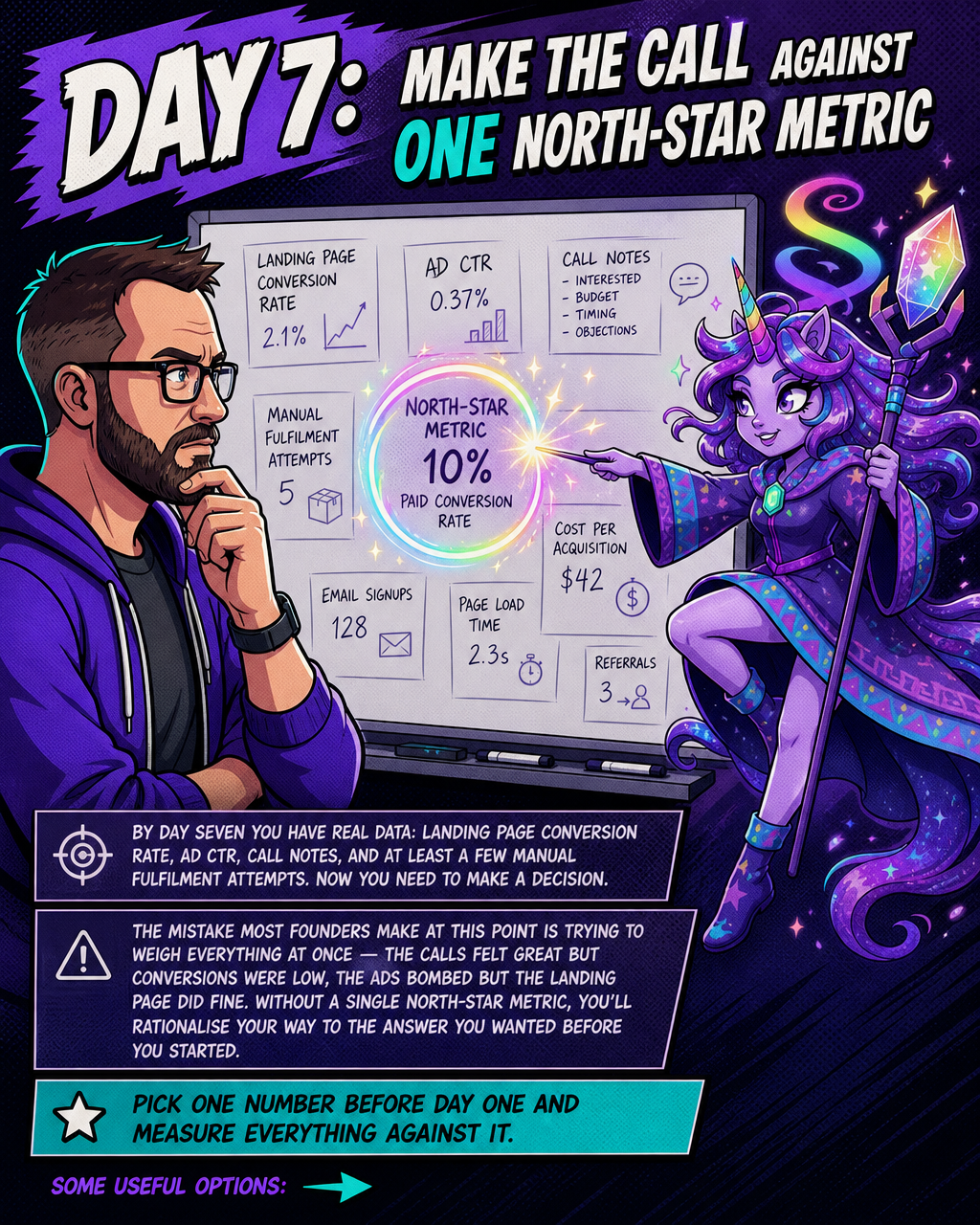
By day seven you have real data: landing page conversion rate, ad CTR, call notes, and at least a few manual fulfilment attempts. Now you need to make a decision.
The mistake most founders make at this point is trying to weigh everything at once — the calls felt great but conversions were low, the ads bombed but the landing page did fine. Without a single north-star metric, you'll rationalise your way to the answer you wanted before you started.
Pick one number before day one and measure everything against it. Some useful options:
- *

Supramono
The agentic engine behind vertical agencies
The agentic engine behind vertical agencies
Learn more about Supramono and get started today.
Visit Supramono